eBook - ePub
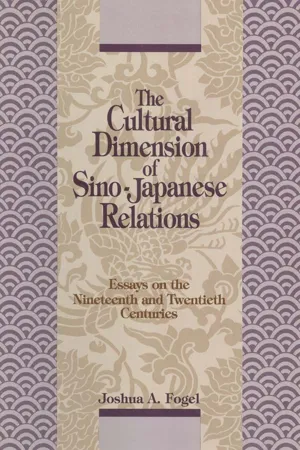
The Cultural Dimensions of Sino-Japanese Relations
Essays on the Nineteenth and Twentieth Centuries
- 216 pages
- English
- ePUB (mobile friendly)
- Available on iOS & Android
eBook - ePub
The Cultural Dimensions of Sino-Japanese Relations
Essays on the Nineteenth and Twentieth Centuries
About this book
Presents the perceptions that the Chinese and the Japanese have of each other, and the information that helped to fuel those perceptions. There are two sections: China in Japan, debating the Asiatic Mode of Production and kyodotai; and Japan in China, covering the Manchurian Railway.
Part I
China in Japan
Chapter One
On the “Rediscovery” of the Chinese Past: Cui Shu and Related Cases
What is meant by the “rediscovery” of some old text, ancient heritage, or person from another era? A whole range of differing circumstances surrounds each of the various entities that we include under this rubric. For instance, the rediscovery par excellence was Dunhuang, where for centuries texts had been preserved in a cave in Gansu Province, apparently without a soul ever having seen them. A less perfect although still exemplary case involved the works of Wang Fuzhi (1619–1692), the brilliant protonationalist and anti-Manchu hermit from Hunan, whose writings were supposedly unknown for 150 years until Zeng Guofan (1811–1872) sponsored their republication. Wang’s works were not totally unknown during the eighteenth and early nineteenth centuries; in fact, from the research of Chinese scholars in the late 1950s and early 1960s, we know that more than a handful of Chinese scholars saw Wang’s writings in manuscript form and commented on them in their own essays throughout this lengthy hiatus. As one eminent sinologist explained to me, “It took a big shot like Zeng Guofan to sponsor the publication of so sensitive a writer as Wang.”1
This essay concerns several even less perfect cases of phenomena heralded, nevertheless, by their promoters as “rediscoveries” (Chinese zai faxian; Japanese sai hakken)—in particular, that of the remarkable eighteenth-century historian and classical scholar Cui Shu (1740–1816). Cui’s works were never lost or sealed in a cave, nor were they remotely anti-Manchu; the importance of his ideas simply had been ignored for a century. Thus, his “rediscovery” involved the resuscitative efforts of twentieth-century scholars who found contemporary meaning in his writings that had been missed or ignored by other readers for many years. What is especially interesting about the case of Cui Shu is that his rediscovery occurred twice—once in China and once in Japan—under entirely different circumstances, and it therefore provides us with a fascinating case of comparative sinology. Thus, this essay has the following aims: (1) to present several cases of “rediscovery” of earlier historians by both Chinese and Japanese historians of this century; (2) to ask why Cui and others were seen as so vital by their revivers; (3) to interpolate possible Sino-Japanese connections; and (4) to discuss the importance of the rediscovery effort itself.
For nearly half a century the historiographical output of the Republican period has been shielded from critical evaluation by two connecting forces: (1) a pervasive nationalism, which among other things has taught students of modern Chinese history that all foreign powers and Japan in particular were monstrous ogres at virtually every turn (this can greatly distort one’s perception of events in twentieth-century history and bring an emotional charge to terms like “imperialist”), and (2) the research of a handful of men, like Hu Shi (1891–1962) and his group of students, whose overwhelming intellects have made serious criticism of their work, or in fact their whole intellectual project, extremely difficult. This essay concentrates on the latter of these forces, which itself was heavily influenced by Chinese nationalism. In recent years historians have begun to liberate themselves from this influence and slowly have gained a better understanding of both scholarship in and the history of the Republican period. Nevertheless, much work remains to be done; much needs to be reassessed. Furthermore, whereas we know something about political ties between the Chinese and Japanese in that period (e.g., Sun Zhongshan, Li Dazhao, China rōnin, anarchism), we know much less of intellectual or scholarly ties. For that matter, we know little about late nineteenth-century and early twentieth-century Japanese sinology. I hope to contribute here to a better understanding of these traditions of scholarship.
Cui Shu’s Dual Rediscovery
In the April 1923 issue of Guoxue jikan [Journal of National Studies], Hu Shi introduced Cui Shu, a then little-known scholar from Zhili, to a large segment of the Chinese intellectual world. Several years before, Gu Jiegang (1893–1980), Hu’s pupil, had begun a laborious process of editing and punctuating Cui’s entire corpus of writings; the final product appeared fifteen years later in 1936 in sixteen string-bound volumes (ce) as the Cui Dongbi yishu [Collected Works of Cui Shu]. In his biography of Gu, Laurence Schneider wrote that “of all the obscure scholars that he resuscitated … none had been more obscure than Cui Shu, nor did any receive more lavish treatment and studied reverence.”2 Schneider suggested that Hu learned of Cui from Zhang Xuecheng’s writings, but as the late Arthur Hummel pointed out in his superb essay on Cui, there is in fact “no evidence” that Zhang knew of Cui Shu’s existence.3 The information came from elsewhere.
The Cui Dongbi yishu contains not only an edited and punctuated edition of Cui’s writings, it includes numerous essays by those who collaborated with Gu in the project (Qian Mu [b. 1895], Qian Xuantong [1887–1938], Hu Shi, William Hung [Hong Ye; 1893–1980], Zhao Zhenxin, and others); reprints of portions of many essays that touch on Cui; a complete punctuated edition of the extant writings of Cui’s younger brother Cui Mai (Cui Degao xiansheng yishu [Collected Works of Mr. Cui Degao]) and of four of Cui’s ancestors, several in-laws, and close relatives; maps of Cui’s travels; and more. In the following year William Hung and others prepared an index to Ciu’s work, the Cui Dongbi yishu yinde, as part of the Harvard—Yenching index series.4
Throughout much of the introductory sections to the Cui Dongbi yishu, thanks and praise are traded among the editors with great delight over their completed project.5 Perhaps the most revealing of these sections, however, is Gu Jiegang’s own prefatory comments, in which he explains in detail how he found various of the Cui materials and identifies who helped at which points of the project. This is interesting less for its content than for the fact that Gu makes no mention that Cui’s works had been edited, punctuated, and published thirty-two years earlier in Japan.6 We will return to this omission shortly.
In the case of Cui Shu, something closer to the ordinary usage of the term “rediscovery” occurred at the turn of this century with a group of Japanese sinologists.7 In 1900 one of the founders of the Kyoto school of sinology, Kano Naoki (1868–1947), was performing some research in Beijing when the Boxer Rebellion erupted. He is said to have gone to great risks in carrying out with him twenty-five juan in manuscript form of Cui Shu’s most famous work, the Kaoxin lu [Record of Investigating Beliefs]. When he arrived in Japan, he showed them to Naka Michiyo (1851–1908), who is generally considered the father of modern sinology in Japan and is the man who coined the term Tōyōshi (East Asian history).8 Naka was convinced quickly that Cui was someone of intellectual import and set out to prepare an edited and punctuated edition (with Japanese-reading punctuation) of the Chinese texts of Cui’s writings.
In December 1900, an announcement of the project appeared in the main Japanese historical journal of the day, Shigaku zasshi [Journal of History], and said that Naka’s edition would appear as the second item in the Shigakkai sōsho [Series of the Historical Association]. The notice concluded by reiterating that Cui Shu’s work was extremely important and that it expressed the realization of the idea of “anticipating [clouds and] rainbows in the midst of a great drought” (taikan ni gei o nozomu), a kind of awkward allusion to the “Liang Huiwang” chapter of the Mencius.9
Naitō Konan (1866–1934), the other principal founder of the Kyoto school, read this notice while in Ōsaka as a staff member of the Ōsaka asahi shinbun and wrote an article, “Dokusho gūhitsu” [Random Notes on Books Read], which the serial Nihon published on January 2, 1901. He apparently had known of Cui before Kano found the Beijing texts, for in his lectures at Kyoto University, which were later turned into the Shina shigaku shi [History of Chinese Historiography], he noted that Naitō Chisō (1826–1902; no relation), an eminent historian of Japan, had read of Cui in the Kuochao xianzheng shilüe [Biographies of Prominent Chinese of the Qing Dynasty], 10 was impressed, and mentioned it to Konan. Chisō had died already, and Konan already owned his own set of Cui’s works by the time of the first Shigaku zasshi notice.
Naitō Konan’s edition was almost certainly a text that had been in Japan since late Tokugawa times. As he personally communicated to his student, Kanda Kiichirō (1897–1984), his edition had come from China and was held in the library of the domain of Tōdō in Ise; this is odd, considering that Cui’s works are not listed among the Chinese books that made their way to Japan in the Edo period.11 In his response to this notice, Naitō reported that his own copy of the Cui Dongbi xiansheng yishu [Collected Works of Mr. Cui Shu] had fifty-five juan and that the Kano—Naka edition did not even contain the complete Kaoxin lu. He went on to suggest strongly that Cui Shu’s works be published as a zenshū (collected works) for the benefit of future readers and cheerfully offered his copy to the Shigakkai sōsho editors. Naitō then moved briefly to a discussion of Cui’s life written by his disciple and original compiler, Chen Lihe (1761–1825), and to the entry on Cui in the Kuochao xianzheng shilüe of which Naitō then translated a large portion.12 Naitō concluded in a thinly veiled tone of slight disgust concerning the way in which the Shigaku zasshi reporters had ended their first notice about “long droughts”; he worded his statement in such a way as to defend Qing scholarship of the Jiaqing (1796–1821) and Daoguang (1821–1851) periods against the idea that this had been a thoroughly arid era in serious historical research.13
In the next issue of Shigaku zasshi, a month later, the editors fell all over each other in apology for their errors in the earlier notice and in gratitude to “Naitō Konan’s great kindness … and genius.” They also reported that Naitō had lent his edition to Naka Michiyo.14 Naka spent the next three years poring over these texts, punctuating them, correcting errors, and preparing them for publication. In the midst of this work, he published an article on the critical importance of Cui Shu’s Kaoxin lu.15 By 1903 three of four prospective volumes were published; by April 1904 the entire project was complete.16 Naka was so excited with this Cui Shu find that in his more popular work, Naka Tōyō ryakushi [Naka’s Brief History of East Asia], published in December 1903 while he was still engaged in his Cui Shu research, he devoted a full half page of praise to Cui and the Kaoxin lu, more space than was allotted to Huang Zongxi (1610–1695), Gu Yanwu (1613–1682), Wang Yangming (1472–1529), Sima Qian (135?-93? B.C.E.), or virtually any other figure in East Asian history.17
Such an extremely high estimate of Cui was not limited to Naka Michiyo. On the one hand, Kano seems to have retained a measure of objectivity with respect to Cui;18 and Naitō, aside from a considerable number of references to Cui’s judgments about the validity of certain ancient texts—to which he referred in his own history of ancient China—seemingly wrote nothing about Cui of an evaluative nature.19 On the other hand, however, many others wrote extremely adulatory things about Cui, including Naka’s biographer and a famous historian in his own right, Miyake Yonekichi (1860–1929), who in commenting on Naka’s edition of Cui’s works compared Cui to Motoori Norinaga (1830–1901)—Motoori’s Kojiki den [Commentary on the Kojiki] and Cui’s Kaoxin lu both being exemplary criticisms of biased views of the true meaning of the classics20 (albeit an entirely different set of classics). The general enthusiasm for Cui must have been remarkable, for seventy years later, in his history of the Qing dynasty, Masui Tsuneo introduced him as “Nihon no gakusha konomi no Sai Jutsu” (Cui Shu whom Japanese scholars so like).21
The excitement that greeted Cui Shu’s rediscovery in Japan found a parallel twenty years later in China. It is difficult to assess how aware of the Japanese edition of Cui’s works Chinese intellectuals were, and it is even harder to say how much use Gu, Hu, and the others made of the Naka edition. Arthur Hummel, who translated Gu’s introduction to the Gushi bian [Symposium on Ancient History] as The Autobiography of a Chinese Historian, states without a trace of doubt that “in 1921 Dr. Hu Shih [Hu Shi] came across a Japanese edition” of Cui’s works, surely the Naka reprint.22 “Though this is an excellent reprint,” wrote Hummel elsewhere, “it attracted little notice in China,” except for an occasional mention, often with glaring errors or misunderstandings.23
Yet the Chinese editors clearly knew of Naka’s work and even praised it here and there. In a 1923 article, Hu Shi stated plainly that, as a result of Naka’s work, “Chinese gradually came to know that such a man as Cui Shu has lived.”24 Hu pointed out also that Liu Shipei (1884–1919) had seen the Japanese text and was influenced by it to write a short biography of Cui for the journal Guocui xuebao [Journal of the National Essence] as early as 1907. This essay was punctuated and included in the Gu Jiegang edition of Cui’s works. Similarly, Zhao Zhenxin, who proofread the original Cui Dongbi xiansheng yishu for errors, remarked in a preface that Cui was not at all well known in China until Naka’s edition was published.25 Near the very end of the Chinese edition were selections from a number of Chinese works relevant to Cui and translations of several Japanese writings; Gu pointed out in his introduction to this section (one of the few times Gu had anything to say of the Japanese edition) that the Naka reprint had led to Cui Shu’s first recognition by Chinese scholars such as Liu Shipei and Ge Xiao, a recognition that spread slowly. Other references to the Japanese text in the Gu edition include several paragraphs in translation from Miyake Y...
Table of contents
- Cover
- Half Title
- Title Page
- Copyright Page
- Table of Contents
- Preface
- Part I. China in Japan
- Part II. Japan in China
- Notes
- Index
Trusted by 375,005 students
Access to over 1.5 million titles for a fair monthly price.
Study more efficiently using our study tools.
Frequently asked questions
Yes, you can cancel anytime from the Subscription tab in your account settings on the Perlego website. Your subscription will stay active until the end of your current billing period. Learn how to cancel your subscription
No, books cannot be downloaded as external files, such as PDFs, for use outside of Perlego. However, you can download books within the Perlego app for offline reading on mobile or tablet. Learn how to download books offline
Perlego offers two plans: Essential and Complete
- Essential is ideal for learners and professionals who enjoy exploring a wide range of subjects. Access the Essential Library with 800,000+ trusted titles and best-sellers across business, personal growth, and the humanities. Includes unlimited reading time and Standard Read Aloud voice.
- Complete: Perfect for advanced learners and researchers needing full, unrestricted access. Unlock 1.5M+ books across hundreds of subjects, including academic and specialized titles. The Complete Plan also includes advanced features like Premium Read Aloud and Research Assistant.
We are an online textbook subscription service, where you can get access to an entire online library for less than the price of a single book per month. With over 1.5 million books across 990+ topics, we’ve got you covered! Learn about our mission
Look out for the read-aloud symbol on your next book to see if you can listen to it. The read-aloud tool reads text aloud for you, highlighting the text as it is being read. You can pause it, speed it up and slow it down. Learn more about Read Aloud
Yes! You can use the Perlego app on both iOS and Android devices to read anytime, anywhere — even offline. Perfect for commutes or when you’re on the go.
Please note we cannot support devices running on iOS 13 and Android 7 or earlier. Learn more about using the app
Please note we cannot support devices running on iOS 13 and Android 7 or earlier. Learn more about using the app
Yes, you can access The Cultural Dimensions of Sino-Japanese Relations by Joshua A. Fogel in PDF and/or ePUB format, as well as other popular books in History & Chinese History. We have over 1.5 million books available in our catalogue for you to explore.