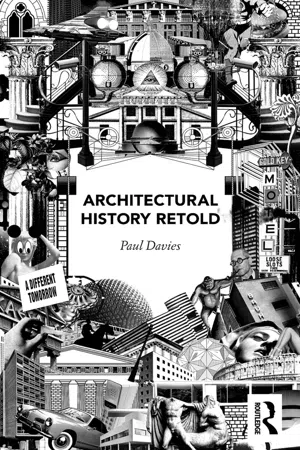
How much do you know about Greek architecture? Roman? Gothic? The Renaissance? Modernism? Perhaps more importantly, do you know how these are connected or how one style evolved to become another? Or what happened historically during each of these periods?
Architectural History Retold is your roadmap for your journey through architectural history. Offering a fresh take on what the author calls the 'Great Enlightenment project', it traces the grand narrative of western architecture in one concise, accessible volume. Starting in Ancient Greece and leading up to the present day, Paul Davies' unconventional, engaging style brings the past back to life, helping you to think beyond separate components and styles to recognise 'the bigger picture'.
The author is an academic and journalist with three decades of experience in introducing students to architectural history. The book is based on his successful entry-level course which has used the same unstuffy approach to break down barriers to understanding and engagement and inspire generations of students.
On the beach. Still the mud lark on Mersea Island, where I was born Credit: Julie Cook
There once was a town in eastern Czechoslovakia called Poruba. I've never been there; I read about it in a book one afternoon. I don't even know how big the town is, but I can be confident it exists because it's on Wikipedia, except now it's in the Czech Republic. Some of the images on Wikipedia even correspond to those in the well-illustrated, good, but rather dry book. It's dry because it's an academic book, probably developed from a PhD dissertation. The book is titled Manufacturing a Socialist Modernity: Housing in Czechoslovakia 1945–60. See what I mean?
I have to wade through books like this, because sometimes bells will ring in my head and, well, you know you've got something interesting; you read something quite dull, but you are busy reinterpreting it. This is what I assume lecturers try to do all the time, especially if the lecturer's slot is nine on a Friday morning and the subject is history; that's how to get students out of bed. The primary means to do this is by filling out the context a little. It's all very well knowing all there is to know on Czech housing 1945–60, but what happens if you compare it with what happened in St Albans at the same time or, for that matter, what appeared on yesterday's news?
One student chirped up that these days Poruba is better known for its party scene. Quelle surprise! I can picture it already: it was originally built in an industrial landscape for industrial purposes; they proudly checked to be sure that there weren't any coal seams beneath it before they built it, since it was at the coal seam that most of the inhabitants worked. Being part of the USSR meant championing of the worker, so the Minister for Heavy Industry asked: ‘Don't you want the miners, who spend all day digging out coal without a ray of sunshine, to have at least enough sunlight in the hours that they have for a little bit of rest?’
The town was built in the 1950s in the Social Realist style: monumental, Neoclassical and grand. The West has dubbed it ‘wedding cake’, a term at once both accurate and snide. There are grand layouts of boulevards with pilasters and capitals and reliefs in the stucco and statues of workers; there is even the rather hopeful idea that, in the architectural transition from home, courtyard, street, boulevard to eventual countryside, the greatness of the socialist community is made manifest in continuity, from field to table. The entrance to Poruba is even marked by an inhabited triumphal arch, worthy of the precedents of Ancient Rome, or at least eighteenth-century St Petersburg.
But this is not the image we have of housing in Czechoslovakia 1945–65. The image we have is of drab prefabricated identical blocks of housing with little care for the sophistication of ideas such as an architectural language symbolising a greater socialist community.
So the question is about how we got from the grand landscape of the former to the drab landscape of the latter, and the answer is numbers. As the grand socialist enterprise matured, with its centralised power structure and superstructural bureaucracy and dedication to plans and targets, it conspired to turn everything into numbers, and, within it, architecture became a totally technically orientated task. Not a whiff of sentimental grandeur could be tolerated. Numbers of units were more important than what the units were, and there you have one big lesson for not only architecture but a whole political system. By the end there were no architects in the architectural offices; there were just technicians. Architects were superfluous.
But, of course, meanwhile, what was happening in St Albans or Crawley or Basildon? Well, you can guess this. Local councils were building lots of individual little houses with gardens that looked pretty much the same, with evocations of both roses around the cottage door and every man's home as his castle.
I've just been listening to Any Questions. I did it by accident, but it certainly struck me that the contemporary debate in the UK, such as it is, is also being driven by numbers. There are quests for so many ‘low-cost’ homes. Will reform of the planning system save the economy? That is, can we build on that meadow or another for the good of all? There's a lot of squabbling – that's why we set up the planning system in 1947 in the first place – because we couldn't quite bring ourselves to nationalise land itself but we could nationalise the right to develop it. It was a start. Now it's gone back to numbers – or, in our case, money – where so-called affordable homes will be built to lower specifications than those that float at market rate; bringing the disturbing image of the most vulnerable placed in the flimsiest accommodation.
PHOTOGRAPH 1 My father (right) as apprentice of the month, Ruston & Hornsby, Lincoln. 1940
At my university I'm told that my office space, my library of books, is valued at £350 per square foot. I don't think it has crossed the mind of the administration that perhaps the value of the books themselves is well above that figure or well below or perhaps that that figure cannot easily be calculated at all. Of course, the value of individual books can be assessed at any one moment, based on rarity perhaps, but, on a broader scale, how might you compare the value of Plato's Republic with that of Harry Potter and the Order of the Phoenix? The numbers sometimes don't establish value at all.
You can't theorise growing flowers, but you can theorise creating buildings. You can't have Marxist or post-Marxist tulips (for that matter, you can't have Conservative-thinking tulips either), but you can have Marxist and post-Marxist buildings; they would just need some explaining. However, most of the language used to describe buildings these days (I'm thinking of TV programmes such as Grand Designs) is indiscernible in tone of rapture from what might be used in Gardeners’ World. Certainly flowers are things we consider pretty, and Kevin McCloud continually enjoys space as ‘lovely’, but really we might enquire deeper: ‘Well, just what does he mean?’ Such questions have vexed me ever since I began my own architectural education.
There are very few architects who regard architecture as a thing. The modern American architect Louis Kahn was one, and he sent everybody spinning round in circles as to what exactly he meant by it as he was trying to define it. Most of us see it as a result of processes; these are not mysterious but explainable. This is the route I have taken with this history, that in general people do things because the environment (physical/political/social/personal/technological) facilitates them in doing them. Then comes the magic.
What the story of Poruba illustrates for us is that of cause and effect, and the cause and effect illustrated there is not the mere husbandry of flowers but the whole creation of a world, a sociopolitical construction, a human idea for humans, or series of ideas, in consecutive operation for generations of different humans under variously auspicious circumstances.
Both architecture and cuisine prefigure any culture's destruction. As soon as you've got architecture or cuisine, it could be said you are doomed, and henceforth it's a struggle, a struggle to hold it together. Take the aborigines, living in perfect harmony with their surroundings for thousands of years with never a thought for the stuff, not so much as a shack but, then again, a fairly challenging diet. Or the Inuit, stuck in the most inhospitable of surroundings but daring to take a similar view. It's as if they say ‘don't come anywhere near us’ while chewing happily on two-year-old whale blubber inside freezing in blocks of ice.
If you want harmony with nature, you do not need architecture, and you probably don't need humans either, for civilisation, such as it is, is the antithesis of nature. If only this were something that architecture students had drilled into them on their first day (Architecture 101: Architecture Is Not Nature), it would render much heartache unnecessary later on. There are of course other things that should be taught on those first days: a course in first-order logic for instance and, perhaps, a course on cookery. That would set the students up just fine for the endurance course ahead.
Alas, this is a mere pipe dream. In reality those students will take their first steps on a long, arduous and meandering road through one of the softest subjects in the curriculum via the hardest of possible paths, with many dead ends, U-turns and false starts. By soft I mean that architecture is culturally defined but scientifically and economically built, so it is inevitably both a compromise and a battle of wills at the same time. They will learn a very little about a lot of things and eventually, after many years and much out of pocket and slightly out of mind, become a professional Jack of no trades, but apparently the sexiest one, albeit the worst paid. Logic might decree you couldn't have both at the same time.
Just as we might put food in a restaurant, we build architecture in to a tradition. T. S. Eliot's essay ‘The Artist and Individual Talent’ (1917) makes considerable play on the fact that the term ‘traditional’ is usually derogatory but maintains that an artist presenting mere novelty is bereft of the necessary historical sense to offer something truly valuable. It is true we live in a world of novelty all around us, but what of our historical sense? Our technology promotes a certain amnesia as we flutter from this to that, but what of our abiding ambitions, the enduring pursuits in the name of humanity itself?
So this is a strange history book to start from such a premise, that of the blind leading the blind through what I shall purloin rather grandly as ‘The Great Enlightenment Project’: two and a half thousand years or more of catastrophe, terror and general calamity in the honourable, in the entirely human pursuit of a better world. It comes of a desire to reaffirm that project, and particularly to those now least able to understand it – undergraduate architectural students and those casual observers of interest, whose embattled nerves, bedazzled with moments, twittered out, can simply no longer see the wood for the trees.
It is an unashamedly grand canvas; I want to provide the big picture. But I am no Géricault, who first shaved his head and then shut himself in his studio (in all revolutionary ardour!) for seven months to paint The Raft of the Medusa in 1818. I am the sort of person who would have liked to be gossiping about him doing it while sitting in the bar round the corner. What I have in mind is more of a jigsaw, and the first piece has me climbing a hill somewhere in the Vosges Mountains of eastern France.
I have climbed this particular hill several times, so I'm very familiar with it. I have been whisked up it in fog in a Renault 21 on a late January afternoon by some boy racer, strained up in sunshine in a Renault 5 packed with university friends; I have crawled up it in a Citroën loaded down with all of a colleague's worldly possessions. I have been up this hill two-up on my Moto Guzzi 500 with a girlfriend on the back, and I have walked it, sweated it, perhaps as it should be done, by myself.
At the bottom of the hill is a little town called Ronchamp, and at the foot of the road – or what used to be track – that leads up from the main road is a bar-hotel-restaurant called La Pomme d'Or. I know that well too; I've played babyfoot with the local youth there, I have dined solo amid heads of wild boar on the wall, I have stayed in one of its bedrooms leaden with Haute-Savoie rusticity.
Halfway up the hill, and it's a substantial hill, there is (at least was) a second hostelry, called Les Acacias. I have stayed there too, with my friend who was moving to Turin with all his worldly possessions. It was a bit musty with the ghosts of so many architectural visitors, a bit haunted. Now this was the last time I was there, and I noticed something – the building, in French chalet style, sported just a few ‘Le Corbusier’ details in the disposition of some tiny windows scattered across its porch wall.
Amused, I trudged with my friend up the remaining hill. At the top used to be a very ordinary café and gift stand. Both were welcome by the time you'd climbed that bloody hill, and they also sported odd but endearing little L-C motifs. However, the final ascent was to the right, where through a wrought-iron gate and between yew hedges you began to comprehend the billowing shape that is Le Corbusier's majestic Ronchamp Chapel (1954).
Now this damn thing is a bit special, and much has been speculated about it. Why is it this shape? (Nun's hat? Seashell? Ship?) Where does it come from? The funny thing is it's not difficult to explain Ronchamp in quite rational terms. First, there's that bloody hill, and in the ’50s it would have been a lot harder to ascend it with equipment. How powerful was a truck back then? On the summit lay the remains of the original chapel, bombed in the Second World War, this being a bitter area of conflict through late 1944. If you are piling up rubble curved walls are stronger than straight ones and battered walls are stronger than plumb ones, especially if you are doing so around a concrete frame. In actuality the swooping south wall of Ronchamp is hollow, so making this piling up a rhetorical device, but it's no less effective for that. Add to this a dash of Le Corbusier's more elemental fascinations: the passing of the day, the weather, the formation of the landscape over time, some notion of the sacred landscape, his notion of ‘visual acoustics’ (or visual echo), which may or may not be something to do with punning, and the origins of architectural form itself (see Ancient Greece), and you may get somewhere.
You can see this information painted by Le Corbusier on the enamelled doors of the chapel, but not that easily. If you have read L-C's ground-breaking if rather peculiar book Towards a New Architecture, you might recall his enthusiasm for Roman vaulting in the lofty side chapels; meanwhile, the roof has something dramatic going on, such as an aircraft wing or a boat, items he also enthused over. If you've tried technical drawing with a T and set square you will wonder at how exactly he managed its multiple curvature, since such things are now commonplace only with computing.
And we haven't even considered the brief yet, which demanded both interior and exterior congregations but not at the same time. Then you will understand why the statue of Mary is mounted on a pivot in the east wall, to face either way, and why the east wall embraces the space outside it so vigorously. Consider all these things and more (I've left plenty out) and you are some way to understanding the whole composition.
Of course I've sat and drawn Ronchamp rather picturesquely, just like any student does, in crayon white against a blue sky. Look the thing up on Google Images and you'll find plenty of silly sketches of this wonderful object by bemused students making an absolute hash of understanding it in rational terms. Perhaps they don't want to understand it in rational terms; it is the mystique they are after: the mist of genius.
However, as I descended the staircase at home this morning, I was relieved that I'd also drawn the handrail detail of the little staircase that runs up the outside of the north wall, because that's what I copied when we refurbished our flat, and on my last visit I realised something else that had nothing to do with mystique.
It is something so obvious and rational that it qualifies as my first revelation in this book: Le Corbusier did not design that rather ramshackle café, the souvenir stand, or the coach park. It was not within his conception of the object to imagine such things, and probably not within the conception of the client either. Swarms of tourists, religious or otherwise, crawling all over the thing – it just didn't enter into their psyches in any way. And, in that sense, Le Corbusier clearly would never have understood consumerism, or perhaps he saw it on the horizon, and as he did so, he decided to kill himself. Now that of course is overly dramatic conjecture; there were plenty of reasons for L-C to kill himself in 1965, as we shall find out, and we cannot even be certain he swam out to sea that morning with the intention of doing so.
But, whatever the case, fifty or so years later, Renzo Piano would be commissioned to provide a big brand-new shiny visitors’ centre...
Table of contents
Cover Page
Half Title Page
Epigraph
Title Page
Copyright Page
Dedication
Contents
Acknowledgements
Prologue
1 Introduction
2 Ancient Greece
3 Ancient Rome
4 The Gothic
5 The Renaissance
6 The Enlightenment
7 The Industrial Revolution
8 European Modernism
9 American Modernism
10 Postmodernism
11 The Future
Further Reading
Index
Trusted by 375,005 students
Access to over 1.5 million titles for a fair monthly price.
Study more efficiently using our study tools.
Frequently asked questions
Yes, you can cancel anytime from the Subscription tab in your account settings on the Perlego website. Your subscription will stay active until the end of your current billing period. Learn how to cancel your subscription
No, books cannot be downloaded as external files, such as PDFs, for use outside of Perlego. However, you can download books within the Perlego app for offline reading on mobile or tablet. Learn how to download books offline
Perlego offers two plans: Essential and Complete
Essential is ideal for learners and professionals who enjoy exploring a wide range of subjects. Access the Essential Library with 800,000+ trusted titles and best-sellers across business, personal growth, and the humanities. Includes unlimited reading time and Standard Read Aloud voice.
Complete: Perfect for advanced learners and researchers needing full, unrestricted access. Unlock 1.5M+ books across hundreds of subjects, including academic and specialized titles. The Complete Plan also includes advanced features like Premium Read Aloud and Research Assistant.
Both plans are available with monthly, semester, or annual billing cycles.
We are an online textbook subscription service, where you can get access to an entire online library for less than the price of a single book per month. With over 1.5 million books across 990+ topics, we’ve got you covered! Learn about our mission
Look out for the read-aloud symbol on your next book to see if you can listen to it. The read-aloud tool reads text aloud for you, highlighting the text as it is being read. You can pause it, speed it up and slow it down. Learn more about Read Aloud
Yes! You can use the Perlego app on both iOS and Android devices to read anytime, anywhere — even offline. Perfect for commutes or when you’re on the go. Please note we cannot support devices running on iOS 13 and Android 7 or earlier. Learn more about using the app
Yes, you can access Architectural History Retold by Paul Davies in PDF and/or ePUB format, as well as other popular books in Architettura & Architettura generale. We have over 1.5 million books available in our catalogue for you to explore.