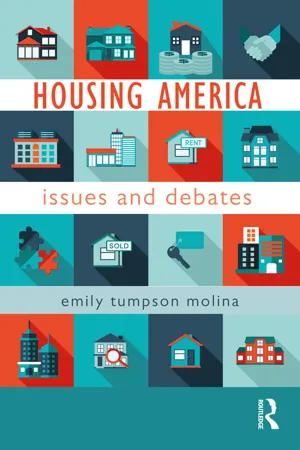
In an effort to explain why housing remains among the United States' most enduring social problems, Housing America explores five of the U.S.'s most fundamental, recurrent issues in housing its population: affordability of housing, homelessness, segregation and discrimination in the housing market, homeownership and home financing, and planning. It describes these issues in detail, why they should be considered problems, the history and fundamental social debates surrounding them, and the past, current, and possible policy solutions to address them. While this book focuses on the major problems we face as a society in housing our population, it is also about the choices we make about what is valued in our society in our attempts to solve them. Housing America is appropriate for courses in urban studies, urban planning, and housing policy.
- 198 pages
- English
- ePUB (mobile friendly)
- Available on iOS & Android
eBook - ePub
About this book
Information
Chapter 1
Introduction
In March of 1937, Gertrude Doyle and her son Walter staged a sit-down strike in their home of twenty-three years in coastal Ocean City, NJ to protest foreclosure proceedings against them. They were evicted on March 19 when their lender repossessed the property with no opportunity to renegotiate the terms of their loan. The Doyles were among the approximately quarter of American households in foreclosure in 1937 as the country debated how to alleviate the economic suffering of its residents while propping up the devastated housing market. Nearly seventy-five years later, nine people were arrested after protesting the foreclosure of the Gudiel family home in La Puente, CA. The Gudiels faced eviction in 2011 after their lender took ownership of their property without renegotiating their loan. The Gudiels were among more than 4 million Americans who lost their homes to foreclosure each year during the Great Recession, as the country again debated how to alleviate the economic suffering of its residents while propping up the housing market.
In the spring of 1971, New York City officials lamented the city’s housing crisis as the homeless population soared, and the relatively new strategy of providing public aid to private developers to build enough housing for the city’s residents resulted in construction of only 20 to 45 percent of the units the city required. More than forty years later, in 2014, newly minted mayor Bill de Blasio’s administration unveiled a ten-year plan to build or preserve 200,000 units of affordable housing after years of public subsidies to real estate developers yielded a fraction of the housing needed for middle and low-income New Yorkers, and the homeless population mounted.
Remove the dates and it is hard to distinguish between the struggles of the Doyles in 1937 and the Gudiels in 2011, or between New York City administrators in 1971 and in 2014. Why do Americans continue to struggle with the same housing problems decade after decade?
This book explores five of the U.S.’s most fundamental recurrent issues in housing its population in an effort to explain why housing remains among the United States’ most enduring social problems. It describes five major housing problems the U.S. currently faces: unaffordable housing; homelessness; segregation and discrimination in the housing market; homeownership and home financing; and housing planning, land use, and the environment. It describes these issues in detail, why they should be considered problems, the history and fundamental social debates surrounding them, and the past, current, and possible policy solutions to address them. While this book focuses on the major problems we face as a society in housing our population, it is also about the choices we make about what is valued in our society in our attempts to solve them.
The Housing Problem
Despite its relative affluence, the world’s largest economy and third most populated country faces fundamental problems in housing its residents. In 2013, more than a third of Americans paid more than 30 percent of their income on housing, as real incomes have not kept up with housing prices in recent decades (U.S. Census Bureau 2015). In 2015, more than a half a million people were homeless in America on any given night (U.S. Department of Housing and Urban Development 2014). The number of Americans living in segregated high-poverty neighborhoods is the highest ever recorded, and the average white American continues to live in a neighborhood that is 75 percent white (Jargowsky 2015; Logan and Stults 2011). A staggering one in forty-five American households received a foreclosure filing at the height of the recent housing crisis (RealtyTrac 2010). And low-density housing sprawl on large lots of land continues to dominate trends in housing development despite the environmental costs and increased risks of natural disasters.
Are these problems a reflection of Americans’ preferences, an outgrowth of our capitalist system, a reflection of other social inequalities, a result of politics and policy, or some combination? This book considers the problems of affordability, homelessness, segregation, homeownership, and housing planning within the context of larger social debates that surround them from a critical perspective at the intersection of sociology, urban studies, geography, urban planning, and public policy. The chapters in this text will introduce you to the extent and history of each problem, the fundamental sociopolitical debates surrounding them, and the past, current, and future policy proposals designed to solve them. It will ask you to delve deeply into each problem, to grapple with the intricacies, to understand the stakes, and to develop well-informed solutions.
The Significance of Housing
Housing is not simply shelter; it structures our social lives. Americans have long recognized that where we live determines much about the shape and quality of our lives: our health; how our time is spent; whom we know; and how we survive. Housing quality and location contribute fundamentally to our health—the toxins we are exposed to through our buildings’ materials, for example, our proximity to environmental hazards, or the time we spend commuting. Where we live determines the quality of our education, which in turn affects our employment prospects. It shapes our personal social networks, which largely shape our social lives and economic opportunities. Where we live also affects the degree to which we are exposed to, at the negative end of the spectrum, life stressors like crime, and on the positive, the institutions necessary for living full, healthy lives, such as hospitals, schools, libraries, and parks.
Housing and Other Social Problems
As a result, the housing problems discussed in this book have repercussions that extend far beyond housing. Decent housing is linked to better health and personal safety, employment opportunities, educational quality, and emotional and physical security. Solving the problems of affordability, homelessness, discrimination, home financing, and land use planning would go a long way toward solving related social problems. Significant changes in housing policy could dramatically affect the provision of education and medical care and access to employment in the U.S., and the extent to which Americans are able to live healthy, productive lives.
In debates over the U.S. educational system and policy, for example, housing is often a central concern. After all, where we live in large part determines where we go to school, and segregated neighborhoods beget segregated schools. Any serious inquiry into how to advance educational equity considers how to integrate neighborhoods. Similarly, debates over the impact of environmental hazards like industrial pollution often touch on housing, as segregated neighborhoods contribute in large part to the disproportionate exposure of poor people and people of color to environmental toxins. Thus, while this book focuses specifically on housing problems, the debates and policies presented extend to a vast array of other social problems.
Housing and Social Inequality
The housing market both reflects and constructs social inequalities in the U.S. Racial, class, and gender inequality are deeply embedded in all of the problems discussed in this book. Housing affordability, for example, has a stronger negative impact on African Americans and Latinos in the U.S., as well as single women. Men are more likely to be homeless than women, and people of color are more likely to be homeless than whites in American society. Segregation and discrimination in the housing market provide the foundation for other forms of social inequality—like educational inequality, for example—and can undermine the benefits of homeownership for poor people and people of color. This book aims to encourage us to think carefully not just about how and why housing problems endure, but about how we might alleviate them—particularly because housing is central to social inequality in the United States.
The Big Debates
Housing problems are a reflection of American society’s most fundamental political, economic, and social problems. Housing availability, affordability, policy, financing, and planning are persistently difficult problems to address from generation to generation because they are so deeply embedded within the nation’s most fundamental struggles over the rights of residents, the functioning of the capitalist system, and the role of government. Many of the debates discussed in this book are specific to particular issues. For example, what is primarily to blame for housing affordability, or what causes residential segregation? But others are echoed again and again from problem to problem, particularly as we address possible solutions in earnest.
Two primary debates recur throughout each chapter of this book: (1) how do we balance the social and economic goals of housing in a capitalist system?; and (2) what is the government’s role in the housing market? These fundamental questions have been echoed in debates over housing problems for decades, as well as in the policies we design to solve them.
Housing as Shelter, Housing as Commodity
As noted in the previous section, the social benefits of adequate, affordable housing are immeasurable. Quality housing underpins quality of life and access to resources. Americans have long recognized that the right to a decent home is central to the “American way of life” and to the nation’s prosperity. But housing is not a guaranteed right, and nearly every attempt to provide adequate housing to all Americans has been hopelessly limited or undercut.
In the U.S., housing is a commodity rather than a guaranteed right. Housing is bought and sold in the marketplace, and we rely on the private sector to provide housing for our population. The private housing market—made up of construction, real estate, and other industries—is an economic powerhouse in our society, providing a range of jobs, pumping billions of dollars into the American economy, and carrying significant political weight. Furthermore, the vast majority of Americans’ household wealth comes from homeownership. Because housing is commodified in the U.S., housing policies perform economic functions. In fact, the social and economic goals of housing are often in fundamental conflict. There is great—possibly irreconcilable—tension between the fundamental human need for shelter and the social goods associated with housing and protecting the housing industry and property values—Americans’ most significant form of wealth. This tension is reflected in debates over housing affordability, segregation, housing finance, and the relationship between housing and the environment.
First, the problem of affordable housing is a locus of this tension. There has never been enough low-rent housing to meet demand in the U.S. The private housing market cannot produce enough housing for the poor because it is essentially unprofitable (Garboden and Newman 2012; Schwartz 2015). This is why New York City, for example, has struggled with an affordable housing crisis for more than forty years.
Almost no one disagrees that safe, adequate, and affordable housing could go a long way toward alleviating the attendant problems of poverty. But the fundamental commodification of housing—that it must generate a profit, or accrue wealth—undermines its public provision. Early arguments over public housing characterized it as “creeping socialism,” expressing fears that public housing would compete with private housing developers. Public housing survived only because it was linked to slum clearance of central cities in a scheme meant to increase the land value of urban America. Profitability is central to affordable housing plans. Our primary low-income housing policies, for example, are tax breaks to developers of low-income housing and rent subsidies to those who manage it in the private market—policies designed to prop up the housing industry. Similarly, we encourage homeownership because it stimulates the construction and real estate industries.
Debates over housing segregation also contend with the tension between the social and economic functions of housing. While racial segregation has abated somewhat in the past thirty years, it remains strong, and economic segregation has risen. The percentage of poor families living in high-poverty neighborhoods doubled nationwide between 1970 and 2009 (Bischoff and Reardon 2013). The concentration of the poor into particular neighborhoods concentrates related social problems, such as crime, and limits access to social mobility. Poverty deconcentration, a central U.S. housing policy discussed in Chapter 3, is designed to help the poor live in more working-class and middle-class communities. But resistance to racial and economic integration is led primarily by property owners who are afraid low-income housing will lower their property values, even as that assumption is challenged by evidence (Massey et al. 2013).
Perhaps most clearly, the balance between the social and economic goals of housing is reflected in debates about the relationship between housing and the environment. The protection of property values has complicated and in some cases thwarted environmental and disaster policy. Housing sprawl, for example—the development of new housing on the far outskirts of American cities and in rural areas—is associated with a host of negative environmental impacts, including pollution from traffic and increased exposure to natural disasters such as wildfires and hurricanes. But policymakers often decide to encourage housing growth rather than limit it, precisely for the economic benefits, even if the cost of sprawl—in both dollar terms and in human suffering—is exorbitant in the long run.
Thus, the tensions between the economic and social aims of housing in a capitalist system color nearly every debate over housing discussed in this text. This tension is not unrelated to the second major recurring theme: the role of government in the housing market.
Government and the Housing Market
A second major debate that recurs throughout this book considers the government’s role in the housing market. While we continue to debate the shape of housing policy, two major trends have characterized government intervention in the housing market in the past four decades: the neoliberal turn—the political shift toward funding market-based solutions to social problems; and the devolution of housing policy—the reliance on local governments to set and enforce housing policy.
The Neoliberal Turn
The contemporary shift to neoliberalism underlies nearly all of our current policy approaches to the housing problems discussed in this book. Neoliberalism is a system of thought and a set of policies that considers the primary function of government to be supporting and enhancing the capitalist marketplace. Neoliberal policies and approaches include those that support government deregulation of business and industry, free trade, fiscal austerity, and the like. The neoliberal turn in the U.S. substantially shifted social service provision from the public to the private sector, as its proponents considered social goods to be best provided by the capitalist marketplace.
The neoliberal turn shifted our approach toward all of the housing problems discussed in this book, but especially toward affordable housing and homeownership. The federal government directly built and managed low-income housing in the postwar period because it was so unprofitable that the private market could not meet demand. But beginning in the 1960s, the federal government shifted away from the direct provision of low-income housing in the form of public housing to subsidizing the private housing market, so that meeting the demand for affordable housing became profitable. Ultimately, we put great faith in the private sector and in the underlying efficiency of the housing market to provide this essential human need and social good to our most vulnerable households. As we will see, this strategy has not necessarily functioned as expected, as the woes of New York City’s leaders in 1971 and again in 2014 illustrate.
The neoliberal turn also fundamentally changed the market for homebuyers and how we finance homeownership. The vast majority of ordinary Americans are able to purchase homes only by taking on debt in the form of mortgages. In contrast to past eras, in which local banks issued mortgages and serviced payments for the life of loans, today’s banks, private mortgage companies, and other private entities lend to homebuyers and then package these loans together and sell them to global investors as financial products called mortgage-backed securities, not unlike stocks and bonds. This process, called securitization, was made possible by large-scale deregulation of the financial industry in the 1980s—a critical component of the neoliberal turn. Today, when one makes a mortgage payment, one is essentially paying a return to an investor, fully integrating American homeownership into global financial markets.
This new system of mortgage lending has injected the demands of investors into the system of housing finance, complicating the functioning of local housing markets. The recent foreclosure crisis, for example, resulted largely from the demand for mortgage-backed securities—the pools of mortgages that investors can invest in. Because the demand for these investments was so high, mortgage lenders had the perverse incentive to issue increasing numbers of mortgages with harmful terms for homebuyers. Because they simply packaged and sold the loans, there was no incentive to ensure that people could afford their mortgages. Housing prices rose dramatically all over the country as an unprecedented number of American households purchased homes with free-flowing debt. In the meantime, lenders and brokers operated with virtually no oversight, ...
Table of contents
- Cover
- Title
- Copyright
- Contents
- List of Figures
- List of Tables
- Acknowledgments
- 1 Introduction
- 2 Housing Affordability
- 3 Housing Segregation and Discrimination
- 4 Homelessness
- 5 Homeownership and Home Financing
- 6 Housing Development, Planning, and the Environment
- 7 Conclusion
- Index
Trusted by 375,005 students
Access to over 1.5 million titles for a fair monthly price.
Study more efficiently using our study tools.
Frequently asked questions
Yes, you can cancel anytime from the Subscription tab in your account settings on the Perlego website. Your subscription will stay active until the end of your current billing period. Learn how to cancel your subscription
No, books cannot be downloaded as external files, such as PDFs, for use outside of Perlego. However, you can download books within the Perlego app for offline reading on mobile or tablet. Learn how to download books offline
Perlego offers two plans: Essential and Complete
- Essential is ideal for learners and professionals who enjoy exploring a wide range of subjects. Access the Essential Library with 800,000+ trusted titles and best-sellers across business, personal growth, and the humanities. Includes unlimited reading time and Standard Read Aloud voice.
- Complete: Perfect for advanced learners and researchers needing full, unrestricted access. Unlock 1.5M+ books across hundreds of subjects, including academic and specialized titles. The Complete Plan also includes advanced features like Premium Read Aloud and Research Assistant.
We are an online textbook subscription service, where you can get access to an entire online library for less than the price of a single book per month. With over 1.5 million books across 990+ topics, we’ve got you covered! Learn about our mission
Look out for the read-aloud symbol on your next book to see if you can listen to it. The read-aloud tool reads text aloud for you, highlighting the text as it is being read. You can pause it, speed it up and slow it down. Learn more about Read Aloud
Yes! You can use the Perlego app on both iOS and Android devices to read anytime, anywhere — even offline. Perfect for commutes or when you’re on the go.
Please note we cannot support devices running on iOS 13 and Android 7 or earlier. Learn more about using the app
Please note we cannot support devices running on iOS 13 and Android 7 or earlier. Learn more about using the app
Yes, you can access Housing America by Emily Tumpson Molina in PDF and/or ePUB format, as well as other popular books in Politics & International Relations & Urban Planning & Landscaping. We have over 1.5 million books available in our catalogue for you to explore.