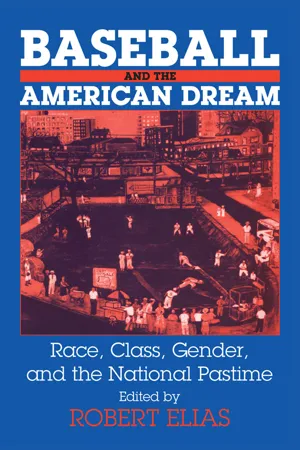
eBook - ePub
Baseball and the American Dream
Race, Class, Gender, and the National Pastime
- 328 pages
- English
- ePUB (mobile friendly)
- Available on iOS & Android
eBook - ePub
About this book
A fascinating look at how America's favorite sport has both reflected and shaped social, economic, and
Information
Dreams of Diversity: Race, Ethnicity, and Baseball
1
THE GREATEST SEASON
From Jackie Robinson to Sammy Sosa
AS THE YEARS PASS, I HAVE TO INCREASINGLY WONDER WHETHER ANYONE, BESIDES myself, was alive—living, eating, breathing, smoking cigarettes—in the year 1947. In fact, has anyone besides myself ever even heard of 1947?
We all know the observation from Shakespeare’s magical play, The Tempest, the line also inscribed on our National Archives Building in Washington: “What is past is prologue.” This says beautifully and succinctly that only when we know the past can we understand the present; only when we know the past can we contend with the future.
America, 1947. Harry Truman is president. He’s busy calling the Republican 80th Congress the worst Congress in history. The Cold War blows an icy wind. America alone possesses nuclear weapons. The Russians didn’t get the bomb until 1949, but that doesn’t protect the country from hysteria. People everywhere believe that under just about every bed in the United States lurks at least one deadly communist spy. No fewer than ten Hollywood screenwriters are sentenced to prison for refusing to tell Congressional witch hunters whether or not they have been members of the Communist party. We see people jailed not for acts—these people threw no bombs—but for ideas, for thoughts. We see in an America so gloriously triumphant in World War II—the “good war” and the war for freedom—the emergence of thought police. Fighting communism with the methods of fascism makes for unsettling times.
Joe Louis is heavyweight champion of the world. Sportswriters call him the “Brown Bomber” and the “Dark Destroyer.” Racial labels are the order of the day. On Broadway, you can see the new Tennessee Williams play, A Streetcar Named Desire, starring an overpowering young actor named Marlon Brando. The movie that wins the Academy Award is called Gentleman’s Agreement. It is a sober examination of upper class anti-Semitism. On television… well, in 1947, not one American in fifty owns a television set. Those who do get to look at tiny round screens that erupt into blizzards of white static whenever an airplane flies overhead.
The world of 1947 was profoundly different from the world we would know in 1998. But not in every single way. In 1947, the best team in baseball, the team that won the World Series, was—we can pretty much say this all together now—the New York Yankees. Only two African Americans played in that World Series. One was a forgotten pitcher named Dan Bankhead, who appeared as a pinch runner for the Brooklyn Dodgers. The other was Jack Roosevelt Robinson. He had a pretty good series, not a great one. Seven hits in the seven games, two stolen bases, a batting average of .259. But that is not and was not the point.
With precious little help from the press, the umpires, and the other ball players, Jackie Robinson integrated major league baseball in 1947. The big leagues had been off limits to blacks, a white mans club since the year 1884 when the brothers Moses Fleetwood Walker and Weldey Wilberforce Walker played for Toledo in what was then the second major league, the American Association. The policy of segregation that began in 1885 was unofficial and absolute. No documents attest to baseballs apartheid. There was simply an understanding among every major league club owner and every minor league club owner for more than sixty years that no blacks could play in so-called organized baseball.
Surely this shaped the nature of American life. If blacks were kept out of the national pastime, and told to go away and play in their own league, didn’t it follow naturally that blacks could be prevented from attending outstanding schools and colleges, forbidden to move into attractive neighborhoods, barred from admission to pleasant country clubs and even, through various forms of intimidation, denied the right to vote? It surely did. America in 1947 was a society stained with brutal bigotry.
In 1997, the fiftieth anniversary of Robinson’s entry into the major leagues, organized baseball produced a celebration and retired Robinson’s number, 42, for all time. Very nice as far as it went, but baseball’s publicists and promoters carefully excluded from their celebration the way things really were for Jackie Robinson as a rookie.
Branch Rickey, a complex white man with roots in southern Ohio, brought Robinson to the Dodgers. Pee Wee Reese, shortstop and captain with roots in segregated Kentucky, befriended him. But not many applauded Rickey’s breakthrough move. The commissioner of baseball, A.B. “Happy” Chandler of Kentucky, refused comment. In some cases—this is one—a “no comment” speaks volumes. Jimmy Powers, sports editor of the New York Daily News, the tabloid that then had the largest circulation of any newspaper in America, wrote: “Robinson will not make the grade. He is a thousand to one shot.” The Sporting News, which called itself baseball’s bible, said Robinson was too old and couldn’t hit. A prominent baseball executive said, “We can now expect the Branch Rickey Temple to be built in Harlem.”
Rickey insisted that Robinson spend a season in the minor leagues and assigned him in 1946 to play second base for Montreal in the International League. That March, during an exhibition game against Indianapolis in Daytona Beach, Florida, Robinson slid home with a first-inning run. A local policeman bolted onto the field, drew his gun and said, “Get off the field right now, or I’m putting you in jail.” During a regular season game someone on the Syracuse Chiefs sent a black cat on the field from the dugout. “Hey, Robinson,” he shouted, “here is one of your relatives.” For the record, Robinson did leave the field in Daytona Beach. In Syracuse, after the innocent cat had been caught, he hit a double. For that year in Montreal he stole forty bases and the fellow who couldn’t hit won the International League batting championship.
At the end of that 1946 season, Robinson told me, as he was leaving the old Montreal ballpark, a crowd of fans swarmed about behind him. Robinson began to run. The fans ran after him. Then Jack began to cry. “I was crying,” he said, “because here was a big crowd running after a black man—not to lynch him, but to get his autograph.”
The next year, when Rickey promoted Robinson to Brooklyn, he thought the other players would welcome Jack. Here was a winning ball player. Here was a man who meant pennants and World Series shares. In an era when most ball players earned eight or ten thousand dollars a year, here was a man who meant “cash.” It surprised Rickey when a half dozen Dodgers prepared a petition that said in effect, “If you’re bringing up the colored guy, you’ll have to trade us.”
The petition was prepared by Dixie Walker, a native of Villa Rica, Georgia, who lived in Birmingham. Many years later, Walker expressed his deep sorrow for the petition, claiming that it was the dumbest thing he’d ever done and that it was motivated less by racism than by a fear of losing business back home in his off-season hardware company. But in 1947 Walker was a recent National League batting champion and team leader, and he got several other Dodgers to sign. Hugh Casey, baseballs best relief pitcher and an Atlanta native, supported the petition, as did Bobby Bragan, a third-string catcher from Birmingham. But if “Confederates” began the petition, “Union” forces did not lack for representation. Harry “Cookie” Lavagetto from Oakland, Carl Furillo from Reading, Pennsylvania, and Eddie Stanky from Philadelphia, also signed.
Harold “Pee Wee” Reese, from Louisville, underwent a crisis. He had grown up in a segregated community, and when he was young his father even showed him the local “hanging tree” for “when a nigger gets out of line.” But as a Christian, Reese wondered how he could deny Robinson the right to inherit a small portion of the earth. He could not and he would not. Citing his financial insecurity and the petition’s possible backlash, he refused to sign, thus implicitly challenging the team’s racists. More recently, Reese said, “People tell me that I helped Jackie. But knowing my background and the progress I’ve made, I have to say he helped me as much as I helped him.”
Word of the petition reached Leo Durocher while the Dodgers were on a spring training tour in Panamas Canal Zone. He was about to embark on what was probably the finest hour of his life. At one o’clock in the morning, Durocher—in his pajamas—assembled the players in an army mess kitchen. He told them what they could do with their petition:
I’m the manager and I’m paid to win and I’d play an elephant if he could win for me and this fellow Robinson is no elephant. You can’t throw him out on the bases and you can’t get him out at the plate. This fellow is a great player. He’s gonna win pennants. He’s gonna put money in your pockets and mine. And here’s something else. He’s only the first, boys, only the first! There’s many more colored ballplayers coming right behind him and they’re hungry, boys. They’re scratching and diving. Unless you wake up, these colored ballplayers are gonna run you right out of the park…. Fuck your petition…. Go back to bed.
If there was a single moment when the success of Robinson and what some called “the Noble Experiment” became assured, it came on a day when the Dodgers were taking infield practice in old Crosley Field in Cincinnati. Robinson played first base for Brooklyn in 1947 and Cincinnati, on the Ohio River, regarded itself as a border town. Fans began to jeer Robinson’s every move. The Cincinnati players picked it up. They shouted at him, “Hey, Jungle Bunny. Hey, Snowflake.”
Suddenly, Pee Wee Reese, the young Dodger captain, raised a hand and called time. The infield drill stopped. Reese walked over from shortstop to first base and put an arm lightly on Robinson’s shoulders. There they stood white man and black man, number one and number forty-two. Reese said not a word but simply stared into the Cincinnati dugout. I do not believe we have known a finer moment in American sports.
During the recent and very exciting 1998 baseball season, numbers of television broadcasters asked me to make appearances as a guest on their shows. Everyone wanted to raise the same point. Wasn’t the season of 1998, with Sammy Sosa and Mark McGwire, with David Wells and the new mellow-fellow George M. Steinbrenner, wasn’t this the greatest season in the history of baseball?
The answer is no, not by a long shot. The greatest season was 1947. The greatest period? The ten years of Jackie Robinson. I’m not talking about home runs or perfect games or winning streaks. I am talking about something more important: the quality of American life.
Once Jackie Robinson made it, at a terrible personal cost, we all began to look at the nature of society. I remember being introduced at Ebbets Field to a charming California politician who was then unemployed. We watched a few innings together. Robinson, with his daring base running and his quick bat and his uncompromising color, the ebony arms extending beyond the Dodger sleeves of white, dominated. This politician was fascinated. A few years later he became Chief Justice of the United States. His name was Earl Warren and he would be the architect of integrated education with his decision in Broivn v. Board of Education of Topeka. I believe Earl Warren’s resolve for fairness in education took firm hold that night he watched Robinson in Ebbets Field.
“My demand,” Robinson said to me once, “was modest enough.” He was simply asking to make a living at the level to which his gifts entitled him. But see what flowed from that: a general recognition that all Americans should have equal economic rights. As other black athletes came forward—Roy Campanella, Satchel Paige, and the matchless Willie Mays—we began to recognize that black athletes and indeed that black citizens were a national asset.
We began to look at blacks not as a breed apart. We began to recognize that American apartheid was just plain wrong. I would say that if there was no Jackie Robinson there would have been no Martin Luther King, Jr., at least not as we remember him. Has anything else in American sports ever approached the impact of the season of 1947?
What accounts for Jackie Robinson’s accomplishment? In white America you still hear a variety of cliches about African Americans: “Sure blacks can run and jump and slide and dunk, but can they think? Hey, that’s the white man’s game. Let Willie chase ‘em in the outfield. Let Jim Brown run for daylight. Let Michael slamma-jamma. Fine for natural athletes like those guys. But for thinking, we gotta have whites. White pitchers and white quarterbacks and white coaches. Know what I mean?”
As one of those accused of having only “natural” ability, Willie Mays had some answers. When talking about athletic performance, he said:
So much is mental. I believe if you can’t think, you can’t play [on a good level]. Baseball or any sport.… Some people who watched Jim Brown play football said, “Man he’s big and fast and strong. He’s gotta be good.” But they don’t realize that when Brown was running with the ball, he was always thinking. Cut back. Fake. Whatever. He was always thinking ahead, two or three moves ahead of the tacklers. Muhammad Ali. Sure he was big and quick. But he was such a good boxing thinker, he could figure the round he’d win in before the fight. Then he made his moves and it would come out like he predicted. He was another athlete who was great because he would think. Julius Erving in basketball. Dr. J. had all the moves. He had a great body to play basketball, but he had the moves because he knew how to think.
And when asked to choose the smartest baseball player he ever saw, Mays answers very quickly: “Jackie Robinson.”
I rejoice with Sammy Sosa at his annual stipend of $10,625,000.1 commend Mark McGwire on his tidy $9,500,000. Except for the San Diego pratfall in the Series, we had a glorious 1998 season.
But I know, too, that baseballs success and Americas success were helped immeasurably by Jackie Robinson, who died, with very little money in 1972. He was a splendid friend, not at all sad. Before his death, I was visiting the Robinson’s in North Stamford, Connecticut, and Mrs. Robinson, Rachel, whom we call Rae, said, “No single reporter, not one, has ever asked me this. If Jack had a hard day at the ballpark, if the bigots were yelling at him, did he take it out on family when he got home? He didn’t,” she said. “The only way I could tell was that he’d take a bucket of golf balls and his driver and start hitting them off the back lawn into the lake.”
Then Jack looked at me and his eyes were twinkling. “The golf balls,” he said, “were white.”
2
JACKIE ROBINSON’S LEGACY
Baseball, Race, and Politics
NINETEEN NINETY-SEVEN MARKED THE FIFTIETH ANNIVERSARY OF JACKIE ROBINSON’S courageous triumph over b...
Table of contents
- Cover Page
- Half Title Page
- Title Page
- Copyright Page
- Dedication
- Table of Contents
- Preface
- Prologue
- Introduction American Dreams
- Part I Dreams of Diversity: Race, Ethnicity, and Baseball
- Part II Material Dreams: Class, Economics, and Baseball
- Part III Gendered Dreams: Women and Baseball
- Bibliography
- About the Contributors
- Index
Trusted by 375,005 students
Access to over 1.5 million titles for a fair monthly price.
Study more efficiently using our study tools.
Frequently asked questions
Yes, you can cancel anytime from the Subscription tab in your account settings on the Perlego website. Your subscription will stay active until the end of your current billing period. Learn how to cancel your subscription
No, books cannot be downloaded as external files, such as PDFs, for use outside of Perlego. However, you can download books within the Perlego app for offline reading on mobile or tablet. Learn how to download books offline
Perlego offers two plans: Essential and Complete
- Essential is ideal for learners and professionals who enjoy exploring a wide range of subjects. Access the Essential Library with 800,000+ trusted titles and best-sellers across business, personal growth, and the humanities. Includes unlimited reading time and Standard Read Aloud voice.
- Complete: Perfect for advanced learners and researchers needing full, unrestricted access. Unlock 1.5M+ books across hundreds of subjects, including academic and specialized titles. The Complete Plan also includes advanced features like Premium Read Aloud and Research Assistant.
We are an online textbook subscription service, where you can get access to an entire online library for less than the price of a single book per month. With over 1.5 million books across 990+ topics, we’ve got you covered! Learn about our mission
Look out for the read-aloud symbol on your next book to see if you can listen to it. The read-aloud tool reads text aloud for you, highlighting the text as it is being read. You can pause it, speed it up and slow it down. Learn more about Read Aloud
Yes! You can use the Perlego app on both iOS and Android devices to read anytime, anywhere — even offline. Perfect for commutes or when you’re on the go.
Please note we cannot support devices running on iOS 13 and Android 7 or earlier. Learn more about using the app
Please note we cannot support devices running on iOS 13 and Android 7 or earlier. Learn more about using the app
Yes, you can access Baseball and the American Dream by Robert Elias in PDF and/or ePUB format, as well as other popular books in Social Sciences & Asian History. We have over 1.5 million books available in our catalogue for you to explore.