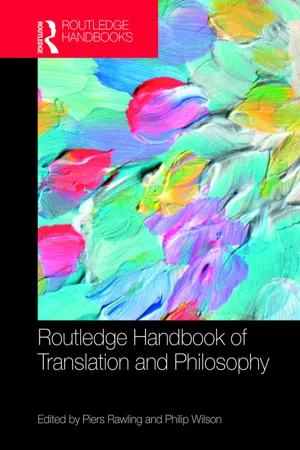
The Routledge Handbook of Translation and Philosophy presents the first comprehensive, state of the art overview of the complex relationship between the field of translation studies and the study of philosophy. The book is divided into four sections covering discussions of canonical philosophers, central themes in translation studies from a philosophical perspective, case studies of how philosophy has been translated and illustrations of new developments. With twenty-nine chapters written by international specialists in translation studies and philosophy, it represents a major survey of two fields that have only recently begun to enter into dialogue. The Routledge Handbook of Translation and Philosophy is a pioneering resource for students and scholars in translation studies and philosophy alike.
eBook - ePub
The Routledge Handbook of Translation and Philosophy
- 496 pages
- English
- ePUB (mobile friendly)
- Available on iOS & Android
eBook - ePub
The Routledge Handbook of Translation and Philosophy
About this book
Information
Part I
Philosophers on translation
1
Schleiermacher
The lecture ‘On the Different Methods of Translating’ (‘Über die verschiedenen Methoden des Übersetzens’), which Friedrich Schleiermacher delivered at the Berlin Academy of Sciences in June 1813, is widely regarded as the beginning of modern translation theory. It also represents Schleiermacher’s most extensive statement on the subject of translation. To understand its core ideas we need to know something of Schleiermacher’s views on language and languages, and on the nature of communication and understanding. We need to be aware of his work as a translator as well. This chapter therefore, after a brief introduction, sketches Schleiermacher’s writings on ethics and dialectics, and then addresses his translation of Plato. These different strands come together in his work on hermeneutics, which provides the key to the 1813 lecture. The final paragraph adds a note drawn from Schleiermacher’s talks on psychology. Contextualising the 1813 lecture in this way will show that the traditional, decontextualised reading of it as presenting a choice between two opposing ways of translating (either the translator brings the foreign author to the reader or he/she takes the reader to the foreign author) is misguided. Even the apparent parallelism in the choice does not in fact exist. [Note: in the following pages, citations not preceded by a name are of Schleiermacher’s work.]
Introduction
Today Friedrich Daniel Ernst Schleiermacher (1768–1834) is known principally as a liberal theologian who spoke in favour of the emancipation of women and of Jews. He became a public intellectual during the turbulent years of the Napoleonic wars and contributed substantially to what we now know as German Romanticism. In recent years he has been increasingly appreciated as a philosopher. Early in his career he read the Ancient Greek and Roman thinkers as well as Leibniz and Spinoza; he was heir to some of Herder’s ideas, a contemporary of Kant and Hegel and familiar with the work of lesser figures such as Fichte and Schelling.
Schleiermacher studied at the University of Halle in 1787–90 and worked for a while as a private tutor and pastor. In the years around 1800, in the Berlin salon of the multilingual Henriette Herz, he became involved with the leading Romantic writers and intellectuals of the time, among them the brothers Friedrich and August Wilhelm Schlegel. He contributed to their short-lived but influential flagship journal Athenaeum and, at their instigation, published his first books (On Religion, 1799, and the effusive Monologues, 1800). He also undertook, initially with Friedrich Schlegel but then on his own, the translation into German of virtually the complete works of Plato; the first five volumes appeared as Platons Werke between 1804 and 1809, with a final sixth volume in 1828. He taught briefly at the University of Halle, but when in 1806 the town was overrun by Napoleon’s troops and the university closed, he returned to Berlin, where he spent the rest of his life. While the French army occupied Prussia, Schleiermacher used his pulpit to preach resistance (Raack 1959; Vial 2005). In 1809 he played a role, alongside Wilhelm von Humboldt, in founding the University of Berlin. He served as its professor of theology and occasional dean for the next twenty-five years. He also became an active member of the Berlin Academy of Sciences, delivering some fifty lectures and speeches there between 1811 and 1834. The 1813 lecture ‘On the Different Methods of Translating’ was just one of these (1858; Nowak 2002).
Schleiermacher wrote prolifically, but a large part of his output remained in manuscript until after his death. His collected writings were first published between 1834 and 1864. The authoritative critical edition of the complete work (Kritische Gesamtausgabe (KGA)), currently in progress, is scheduled to comprise sixty-five volumes.
Most of what Schleiermacher issued in print during his lifetime is concerned with theology, although in terms of volume the Plato translation looms large. For his thinking about translation, his writings on ethics, dialectics, hermeneutics and psychology are all relevant. Yet he himself did not publish anything at all, or very little, in these fields. He did however lecture on them at the University of Halle and then in Berlin. What we have on these subjects, therefore, are lecture notes, by himself or sometimes by students, as well as various outlines and drafts from different periods in his life. He lectured on ethics at Halle in 1804–5 and in Berlin in 1808 (before the university was formally opened), 1812–13, 1816, 1824, 1827 and 1832 (1981: xiv). The lectures on dialectics took place in Berlin in 1811, 1814–15, 1818–19, 1822, 1828 and 1831 (2002a, 1: xxv–vi). He gave lectures on hermeneutics first at Halle in 1805 and then in Berlin in 1809–10, 1810–11, 1814 and 1819, and several more times in the 1820s and early 30s (2012: xix–xxix). The lectures on psychology began in 1818 and were then held in 1822, 1830 and 1833–4 (1862: viii). The manuscripts that are unrelated to his lecturing are often difficult to date, and some contain later additions and comments. He appears to have drafted a book on hermeneutics around 1810 but lost the manuscript and started anew in 1819. He was working on a book on dialectics when he died in 1834. The writings on ethics and dialectics in particular are often forbiddingly abstract.
Ethics
Chronologically, Schleiermacher’s interest in ethics came first. He planned to translate Aristotle’s Nicomachean Ethics as early as the late 1780s, when he was only around twenty years of age. In the next decade he published reflections on freedom, on sociability and on religious feeling, before composing a ‘Draft towards an Ethics’ (‘Brouillon zur Ethik’) in 1805–6, as his lecturing on the subject got underway.
His ideas, in this as in other domains, take shape around binary oppositions, such as real versus ideal, individual versus community, or particularity versus what he refers to as the shared ‘identity’ of human nature in all. The oppositions are not exclusive but mutually dependent and in constant interaction (which he calls ‘oscillation’), so that one concept cannot be thought without the other and neither is ever present in an absolute form. Consciousness of one’s own self presupposes a contradistinction with those who are not part of this self. Human nature is the same in all but manifests itself differently in every individual. We are open to the world around us but also project our own cognitive schemata onto it. Recognising the specific thoughts that each of us entertains permits the positing of a level of ideal or pure reason.
Human beings, for all their individuality, have a natural tendency to communicate and thus to form communities. Communication, for Schleiermacher, means that something that was internal to one person – for instance, a thought – is exteriorised and subsequently interiorised as the same thought by someone else. The means to achieve this is language: what is expression for the speaker functions for the interlocutor as a sign. Successful transfer depends on a shared schematism, a common way of thinking (1981: 65; 2002b: 49).
Communication enables sociability. It requires not only expression of one’s own personality but also a receptive openness to others, a willingness to contemplate difference. The task is paradoxical because, on one hand, it will never be possible to really grasp another person’s individual nature, while, on the other, a common humanity must be assumed (Berner 1995: 189–90). Sociability and individuality, although opposed, go together. The essence of sociability consists in respecting the other’s closed world while inviting it to open itself up and, simultaneously, making ourselves available to others keen to get to know us (‘das Wesen der Geselligkeit, welches besteht in der Anerkennung fremden Eigenthums, um es sich aufschlieβen zu lassen, und in der Aufschlieβung des eigenen, um es anerkennen zu lassen’; 1981: 265).
The uniqueness of each person’s individuality, however, remains inaccessible to others and thus untranslatable; already the ‘Brouillon zur Ethik’ equates ‘Eigentümlichkeit’ (‘individuality’) with ‘Unübertragbarkeit’ (‘non-transferability’) (1977: 361). The adjective ‘eigentümlich’ and its associated noun ‘Eigentümlichkeit’ (‘individual, individuality’) will be key words in the 1813 lecture on translation. Nevertheless, since self-expression draws on language, and language is a means of communication, self-expression already contains within it a desire to be understood. In one sense, language also acts as a brake on idiosyncrasy. In a lecture on aesthetics Schleiermacher notes that, as a shared property and a relatively fixed system, language is not well equipped to express either strict singularity or fluidity (‘die Bestimmtheit des Einzelnen’; ‘das in sich Wechselnde’); it takes a creative artist to force it to do that (1977: 403).
Forms of sociability are determined primarily by language. Following Herder, Schleiermacher conceives of language as creating a bond, initially within the family, but then extending to the clan and from there to the nation. Nations and languages, like persons, have their own individuality (1981: 47; 2002b: 25). And since thinking and speaking are interdependent, communities speaking different languages also think differently. These differences constitute what Schleiermacher calls the ‘irrationality’ of language and of languages. The term, which is of prime importance and also appears in the 1813 lecture on translation (2002: 70; 2012a: 46), denotes the non-isomorphism and incommensurability between different ways of thinking and speaking (1830: 57). The ‘Brouillon zur Ethik’ already referred to ideas in a work of art as being ‘irrational’ in that they resist understanding (‘daβ die darin enthaltene Idee irrational ist gegen das Verstehen’: 1977: 362), in a passage explaining the impossibility of ever reaching full understanding of another’s discourse. In his outline of dialectics of 1814–15 Schleiermacher speaks of the ‘irrationality’ of the individual person as being counteracted by the use of language as such (1988: 109), because, as we just saw, language is always shared with others and, as he puts it in a draft on ethics in 1812–13, it imposes a degree of commonality on even the most individual thought (1981: 68–9; 1977: 410). Irrationality, then, is not absolute but increases the further languages and cultural traditions are removed from each other.
If irrationality troubles the relatively leisurely type of communication at the heart of sociability, it also haunts the more purposeful form of dialogue that drives dialectics.
Dialectics
Dialectics is concerned with the search for knowledge that would be both absolute and certain. The reasoning, in true German Idealist fashion, is that if individuals can gain a certain degree and kind of knowledge about a portion of the world, then the idea of complete knowledge that would be true to the whole world and shared by all can be posited. Knowledge as it resides in individual languages, Schleiermacher says in an Academy lecture in 1830, stands to absolute knowledge like refracted rays of light to light as such (2002: 675). Reason points the way towards such knowledge. Reason is universal, and all humans possess a fraction of it, each in their own way. While universal knowledge will remain an unattainable ideal, it acts as a regulatory principle in that it must be aspired to. Indeed, in practice, ‘the whole history of our knowledge is an approximation to it’ (2002a, 1: 149).
This approximation has to start from concrete reality and real people, and therefore from the recognition of difference, with the aim of reaching consensus. Taking his cue from Plato, Schleiermacher conceives of dialectics as dialogue, an exchange of ideas (2002a, 1: 81). The ideas themselves as well as their exchange require language. For the individual, knowledge that is more than vague intuition or a jumble of impressions can become cogent knowledge only when it is articulated in language. Thinking is silent speaking, as Schleiermacher never tires of repeating.
Knowledge becomes socially productive when it is shared with others. But communication, as we saw, is an uncertain undertaking. The search for perfect knowledge and consensus should therefore begin where the risk is lowest – that is, within one language. This is already difficult enough, due to the inaccessibility of the thoughts of individuals. The difficulties increase exponentially when knowledge is negotiated across languages, as in every field of knowledge different languages embody an ineradicable difference (‘eine unaustilgbare Differenz’) in ways of thinking (2002a, 1: 403). Schleiermacher refers to Cicero to drive the point home. Compare, he says, the self-assurance with which Cicero writes philosophy in his native Latin with the apprehension he betrays when he is translating from Greek; in the latter case he is like any other Roman, ‘for whom the value of the translated Greek remained foreign’ (‘ein Römer, dem der Werth des wiedergegebenen griechischen fremd war’: 2002a, 1: 402).
Like ethics, then, dialectics comes up against the irrationality of languages, and Schleiermacher supplies illustrations that are devastating for any concept of translation as the integral transfer of meaning or ideas. ‘No knowledge in two languages can be regarded as completely the same, not even [the concept of] thing and A=A’)’ (‘Kein Wissen in zwei Sprachen kann als ganz dasselbe angesehen werden; auch Ding und A=A nicht’), he notes in the 1814–15 draft on dialectics (2002a, 1: 98). He argues in the same passage that even mathematics, despite its language-independent notation, is thought differently in different cultural traditions. In one of his lectures on psychology he adds similar examples, from the top and the bottom end of the linguistic spectrum. Different words for ‘and’, he explains with reference to German ‘und’, Latin ‘et’ and Greek και (kai), are not equivalent because they have different usages; and the German word for God (‘Gott’) differs from its Latin or Greek counterparts in that it is rarely used in the plural and then only to reflect foreign conceptions (1862: 173). The 1813 lecture on translation remarks in the same vein that not even the words ‘God’ and ‘to be’ are the same across languages (2002: 89; 2012a: 60).
The incompatibility between languages grows the more distant they are. In the 1832–3 manuscript of his dialectics Schleiermacher, clearly reflecting contemporary developments in comparative Indo-European linguistics (one of its pioneers, Franz Bopp, had been his colleague in Berlin since 1821), observes that, despite linguistic affinities stretching from Europe to India, the various local traditions are so different it is hard to find common philosophical ground. If this is true within the Indo-European sphere, what about cultures beyond it (2002a, 1: 405–6)?
Yet a universal language would not be the solution. Schleiermacher rejects the idea on several grounds. Its construction would be a logical impossibility since agreement would have to be reached in existing languages, making the universal tongue redundant. In any case, linguistic differences are valuable in themselves because their sum total reflects the richness of the human mind (2002a, 1: 404). Where a dead language like Latin has been employed as a transnational vehicle, its use has remained restricted to a social elite and, lacking the vibrancy of a living tongue, it would struggle to accommodate unfamiliar modes of thought (1862: 179).
In his 1811 lecture notes on dialectics Schleiermacher mentions another alternative to deal with the irrationality of languages. It consists in focusing on broader discursive and conceptual issues rather than on the non-synonymy of individual items: ‘I cannot appropriate an alien singularity, I have to reconstruct it through the way the foreign concept is formed’ (‘Das Einzelne fremde kann ich mir nicht aneignen; aber ich soll es in der fremden Begriffsbi...
Table of contents
- Cover
- Half-title Page
- Title Page
- Copyright
- Contents
- Acknowledgements
- I Philosophers on translation
- II Translation studies and philosophy
- III The translation of philosophy
- IV Emerging trends
- Index
Trusted by 375,005 students
Access to over 1.5 million titles for a fair monthly price.
Study more efficiently using our study tools.
Frequently asked questions
Yes, you can cancel anytime from the Subscription tab in your account settings on the Perlego website. Your subscription will stay active until the end of your current billing period. Learn how to cancel your subscription
No, books cannot be downloaded as external files, such as PDFs, for use outside of Perlego. However, you can download books within the Perlego app for offline reading on mobile or tablet. Learn how to download books offline
Perlego offers two plans: Essential and Complete
- Essential is ideal for learners and professionals who enjoy exploring a wide range of subjects. Access the Essential Library with 800,000+ trusted titles and best-sellers across business, personal growth, and the humanities. Includes unlimited reading time and Standard Read Aloud voice.
- Complete: Perfect for advanced learners and researchers needing full, unrestricted access. Unlock 1.5M+ books across hundreds of subjects, including academic and specialized titles. The Complete Plan also includes advanced features like Premium Read Aloud and Research Assistant.
We are an online textbook subscription service, where you can get access to an entire online library for less than the price of a single book per month. With over 1.5 million books across 990+ topics, we’ve got you covered! Learn about our mission
Look out for the read-aloud symbol on your next book to see if you can listen to it. The read-aloud tool reads text aloud for you, highlighting the text as it is being read. You can pause it, speed it up and slow it down. Learn more about Read Aloud
Yes! You can use the Perlego app on both iOS and Android devices to read anytime, anywhere — even offline. Perfect for commutes or when you’re on the go.
Please note we cannot support devices running on iOS 13 and Android 7 or earlier. Learn more about using the app
Please note we cannot support devices running on iOS 13 and Android 7 or earlier. Learn more about using the app
Yes, you can access The Routledge Handbook of Translation and Philosophy by J Piers Rawling, Philip Wilson, J Piers Rawling,Philip Wilson in PDF and/or ePUB format, as well as other popular books in Languages & Linguistics & Linguistics. We have over 1.5 million books available in our catalogue for you to explore.