Understanding Applied Learning enables teachers, lecturers and educators to facilitate applied learning effectively with learners in schools, colleges and universities. It introduces teachers to the concept of applied learning in practice, cutting across any vocational and academic divide to show how this approach supports high-quality and effective outcomes for learners. Applied learning prepares and equips learners for life in the twenty-first century and lifelong learning. Offering practical guidance on why and how to adopt applied learning in all post-primary settings, this practical resource introduces and explores the core concepts, practices and benefits of using this approach. Illustrated with real-life scenarios, it examines why applied learning is relevant today, how it enables learners to connect knowledge with new situations, how to navigate and solve intellectual and skills-based problems and how to work collaboratively and develop higher-level thinking skills.
Key topics covered include:
A range of applied learning theories and strategies
Relevant, Engaging, Active Learning (REAL) for successful knowledge and skills development
The relevance of applied learning to employers
Overcoming issues in embedding applied learning approaches
How to embed creativity into learning experiences.
Understanding Applied Learning is an authoritative, down-to-earth guide to facilitate applied learning effectively and successfully with students in secondary schools, colleges and universities. It is a source of support and inspiration for all those committed tohigh-quality and effective outcomes for learners.
● discuss why applied learning is relevant to teaching, learning and assessment today;
● describe how teachers and educators can begin to incorporate some of the underlying concepts of applied learning into their professional practice;
● suggest some prompts for professional reflection.
Applied learning sets learning within practical situations to improve the learner’s understanding of how theory works in practice. Ask yourself the following questions and if the answer is ‘no’ to any of them, then you are already likely to be an advocate for applied learning.
● Would you want to be treated by a doctor who had never practised medicine?
● Would you want a lawyer who had never practised law?
● Would you want to be taught by a teacher who had never been on teaching practice?
So why is applied learning important for learners in schools, colleges and universities?
The answer is because applied learning is fast becoming recognised as one of the key approaches needed to meet the needs of the young people today who will live their adult lives in the mid-to-late twenty-first century and into the twenty-second century. While this is a bold claim, it is one that is based on a strong and growing research base, which we will explore in this chapter. However, we must, of course, be cautious about predicting the future needs of young people, and tread carefully when assuming what strategies and approaches will meet those needs.
As Sir Ken Robinson observed in a conference presentation in 2006, “Children starting school this year will be retiring in 2065. Nobody has a clue … what the world will look like in five years’ time. And yet we’re meant to be educating them for it” (Robinson, 2006). However, research into twenty-first century employability and the challenges of teaching and learning for the future are already highlighting applied learning as a secure approach to teaching and learning that is highly relevant to meeting the economic and workforce demands of the future.
For example, the 2016 CBI/Pearson report (CBI, 2016) concluded that businesses and employers are looking for two key skillsets in young people: (1) literacy and numeracy, but also, (2) “skills that go beyond academic ability” (CBI, 2016, pp. 31–32). This second category of skills includes communication, problem solving, analysis, resilience and creativity. These are described as “essential skills for the workplace and the rest of life” (CBI, 2016, p. 32). What is most striking is that all of these skills (alongside literacy and numeracy) are effectively and dynamically developed through applied learning.
Similarly, a recent Organisation for Economic Co-operation and Development (OECD) report highlighted the changes and challenges for teaching and learning, with education moving towards teaching for innovation and creativity (OECD, 2012). The report highlighted a framework developed by Charles Fadel, founder of the US-based Center for Curriculum Redesign, as being highly relevant for twenty-first century education. This framework (Fadel, 2015) highlights the importance of:
●Knowledge – what we know and understand, where content (curricular) needs to focus more on ‘real-life’ situations.
●Skills – how we use what we know, with teaching of skills integrated into the teaching of knowledge. This is of particular relevance in light of the higher level skills: creativity, critical thinking, communication and collaboration.
●Character – how we behave and engage in the world, where development of values is seen as essential for lifelong learning, relationships – within the family and beyond – and participation in the world.
●Meta-learning (learning how we learn) – how we reflect and adapt learning.
Each part of this influential framework points towards applied learning as being key and relevant to young people’s future work, life, and effective twenty-first century learning experiences.
Defining applied learning
Applied learning is the development of knowledge, skills and understanding through settings or scenarios that relate to the [employment] sector. It enables learners to develop skills and understanding in a variety of contexts with teachers, other learners and individuals from outside the classroom.
(QCA, 2009, p. 2)
Experiential and active learning are common terms in teaching, and are linked to, and underpin, the ethos and approach of applied learning.
Experiential learning
Experiential learning encourages learners to identify the purpose of the task being undertaken, to learn through reflection about how they undertook the task, and then apply (or transfer) this learning to other situations.
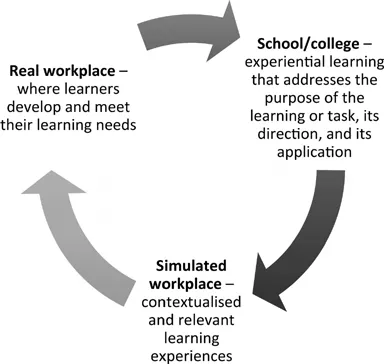
Experiential learning is therefore central to successful applied learning. It is an important part of the applied learning cycle. This cycle is a way of ensuring that learning experiences are relevant to learners and contextualised by a journey that takes them from the school/college to a simulated workplace to a real workplace and back to school/college. Figure 1.1 summarises the applied learning cycle.
Figure 1.1 The applied learning cycle
Active learning
Active learning requires the learner to learn by doing, in order to process skills or information. Active learning can include taking notes, transforming text into a graph, discussing a point with a partner or preparing a presentation. However, all of these activities could be done without thinking about the actual purpose of the learning, or how the learning might be applied to another context.
Active learning can move learners away from being ‘passive consumers’ of knowledge-based learning towards being ‘active explorers’ of knowledge, skills and ideas. However, it is important to remember that learners need to be aware of the value of their learning tasks to avoid poor motivation. ‘We have constructed ways of being together in formal education that are dull, draining of human creativity, and that fly in the face of intrinsically motivating learning’ (Collins, Harkin, & Nind, 2002, p. 167).
Applied learning
Applied learning can simply be defined as: Education put to practical use; learning is experiential, contextualised to real situations and personalised to the learners’ needs.
Effective applied learning brings relevance and meaning to learners through activities that move them from the classroom to the workplace. Activities should centre around real investigation and inquiry, based on contact with working professionals and the roles that they do, wherever possible. Learning should be active, but have a purpose and cross different contexts so that learners can apply knowledge, understanding and skills throughout their lives.
Many learning strategies, such as work-related learning, problem-based learning, creative problem solving and authentic creative challenges can be seen to have elements of, and links to, applied learning. These strategies are often embedded in either experiential or active learning, but the challenge for teachers is to facilitate an appropriate applied learning strategy (or strategies) that has authenticity for the learner and is relevant to the discipline being learned.
Professionalism in practice
Applied learning provides opportunities for learners to take control of their learning. Experiences need to be planned carefully by the teacher, so that learners can make real decisions within parameters of the applied learning activity. Solomon and Rogers, cited in Harkin (2007), conducted a small-scale study of pupil referral units and learner disaffection. They discovered that learners largely felt that learning was something that was done to them and was beyond their control. It is possible to engage learners by giving them more control. Within an applied learning context, this means giving the learner choice and responsibility.
As the teacher you need to manage learners’ control and choice. It is worth noting that although it may feel worrying at first to release control to your learners, many teachers report that learners given responsibility in lessons become highly motivated.
Why not give it a go? Identify an element of a lesson you control, such as the plenary, and give your learners the responsibility of designing it from a series of structured options using the principles of applied learning – experiential, contextualised and personalised.
Applied learning and the practice of teachers
In the remainder of this chapter we will look at some of the key aspects of teachers’ everyday practice and how this practice can relate to, support or facilitate effective applied learning.
However, it is important to remember that research shows that teachers tend to interpret new learning through previous experience, which is in turn influenced by their personal beliefs and values. The result is that sometimes new ideas that could be beneficial to teaching, learning and assessment may not get the attention deserved and are not implemented as they should be. By making you aware of this possibility, coupled with the fact that you are reading this book, it increases the chance of full engagement with applied learning as an approach for your professional practice.
Applied learning seeks to address the needs of young people in the future, and to establish a more integrated and holistic approach to teaching and learning. This change in approach requires us as teachers and educators to effectively challenge our own assumptions about educational practice. Each of the following sections challenges us to think differently about an area of practice that forms a part of an effective ...
Table of contents
Cover
Half Title
Title Page
Copyright Page
Table of Contents
List of figures and tables
Acknowledgements
Introduction
1 What is applied learning?
2 The theory and ‘pedagogy’ of applied learning
3 Applied learning in teaching
4 Applied learning, employment and employers
5 Facilitating applied learning
6 Creativity in applied learning
7 Reflective learning and self-evaluation in practice
Conclusion
Glossary
Index
Trusted by 375,005 students
Access to over 1.5 million titles for a fair monthly price.
Study more efficiently using our study tools.
Frequently asked questions
Yes, you can cancel anytime from the Subscription tab in your account settings on the Perlego website. Your subscription will stay active until the end of your current billing period. Learn how to cancel your subscription
No, books cannot be downloaded as external files, such as PDFs, for use outside of Perlego. However, you can download books within the Perlego app for offline reading on mobile or tablet. Learn how to download books offline
Perlego offers two plans: Essential and Complete
Essential is ideal for learners and professionals who enjoy exploring a wide range of subjects. Access the Essential Library with 800,000+ trusted titles and best-sellers across business, personal growth, and the humanities. Includes unlimited reading time and Standard Read Aloud voice.
Complete: Perfect for advanced learners and researchers needing full, unrestricted access. Unlock 1.5M+ books across hundreds of subjects, including academic and specialized titles. The Complete Plan also includes advanced features like Premium Read Aloud and Research Assistant.
Both plans are available with monthly, semester, or annual billing cycles.
We are an online textbook subscription service, where you can get access to an entire online library for less than the price of a single book per month. With over 1.5 million books across 990+ topics, we’ve got you covered! Learn about our mission
Look out for the read-aloud symbol on your next book to see if you can listen to it. The read-aloud tool reads text aloud for you, highlighting the text as it is being read. You can pause it, speed it up and slow it down. Learn more about Read Aloud
Yes! You can use the Perlego app on both iOS and Android devices to read anytime, anywhere — even offline. Perfect for commutes or when you’re on the go. Please note we cannot support devices running on iOS 13 and Android 7 or earlier. Learn more about using the app
Yes, you can access Understanding Applied Learning by Tanya Ovenden-Hope,Sonia Blandford in PDF and/or ePUB format, as well as other popular books in Education & Education General. We have over 1.5 million books available in our catalogue for you to explore.