- 392 pages
- English
- ePUB (mobile friendly)
- Available on iOS & Android
eBook - ePub
About this book
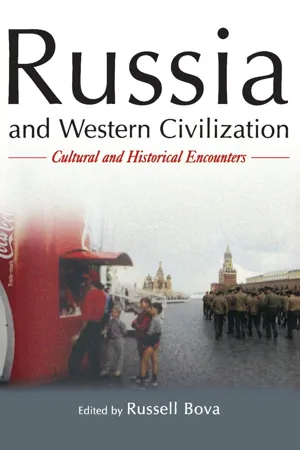
This volume introduces readers to an age-old question that has perplexed both Russians and Westerners. Is Russia the eastern flank of Europe? Or is it really the heartland of another civilization? In exploring this question, the authors present a sweeping survey of cultural, religious, political, and economic developments in Russia, especially over the nineteenth and twentieth centuries. Based on the inter-disciplinary Russian studies program at Dickinson College, this splendid collection will complement many curricula. The text features highlight boxes and selected illustrations. Each chapter ends with a glossary, study questions, and a reading list.
III
Perspectives on the Future
Convergence or Divergence?
7
Democracy and Russian Political Culture
Russell Bova
What a difference a decade makes. In 1991, there was cause for celebration for democrats around the world and in Russia in particular. In August of that year, an effort to overthrow the reformist Gorbachev regime in Russia ended in failure as tens of thousands rallied to defend recently acquired freedoms. By the end of the year, the Soviet Union had disintegrated and the Soviet communist system, arguably the greatest global threat to democracy and liberty at least since the end of World War II, was no more. Boris Yeltsin, the leader of the newly independent Russian state, was by now an implacable anticommunist who appeared to be committed to transforming Russia into a democracy and reintegrating Russia with the West. This change in Russia seemed in accord with the provocative argument of Francis Fukuyama that the world had reached “the end of history”—a point at which all the great debates about how best to organize societies politically and economically had been resolved. According to Fukuyama, democracy, in the political realm, and markets, in the economic realm, had triumphed over all challengers and were in the process of becoming the universal forms of political and economic organization.1 Nothing seemed to confirm this optimistic view more than the transformation under way in Russia.
By 2001, the prevailing mood about Russian democracy had turned distinctly pessimistic, and “end of history” euphoria had given way to real doubts about Russia’s democratic experiment. Yeltsin’s “reforms” seemed to have led less to liberal democracy and free markets than to a political system dominated by an unpredictable and autocratic president and to an economic system dominated by corrupt robber barons. Yeltsin’s successor, Vladimir Putin, was a former KGB officer who did not hesitate to employ brutal tactics in Chechnya and whose commitment to a free media and to democracy in general seemed, at best, to be questionable. Two leading scholars of Russian politics, Timothy Colton and Michael McFaul, suggested in June 2001 that a “new narrative” about Russia was “taking hold in policy, media, and academic circles,” according to which “Russia’s experiment with democracy has flat-out failed.”2 For many, this failure is rooted in a fundamental incompatibility between Western democratic institutions and a set of values and ways of thinking about the world produced by Russian history and deeply rooted in Russian political culture. According to this view, the problems in democratizing Russia in the years since the Soviet collapse are less the result of policy mistakes, bad luck, or poor leadership than they are a reflection of the fact that democracy, a product of the West, is simply a poor fit for non-Western Russia.
The record of post-communist democratization in Russia is, thus, a key indicator of Russia’s cultural relationship to the West. To the extent that Russia becomes a stable, consolidated democracy one might argue that Russia has returned to the path of Westernization, first trodden by Peter the Great but abandoned, temporarily and at great cost, during the communist era. To the extent that post-communist democratization efforts stall or are reversed, it leads credence to the view that Russia and the West remain two distinct cultural entities.
This chapter will examine the effort at democratic transformation in Russia in the post-communist era. How much progress has been made in democratizing Russia? Is Russia a democracy? And is it the case, as the pessimists argue, that democracy simply cannot take root in the soil of Russian political culture? Before turning to Russia, however, it is first necessary to address the concept of democracy itself.
What Is Democracy?
How one chooses to define the concept of democracy will have a profound effect on how one assesses Russia’s (or any other country’s) progress in becoming democratic. The term democracy comes from the Greek words demos (rule) and kratos (people), but determining exactly what the “rule of the people” should look like and how it should operate in practice leaves a lot of room for debate.3
At one end of the spectrum are democratic maximalists who subscribe to a very demanding definition of democracy as a system in which there exist very high levels not only of political equality but also of social and economic equality. The latter, it is presumed, are necessary to make the former meaningful.4 Depending on the degree of equality assumed to be necessary, it is easy to imagine such definitions of democracy leading to the conclusion that there are few actual examples of truly democratic governments. For example, the United States, with its vast disparities in wealth and income and the consequent differences in social, economic, and political power, would hardly provide the degree of equality necessary to meet the most stringent definition of democracy. At the other end of the spectrum are democratic minimalists for whom the mere existence of reasonably competitive elections is enough to qualify a system as democratic. Indeed, one scholar has recently argued that even elections may be unnecessary for democracy as long as the government is “routinely and necessarily responsive” to the needs of the governed.5 Applied generously, this definition might lead one to categorize a large majority of the world’s countries as democratic.
For most contemporary scholars of democracy, however, the consensus definition of democracy is a procedural definition that falls somewhere between the maximalist and minimalist extremes. According to this procedural definition, a democratic regime is one characterized by the following three elements:6
1. Participation—the right of adult members of the political community to participate in the political process, most importantly in the process of electing public officials;
2. Contestation—competition among individuals and parties for all effective positions of government power allowing for meaningful electoral choice; and
3. Civil Liberties—those freedoms (e.g., freedom of association, free media, freedom of expression) necessary to ensure both that citizens can participate in an informed manner and that the integrity of the democratic process is upheld.
Note that even the most democratic regimes will only imperfectly meet these three criteria, and even the least democratic might allow very limited recognition of one or more of these three elements. Thus, powerful Supreme Court justices in the democratic United States are unelected and serve life terms in a manner arguably inconsistent with the principles of participation and contestation. In contrast, local elections in undemocratic China provide for at least a limited amount of participation and competition. Thus, one might think of democracy as a continuum in which degrees of democracy might be compared from country to country and within a single country over time. That Russia might not be as democratic as Sweden, for example, is not necessarily to deny that Russia is more democratic today than it was under Brezhnev. Particularly for countries, such as Russia, in transition from authoritarian regimes, the question of the amount of progress in democratizing might be more important than the question of whether it is yet a fully developed democracy.
Democracy and the West
Historically, at least up until the 1990s, countries that have done the best in meeting the procedural definition of democracy have been either Western countries (i.e., West European countries and European-settled countries) or countries heavily influenced by Western culture via colonialism. According to Samuel Huntington, in 1973 there were only twenty-nine countries worldwide that did well enough in meeting the procedural definition of democracy to be classified as democratic. Of those countries, twenty were either West European, European-settled, or Latin American countries, and eight were former British colonies. The remaining democracy was Japan, and, though neither Western nor a former Western colony in the traditional sense, the Japanese political regime is largely the product of American post-World War II occupation of the Japanese islands.7
By 1990, according to Huntington, the number of democracies rose to fifty-eight, but still the connection between democracy and the West was largely maintained. Of the fifty-eight, thirty-seven were West European, European-settled, or Latin American countries, six were Central or East European countries, and nine were former colonies of either Britain, the United States, or Australia. Only six countries (Japan, South Korea, Turkey, Mongolia, Namibia, and Senegal) fit into none of those categories, though at least Japan and South Korea might be said to be heavily influenced by the United States since World War II.8
In the 1990s, the number of countries adopting democratic institutions continued to grow. From Asia to sub-Saharan Africa to the post-Soviet states and beyond, countries began to experiment, some for the first time, with democratic government. Since the “Western connection” in many of these countries was questionable or nonexistent, the notion that democracy could be a universal system of government transcending the borders of the West was now gaining credence.
Still, the verdict was not completely clear. Experimenting with democratic institutions such as elections and competing political parties does not necessarily guarantee that the experiment will be successful. One might plant a flower in the desert, but that does not guarantee that it will take root and thrive. Political scientists use the phrase “democratic consolidation” to describe the process by which democratic government takes root in a society. A “consolidated democracy” can be defined as one in which all of the elements of the procedural definition of democracy (participation, contestation, civil liberties) are present and in which, furthermore, there is also to be found a general consensus by all significant players that those elements should and will prevail.
To put it differently, a democracy is consolidated to the extent that both elites and the mass public accept democracy as “the only game in town.”9 It means that a regime that loses an election will peacefully give up power. It means that an opposition that loses will not resort to arms. It means that citizens expect that democratic institutions will survive economic downturns and foreign policy crises. In short, the concept of consolidation suggests that democratization involves more than just a change in political institutions. It is also a question of change in a country’s political culture.
Traditional Russian Political Culture
Political culture can be defined as the general orientation to politics found within a particular political community. It includes a set of values, attitudes, and understandings concerning how the political process both should and does work. It has to do less with people’s views on specific political issues or individual political candidates, than with broader and more fundamental beliefs about such things as the relative importance of individual vs. community rights, the priority given to freedom vs. order, or the role of the state vs. nongovernmental organizations. Of course, even within the smallest political community, differences are likely to be found with respect to these broad issues. Still, the concept of political culture assumes that, on balance, the relative distribution of attitudes and orientations toward politics across societies will vary. Thus, one might, for example, distinguish American political culture from Italian political cult...
Table of contents
- Cover Page
- Half Title page
- Title Page
- Copyright Page
- Contents
- List of Boxes
- Preface
- fm
- Introduction
- I Historical and Cultural Foundations
- II Literature and the Arts Russia and the European Tradition
- III Perspectives on the Future Convergence or Divergence?
- Glossary of Key Terms
- List of Contributors
- Index
Trusted by 375,005 students
Access to over 1.5 million titles for a fair monthly price.
Study more efficiently using our study tools.
Frequently asked questions
Yes, you can cancel anytime from the Subscription tab in your account settings on the Perlego website. Your subscription will stay active until the end of your current billing period. Learn how to cancel your subscription
No, books cannot be downloaded as external files, such as PDFs, for use outside of Perlego. However, you can download books within the Perlego app for offline reading on mobile or tablet. Learn how to download books offline
Perlego offers two plans: Essential and Complete
- Essential is ideal for learners and professionals who enjoy exploring a wide range of subjects. Access the Essential Library with 800,000+ trusted titles and best-sellers across business, personal growth, and the humanities. Includes unlimited reading time and Standard Read Aloud voice.
- Complete: Perfect for advanced learners and researchers needing full, unrestricted access. Unlock 1.5M+ books across hundreds of subjects, including academic and specialized titles. The Complete Plan also includes advanced features like Premium Read Aloud and Research Assistant.
We are an online textbook subscription service, where you can get access to an entire online library for less than the price of a single book per month. With over 1.5 million books across 990+ topics, we’ve got you covered! Learn about our mission
Look out for the read-aloud symbol on your next book to see if you can listen to it. The read-aloud tool reads text aloud for you, highlighting the text as it is being read. You can pause it, speed it up and slow it down. Learn more about Read Aloud
Yes! You can use the Perlego app on both iOS and Android devices to read anytime, anywhere — even offline. Perfect for commutes or when you’re on the go.
Please note we cannot support devices running on iOS 13 and Android 7 or earlier. Learn more about using the app
Please note we cannot support devices running on iOS 13 and Android 7 or earlier. Learn more about using the app
Yes, you can access Russia and Western Civilization by Russell Bova in PDF and/or ePUB format, as well as other popular books in History & Art General. We have over 1.5 million books available in our catalogue for you to explore.