Within and among nations, rising levels of social inequality threaten our collective future. Currently, upwards of 80% of people's life chances are determined by factors over which they have absolutely no control. Social inequality threatens the democratic project because it destroys the trust on which governments depend, and it gives rise to corrupt political and economic institutions. How can we get out of the traps we have created for ourselves? We need to reboot capitalism. Drawing on diverse examples from a range of countries, McNall explains the social, economic, and ecological traps we have set for ourselves and develops a set of rules of resilience that are necessary conditions for the creation and maintenance of democratic societies, and a set of rules essential for creating a sustainable future.
eBook - ePub
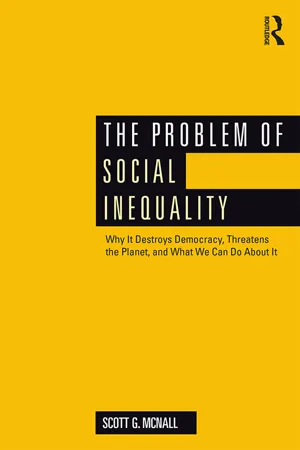
The Problem of Social Inequality
Why It Destroys Democracy, Threatens the Planet, and What We Can Do About It
- 292 pages
- English
- ePUB (mobile friendly)
- Available on iOS & Android
eBook - ePub
The Problem of Social Inequality
Why It Destroys Democracy, Threatens the Planet, and What We Can Do About It
About this book
Information
1
THE NATURE OF SOCIAL INEQUALITY
Consider:
• Out of a world population of 7 billion, 3 billion people live on less than $2.50 a day.1
• Thirty million people live in slavery due to forced marriage, sex trafficking, debt bondage, and the exploitation of children, including child soldiers.2
• One billion of the world’s children live in poverty.3
• Twenty-five thousand people die from hunger each day.4
• The world’s wealthy 10% accounted for 60% of all world consumption in 2014.5
• The world’s poorest 20% accounted for just 1.5%.6
• The richest 1% own 50% of all the world’s wealth.7
• The poorest 50% of the world’s population hold just 1% of the world’s wealth.
The consequences of growing inequality are considerable, for they affect social cohesion, levels of trust, the ability of countries to maintain or move toward a democratic form of government, and the ability of a country or people to adapt to new and changed circumstances. This leads directly to the question: What would a fair and just society be like? The American philosopher, John Rawls (1921–2002), sought to answer this question in his book, A Theory of Justice.8 He argued that a just society was a fair society, which is not the same thing as an equal society. Rawls asks us to imagine a society into which we will be born and to decide what the rules of the game will be. We get to make up our own imaginary society but we must operate under a “veil of ignorance,” which means we have no idea whatsoever what our own attributes will be. We don’t know if we will be born male or female, black or white, rich or poor, Muslim or Christian, or any number of other things. The only thing we know about ourselves is that we have the capacity to participate in an enduring system of cooperation and we know we will be a member of the society we choose to create. Rawls assumes humans are rational, and therefore we would design a society that would secure for us maximum advantage at birth.
What would a fair and just society look like?
We would not design a society that would privilege someone on the basis of their race or gender because that would be irrational. Would a just society be one in which inherited wealth was passed from one generation to the next according to religious status? Would we design a system in which people were denied food and shelter based on their gender? Probably not. This would not mean, however, that all differences would disappear, because each of us would be born with different characteristics and abilities. As the cognitive scientist Steven Pinker noted in commenting on Rawls, we are not born as blank slates. Some of us might be dealt a lousy genetic hand so we would want to guard against that possibility by designing a social system that provided protection in the form of a social safety net. Even if we assumed that genetics explained 100% of the differences between people, we could still get a just and fair society if it were designed along the lines Rawls suggested.9 We would have to design a system that met universal human needs, regardless of our genetic endowments, and correct injustices when they are found. We would want to create a democratic society.
Democratic Societies
A democratic society does not need to be an equal society, but it needs to be a fair society. By “fair,” I mean that it provides an opportunity for all of its citizens to meet their needs, regardless of their ethnicity, gender, religion, and regardless of their opinions, the amount of property they own, or whether they were born to rich or poor parents. As the Universal Declaration of Human Rights, adopted by the United Nations in 1948, spells out, “recognition of the inherent dignity and of the equal and inalienable rights of all members of the human family is the foundation of freedom, justice, and peace in the world.”10
The nations of the world fall along a continuum in terms of whether their citizens are treated equally before the law and whether they are provided equality of opportunity, freedom of speech, freedom of assembly, and the right to individual liberty. Some nations do a much better job than others in terms of these goals. At one end of the spectrum, the “worst of the worst,” we find countries like North Korea, Uzbekistan, South Sudan, and despotic African regimes. And at the other end we find countries like Denmark, Norway, Sweden, and New Zealand. However, no country is a perfect democracy. Let’s look at what a lack of civil liberties can mean.
In 2012, a 14-year-old girl in Pakistan was shot in the head for being an advocate for the right of girls to an education. In Cambodia, a 70-year-old protesting the government’s policy of seizing land for powerful corporate interests was sent to jail for twenty years. In Honduras a human-rights lawyer was killed because he opposed the development of special economic zones that would have benefited multinational corporations. It is best to understand democracy not as a final stage but as a continued effort to achieve and protect political and civil rights, to meet universal human needs, and to press continually for the development of open, rather than closed, political and economic systems.
Democracy involves far more than the being able to vote. Democracy can be fragile.11 Freedom House, which tracks the progress of the nations of the world in granting their citizens full civil and political rights, reported in 2015 that for the ninth year in a row there were democratic reversals in the world.12 While 33 countries showed gains, 61 showed reversals. Among the causes of these reversals were Russia’s invasion of Ukraine; a rollback of democratic gains in Egypt by the president and former Army General, Abdel Fattah al-Sisi; the campaign of the Turkish president, Recep Tayyip Erdoğan, against freedom of the press; and China’s continued centralization of power and authority. At the end of the day, democratic societies are ones that consistently work to assure the civil and political rights of all their citizens and to meet their needs.
Human Needs
Karl Marx once posited that we humans are creatures of need, and our needs are infinitely expandable.13 We have both physical and emotional needs which, as we struggle to meet them, will be transformed over the course of our own life history as well as our collective human history. Marx hoped that at later stages of social development our higher needs, for instance, our need for time for creative and intellectual activities, would supersede our need to struggle simply for survival. Billions of people around the world are, however, still struggling to meet what we think of as basic human needs.
There is considerable debate that has extended over decades about whether or not all human beings in all places and all times have the same needs. I believe that what it means to be human in a society is universal although, again, how a specific need is met will vary. We all need sustenance to survive, but whether I eat pork depends on my culture and values. The approach I will sketch out differs from that of someone like Abraham Maslow, who outlined a hierarchy of needs. In Maslow’s scheme our needs begin with the most fundamental. These needs are at the physiological stage and include such things as breathing, food, water, and sex. The highest need in Maslow’s hierarchy is self-actualization, which is realized through creative and spontaneous acts.14 A hierarchy of needs clearly suggests some needs are more important than others. And while it seems to make intuitive sense to argue that it is more important to eat, breathe, and procreate than to engage in creative problem-solving activities, the reality is that human beings need to do all of these things and more. There isn’t a simple hierarchy of human needs; rather, there is a panoply of needs, all of which interact with one another, and all of which must to be met in order to be human in one’s own society.
There isn’t a simple hierarchy of needs; rather there is a panoply of needs, all of which interact with one another and all of which must be met in order to be human in one’s own society.
This perspective differs from that found in the work of those who focus on developing countries and who ask: What, at the most fundamental level, is essential for people to survive? This approach, sometimes referred to as the basic needs approach, focuses on the concept of absolute poverty, which is a set standard in all societies and does not change over time.15 The idea of basic needs grew out of a 1976 conference of the International Labor Organization and has shaped the development policies of agencies such as the United Nations.16 Under this framework resources are provided to a country in order to meet basic physical needs, as opposed to providing resources to develop human potential or transform the economic and social structures of a country. The Urban Institute estimates that just to cover basic, subsistence household expenses (rent or mortgage, utilities, food, and so forth), a family of four in the United States needs an income of $42,000 a year.17 While meeting basic needs of subsistence is of critical importance, it alone will not allow people to develop the potential to transform their lives and that of their society or to be a full participant human in their own society or to live a decent life.
Another important and useful concept for any discussion of inequality is relative poverty. Relative poverty recognizes that what it takes to meet basic needs will vary from society to society and can change over time. The British sociologist Peter Townsend (1928–2009) provided a good definition of relative poverty that has been used by many.
Individuals, families, and groups in the population can be said to be in poverty when they lack the resources to obtain the diet, participate in the activities, and have the living conditions and the amenities [that] are customary, or at least widely encouraged or approved in societies to which they belong. Their resources are so seriously below those commanded by the average family that they are in effect excluded from the ordinary living patterns, customs, and activities.18
Many of the men and women who engage in low-wage work in cities such as New York, London, Hong Kong, or San Francisco, where housing costs are extremely high, experience relative poverty. They can meet their subsistence needs but find it difficult to be active in the cultural and political life of the cities they where they live.
The concept of relative poverty is important when considering whether poor Americans are really poor. If we look at the bottom 20% of the U.S. population in terms of income, 69% have a washer, 45.5% have a dishwasher, and 53.3% have a computer.19 The bottom 20% also own televisions, refrigerators, cell phones, and microwaves.20 However, they also have problems with paying their rent or mortgage as well as their utility bills and do not see a doctor or dentist when needed. Having a lot of low-priced things, then, is not an adequate measure of whether or not one can be fully active in society. It is irrelevant that somebody living in the slums of Mumbai doesn’t have it as good as somebody living in Louisiana. What is relevant is whether or not a poor person in Louisiana can meet what are universal needs. We clearly need a richer understanding of universal human needs and how they are met in any society.
There are nine needs of equal importance: subsistence, protection, affection, understanding, participation, leisure, creation, identity, and freedom. All must be met for a decent life.
Without reprising all of the debates about exactly how many human needs there are, I want to draw on two primary bodies of work to expand upon the position that there are basic, universal human needs that must be met. There is a moral argument embedded here...
Table of contents
- Cover
- Half Title
- Title Page
- Copyright Page
- TABLE OF CONTENTS
- LIST OF ILLUSTRATIONS
- PREFACE AND INTRODUCTION
- ACKNOWLEDGMENTS
- 1 THE NATURE OF SOCIAL INEQUALITY
- 2 A WORLD DIVIDED BY INCOME AND WEALTH
- 3 CAPITALISM AND INEQUALITY
- 4 THE CONTINUING CRISES OF CAPITALISM
- 5 TRUST, INEQUALITY, AND DEMOCRACY
- 6 CORRUPTION AND SOCIAL INEQUALITY
- 7 NARRATIVES OF POWER: HOW THEY DRIVE INEQUALITY
- 8 REBOOTING CAPITALISM TO CREATE A RESILIENT FUTURE
- INDEX
Trusted by 375,005 students
Access to over 1.5 million titles for a fair monthly price.
Study more efficiently using our study tools.
Frequently asked questions
Yes, you can cancel anytime from the Subscription tab in your account settings on the Perlego website. Your subscription will stay active until the end of your current billing period. Learn how to cancel your subscription
No, books cannot be downloaded as external files, such as PDFs, for use outside of Perlego. However, you can download books within the Perlego app for offline reading on mobile or tablet. Learn how to download books offline
Perlego offers two plans: Essential and Complete
- Essential is ideal for learners and professionals who enjoy exploring a wide range of subjects. Access the Essential Library with 800,000+ trusted titles and best-sellers across business, personal growth, and the humanities. Includes unlimited reading time and Standard Read Aloud voice.
- Complete: Perfect for advanced learners and researchers needing full, unrestricted access. Unlock 1.5M+ books across hundreds of subjects, including academic and specialized titles. The Complete Plan also includes advanced features like Premium Read Aloud and Research Assistant.
We are an online textbook subscription service, where you can get access to an entire online library for less than the price of a single book per month. With over 1.5 million books across 990+ topics, we’ve got you covered! Learn about our mission
Look out for the read-aloud symbol on your next book to see if you can listen to it. The read-aloud tool reads text aloud for you, highlighting the text as it is being read. You can pause it, speed it up and slow it down. Learn more about Read Aloud
Yes! You can use the Perlego app on both iOS and Android devices to read anytime, anywhere — even offline. Perfect for commutes or when you’re on the go.
Please note we cannot support devices running on iOS 13 and Android 7 or earlier. Learn more about using the app
Please note we cannot support devices running on iOS 13 and Android 7 or earlier. Learn more about using the app
Yes, you can access The Problem of Social Inequality by Scott G. McNall in PDF and/or ePUB format, as well as other popular books in Social Sciences & Political Economy. We have over 1.5 million books available in our catalogue for you to explore.