In recent decades, some of the most celebrated and culturally influential American oratorical performances have come not from political leaders or religious visionaries, but from stand-up comics. Even though comedy and satire have been addressed by rhetorical scholarship in recent decades, little attention has been paid to stand-up. This collection is an attempt to further cultivate the growing conversation about stand-up comedy from the perspective of the rhetorical tradition. It brings together literatures from rhetorical, cultural, and humor studies to provide a unique exploration of stand-up comedy that both argues on behalf of the form's capacity for social change and attempts to draw attention to a series of otherwise unrecognized rhetors who have made significant contributions to public culture through comedy.
eBook - ePub
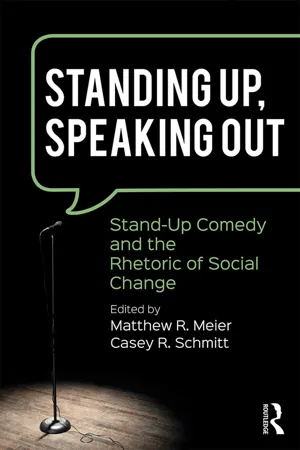
Standing Up, Speaking Out
Stand-Up Comedy and the Rhetoric of Social Change
- 252 pages
- English
- ePUB (mobile friendly)
- Available on iOS & Android
eBook - ePub
Standing Up, Speaking Out
Stand-Up Comedy and the Rhetoric of Social Change
About this book
Information
Part I
Stand-Up and Identity
People come up to me and say, “God, Roseanne, you’re not very feminine.” They say that, can you believe that they would say that to me? Can you even believe that? “You’re not very feminine.” So I say, “Well, suck my dick!”
(Roseanne Barr)
1
“You Gotta Get Chinky with It!”
Margaret Cho’s Rhetorical Use of Humor to Communicate Cultural Identity
When comedian Margaret Cho introduced herself to the American public in the early 1990s, it was the first time most, if not all, Americans had seen a popular Asian American – specifically Korean American – comedian (Rotella 2001). Though outspoken women comedians such as Roseanne Barr, Joan Rivers, and Brett Butler had already entered the typically male-dominated world of stand-up comedy before Cho, not yet had an Asian American man or woman offered a humorous voice to audiences on such a large scale. Unwilling to shy away from a predominantly white male profession, over the past 20 years, Cho has forged an unlikely path within the world of stand-up comedy, commonly discussing specific aspects of her Korean heritage. Whether it is because of or in spite of her minority status, Cho has developed a substantial and loyal following since her first appearances on the stand-up comedy stage and television shows, and was recently named the “Number One Asian American Comedian of All Time” (Fung 2010). She has become best known for her social commentaries about gender, sexuality, and, perhaps most notable, race. Additionally, to discuss such heavy issues, Cho routinely uses aggressive, confident, and unapologetic humor while voicing her opinions (Holden 2000). Though she has parlayed her talents into successful television, movie, and music careers, she began (and continues to be most known for) her work as a stand-up comedian.
In 1994, Cho’s stand-up comedy routine was transformed into the sitcom, All American Girl, the first show in America to feature an Asian American family in primetime (Marin & Lee 1994). At that point, Asians had been underrepresented and misrepresented in the media and the production of this show seemed to signal a turning point for society’s perceptions of minorities, particularly Asian Americans (Park, Gabbadon, & Chernin 2006). However, the show was cancelled after only 13 episodes, in part because critics accused Cho of not being “Asian enough” (Boone 2002; Strauss 2008). It was clear that Cho’s race played a significant role in who she was as a comedian whether she wanted that aspect of her identity to take center stage or not. As her career developed, Cho, never one to flee from conflict, directly addressed her race, as well as the subsequent discriminatory encounters that have developed because of it (Fowler 2000; Holden 2000; Kelly 2000). The fact that Cho has been so humorous while addressing serious racial issues has elicited some backlash from the Asian American community (Fung 2010). In fact, some of her most predominant critics come from within the Korean and Korean American communities. While some may view her comedy as racially stereotypical, others laud Cho for her willingness to discuss topics otherwise avoided by the general population (Esther 1999; Holden 2000). To many, Cho is the voice of various minority groups due to her bravery and honest humor.
In an effort to better understand the importance of Margaret Cho’s moniker as the first notable Korean American comedian, we argue that humor offers a rhetorically significant method for performing cultural identity membership. In order to do this, we examine Cho’s stand-up comedy, specifically the ways in which she discusses her racial identity and cultural background. We offer an analysis of Cho’s stand-up comedy followed by conclusions and implications that arise based on her use of humor to create a culturally-based identity.
Margaret Cho’s Stand-Up Comedy
Margaret Cho is not afraid to directly address social issues that affect not only her, but the world at large. While her stand-up comedy has certainly provided a voice for women as well as for the gay, lesbian, and bisexual communities, Cho’s use of racial humor provides a unique Korean American perspective through stand-up comedy (Holden 2000). Before Cho reached her current level of fame, she focused much of her performances on her Korean heritage, particularly her traditional Asian family. Through several short televised stand-up comedy performances in the early 1990s, Cho developed and perfected her most well-known character: an impression of her traditional, conservative Korean mother. With this impression as her vehicle, Cho routinely addressed Asian stereotypes, social and racial discrimination, and even the fact that few Asian American role models were available in the media (Esther 1999). Cho was a pioneer among stand-up comedians considering the fact that she was the first to offer a widely seen humorous voice for the Korean American minority population (Esther 1999; Kelly 2000).
With the release of her 2000 one-woman comedy special, I’m the One That I Want, Cho performed her first full-length stand-up comedy special solely devoted to her thoughts, opinions, and jokes (Boone 2002). Though various aspects of her life and personal identity are represented during the 96-minute performance, Cho pays close attention to her family, the discrimination she has experienced, and her personal struggles with her cultural identity (Esther 1999). Additionally, in light of the failure of Cho’s sitcom All-American Girl, much of the content of this performance addresses the struggles and discrimination she faced during the show’s production (Lee 2004). Cho utilizes various styles of humor from imitation to irony as a means of offering a completely unique perspective. Bolstering the popularity of her impression of her mother, much of the humor in I’m the One That I Want centers around the traditional perspectives of Cho’s mother and the ways in which they routinely juxtapose with Cho’s liberal behaviors and opinions. Further, Cho directly discusses more serious issues such as racism, cultural ignorance, and Asian stereotypes, all topics that Cho had discussed in her previous work, but never to this extent. Perhaps because of her willingness to be blatantly honest, combined with her unique sense of humor, Cho was awarded New York Magazine’s Performance of Year award for her performance in I’m the One That I Want (Kelly 2000). The social effects of this performance continue to impact the entertainment world and the public’s perception of Asian American identity. Therefore, jokes from I’m the One That I Want, along with several jokes from various comedy specials filmed in 1992, early in Cho’s career, provide the basis of this examination. Each of these jokes directly and humorously addresses aspects of Cho’s cultural background, perspectives, or struggles, and they provide an adequate representation of Cho’s body of humorous performances. While Cho has written and performed multiple stand-up comedy and television specials since the production of these particular performances, it is through her earlier stand-up comedy performance that she allows audiences into her life and Korean American identity in the most significant way.
Rhetorical Forces in Cho’s Stand-Up Comedy Performances
Within Cho’s distinctive humor – and, specifically, its focus on her Korean American background – three theoretical lenses emerge that offer a better understanding of humor as a tool for communicating culture. First, Cho highlights the problematic aspects of bicultural otherness. Individuals who identify with two distinct sets of cultural norms, practices, and values are categorized as bicultural (Mok, Cheng, & Morris 2010; LaFromboise, Coleman, & Gerton 1993). For instance, Asian Americans often identify and implement Asian cultural tradition while simultaneously incorporating Americanized values or behaviors in their identities. Attempting to combine aspects of both cultural affiliations can be problematic for the individual or the people around them (Mok & Morris 2010). Often, bicultural individuals suffer from cultural “othering” based on aspects of their identity that do not align with the majority group (Gianettoni & Roux 2010). When expectations stemming from one aspect of an individual’s bicultural identity are challenged, it can create social dissonance and lead to cultural othering (Gianettoni & Roux 2010; Iwamoto & Liu 2010). This social separation delineates clear out-groups based solely on cultural group membership, and the formulation of these boundaries highlights the unique set of social issues that arise for bicultural individuals (Brewer 1999; Lwin, Stanaland, & Williams 2010; Mok & Morris 2010).
Second, in light of the impressions she constructs of Asian woman in general, and her mother in particular, Cho appears to ironically essentialize Asian identity. Essentialism is the mental tendency to apply a “fixed, underlying nature to members of a category, which is understood to determine their identity,” and “render them fundamentally alike” (Haslam et al. 2006, p. 64). In other words, essentialist attitudes allow entire cultural groups to be reduced to a finite set of behaviors, characteristics, or attributes. Essentialized groups tend to be perceived as social outsiders, and, thus, are more likely to be discriminated against or ostracized (Bernstein et al. 2010). When essentialized ironically, however, the portrayal of specific social groups is not meant to be taken literally (Booth 1974). Irony allows a speaker to develop dual narratives: one within the literal words and one within the underlying meaning of the message (Partington 2007). Cho seems to implement a postmodern, rhetorical version of irony in that her messages are “multiple, complex, and inconsistent” (Shugart 1999, p. 436) and require a specific level of understanding from her audience (Booth 1974). By ironically essentializing a cultural group, a comedian is able to subversively highlight the absurdity embedded within this extreme form of cultural categorization (Shugart 1999) while simultaneously appearing to adhere to it.
Finally, through stereotypical self-deprecating humor, Cho not only implicates herself, but also her entire cultural group. In most jokes, there is an object and a subject, and self-deprecation places the joker in the role of the object. An individual who uses self-deprecating humor is ostensibly able to remain aligned with social hierarchies while placing themselves as the object of the joke (Gilbert 2004). Because this type of humor puts listeners at ease due to its lack of aggression, it often creates a sense of community among the joker and the audience (Meyer 2000). Additionally, self-deprecating humor routinely makes use of social or cultural stereotypes, which can serve to further separate the cultural out-group from the majority (Lin et al. 2005). In particular, Asian Americans are commonly stereotyped as being socially awkward based on American social standards, and humor that reinforces this perception justifies prejudicial attitudes from the racial majority and cultural discrimination toward this minority group (Lin et al. 2005).
Therefore, in light of these theoretical perspectives, we examine Margaret Cho’s stand-up comedy with a specific focus on bicultural otherness of Asian Americans, ironic essentialism of the Asian culture, and stereotypical self-deprecating humor as a means of cultural separation. Through these specific units of analysis, we argue that Cho implements humor as a method of creating and communicating cultural identity to a large audience.
The stand-up comedy performances of Margaret Cho offer much more than just laughs. Her humorous implementation of bicultural “otherness,” ironic essentialism, and self-deprecating humor highlight the rhetorical implications within her humor with regard to cultural identity development. Through an examination of Cho’s culture-based jokes within her early stand-up comedy performances as well as from I’m the One That I Want, it is clear that the use of humor as a means of communicating cultural identity is rhetorically significant.
Bicultural “Otherness”
Bicultural individuals face a unique set of benefits and drawbacks when developing and maintaining their cultural identity (Mok & Morris 2010). Because they are able to draw upon two distinct sets of cultural values, norms, and practices, bicultural individuals can experience pressure from one or both sides of their heritage to fully adopt only one aspect of their identity, which can lead to uncertainty (Gong 2007; Mok, Cheng, & Morris 2010). It can be increasingly difficult for a bicultural individual to negotiate his or her personal identity as cultural boundaries become unclear or confusing at times (Palmer 2006). According to biculturalism theory, achieving a high level of bicultural competence requires an individual to “live effectively” among two cultural groups without displaying preference to one particular group (LaFromboise, Coleman, & Gerton 1993, p. 404). Because achieving a balanced identity is difficult among two separate cultural backgrounds, bicultural individuals are often perceived as rebellious against social norms if they choose to implement aspects from both of their cultural identities (Mok, Cheng, & Morris 2010). People who identify with two or more cultural backgrounds are often “othered,” or forced into a position of an outsider by members of one aspect of their cultural background, because they are unable or unwilling to conform to only one set of cultural practices (Gianettoni & Roux 2010). Therefore, individuals who assume a bicultural identity often deal with the negative effects of cultural “othering” from members of one or both of their cultural backgrounds.
Cho discusses her bicultural identity numerous times throughout her stand-up comedy special I’m the One That I Want, paying particular attention to the ways in which she was the victim of cultural “othering.” During the filming of her 1994 sitcom All-American Girl, Cho was criticized for not portraying enough “Asian-ness”:
This really scared the network. “She’s not Asian enough. She’s not Asian enough. She’s not testing Asian.” So, for my benefit, they hired an Asian consultant. Oh yes, because I was fucking it up so bad, they had to hire someone to help me be more Asian. She would follow me around, “Margaret, use chopsticks. Use chopsticks, and when you’re done eating, you can put them in your hair. So, you’re wearing shoes, which is something we don’t do in the house. We don’t wear shoes in the house. Now, I’m going to leave this abacus right here.”
(Coleman 2000)
Despite the fact that Cho was raised by Korean parents, and the sitcom was based on her stand-up comedy routine, it was clear that the American television studio had a clear idea of what it meant to be “Asian.” Culturally appropriate behaviors are a significant factor within the development of a bicultural identity (LaFromboise, Coleman, & Gerton 1993; Wei et al. 2010). When an individual does not adhere to socially accepted culture standards that are based on mainstream expectations, “othering” can be a result. Regardless of Cho’s status as an American citizen, she was forced to comply with clear cultural stereotypes and expectations (Brewer 1999; Gianettoni & Roux 2010). Though stereotypical behaviors may not always be negative, applying them to a member of a particular cultural group emphasizes an individual’s status as the social “other” (Maddux et al. 2008).
Also, Asian Americans often display a distinct physical difference compared to the dominant cultural group in America, and due to this clear physical difference, they are the victims of othering more often than many other cultural groups (No et al. 2008; Tafarodi, Kang, & Milne 2002). To illuminate a practical application of othering based on physical appearance, in one of her early stand-up comedy performances, Cho describes an experience she had during a promotional tour for All-American Girl. Though she was born in the United States and English was her first language, she highl...
Table of contents
- Cover
- Title
- Copyright
- Contents
- Contributors
- Preface
- Foreword: Stand-Up Comedy, Social Change, and (American) Culture
- Introduction: Standing Up, Speaking Out
- Part I Stand-Up and Identity
- Part II Stand-Up, Race, and Culture
- Part III Stand-Up and Politics
- Part IV Standing Up, Breaking Rules
- Index
Trusted by 375,005 students
Access to over 1.5 million titles for a fair monthly price.
Study more efficiently using our study tools.
Frequently asked questions
Yes, you can cancel anytime from the Subscription tab in your account settings on the Perlego website. Your subscription will stay active until the end of your current billing period. Learn how to cancel your subscription
No, books cannot be downloaded as external files, such as PDFs, for use outside of Perlego. However, you can download books within the Perlego app for offline reading on mobile or tablet. Learn how to download books offline
Perlego offers two plans: Essential and Complete
- Essential is ideal for learners and professionals who enjoy exploring a wide range of subjects. Access the Essential Library with 800,000+ trusted titles and best-sellers across business, personal growth, and the humanities. Includes unlimited reading time and Standard Read Aloud voice.
- Complete: Perfect for advanced learners and researchers needing full, unrestricted access. Unlock 1.5M+ books across hundreds of subjects, including academic and specialized titles. The Complete Plan also includes advanced features like Premium Read Aloud and Research Assistant.
We are an online textbook subscription service, where you can get access to an entire online library for less than the price of a single book per month. With over 1.5 million books across 990+ topics, we’ve got you covered! Learn about our mission
Look out for the read-aloud symbol on your next book to see if you can listen to it. The read-aloud tool reads text aloud for you, highlighting the text as it is being read. You can pause it, speed it up and slow it down. Learn more about Read Aloud
Yes! You can use the Perlego app on both iOS and Android devices to read anytime, anywhere — even offline. Perfect for commutes or when you’re on the go.
Please note we cannot support devices running on iOS 13 and Android 7 or earlier. Learn more about using the app
Please note we cannot support devices running on iOS 13 and Android 7 or earlier. Learn more about using the app
Yes, you can access Standing Up, Speaking Out by Matthew R. Meier, Casey R. Schmitt, Matthew R. Meier,Casey R. Schmitt in PDF and/or ePUB format, as well as other popular books in Languages & Linguistics & Communication Studies. We have over 1.5 million books available in our catalogue for you to explore.