eBook - ePub
War in Heaven/Heaven on Earth
Theories of the Apocalyptic
- 320 pages
- English
- ePUB (mobile friendly)
- Available on iOS & Android
eBook - ePub
About this book
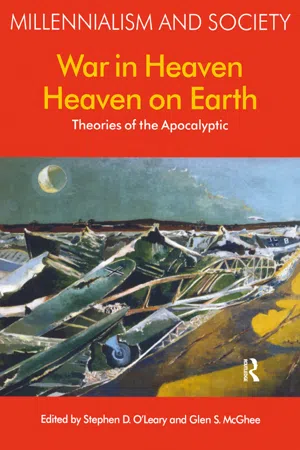
The apocalypse is a motif that lies behind many religious beliefs and practices. 'War in Heaven/Heaven on Earth' theorizes the apocalyptic as it has arisen in a variety of religious traditions, from Native American religion to Islam in Northern Nigeria and new terrorist movements. Millennial theory and history are explored from the perspective of social psychology, sociology and post-modern philosophy. The volume is unique in applying an analysis of millennial themes to a comparative study of religion.
Information
Part I
Core Ideas of Millennial Theory
Charters of Righteousness:
Politics, Prophets and the Drama of Conversion*
Politics
The apocalyptic drama begins when someone says the world is about to be changed in every respect, down to its very physical form. Commonly he or she foretells that nearly everyone will die, or at least suffer, in the process. But there is hope for a tiny number of very special people. They will survive the changes, and afterwards they will be (at least) demigods, who will live forever. Generally speaking, at the end the earth will return to its original condition: paradise.
This kind of prophecy involves a familiar form of belief about the end of human life as we know it. Many religious systems have their own versions of this account, and they all involve destruction of the way things are, a sort of cosmic recycling. Life starts over on a cleansed planet, all things made new and perfect.
Eschatology is generally understood to refer to ideas about last things. Catherine Keller gives a somewhat more nuanced translation of this root word, saying it is best rendered as ‘edge’, which suggests an important difference.1 Prophets and commentators refer to apocalypse as The End, but its focus ultimately is always on a new beginning, a sudden shift in the order of the world. There’s always something beyond the edge for the millenarian believer.
Prophets threaten us with falling stars, titanic earthquakes, famine, pestilence, and wars. One thing accomplished by the mention of Earth Changes, as the New Age calls them, is to manifest the scope and seriousness of the change that is envisioned. Even the fabric of creation becomes a moral player in this titanic and final battle between the forces of good and evil, no matter how they are conceived. In fact it is the order of the world, not the world itself, that will end. This glorious victory will herald the dawn of the millennium, which in Christian theology refers to Christ’s final thousand-year reign of perfect peace and justice: a restoration of Paradise.
Perhaps the most generally accepted definition of millennialism is Norman Cohn’s. He calls it a type of salvationism: it must be collective, terrestrial, imminent (i.e., to be expected soon and suddenly), total (embodying perfection, not mere improvement), and brought on by a recognized supernatural agency.2 There is room to argue with some of these points; many apocalyptic movements invoke no supernatural agency, for example, relying instead on conceptions of natural law to legitimize their predictions of change. However, a key point in Cohn’s definition, one with which no one I’m aware of has found fault, is that the salvation millennialism invokes is terrestrial. It will happen here, it will involve this world.
Millennialism is not, or not only, a matter of finding an individual heavenly home. It promises rescue from evil, perhaps for everyone, but typically for a small community of believers.
This salvation will happen in time, that is, in this world, not in a hereafter. However, in religious doctrines of apocalypse, it is placed at time’s end: the present is always just on the cusp of dissolution into eternity.
All societies have an account of creation, attributed to some superhuman, if not supernatural, force. These accounts of how we came to be all serve to provide a charter for society, a set of basic assumptions, which, in the ordinary course of events, go unquestioned.3 These cosmologies nearly all propose that the earth was, at its beginning, perfect. Beginnings are sacred, and at that time the world was paradise. Who would worship a God who couldn’t make a perfect world?
Yet in every paradise there is a fall. In the myths some event introduces change into paradise and turns it into the world. What brings on this change can be almost anything: sin, a mistake, or mere chance. Ever since whatever-it-was happened, the world has been bad, and life has been hard and painful: close to hell, if not actually hell itself.
Apocalypse promises to redress this turn of events. After evil’s destruction, there will be a perfected world. We, or at least the saints, will live out a blissful existence in Eden.
Since paradise is perfect it is incapable of change. Change in perfection can only transform it into something else and something less. The situation of a dweller in paradise confronting change is like that of someone standing at the North Pole: every direction is south and downhill. Perfection can only degrade, and any change in paradise is subversive. Paradise is outside time, but it’s never more than a moment long. It always fails, and when it does, it changes to its opposite: hell. In myths of perfection there is no middle ground, no compromise. Paradise, like everything else in the millennium, reflects a precarious shifting polarity.
Secular and political millenarianism are just beginning to attract the kind of analytic attention that has for years been paid to their religious counterparts, in part because the conclusion that millenarianism is inherently political is becoming inescapable. This can be said of religion in general: to the extent that it attempts to govern access to power, and to prescribe its exercise, religion is political.
Martha F. Lee makes much this point in her Earth First!: Environmental Apocalypse, where she observes, following Clifford Geertz and others, that political ideology and religious dogma share most attributes in common, other than their purported origins.4 Both consist of ‘basic assumptions’ about humanity and its place in the world. The two arenas often remain rigidly separated, especially in their own self-presentations, and frequently come into conflict, but at the analytical level the similarities are striking. Religion and politics are competing gladiators in the arena of opinion, where they also must compete with science. Neither of the latter two makes much reference to spiritual matters and they ordinarily reject any attempt to find it in their texts, but nevertheless all three attempt to provide and govern a social world-view. Lee observes that it is difficult in this environment to classify any given movement with millenarian ideas as either political or religious. I suggest that the attempt be abandoned, in recognition that the two are not ultimately distinct.
Philip Lamy observes that strictly secular millenarian ideas propose a human apocalypse.5 That is, they rely on purely human agency both as promoters of evil and as ultimate saviors: self-salvation is the best we can hope for in most of the movements he discusses, though there are others where salvation will be collective. Lamy notes that many such secular millenarian movements are closely allied with, if not actually part of, nationalist movements, though the latter have ‘purely political’ goals in mind.6 It is not clear what distinction he intends to draw here, since it appears that all apocalypses propose political aims: it is the order of this world that is to be redeemed, and that is a political action, regardless of the nature of the agency that will bring it about. This observation—that millennialism has political aims—is not new. It appears in any number of analytical writings on millennialism and apocalypse, but few if any observers have reached the conclusion that seems to me inescapable: that millennialism is inherently political because it arises from the perception of political evil—the abuse of power—and seeks to remedy it.7
The failure to observe the inherently political nature of millenarianism may arise from an unspoken assumption that politics necessarily involves direct involvement in political activity: everything from getting out the vote to staging coups to mailing bombs. Millenarian movements frequently (but by no means invariably) withdraw from the world in an effort to protect their purity from contamination by the world’s corruption. They oppose and frequently renounce the world’s order, actions which are in fact political. Rejection of politics is political. As with the hermit who rejects society in his isolation, the action of withdrawal condemns that which will not change. Stephen O’Leary’s point that millennialism is rhetorical furthers this argument.8 Apocalypse is an argument about power, and it is not always addressed to its adherents. It may make a proclamation across an ideological divide.
Prophets and Conversion
Almost anywhere you look prophetic careers follow the same trajectory. Prophets begin their lives as sinners, outsiders, disregarded and insignificant people. Then something happens. They undergo some crisis that changes their lives in fundamental and drastic ways. They experience conversion, in a sudden and sometimes shocking way. This conversion is seen, by them and at least some others, as a total and perhaps inexplicable change in their character. Where once the prophet was feckless, perhaps rootless, but in any case a nonentity, now he (they are frequently women) has absolute confidence in himself and the mission he thinks comes directly from god.9
The source of this enormous faith in oneself and one’s mission may derive from the conversion experience itself, but in many cases it is seen to follow on the experience of a vision in which the prophet is given the mission from a divine or superhuman source whose authority is quite unquestionable. It generally contains instructions on how the prophet is to proceed in accomplishing this divine and enormous task, and absolute assurance that its source is both authentic and infallible in its support of the mission. These experiences combine to provide the prophet with whatever share of charisma he or she may garner from supporters, and contribute greatly to the loathing opponents feel. Charisma is negative as well as positive.
In any case conversion is the prime motif of both the prophet’s career in general, and of apocalyptic thinking when the prophet’s mission takes that track. To consider one more or less obscure example: at the time of Handsome Lake’s first vision (1799) the Seneca Nation had gone from the position of one of the three major powers in northern North America to a rural proletariat in extreme deprivation and hardship in the course of two generations. Alcoholism was rampant, and Handsome Lake suffered heavily from it and other miseries common to his people among whom he was a chief, albeit a despised one.
This was a typical prophetic career. Handsome Lake’s alcoholism and other troubles had made him so ill that he was bedridden, and then he had his vision. This seems to have come to him in a coma—his relatives were preparing to bury him when he revived. This apparent resurrection would certainly give him a powerful and immediate charisma. Following this vision and others he became a widely-known and well-respected prophet, and quickly recovered from his ailments, giving up alcohol for the rest of his life and leading his people to do the same, also adopting European farming practices and modes of life while retaining in ‘pure’ form certain traditional rites and practices.10
Handsome Lake’s beliefs and practices were apocalyptic. He predicted the destruction of the world in three generations; such delay, by the way is a rarity in apocalyptic prophecy, which typically reports an imminent destruction. If it is not going to involve people alive now, what’s the point of listening? Handsome Lake’s mission was to forestall this outcome, with the help of three angels and the Great Spirit. Like many other prophets, he at first fell into a grandiose, world-saving pattern of behavior, but later moderated his aims under the influence of another vision. His mission focused on ridding the Seneca of white dominion. It is especially significant that this political aspect of his mission was given to him in a co-appearance of Jesus Christ and George Washington; a marriage of political with religious revolution. His way was intended for his people alone, a way for them to survive and possibly flourish in a radically new social and economic context. Handsome Lake’s movement still exists today. He is revered among the Seneca, but his movement, though it envisioned apocalyptic global change, functions, like many others, as a nativist revitalization.
It may be instructive to consider a different prophetic career, where real conversion, like that described for Handsome Lake, seems not to have occurred. In seventeenth-century Jerusalem the recognized Jewish prophet Nathan of Gaza declared that he’d had a vision that told him that a wandering holy man named Sabbatai Zvi (1626–1676) was the messiah. Despite Zvi’s apparent instability—he seems to have suffered from what is now known as ‘bipolar disorder’—and his uncertainty of his own calling, he was widely and almost immediately accepted as the messiah throughout world Jewry, despite opposition from some rabbis. Even Christians applauded this apparent sign of the imminence of the Second Coming.11
Zvi made his way from his native city of Smyrna (now Izmir) to Jerusalem, where he attracted a good deal of attention. He had a sound rabbinic education but was prone to ecstatic moments in which he would perform bizarre and unlawful acts. He claimed religious meaning in these performances, some of which he declared to be new rituals.12 He belonged to a type wholly unknown to Judaism, the holy sinner. From the moment he first became known in Smyrna in 1648 until Nathan had his vision and proclaimed him in 1665, there was literally no ...
Table of contents
- Cover
- Half Title
- Title Page
- Copyright Page
- Table of Contents
- Series Foreword
- Acknowledgements
- List of Contributors
- Introduction and Overview
- Part I Core Ideas of Millennial Theory
- Part II Approaches to Millennial History
- Part III Millennial Hopes, Apocalyptic Disappointments
- Index
Trusted by 375,005 students
Access to over 1.5 million titles for a fair monthly price.
Study more efficiently using our study tools.
Frequently asked questions
Yes, you can cancel anytime from the Subscription tab in your account settings on the Perlego website. Your subscription will stay active until the end of your current billing period. Learn how to cancel your subscription
No, books cannot be downloaded as external files, such as PDFs, for use outside of Perlego. However, you can download books within the Perlego app for offline reading on mobile or tablet. Learn how to download books offline
Perlego offers two plans: Essential and Complete
- Essential is ideal for learners and professionals who enjoy exploring a wide range of subjects. Access the Essential Library with 800,000+ trusted titles and best-sellers across business, personal growth, and the humanities. Includes unlimited reading time and Standard Read Aloud voice.
- Complete: Perfect for advanced learners and researchers needing full, unrestricted access. Unlock 1.5M+ books across hundreds of subjects, including academic and specialized titles. The Complete Plan also includes advanced features like Premium Read Aloud and Research Assistant.
We are an online textbook subscription service, where you can get access to an entire online library for less than the price of a single book per month. With over 1.5 million books across 990+ topics, we’ve got you covered! Learn about our mission
Look out for the read-aloud symbol on your next book to see if you can listen to it. The read-aloud tool reads text aloud for you, highlighting the text as it is being read. You can pause it, speed it up and slow it down. Learn more about Read Aloud
Yes! You can use the Perlego app on both iOS and Android devices to read anytime, anywhere — even offline. Perfect for commutes or when you’re on the go.
Please note we cannot support devices running on iOS 13 and Android 7 or earlier. Learn more about using the app
Please note we cannot support devices running on iOS 13 and Android 7 or earlier. Learn more about using the app
Yes, you can access War in Heaven/Heaven on Earth by Stephen D. O'Leary,Geln S. McGhee in PDF and/or ePUB format, as well as other popular books in Theologie & Religion & Vergleichende Religion. We have over 1.5 million books available in our catalogue for you to explore.