This new collection includes essays covering specific themes in the field of migration and geographic overviews, written by a variety of academics and experts. It also contains key maps and a glossary covering up-to-date issues in the field of migration, including theories, issues, countries, national and international organizations and personalities.
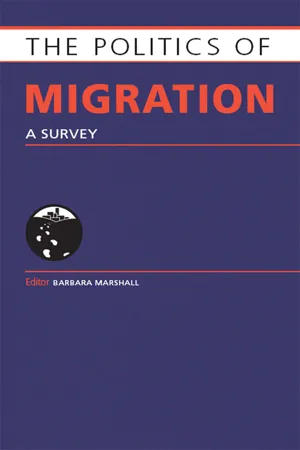
- 320 pages
- English
- ePUB (mobile friendly)
- Available on iOS & Android
eBook - ePub
About this book
Information
Subtopic
GeopoliticsIntroduction
What exactly is migration and why has it become one of the most controversial issues in the world today? Migration, i.e. the movement of people, has occurred throughout history and as such contemporary migration is not new. The difference is mainly one of geographic and numerical scale. Migration today involves the entire world and huge numbers. This is due to new technology where world-wide information is easily available. This in turn raises the awareness of the large discrepancies between the wealth and relative order of the industrialized world and the standards of living, human rights1 violations and environmental degradation prevalent in many parts of the less developed world. Moreover, frequently a false impression is created of easy riches awaiting anyone who reaches the first world. Encouragement to migrate also results from lower transportation and communications costs. In other words, the relative ease of long-distance mobility has led to a constant rise in the numbers of people who are prepared to move.
Migration is a multi-faceted, highly complex phenomenon, touching many aspects of modern life. It can be categorized in many different ways. For example, in earlier writing a distinction is made between push factors, i.e. involuntary or forced migration by people fleeing persecution, natural disasters or extreme poverty, and pull factors, i.e. migration induced by the availability of jobs in the developed world. Another distinction is made between ‘rights driven’ and economic migration, with the former category comprising family reunion, as well as refugees and asylum-seekers and the latter legal labour migration. In addition, and perhaps most controversial today, there is illegal/irregular migration, i.e. the clandestine movement of people to enter countries of destination for the purpose of protection and/or work. Moreover, whereas earlier migration tended to be ‘linear’ with permanent settlement at the destination, contemporary migration is often circular with short spells abroad, followed by return home and new, short periods abroad. This type of migration makes use of established ‘networks’ of friends and families who successfully migrated earlier. In this way diasporas of nationals abroad can be found whose economic importance in the form of remittances to their home countries has been growing steadily. A migration industry has sprung up to service contemporary migration, ranging from facilitators to formal and informal support systems and to criminal gangs of traffickers. This ‘industry’ has been estimated to be more profitable than the oil industry.
But who actually migrates and, more importantly in the current migration debate, what are the numbers involved? By definition migrants are the most mobile of any society, between 18 and 40 years old, frequently highly motivated and educated, as several contributions in Part lb of this volume demonstrate. In the past men predominated, but the share of women has been increasing steadily and in some parts of Asia and Africa is now about 50% of all migrants, a process which experts call ‘the feminization of migration’. What these migrants have in common is the desire to better their lives by hard work, frequently well below their qualifications. They represent the bulk of legal economic and also of irregular migration, the benefits of which have now been widely accepted. Indeed, with ageing and declining populations in most developed countries, migration will become increasingly necessary and a certain competition between these countries for the recruitment of the brightest and the best of the less developed world is already under way, frequently leading to the loss of valuable skills in the sender countries, the so-called brain drain (see A. de Haan’s contribution in Part 1a).
But migrants nowadays are also frequently filling the most menial ‘3D’ (dirty, difficult and dangerous) jobs which indigenous labour is often no longer prepared to accept. Moreover, irregular migrants are providing cheap and flexible services of all kinds and are thus fulfilling a vital role in the economies of the developed world. However, as T. Straubhaar points out in Part 1a, the economic benefits depend on the context in which migration takes place. Young, energetic migrants can displace native workers. The economic argument for and against migration needs careful calibration. Economic benefits also need to be balanced against the frequently negative popular perceptions of all migrants and the very real social costs of migration. These come in many guises. On a micro level, local communities have to share amenities such as housing, schools and health provisions with migrants, and tensions can flare up when native residents see themselves in competition with these newcomers for scarce resources. This in turn can result in xenophobic hatred and violence which media and politicians can exploit for financial and electoral purposes. In more general terms, citizens in Europe, North America and many other receiving countries have a fear of being overcrowded by unwanted supply-driven migration from all over the world.
How large is contemporary migration in real terms? Here a note of caution is required: overall numbers are difficult to calculate. Statistical data are collected in different forms in different countries and frequently not at all. This applies particularly to Asia and Africa. Much irregular migration by definition remains unrecorded and figures are based on estimates which can vary widely. Moreover, what is measured exactly? A distinction can be made between internal and international migration, that is the movement of people within one country (e.g. from rural to urban areas) and that which crosses international borders. A further difference exists between migrant ‘stocks’, i.e. the numbers of long-term resident foreigners in any given country and of ‘migration flows’, i.e. the number of people actually and frequently shortterm ‘on the move’. According to the United Nations, there were some 175m. migrants world-wide in 2004 (an increase from 76m. in 1960 and 100m. in 1980). Of these, 81m. were in the developed world (excluding the former Soviet Union) and 65m. in developing countries. Although these numbers appear huge, when compared to trade or financial flows, this movement of people is relatively limited. The share of the export of goods and the trade in services in the world’s gross domestic product roughly doubled between 1960 and 2000, whereas the share of international migrants in the world population rose less dramatically, from about 2.5% to 3%.
As most migrants move in search of a better life, the fastest growth in migration has been in developed countries. High-income countries have 16% of the world’s workers, but more than 60% of the world’s migrants. However, there are wide variations in their geographical distribution: migrant shares ranged from 1% in Ireland and Japan to 23% in Australia and to more than 30% in Singapore. A survey of the regions covered in Part lb shows that 13% of the North American population was born in another country, well above the global average (see K. O’Neill’s contribution in Part lb). Europe now matches North America in its significance as a region of immigration. Net immigration in Europe in 2003 stood at 5.3 per 1,000 inhabitants, compared to 4.4 in the USA. The region hosts a foreign-born population of 31.6m. migrants (or 9.7% of the population), as compared to 34.6m. in the USA (12.3% of the population—see the essay by C. Boswell in Part lb). However, the world’s highest share of migrant population is to be found in the Middle East. According to UN data for 2000, the highest ratio of migrants to total population is in the MENA2 region (see M. Baldwin-Edwards in Part lb). As far as the Asia-Pacific region is concerned, its vast size and cultural, ethnic, political, religious and economic complexity makes it difficult to generalize about international migration there. But Asia is the largest supplier of emigrants to other parts of the world; to OECD countries alone the figure for 2005 was almost 17m. (see G. Hugo in Part lb). Figures for migrants from Africa vary: according to the UN, they were 17m., whereas ILO estimates 20m. and the African Union calculates that there are as many as 50m. African migrants world-wide (see R. Black in Part lb). Although precise figures are thus not available, there is evidence of substantial African migration to Europe (2m. in 2000/01) and North America (just under lm.).
What conclusions can be drawn from these figures? From the perspective of developed countries, the effects of migration depend on the role it plays in the political, economic and social structures and traditions of the receiving country. Thus in the traditional countries of immigration, such as Australia, Canada, New Zealand or the USA, immigration is an integral part of their identity, the myth of the ‘melting pot’ of all newcomers into new nations. On the other hand, Europe before the Second World War or parts of Asia until comparatively recently were regions of emigration. Characteristic of today’s migration is the fact that Europe has become a continent of immigration and this transition from emigration to immigration has been even faster in some Asian countries (see G. Hugo in Part lb). It is therefore not surprising that these areas are facing the more serious challenges when it comes to the treatment of migrants, i.e. the form of their integration which, given their frequent cultural distinctiveness and growing assertiveness, goes to the heart of their sense of identity.
More specifically, the concerns which migration arouses are linked to two categories of migrants: irregular migrants and asylum-seekers/refugees. As far as irregular migration is concerned, there is a dearth of precise information and some confusion in the terminology used, which ranges from ‘illegal’, to ‘undocumented’, ‘unauthorized’ and ‘clandestine’ migration. K. Koser in Part 1a suggests the use of ‘irregular’ migration because the other terms only highlight certain aspects of this type of migration. ‘Illegal’, for example, stresses the existence outside the law of these migrants, suggesting some form of criminality. However, the breach of the law often consists in no more than reaching the destination country by the use of smugglers, i.e. illegal entry, or unsuccessful asylum-seekers not leaving the country or the circumvention of immigration controls in the form of bogus marriages or fake adoptions. ‘Unauthorized’ or ‘undocumented’ means that migrants are not in possession of the required documents, but this term does not cover the whole range of possible migrants in this category. A further problem arises from the fact that migrants frequently change their status, for example when a student or tourist entered the country on a visa and subsequently overstayed. The term ‘irregular’ migrants therefore seems to reflect the special status of these migrants without casting them into the lawlessness of an ‘illegal’ and this term has therefore been adopted throughout this volume.
As difficult as the nomenclature is the availability of definite numbers, as irregular migrants by definition hesitate to make their presence known to the authorities. There are also many methodological and practical difficulties in the collection of relevant data. The general consensus, however, is that the global scale of irregular migration has grown in line with the increase of international migration generally. In the USA, for example, it is estimated that more than 10m. irregular migrants make up nearly one-third of the foreign-born population and more than half of these are Mexican. Despite efforts to improve border controls, about 500,000 additional irregular migrants enter the USA every year. The figure for Russia is 3.5m.−5m., with irregular migrants there coming mainly from the Commonwealth of Independent States and South-East Asia. Up to 20m. irregular migrants live in India today. About one-half of all migrants in Africa and Latin America are thought to...
Table of contents
- Cover
- Half Title
- Title Page
- Copyright Page
- Table of Contents
- Acknowledgements
- The Contributors
- Abbreviations
- PART 1 – ESSAYS
- PART 2 – A–Z GLOSSARY by Barbara Marshall
- PART 3 – STATISTICS
Trusted by 375,005 students
Access to over 1.5 million titles for a fair monthly price.
Study more efficiently using our study tools.
Frequently asked questions
Yes, you can cancel anytime from the Subscription tab in your account settings on the Perlego website. Your subscription will stay active until the end of your current billing period. Learn how to cancel your subscription
No, books cannot be downloaded as external files, such as PDFs, for use outside of Perlego. However, you can download books within the Perlego app for offline reading on mobile or tablet. Learn how to download books offline
Perlego offers two plans: Essential and Complete
- Essential is ideal for learners and professionals who enjoy exploring a wide range of subjects. Access the Essential Library with 800,000+ trusted titles and best-sellers across business, personal growth, and the humanities. Includes unlimited reading time and Standard Read Aloud voice.
- Complete: Perfect for advanced learners and researchers needing full, unrestricted access. Unlock 1.5M+ books across hundreds of subjects, including academic and specialized titles. The Complete Plan also includes advanced features like Premium Read Aloud and Research Assistant.
We are an online textbook subscription service, where you can get access to an entire online library for less than the price of a single book per month. With over 1.5 million books across 990+ topics, we’ve got you covered! Learn about our mission
Look out for the read-aloud symbol on your next book to see if you can listen to it. The read-aloud tool reads text aloud for you, highlighting the text as it is being read. You can pause it, speed it up and slow it down. Learn more about Read Aloud
Yes! You can use the Perlego app on both iOS and Android devices to read anytime, anywhere — even offline. Perfect for commutes or when you’re on the go.
Please note we cannot support devices running on iOS 13 and Android 7 or earlier. Learn more about using the app
Please note we cannot support devices running on iOS 13 and Android 7 or earlier. Learn more about using the app
Yes, you can access The Politics of Migration by Barbara Marshall in PDF and/or ePUB format, as well as other popular books in Politics & International Relations & Geopolitics. We have over 1.5 million books available in our catalogue for you to explore.