- 278 pages
- English
- ePUB (mobile friendly)
- Available on iOS & Android
eBook - ePub
About this book
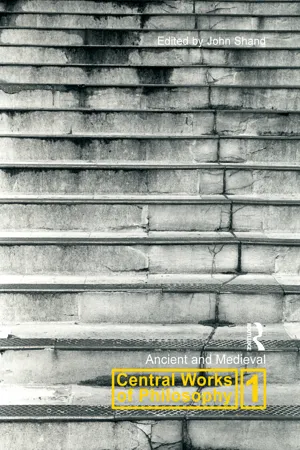
This collection of essays showcases the most important and influential philosophical works of the ancient and medieval period, roughly from 600 BC to AD 1600. Each chapter takes a particular work of philosophy and discusses its proponent, its content and central arguments. These are: Plato's Republic; Aristotle' Nichomachean Ethics; Lucretius' On the Nature of the Universe; Sextus Emperiicus' Outlines of Pyrrhonism; Plotinus' The Enneads; Augustine's City of God; Anselm's Proslogion; Aquinas' Summa Theologia; Duns Scotus' Ordinatio; William of Ockham's Summa Logicae .
Information
Topic
Philosophy1 Plato
Republic
Hugh H. Benson
Plato's Republic is many things to many people. To some it is among the first works in political theory in the Western tradition. To others it is a penetrating discussion of the relationship between the arts and the state, the nature of education or the sociological role of myth. To others still it may be the first examination of a fundamental ethical question, or the presentation of a fundamental metaphysical theory, or simply the locus classicus of classical Platonism. And as far as I can tell they may all be right. Nevertheless, I believe that the Republic contains a single thread of argument that one must come to terms with before the other issues in the Republic can be properly understood, and it is this thread of argument that will be the focus of this essay.
Before turning to the Republic, let me say a brief word about its author. To the best of our knowledge Plato was born to an aristocratic family in Athens in 427 BCE. His father, Ariston, who traced his lineage to the old kings of Athens, died in Plato's youth. His stepfather, Pyrilampes was a personal friend of Pericles, the great Golden Age Athenian statesman, and his mother, Perictione, was related to Solon, the famous Athenian legal reformer. Some time in his late teens or early twenties, Plato began to associate with Socrates (469-399 BGE), who was executed for impiety by the Athenians in 399 BCE. Around 387 BGE, Plato founded the Academy, which was named after the sacred olive grove in the outskirts of Athens in which it was located, and which boasted such members as Eudoxus and Aristotle. Plato died in 347 BCE. Plato flourished during the attempt by Athens to recover from its defeat at the hands of Sparta in the Peloponnesian War (431-404 BCE), a war that ended the so-called Golden Age of Athens.
A quick outline of the Republic
The Republic falls into ten books. These divisions do not reflect Plato's choices, but rather the work of a later Greek scholar and the constraints of what will fit on a single papyrus roll. Nevertheless, it is traditional to trace the outline of the Republic by discussing what takes place in each of these books.
Book I resembles Plato's shorter so-called Socratic definitional and aporetic dialogues, dialogues like the Euthyphro, the Laches, the Charmides, the Lysis, and the Hippias Major. In these dialogues, Socrates examines with one or more interlocutors various answers to his "What is F-ness?" question, a question that aims to determine the nature of F-ness rather than various instances or examples of it. For example, in the Euthyphro, Socrates and Euthyphro consider a variety of answers to the question "What is piety?"; in the Laches, Socrates, Laches and Nicias consider a variety of answers to the question "What is courage?"; and in the Charmides, Socrates, Charmides and Critias consider a variety of answers to the question "What is temperance?" In none of these dialogues, however, does a satisfactory answer appear to be uncovered. The first book of the Republic has a similar structure.
In Book I, Socrates and his companion, Glaucon, while walking back to Athens after attending the feast of Bendis in the Piraeus, are invited to join a gathering at the house of Polemarchus. As is common in the Socratic dialogues, the discussion quickly turns to the nature of some moral concept. In this case, the question raised is "What is justice?" After dismissing the implied answer of Cephalus, Polemarchus's father, with a counter-example, Socrates turns first to Polemarchus's defence of his father's answer, that justice is to tell the truth and pay one's debts (331d), and then to Polemarchus's new answer, that justice is helping one's friends and harming one's enemies (332d). When Polemarchus proves unable to sustain either of these two answers, Thrasymachus angrily interrupts, complaining that Socrates will not provide an answer to the question himself and that instead Socrates ironically and disingenuously claims not to know what justice is. Socrates, however, professes to be genuinely ignorant, and persuades Thrasymachus to offer his own response that justice is the advantage of the stronger (338c). The remainder of Book I is devoted to an examination of this Thrasymachean conception of justice, culminating with the claim that injustice is never more profitable than justice contrary to the Thrasymachean conception. This leads Socrates to bring the first book of the Republic to a close as follows:
the result of the discussion, as far as I'm concerned, is that I know nothing, for when I don't know what justice is, I'll hardly know whether it is a kind of virtue or not, or whether a person who has it is happy or unhappy.
[Republic 354-D9-C3]1
Unlike many of the Socratic dialogues, the Republic does not end in this inconclusive or aporetic manner. Rather, Book II begins with Glaucon asking Socrates whether he wants to have appeared to persuade them that justice "is better in every way" than injustice, or to have genuinely persuaded them. When Socrates chooses the latter, Glaucon presents his threefold classification of goods. According to Glaucon there are three kinds of goods:
- Type 1: Goods "we welcome not because we desire what comes from [them], but because we welcome them for [their] own sake[s] - joy, for example, and all the harmless pleasures which have no results beyond the joy of having them" (357b5-8).
- Type 2: Goods "we like for [their] own sake[s] and also for the sake of what comes from [them] - knowing, for example, and seeing and being healthy" (357ft-3).
- Type 3: Goods "we wouldn't choose ... for their own sakes, but for the sake of the rewards and other things that come from them ... such as physical training, medical treatment when sick, medicine itself, and the other ways of making money" (357c5-d2).
Socrates and Glaucon agree that the Socratic conception of justice according to which justice "is better in every way" than injustice requires that justice is not simply a Type 1 good nor a Type 3 good, but a Type 2 good. The Thrasymachean conception rejected in Book I, on the other hand, only requires that justice is a Type 3 good. Glaucon challenges Socrates, then, to maintain that justice is a Type 2 good. After the challenge is clarified, developed and amplified, first by Glaucon (358c-362c) and then by his brother Adeimantus (362d-367e), Socrates accepts the challenge (368b-c), and proceeds to address it.
In typical fashion, Socrates suggests that in order to determine which kind of good justice is, they will first need to determine its nature; they will need, that is, to answer the question "What is justice?" To do this, Socrates maintains that since justice can be found in both the individual and in the city, and since the city is larger than the individual, it may be easier to uncover what justice in the city is than what justice in the individual is. Consequently, he proposes first to look for justice in the city and then to look for it in the individual (368c-369b), and so he sets out to describe the origins of the city, intending to find justice therein. Socrates begins by describing a simple city (369a-372d), but is quickly encouraged to describe a more complex or luxurious one (372d-427c). In the course of describing this complex city, Socrates is led to postulate three distinct types of citizens corresponding to the three fundamental needs of the complex city: the workers or craftsmen, who provide for the ordinary daily needs of food, clothing, and so on; the guardians or auxiliaries, who provide for the protection of the city from outside invasion; and the rulers, who provide decision-making for the overall advantage of the city. After describing the nature, selection procedure, accommodations and duties, especially of the guardians and rulers, Socrates concludes his description of this complex ideal city or Kallipolis about a third of the way through Book IV. Socrates now turns to the task that led him to begin his description of Kallipolis in the first place: the determination of the nature of justice. First, he provides an argument for the nature of justice in the city (427c-434c); then he provides an argument to the effect that the nature of the individual is sufficiently similar to the nature of Kallipolis that justice in the individual will be structurally the same as justice in the city (434d-441c); and he concludes that the nature of individual justice is each part of an individual's soul performing its own function (443c-444b).
Having determined the nature of justice, Socrates turns to meet Glaucon's challenge head on. Socrates begins a long discussion in which he lays out the five forms of government and the corresponding five forms of individual. The first form refers to Kallipolis and the corresponding virtuous individual; the next four forms refer to progressively degenerate forms of government and their corresponding degenerate forms of individual (445c-d, 545c-576b). Before Socrates gets very far with this discussion, however, Polemarchus and Adeimantus interrupt him at the beginning of Book V with a series of three objections - or three "waves" as Socrates calls them - to his description of Kallipolis completed earlier in Book IV The first wave is the implausibility of the suggestion that women as well as men can and should serve as rulers of Kallipolis (451c-457b); the second wave is the implausibility of the suggestion that spouses, children and other possessions are to be held in common by guardians (457d—471c); and, finally, the third wave is the implausibility of the suggestion that Kallipolis could ever actually be brought into existence (471 c-540c). Books V-VTI consist of Socrates' attempts to address these three waves with most space devoted to addressing the third wave. Socrates attempts to turn back this wave by maintaining that Kallipolis is possible when and only when rulers become philosophers and philosophers become rulers. Beginning at the end of Book V, Socrates provides an elaborate account of the nature of the genuine philosopher (474c—502c) and his or her education (502c-540c).
Book VIII opens with Socrates returning to the main thread of argument. Recall that Socrates had just determined the nature of justice and was about to respond to Glaucon's challenge by discussing the five forms of government and individuals when Polemarchus and Adeimantus interrupted him. He had begun reviewing the nature of aristocracy and the aristocratic individual - the government of Kallipolis and the corresponding individual - and now he returns to where he left off. Socrates next discusses the nature and origin of the four progressively degenerate governments and their corresponding individuals: first timocracy and the timocratic individual (545c-550c); secondly, oligarchy and the oligarchic individual (550c-555b); thirdly, democracy and the democratic individual (555b-562a); and, finally, tyranny and the tyrannical individual (562a 576c). This leads to the first of three arguments for the profitability of justice in Book IX, according to which the tyrannical individual is worst, most unjust and most miserable, and the aristocratic or kingly individual is best, most just and most happy (576b-580c). Socrates follows this argument for the profitability of justice with a second argument according to which the just individual is best suited to judge the pleasure associated with the lives of reason, spirit and appetite, and he or she judges the life of reason, that is, the just life, to be the most pleasant (580c-583b). Finally, Socrates provides a third argument according to which the tyrant and tyrannical individual is farthest away from experiencing genuine or true pleasure and the king and kingly or aristocratic individual is nearest to experiencing genuine or true pleasure (583b-587b). Socrates draws these arguments to a conclusion with the image of an individual composed of a many-headed beast (corresponding to the appetitive part of the soul), a lion (corresponding to the spirited part of the soul) and a man (corresponding to the reason part of the soul) (587b-592b).
Book X begins rather awkwardly with a second defence of the banning of poetry, or at least the vast majority of contemporaneously available poetry, from Kallipolis (595a-608b). It then turns to an argument on behalf of the rewards of justice as it has come to be understood throughout the course of the Republic. Socrates begins this argument with an argument for the immortality of the soul (608d-612a). This is followed by a discussion of the rewards of justice in this life (612a-614a) and the even more impressive rewards of justice in the afterlife as described in the myth of Er (614a-621d).
While this outline of the Republic is hardly indisputable, it provides an arguably fair and unbiased summary of the text. As such, the main thread of argument in the Republic emerges. The goal of the Republic is the refutation of the Thrasymachean conception of justice first expressed in Book I. Book II explains that in order to accomplish this goal Plato must show that justice is welcomed both for its own sake and for its consequences ("what comes from it"). To do this Plato must determine the nature of justice, which he does by the end of Book IV, first by determining justice in the city and then arguing that justice in the individual is similar. Having established the nature of individual justice, Plato begins his argument that, so understood, justice is welcomed for its own sake and for its consequences. The argument gets interrupted at the beginning of Book V to respond to the three waves, only to be resumed at the beginning of Book VIII. Book VIII provides the background to the three arguments for the profitability of justice near the end of Book IX, presumably establishing that justice is welcomed for its own sake, and Book X concludes by showing that justice is also welcomed for its rewards, presumably establishing that justice is also welcomed for its consequences.
On the surface this does appear to be the main thread of argument in the Republic, but along the way a number of objections, complications and elaborations arise. In order, then, to gain a deeper understanding of this main thread of argument, the remainder of this essay will be structured as follows. First I shall look more closely at the Thrasymachean conception of justice advocated in Book I. Next, I shall examine the challenge posed at the beginning of Book II. I shall then turn to a brief examination of the argument for the nature of justice in the city, and then to the argument for the nature of justice in the individual. I shall then sketch the arguments for the profitability of justice and for its rewards.
Thrasymachean justice
After succumbing to Socrates' encouragement to say what justice is, Thrasymachus offers three apparently distinct accounts of justice (338c-344d). He maintains that:
- "justice is nothing other than the advantage of the stronger" (338c1—2);
- "it is just to obey the rulers" (339b7—8); and
- "justice is really the good of another" (343c3-4).
These formulations may appear to be at odds, but Thrasymachus evidently does not take them to be. He concludes his explanation of his account of justice by reiterating the formulation with which he began.
So, Socrates, injustice, if it is on a large enough scale, is a stronger, freer, and more masterly thing than justice. And, as I said from the first, justice is what is advantageous to the stronger, while injustice is to one's own profit and advantage.
(344c4-8)
Let us see what a conception incorporating all three of these formulations could be like.
In his initial explanation (338d-339a), Thrasymachus provides the following short argument:
- Acting justly is obeying the laws of the city
- But, the laws of the city are established by those who are strong in the city, that is, the rulers, and
- they are established by the rulers for their own advantage.
- Consequently, by acting justly one is acting for the advantage of the stronger.
We should notice that in explainin...
Table of contents
- Cover Page
- Half-Title Page
- Title Page
- Copyright Page
- Table of Contents
- Contributors
- Preface
- Ancient and Medieval Philosophy: Introduction
- 1 Plato: Republic
- 2 Aristotle: Nicomachean Ethics
- 3 Lucretius: On the Nature of the Universe
- 4 Sextus Empiricus: Outlines of Pyrrhonism
- 5 Plotinus: The Enneads
- 6 Augustine: City of God
- 7 Anselm: Proslogion
- 8 Aquinas: Summa Theologiae
- 9 Duns Scotus: Ordinatio
- 10 William of Ockham: Summa Logicae
- Index
Trusted by 375,005 students
Access to over 1.5 million titles for a fair monthly price.
Study more efficiently using our study tools.
Frequently asked questions
Yes, you can cancel anytime from the Subscription tab in your account settings on the Perlego website. Your subscription will stay active until the end of your current billing period. Learn how to cancel your subscription
No, books cannot be downloaded as external files, such as PDFs, for use outside of Perlego. However, you can download books within the Perlego app for offline reading on mobile or tablet. Learn how to download books offline
Perlego offers two plans: Essential and Complete
- Essential is ideal for learners and professionals who enjoy exploring a wide range of subjects. Access the Essential Library with 800,000+ trusted titles and best-sellers across business, personal growth, and the humanities. Includes unlimited reading time and Standard Read Aloud voice.
- Complete: Perfect for advanced learners and researchers needing full, unrestricted access. Unlock 1.5M+ books across hundreds of subjects, including academic and specialized titles. The Complete Plan also includes advanced features like Premium Read Aloud and Research Assistant.
We are an online textbook subscription service, where you can get access to an entire online library for less than the price of a single book per month. With over 1.5 million books across 990+ topics, we’ve got you covered! Learn about our mission
Look out for the read-aloud symbol on your next book to see if you can listen to it. The read-aloud tool reads text aloud for you, highlighting the text as it is being read. You can pause it, speed it up and slow it down. Learn more about Read Aloud
Yes! You can use the Perlego app on both iOS and Android devices to read anytime, anywhere — even offline. Perfect for commutes or when you’re on the go.
Please note we cannot support devices running on iOS 13 and Android 7 or earlier. Learn more about using the app
Please note we cannot support devices running on iOS 13 and Android 7 or earlier. Learn more about using the app
Yes, you can access Central Works of Philosophy v1 by John Shand in PDF and/or ePUB format, as well as other popular books in Philosophy & Medieval & Renaissance Philosophy. We have over 1.5 million books available in our catalogue for you to explore.