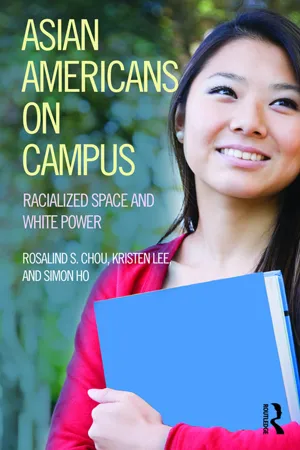
While there are books on racism in universities, few examine the unique position of Asian American undergraduates. This new book captures the voices and experiences of Asian Americans navigating the currents of race, gender, and sexuality as factors in how youth construct relationships and identities. Interviews with 70 Asian Americans on an elite American campus show how students negotiate the sexualized racism of a large institution. The authors emphasize the students' resilience and their means of resistance for overcoming the impact of structural racism.
eBook - ePub
Asian Americans on Campus
Racialized Space and White Power
- 116 pages
- English
- ePUB (mobile friendly)
- Available on iOS & Android
eBook - ePub
About this book
Information
1
INTRODUCTION
Asian Americans on Campus
I, Kristen Lee, grew up hearing this advice from my mother: “Just ignore them; they’re idiots. High school is stupid like that. Wait until college.” These words were spoken when I came home from high school upset over a peer singing “ching-chong” songs. They were repeated to me when I was angry about a friend telling me my straight-A performance was due to my “Asianness.” Growing up in an upper-class white suburban environment I tried to blend in as much as possible, which was difficult considering I was one of a handful of Asian American students in my class. I began to count the days I would need to deal with high school students who pulled their eyelids to the sides to mock my Asian features and made insensitive jokes.
“Just ignore them; they’re idiots. Just wait until college.” It became a type of mantra for me to endure high school years. I would say it to myself repeatedly. It was a comforting thought. The way my mother talked about college, it sounded like a blank social check waiting for me to cash in. I did not need a “tiger mother”1 to motivate me to study and apply for university; the promise of a space free of bullying and comments on my “Asianness” was enough to keep me after hours at the library studying for the SAT. To me, at the time, university meant freedom.
Looking back at my time at a top-ten university I have realized I was not prepared for the hidden university curriculum that is left out of admissions pamphlets. Coming to college, I was not prepared to deal with a white male student asking, “Why are there so many fucking Asians in the library?” I was not prepared to walk down the street and have a male shout out, “Ni hao, baby.”2 I was not prepared to have my friends shrug off these racialized experiences as me being “too sensitive” or “crazy.” I had let my guard down with my mantra, with the myth that racism goes away as one climbs the ivory tower. I was not prepared for the pervasive, overt, and subtle racism that colored my university experiences. Drawn in by the laudable backgrounds of my peers and the prestige that comes with an elite university, I was not adequately prepared for the racism that was very much a part of university life.
When we first talked about writing this book, we realized there was a shortage of research that critically examines the lives of Asian American college students and does this through their own voices. While Asian American race scholarship has grown exponentially over these past few decades, much of the research lacks a critical race perspective, and in some cases, supports existing stereotypes that Asian Americans are high-achieving model minorities with few issues with racial discrimination.
Assumptions that Asian American students are largely high-achieving “model minorities” are inaccurate.3 There are a number of factors that complicate generalizations: Asian Americans and Pacific Islanders (AAPIs) “are treated as though one percent of their enrollment can tell the story for the rest of the 99 percent of the college going population.”4 Also mythologized is that universities, including the most elite among them, together form a safe haven from ignorance and racial prejudice.5 Contrary to the myth, the most prestigious American universities are not outside of the existing US racial structure; in fact, a normalized ideology and socialization process that “white is ideal” permeates every nook and cranny of this country including its most prestigious universities.6
In this book we challenge the one-dimensional notion that high enrollment of Asian Americans at colleges and universities protects them from racial discrimination. Such statistics are often used to further marginalize blacks and Latinos for their lower rates of college enrollment. Whites use Asian Americans to, in some ways, shame other groups of color, further cementing the existing racial hierarchy.7 We also demonstrate the numerous ways that gendered racism affects Asian American students. Through an intersectional lens, we find that Asian Americans are influenced by racial constructions of gender and sexuality. In turn, these students either pull from or resist white standards of beauty and sexuality. We use qualitative interviews and respondent surveys to analyze the experiences of Asian American students at an elite university.8 Our analysis addresses the following important questions: (1) How does the construction and regulation of gender, sexuality, and race of Asian Americans in white spaces support, or challenge, the racial status quo in the United States? (2) What toll does gendered racism take on Asian American students physically and mentally? (3) What is the Asian American experience at the university, and what can it tell us about race and racism today and about other historically white colleges and universities? Finally, we summarize our findings and look at the ways these Asian American students resist the gendered racism they face on campus.
Theoretical Overview
Systemic Racism and the White Racial Frame
We use a systemic racism approach to view racial oppression as a foundational and persisting underpinning of this society in the United States. From the beginning, powerful whites have designed and maintained the country’s economic, political, and social institutions to benefit, disproportionately and substantially, their own racial group. For centuries, unjust impoverishment of Americans of color has been linked to unjust enrichment of whites, thereby creating a central racial hierarchy and status continuum in which whites are generally the dominant and privileged group.9
Since the earliest period of colonization, European Americans have sustained this hierarchical system of unjust material enrichment and unjust material impoverishment with legal institutions and a strong white racial framing of this society. These prestigious institutions have a history of gender and racial exclusion.10 Understanding the historical context provides a foundation for the invisible, yet powerful, white norms and policies that shape and further reinforce the white racial frame on campus.
Understanding framing is essential to understanding how racism persists today and is disguised in institutions of higher education. Whites have combined within this pervasive white frame many racist stereotypes (the cognitive aspect), racist concepts (the deeper cognitive aspect), racist images (the visual aspect), racialized emotions (feelings), and inclinations to take discriminatory action.11 The white racial frame is old, enduring, and oriented to assessing and relating to Americans of color in everyday situations. Operating with this racial frame firmly in mind, the dominant white group has used its power to place new non-European groups, such as Asian immigrants and their children, somewhere in the racial hierarchy that whites firmly control—that is, on a white-to-black continuum of status and privilege with whites at the highly privileged end, blacks at the unprivileged end, and other racial groups typically placed by whites somewhere in between.12 This white racist framing is centuries old and continues to rationalize racism that has been systemic in this society. Situated centrally as institutions that pass along the central components of the white racial frame are historically white colleges and universities (HWCUs).
In opposition to the white racist framing and hegemonic framing of masculinity are three types of counter-frames: (1) a white crafted “liberty and justice” frame; (2) the anti-oppression counter-frames of Americans of color; and (3) the home-culture frames that Americans of color have drawn on in developing their counter-frames.13 Asian Americans, collectively, have very few counter-frames from which to view alternative constructions of Asian American masculinity, femininity, or sexuality.14 The externally imposed identity of “Asian American” represents many different cultures, which would provide a splintered or quilted “home-culture” frame with some overlap but a great deal of diversity of meanings and practices. Additionally, with more than half of Asians in the United States being newer immigrants, there are complications in identifying racist structure and oppression, which serves as another obstacle for developing strong “anti-oppression” counter-frames.15
Whether scholars choose to use “white racial framing,” “white habitus,” or racial “hegemony” to explain the persistence of racist thoughts, feelings, and practices, white supremacist ideology persists and comes in various forms embedded in institutions like US colleges and universities and in the psyches of whites students and students of color alike. Racist ideology is passed along subconsciously through “color-blind discourse” or subtly through racialized constructions of gender and sexuality.16 Asian Americans students in this study have been socialized in a society where whiteness is normalized.
Model Minority
While Asian Americans make up only a small percentage of the nation’s population, they are growing in numbers as well as socioeconomic status. Several demographic indicators suggest that Asian Americans are doing very well in America: They have a higher median income than any other racial group,17 and they have the highest rates of achieving a college degree compared to other racial groups.18 Asian American overrepresentation in upper-tier American universities is often used as proof that racial minorities can be successful if they just work hard enough and that racism is not a barrier.19 While they comprise only 5 percent of the total population of the United States, Asian Americans make up to 30 percent of the student population in some elite universities. Following the Immigration Act of 1965, the United States has seen a huge increase in the number of foreign-born Asian Americans, and the median income of Asian Americans has surpassed that of white non-Hispanic Americans within the last several decades. It is from such achievements that Asian Americans have often been labeled the “model minority.”20
However, the statistics cited on Asian Americans as a demographic only draw attention to one side of a bimodal population. Although statistics show Asian Americans have made strides in educational and economic achievement, on the whole they suffer from a poverty rate higher tha...
Table of contents
- Cover
- Title
- Copyright
- Contents
- Preface
- Acknowledgments
- Chapter 1 Introduction: Asian Americans on Campus
- Chapter 2 White Space, White Campus
- Chapter 3 Color-blind Discourse and Asian American Sexual Politics
- Chapter 4 Intraracial and Interracial Relationships
- Chapter 5 Conclusion: Resign or Resist? Disengage or Engage?
- References
- Index
Trusted by 375,005 students
Access to over 1.5 million titles for a fair monthly price.
Study more efficiently using our study tools.
Frequently asked questions
Yes, you can cancel anytime from the Subscription tab in your account settings on the Perlego website. Your subscription will stay active until the end of your current billing period. Learn how to cancel your subscription
No, books cannot be downloaded as external files, such as PDFs, for use outside of Perlego. However, you can download books within the Perlego app for offline reading on mobile or tablet. Learn how to download books offline
Perlego offers two plans: Essential and Complete
- Essential is ideal for learners and professionals who enjoy exploring a wide range of subjects. Access the Essential Library with 800,000+ trusted titles and best-sellers across business, personal growth, and the humanities. Includes unlimited reading time and Standard Read Aloud voice.
- Complete: Perfect for advanced learners and researchers needing full, unrestricted access. Unlock 1.5M+ books across hundreds of subjects, including academic and specialized titles. The Complete Plan also includes advanced features like Premium Read Aloud and Research Assistant.
We are an online textbook subscription service, where you can get access to an entire online library for less than the price of a single book per month. With over 1.5 million books across 990+ topics, we’ve got you covered! Learn about our mission
Look out for the read-aloud symbol on your next book to see if you can listen to it. The read-aloud tool reads text aloud for you, highlighting the text as it is being read. You can pause it, speed it up and slow it down. Learn more about Read Aloud
Yes! You can use the Perlego app on both iOS and Android devices to read anytime, anywhere — even offline. Perfect for commutes or when you’re on the go.
Please note we cannot support devices running on iOS 13 and Android 7 or earlier. Learn more about using the app
Please note we cannot support devices running on iOS 13 and Android 7 or earlier. Learn more about using the app
Yes, you can access Asian Americans on Campus by Rosalind Chou,Kristen Lee,Simon Ho in PDF and/or ePUB format, as well as other popular books in Social Sciences & Asian American Studies. We have over 1.5 million books available in our catalogue for you to explore.