In today's globalized world, halal (meaning 'permissible' or 'lawful') is about more than food. Politics, power and ethics all play a role in the halal industry in setting new standards for production, trade, consumption and regulation. The question of how modern halal markets are constituted is increasingly important and complex. Written from a unique interdisciplinary global perspective, this book demonstrates that as the market for halal products and services is expanding and standardizing, it is also fraught with political, social and economic contestation and difference. The discussion is illustrated by rich ethnographic case studies from a range of contexts, and consideration is given to both Muslim majority and minority societies. Halal Matters will be of interest to students and scholars working across the humanities and social sciences, including anthropology, sociology and religious studies.
eBook - ePub
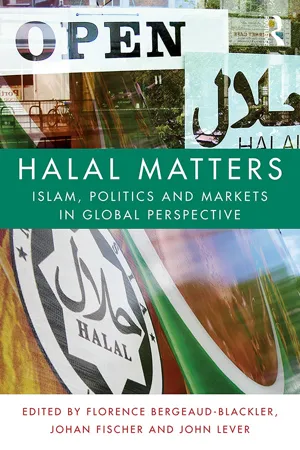
Halal Matters
Islam, Politics and Markets in Global Perspective
- 204 pages
- English
- ePUB (mobile friendly)
- Available on iOS & Android
eBook - ePub
Halal Matters
Islam, Politics and Markets in Global Perspective
About this book
Information
1
Introduction
Studying the politics of global halal markets
This book argues that answering the question how are modern halal markets constituted? is increasingly important and complex in a globalized world. In Arabic halal literally means “permissible” or “lawful”. Traditionally it has several significations such as “pure” or “wholesome” with regard to meat in particular in proper Islamic practice, for example ritual slaughter and pork avoidance. Yet in the modern and globalized industry, halal is not only about food; it is also about biotechnology, tourism and care products. A number of Muslim requirements have already been met in the international arena, including an injunction to avoid any substances that may be contaminated with porcine residues or alcohol, gelatine, glycerine, emulsifiers, enzymes, flavours and flavourings. In a globalized market these requirements are setting new standards for halal production, preparation, handling, storage and certification. Optimistically, market players have estimated the value of the halal food market to be around $632 billion annually (Agriculture and Agri-Food Canada, 2011).
Drawing on studies from around the world, this book explores how global halal production, trade, consumption and regulation are taking place. In spite of these global transformations in halal, this topic has only attracted sporadic academic attention. The research question answered is: How and by whom, for whom, and for what reasons are objects, discourses and practices actually called “halal” or “haram” (literally, “unlawful” or “prohibited”)? Hence, in this book readers will learn that even if the global market for halal products and services such as certification is expanding and standardizing, this market is still fraught with contestation in terms of politics and power/knowledge.
There exists no edited book from an interdisciplinary perspective that explores how modern forms of halal production, consumption, trade and regulation take place in diverse contexts. This research moves beyond previous works on halal consumption in the everyday lives of Muslims in a globalized market (Bergeaud-Blackler, 2004, 2005, 2007; Bergeaud-Blackler and Bernard, 2010; Fischer 2008, 2011; Lever, 2013; Lever and Miele, 2012).
Existing studies of halal and Islamic consumption in general explore microsocial aspects. For example, from an interdisciplinary perspective the edited volume Muslim Societies in the Age of Mass Consumption (Pink, 2009) argues that in spite of the intensifying globalization of markets and consumption, these processes have received modest scholarly attention. More specifically, this volume explores issues such as the changing spaces of consumption, branding and the marketing of religious music as well as the consumption patterns of Muslim minority groups. Another important study looks at urban Muslims in China, where the Hui’s halal food and eating habits stood out as the most important identity marker in contradistinction to the surrounding Han majority. Besides nutritional and economic functions, food and eating practices expressed values and traits that they regarded as fundamentally Hui (Gillette, 2000). Lastly, in Turkey the politics of identity among Islamists and secularists has been deeply influenced by an expanding consumer market, a “market for identities”, in the context of the globalization of the 1980s and 1990s (Navaro-Yashin, 2002). Many of the chapters in the present book explore halal from microsocial or everyday perspectives, but they do so by taking into consideration the “bigger institutional picture” that frames the everyday consumption of halal products.
We are inspired by practice theory that is used as a general framework for the project’s analyses. A “practice” can be defined as “a routinized way in which bodies are moved, objects handled, subjects are treated, things are described” (Reckwitz, 2002, 250). Such a practice-theoretical perspective involves assumptions about “performativity of social practices” as in Bourdieu’s classic study The Logic of Practice (1990). Reflexive and strategic practices also evoke the question of ideas/intentionality versus practice in public/private domains (Goffman, 1971). Hence, a central issue in the chapters that follow is the extent to which ideas, ideals, policies, discourses and intentions about what halal is or ought to be are translated into actual practices at different levels of the social scale in everyday life and by halal certifying bodies. Theoretically, we also draw on recent scholarship on the interfaces between markets and regulation such as Ong and Collier’s Global Assemblages: Technology, Politics, and Ethics as Anthropological Problems (2005).
What is modern halal understanding and practice?
Industrial players, merchants and some Muslim scholars involved in halal trade and standardization have based their halal food rulings on statements from selected verses from the Qur’an such as: “Allah makes good things lawful to them and bad things unlawful” (7: 157) and:
You who believe, eat the good things We have provided for you and be grateful to God, if it is Him that you worship. He has only forbidden you carrion, blood, pig’s meat, and animals over which any name other than God’s has been invoked. But if anyone is forced to eat such things by hunger, rather than desire or excess, he commits no sin: God is Most Merciful and Forgiving.
(Abdel Haleem, 2008, 2: 172–73)
It is repeated that
You are forbidden to eat carrion; blood; pig’s meat; any animal over which any name other than God’s has been invoked; any animal strangled, or victim of a violent blow or fall, or gored or savaged by a beast of prey, unless you still slaughter it [in the correct manner]; or anything sacrificed on idolatrous altars.
(Abdel Haleem 2008, 5: 3)
Halal is that which is beneficial and not detrimental to Muslims. A number of conditions and prohibitions must be observed. Muslims are expressly forbidden from consuming carrion, spurting blood, pork and foods that have been consecrated to any being other than God himself: these substances are called haram (“unlawful” or “forbidden”). The lawfulness of meat depends on how it is obtained. During ritual slaughter, dhabh, animals should be killed in God’s name by making a fatal incision across the throat, with the blood being drained as fully as possible. Among Muslim groups and individuals, the question of the stunning of animals prior to slaughter is highly contested. While some Muslims only consider meat from unstunned animals halal, others accept that stunning is part of modern and ethical food production.
Sea creatures and locusts are considered halal by most Sunni groups. Because the sea is seen to be pure in essence, all marine animals, even if they have died spontaneously, are halal. Despite the fact that they are not mentioned in the Qur’an, land creatures such as predators, dogs, and, in the eyes of some jurists, donkeys are haram. What is more, crocodiles, weasels, pelicans, otters, foxes, elephants, ravens and insects have been condemned by the ulama (literally, ‘those who know the law’ or ‘religious scholars’). Another significant Islamic prohibition relates to wine and any other alcoholic drink or substance, all of which are haram whatever the quantity or substance (Denny, 2006, 279). As we shall see, alcohol has become a highly controversial issue.
With the advent of Islam, ancient negative attitudes towards pigs and pork were reinforced (Benkheira, 1996). Inspired by Jewish law, the Prophet Mohammad banned the flesh of pigs and in the Qur’an the prohibition is repeated several times (Simoons, 1994, 32). In effect, Muslims were distinguished from their Christian adversaries (Simoons, 1994, 33). Some Muslim groups came to abhor pigs and pork to such an extent that everything touched by them was regarded as contaminated and worthless (Simoons, 1994). Under Western colonialism, pig abhorrence declined in many parts of the world, only to increase again at the end of European colonial rule and the advent of Islamic revivalism (Simoons, 1994).
The reasons for the ban on pork within Islam follow the five main types of explanation advanced to analyse the origin of the Hebrew food laws. One is that these are arbitrary and make no sense to humans and can only be understood by God. Another is that injunctions were based on sanitary concerns (Simoons, 1994). A symbolic explanation proposed by Mary Douglas (2004) argues that acceptable animals represented proper human behaviour versus the sinful behaviour of banned animals. Yet another explanation is that Hebrew food laws originated in their rejections of cultic practices of alien peoples and the worship of deities other than Jehovah. Involved in both the third and fourth hypotheses is the notion that the Hebrews wanted to set themselves apart from other peoples. Some anthropologists, most famously Marvin Harris, have argued for a fifth and recent explanation, according to which the prohibitions are grounded in economic, environmental, and/or ecological reasons (Simoons, 1994, 64–65). According to Harris (1977, 1998), the Israelite taboo on pigs was reconceptualized with the rise of Islam as a new set of sanctioned dietary laws “ecological” in essence, that is, religious ideas traced to the cost–benefit analysis of ecological processes.
The proliferation of halal can be seen as distinct sets of invocations of haram or taboo. Taboo can protect distinctive categories of the universe, consensus and certainty about the organization of the cosmos, thus reducing intellectual and social disorder (Douglas, 2004, xi). However, certainty and order can easily mirror feelings of uncertainty and disorder. These doubts mostly surface in everyday strategies about how to practise the ever-intensifying demands of proper Islamic consumption. Elsewhere, Douglas (1975, 275) argues that when people become aware of encroachment and danger, dietary rules that control what goes into the body function as an analogy of the corpus of their cultural categories at risk.
The debate over the origins of the ban on pork in Judaism and Islam is far from resolved. One central reason for this is that there is not sufficient historical evidence in existence. The prohibition of pork is one of the rare food taboos that lives on in Islam, but the true reason for its prohibition is unknown. Our brief discussion of the arguments of Douglas and Harris provides the reader with key arguments in a debate that has spanned decades, and which still seems to inform scholarly and popular controversy over the prohibition of pork and the nature of taboo itself. Taboos distinguish between groups and individuals within their own society. Moreover, they operate in terms of the production, preparation and distribution of food (Manderson, 1986).
The understanding and practice of halal requirements vary among import countries and companies producing halal food. This is the point made in the book Halal Food Production (Riaz and Chaudry, 2004, vii). This book by two US scholars is a popularized guide to producing and marketing halal (foods) for professionals in an expanding global food market. Chaudry is President of the Islamic Food and Nutrition Council of America (IFANCA), a leading halal certifier based in the US, and Riaz is a Senior Auditor in the same organization. Riaz is also Texas A&M University’s Director of Food and Protein R&D Center; the Islamic Food Council of Europe is a kind of subsidiary of IFANCA. To our knowledge, this is the only book of its kind and it is widely used by companies worldwide to understand and comply with the current transformation of halal and it is a unique piece of empirical material. It is the guide to modern and global halal.
In classical fiqh (Islamic jurisprudence), there are five qualifications: obligatory, recommended, indifferent, reprehensible and forbidden. Therefore, in addition to halal and haram, doubtful things may be avoided; that is, there is a grey area between the clearly lawful and the unlawful. The doubtful or questionable is expressed in the word mashbooh, which can be evoked by divergences in religious scholars’ opinions or the suspicion of undetermined or prohibited ingredients in a commodity (Schacht, 2014). Hence, individual and fuzzy aspects of context and handling are involved in determining the halalness of a product. The problem in certifying food and other products with regard to these substances is that they are extremely difficult to discover. The interpretation of these mashbooh areas is left open depending on the nature of the food product and how/where it is obtained/processed.
Knowledge of the above requirements is, of course, essential to innovative companies seeking to establish themselves in an expanding global halal market. The increased demand for halal products by conscious and educated Muslim consumers has encouraged developed countries to export halal products. Moreover, the proliferation of Western franchised food has changed the international food market and subjected it to new standards of halal certification (Riaz and Chaudry, 2004, 29–30).
In countries such as Malaysia, Singapore and Indonesia even paper/plastic labels and printing on food are seen as problematic. Glue used for labels as well as edible printing and dyes used directly on food may contain non-permissible ingredients. Some halal certifying bodies in importing countries feel that such seepage or cross-contamination may violate the halal status of food (Riaz and Chaudry, 2004, 134). What is more, packaging food in a halal environment is essential (Riaz and Chaudry, 2004, 134–35).
Divergences between jurists of the different schools of Islamic jurisprudence (Hanafi, Maliki, Hanbali and Shafi’i) exist on halal understanding and practice (see Chapter 2). This point is of particular relevance in relation to Ong and Collier’s (2005) notion of a global assemblage (see p. 10) in which theology, politics and regulation diverge and overlap across different countries and contexts. The book Issues on Halal Products (2007) is a fatwa (opinion concerning Islamic law issued by an Islamic scholar) published by the State Mufti’s Office in the Prime Minister’s Office, Brunei Darussalam. In Brunei and other Southeast Asian countries such as Malaysia and Singapore (as we shall see in subsequent chapters) the Shafi’i school of jurisprudence within the Sunni division of Islam is dominant. For a number of reasons halal has taken on a special meaning in these Southeast Asian countries in the interfaces between revivalist Islam, state and market. The State Mufti’s fatwa, for example, goes to great lengths to define and “standardize” halal understanding and practice among consumers and companies involved in the market for halal products and services. The book offers its opinions on issues such as monosodium glutamate in prawn crackers and emulsifiers and sausages wrapped in pigs’ intestines (food); soft drinks in beer bottles (drinks); displaying signs that particular locations are not suitable for Muslims at companies, restaurants and other eating places where the majority of employees or customers are not Muslims (restaurants); tranquillizers for slaughtered chickens (slaughter); medicines mixed with gelatine or alcohol (treatment); involvement of conventional banks in halal projects and the buying and selling of pork in supermarkets (trading); hair dye and praying using perfume that contains alcohol (cosmetics); the word “Carlsberg” on clothes (adornment); utilizing a building that was once a pig market (premises); and transport of pork (transportation). The limited space here does not permit us to go into detail with all these rulings, but it suffices to say that halal is subjected to strict and highly regulated understandings and practices in this fatwa originating in the heartland of Southeast Asian Sunni Islam.
Another example is The Lawful and the Prohibited in Islam (1995), publis...
Table of contents
- Cover
- Half Title
- Title Page
- Copyright Page
- Table of Contents
- List of figures
- List of contributors
- Acknowledgements
- 1. Introduction: Studying the politics of global halal markets
- 2. Re-imagining Malaysia: a postliberal halal strategy?
- 3. From an implicit to an explicit understanding: new definitions of halal in Turkey
- 4. Remembering the spirit of halal: an Iranian perspective
- 5. Beldi matters: negotiating proper food in urban Moroccan food consumption and preparation
- 6. Islamizing food: the encounter of market and diasporic dynamics
- 7. The halal certification market in Europe and the world: a first panorama
- 8. Green halal: how does halal production face animal suffering?
- 9. Halal, diaspora and the secular in London
- 10. Muslim food consumption in China: between qingzhen and halal
- 11. Halal training in Singapore
- 12. Who owns halal? Five international initiatives of halal food regulations
- Index
Trusted by 375,005 students
Access to over 1.5 million titles for a fair monthly price.
Study more efficiently using our study tools.
Frequently asked questions
Yes, you can cancel anytime from the Subscription tab in your account settings on the Perlego website. Your subscription will stay active until the end of your current billing period. Learn how to cancel your subscription
No, books cannot be downloaded as external files, such as PDFs, for use outside of Perlego. However, you can download books within the Perlego app for offline reading on mobile or tablet. Learn how to download books offline
Perlego offers two plans: Essential and Complete
- Essential is ideal for learners and professionals who enjoy exploring a wide range of subjects. Access the Essential Library with 800,000+ trusted titles and best-sellers across business, personal growth, and the humanities. Includes unlimited reading time and Standard Read Aloud voice.
- Complete: Perfect for advanced learners and researchers needing full, unrestricted access. Unlock 1.5M+ books across hundreds of subjects, including academic and specialized titles. The Complete Plan also includes advanced features like Premium Read Aloud and Research Assistant.
We are an online textbook subscription service, where you can get access to an entire online library for less than the price of a single book per month. With over 1.5 million books across 990+ topics, we’ve got you covered! Learn about our mission
Look out for the read-aloud symbol on your next book to see if you can listen to it. The read-aloud tool reads text aloud for you, highlighting the text as it is being read. You can pause it, speed it up and slow it down. Learn more about Read Aloud
Yes! You can use the Perlego app on both iOS and Android devices to read anytime, anywhere — even offline. Perfect for commutes or when you’re on the go.
Please note we cannot support devices running on iOS 13 and Android 7 or earlier. Learn more about using the app
Please note we cannot support devices running on iOS 13 and Android 7 or earlier. Learn more about using the app
Yes, you can access Halal Matters by Florence Bergeaud-Blackler, Johan Fischer, John Lever, Florence Bergeaud-Blackler,Johan Fischer,John Lever in PDF and/or ePUB format, as well as other popular books in Social Sciences & Islamic Theology. We have over 1.5 million books available in our catalogue for you to explore.