eBook - ePub
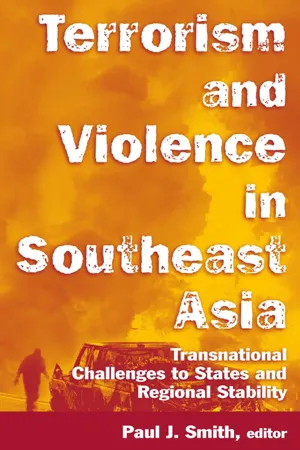
Terrorism and Violence in Southeast Asia
Transnational Challenges to States and Regional Stability
- 282 pages
- English
- ePUB (mobile friendly)
- Available on iOS & Android
eBook - ePub
Terrorism and Violence in Southeast Asia
Transnational Challenges to States and Regional Stability
About this book
This timely work examines the scale and root causes of terrorism across Southeast Asia, including the role of al-Qaeda's ascendancy in the region. It begins with an overview of the analytical and theoretical framework for discussing the subject. Individual chapters then examine terrorist activities from both functional and country-specific perspectives. The book traces fundamental linkages between terrorism and security issues, such as illegal immigration, narcotics trafficking, and other criminal activity. In addition, it considers the issue of convergence - the growing connection between criminal groups and terrorism, and how this may facilitate future violence. Written by a range of experts in the field, the individual chapters reflect a variety of perspectives. The contributions fall into two broad categories - chapters that directly address terrorism (the groups, their ideologies, their modus operandi, their origins, and state responses to them); and chapters that address the "enabling environment" that exists in Southeast Asia (the role of transnational crime, porous borders, convergence between terrorism and crime).
Information
III

Southeast Asia’s
Ideological and Physical
Enabling Environment
8
Countering Radical Islam in Southeast Asia
The Need to Confront the Functional and Ideological “Enabling Environment”
Kumar Ramakrishna
Introduction
Jemaah Islamiya (JI) represents the key terrorist threat in Southeast Asia. Through its Rabitatul Mujahideen (RM) coordinating framework, JI, whose ideological and operational locus is Indonesia, has sought to build a coalition of radical Islamist groups in its quest to forcibly establish a Darulah Islamiah Nusantara, or pan-Southeast Asian Islamic state. The RM was formed by JI spiritual leader Abu Bakar Bashir in late 1999 in Kuala Lumpur.1 The first meeting, apart from JI core members, included elements from other regional radical Islamist groups such as Kumpulan Mujahideen Malaysia (KMM); Laskar Jundullah and Darul Islam; the Free Aceh Movement (GAM) and Republik Islam Aceh from Indonesia; the Moro Islamic Liberation Front (MILF) from the southern Philippines; the Rohingya Solidarity Organization (RSO) and the Arakan Rohingya Nationalist Organization (ARNO) from Myanmar; and the Pattani United Liberation Organization (PULO) from southern Thailand.2 It must be emphasized that not all of these groups share JI’s global jihad agenda. While the RM has not been particularly active,3 it would be an error to disregard its significance. Because of the shared experience of jihad either in Afghanistan or Ambon in the Maluku Archipelago in eastern Indonesia, a sense of “brotherhood” exists between disparate Southeast Asian radical Islamists, and the RM mechanism can, and has, crystallized this commodity for mutual assistance and support. Hence, in late December 2000, JI colluded with MILF elements to stage bombings in Manila that killed twenty-two people. This was in retaliation for a major offensive by Filipino armed forces that had earlier in the year resulted in the capture of more than forty MILF camps in the southern Philippines.4
The RM should thus be seen as an informal, loose, but potentially force-multiplying extension of JI. It is the latter, however, that truly represents the transnational guiding intelligence of radical Islamist terrorism in Southeast Asia. Whatever its indigenous historical origins in the Darul Islam movement in Indonesia,5 JI’s global jihad vision makes it an al-Qaeda ally in Southeast Asia.6 Moreover, JI’s ambitions and organizational capacity renders it the center of gravity of the radical Islamist terrorist threat in the theater. At this time, JI remains a threat because of the functional and political space that it has been able to exploit.
The Problem of JI’s “Functional Space”
JI’s functional space—defined broadly as the freedom to carry out the various activities necessary to support the terrorist agenda—is expressed in several ways. First and foremost is the fact that the network’s membership is very extensive, numbering, according to one recent authoritative estimate, “probably” in the “thousands.”7 Furthermore, JI possesses considerable expertise to cause mayhem. Included in its ranks are operatives such as Dr. Azahari Husin and Dulmatin, both of whom have the skills to construct powerful explosives such as the ones used in the Bali and Marriott blasts. In addition, scores more militants have received training in weapons and explosives use in Mindanao since about 1997.8 Additionally, JI’s functional space has been expressed through the relative ease with which militants, arms, and money have circulated throughout the region. Part of the reason for this lies in geographical realities. The region is crisscrossed by waterways, and Indonesia and the Philippines especially are fragmented archipelagic entities whose maritime boundaries are notoriously difficult to police even at the best of times. Thus the maritime approaches to significant swaths of Indonesian and Filipino territory remain inadequately monitored, expediting the movement of Southeast Asian militants. In April 2003, Jakarta and Manila expressed concern about three hundred Indonesian JI militants who had entered the southern Philippines and dispersed throughout Mindanao. In fact, the Filipino police suspect that some of these Indonesian JI may have perpetrated bomb attacks in Davao City in March and April 2003.9
Geography aside, the weak regulatory capacities of some governments also contribute to JI’s functional space. One problem lies in still-inadequate border controls. Lax immigration and visa requirements continue to allow dubious figures into some Southeast Asian states. Thus the Filipino authorities reported in late March 2003 that a four-man Middle Eastern al-Qaeda cell, armed with “substantial amounts of money,” entered central Mindanao. They had apparently been able to enter legally either as “tourists, preachers, or as spouses of Filipinas.”10 Illegal entry is another problem. While on the one hand this might be due to corrupt immigration officials at the port of entry, not all immigration authorities in the region possess the expertise to detect forged travel documents and visas.11 Key JI leader Hambali, prior to his arrest in August 2003, had managed to slip into Thailand through a northern border crossing from Laos or Myanmar, prompting Bangkok to wonder how he had managed to elude immigration checks despite possessing a Spanish passport. It was speculated that he might have secured the false document from Thailand itself.12 In fact, elements of foreign criminal syndicates from the Middle East and South Asia have exploited Bangkok’s lax immigration rules, coming in as tourists and businessmen, and producing high quality forged passports and identity papers. The latter have been used by “worldwide Islamic terrorist networks” to facilitate terrorist movement both within and without Southeast Asia.13 It is significant that JI has cultivated actively preman (criminal) elements to “arrange illegal border crossings from Indonesia to Malaysia or the Philippines; to secure false identity papers; and to transport people and goods.”14 In September 2003, ASEAN chiefs of national police identified the region’s porous borders as a big problem hindering regional counterterror efforts.15
Critically, JI’s functional space has been enhanced by the inability of some Southeast Asian states to effectively track dubious electronic money transfers due to poorly regulated financial systems. This problem is especially acute in the case of Manila and Bangkok, as Middle Eastern individuals transact huge amounts of funds and deposits.16 The problem of poor regulation extends to foreign charities, especially Saudi ones, which have operated within Southeast Asia for years. One such Saudi charity, Al Haramain, has been used by al-Qaeda to channel funds to JI.17 Another way in which al-Qaeda money has been laundered into the region is through the setting up of front companies, especially in Malaysia. These companies have not only masked the funding of terrorist activities, but have also generated revenue to be plowed back into those activities.18 Finally, Southeast Asia has an extensive hawalla network, as hundreds of thousands of Indonesians, Filipinos, and Thais work overseas, particularly in western Asia.19 Compounding matters is the relatively low cost of medium-scale terrorist attacks like the Bali tragedy. Rather than hundreds of thousands of dollars, the operation is estimated to have cost only about US$30,000.20 Given the combination of the huge volume of financial flows in and around the region, the variations in regulatory capacities among states, and the modest sums involved in mounting antiterrorist strikes, isolating and tracking funding intended for terrorist operations in the region is an excruciatingly difficult enterprise.
Serious regulatory weaknesses also help explain the relative accessibility of weapons and explosives. The extremely lucrative arms trade in Southeast Asia has its locus in Thailand and Cambodia. According to an estimate by Panitan Wattanyagorn, one-third of the arms flowing through the region are smuggled out from former war zones in Cambodia. Another third come from China, via Laos and Thailand. A third come from illegal arms sales by rogue Thai military elements. Some of these weapons have found their way to radical Islamist groups in the region.21 Certainly, firearms from Thailand have reached JI militants in Indonesia.22 Unsurprisingly, official corruption is another source of weapons and explosives. The Abu Sayyaf Group in Mindanao, for instance, flush with cash from criminal activities, has been able to buy arms from soldiers of the Armed Forces of the Philippines (AFP).23 Similarly, weapons, ammunition, and explosives have mysteriously been siphoned off from Indonesian military depots.24 The largesse of sympathetic military elements is yet another source. During the Maluku conflict, for instance, it was known that elements of the Indonesian military (TNI) trained and funded the militant anti-Christian Laskar Jihad.25
One more factor exacerbated matters: the varying levels of political commitment among Southeast Asian governments to the U.S.-led war on terror. There are two key reasons for this. First, several Southeast Asian states have significant Muslim communities whose concerns about the perceived U.S. bias against Islam needed to be accommodated in order to forestall the possibility of a domestic backlash. Second, the region has yet to fully recover from the devastating effects of the 1997/98 Asian financial crisis, and thus governments, eager to attract both foreign investors and tourists, are naturally loath to buttress the impression often created in the Western media that their territories are radical Islamist terrorist hotbeds. This second factor helps explain Jakarta’s heavily criticized hands-off stance before the Bali attacks as well as Bangkok’s noncommittal official posture before August 2003, when it finally introduced tougher legislation to counter terrorist activity.26 The image factor also explains why Jakarta and Bangkok as well as other Southeast Asian governments have been very prickly about the issuance of terrorism-related travel warnings by the United States, the U.K., and other Western countries. Tourism, for instance, generates 6 percent of GDP for Thailand.27
Counter-Terrorist Strategy in Southeast Asia: Closing Down JI’s Functional Space
At the time of writing it would be fair to assert that Southeast Asian governments and their Western partners have focused in the main on eliminating the immediate, operational threat emanating from JI. In other words, theirs is a counter-terrorist approach ...
Table of contents
- Cover
- Half Title
- Title Page
- Copyright Page
- Table of Contents
- List of Figures
- Introduction
- List of Abbreviations
- I. A Transnational Perspective of Terrorism in Southeast Asia
- II. Regional Perspectives on Terrorism in Southeast Asia
- III. Southeast Asia’s Ideological and Physical Enabling Environment
- About the Editor and Contributors
- Index
Trusted by 375,005 students
Access to over 1.5 million titles for a fair monthly price.
Study more efficiently using our study tools.
Frequently asked questions
Yes, you can cancel anytime from the Subscription tab in your account settings on the Perlego website. Your subscription will stay active until the end of your current billing period. Learn how to cancel your subscription
No, books cannot be downloaded as external files, such as PDFs, for use outside of Perlego. However, you can download books within the Perlego app for offline reading on mobile or tablet. Learn how to download books offline
Perlego offers two plans: Essential and Complete
- Essential is ideal for learners and professionals who enjoy exploring a wide range of subjects. Access the Essential Library with 800,000+ trusted titles and best-sellers across business, personal growth, and the humanities. Includes unlimited reading time and Standard Read Aloud voice.
- Complete: Perfect for advanced learners and researchers needing full, unrestricted access. Unlock 1.5M+ books across hundreds of subjects, including academic and specialized titles. The Complete Plan also includes advanced features like Premium Read Aloud and Research Assistant.
We are an online textbook subscription service, where you can get access to an entire online library for less than the price of a single book per month. With over 1.5 million books across 990+ topics, we’ve got you covered! Learn about our mission
Look out for the read-aloud symbol on your next book to see if you can listen to it. The read-aloud tool reads text aloud for you, highlighting the text as it is being read. You can pause it, speed it up and slow it down. Learn more about Read Aloud
Yes! You can use the Perlego app on both iOS and Android devices to read anytime, anywhere — even offline. Perfect for commutes or when you’re on the go.
Please note we cannot support devices running on iOS 13 and Android 7 or earlier. Learn more about using the app
Please note we cannot support devices running on iOS 13 and Android 7 or earlier. Learn more about using the app
Yes, you can access Terrorism and Violence in Southeast Asia by Paul J. Smith in PDF and/or ePUB format, as well as other popular books in Politics & International Relations & Labour Economics. We have over 1.5 million books available in our catalogue for you to explore.