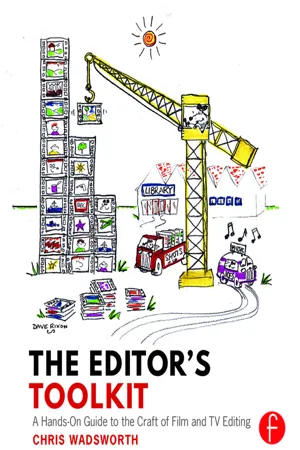
The Editor's Toolkit: A Hands-On Guide to the Craft of Film and TV Editing is a tutorial-based introduction to the craft of editing. Today's process of media editing is fast and competitive, making this guide a necessity for anyone looking to break into the business. Here, Chris Wadsworth provides 52 media-based examples for you to put together, with the benefit of seeing what he did with those same exercises, giving you essential feedback to improve your technique and learn the tricks of the trade. Accessible and to-the-point, the primer is a must-read for anyone looking to learn both the art and technique of editing. This 4-color guide features:
Examples from the world of film and TV that show how even the greatest directors employ the same techniques in their productions that are mentioned in this guide
A look at CV's and the right attitudes that will give you the best chance at breaking into the editing world
Intensive sections about the way music and sound editing can shape the entire production
A companion website featuring video and other media that you can edit on your own, each featuring examples of cuts and techniques discussed in the book as well as a discussion forum.
I have lost count of how many times I’ve been asked, by runners and youngsters just starting out in film or TV, whether I had any shot material with which they might practice their editing skills. I usually let them have copies of some rushes of a scene or two, with the understanding that first, the material is strictly for their personal use, and second, that I would like to see what they do with it. This seemed to work incredibly well, as those aspiring editors were able to compare what they did with my version.
Editing your own films is okay up to a point, but it’s not what you’re going to be doing if you take up editing as a career. The trouble with editing your own stuff is that you know exactly how it should go together. Also, there are no limits: your cut can be any length, any style and there’s no one around to say ‘Hang on, what if we …?’ Sadly, the real editing world is very different, and it seems to me this is where some media courses fall short in their teaching.
This book intends to solve that problem. What’s different here is that alongside the text there are exercises with clips of properly shot material for you to put together yourself, with some guidance if you want, and then I give you the chance to compare your version with what I did with the same material. Starting with examples as simple as joining pairs of shots together through to assembling chunks of real scenes, the exercises are carefully graded in complexity.
You will also be glad to know this book is not about software—well, not more than is necessary. This publication is the equivalent of showing you how to write a novel and not how to use a typewriter. With text explanations alongside the exercises, you will be able to explore all aspects of the craft of editing.
It was my ambition to write the text and design the exercises for all levels of experience. With luck, the combination of text explanations and practical exercises will take you—whether you’re an absolute beginner, keen amateur, or just starting your career in the business—through to a level of professionalism that will impress any future client or employer. I would hope that even the most experienced of you will get something out of this; I know I did, during the preparation of this publication.
It’s so magnificently rewarding to coax shots into sequences, sequences into scenes, and scenes into complete programmes or films that have the power to make us laugh, learn, cry, or fear.
Here’s your chance to do some of the same.
1.1 A Brief Introduction
Throughout the book, I will use the titles of mainly British TV programmes and various films as cryptic paragraph title names. Some of these titles will mean nothing to you, but please feel free to Google them.
If the programme title is just acting as a paragraph title, it will look like this:
Just a Film Title—It’s Only Acting as a Paragraph Title
And if the paragraph refers to a film or TV programme that you should search out and watch, it will look like this:
A Film Worth Watching (2015)—Give It a Watch Sometime!
I hope that is reasonably clear.
For a long time I resisted filling the book with movie or TV examples of technique, as I didn’t want this publication falling into the trap of becoming too worthy about the ‘art’ of filmmaking. But I realised that movie clips provided us with marvellous examples of the techniques we will be examining here. And, given that so many of these clips are available on the Internet, it seemed silly to exclude such references. I also tried to make the film or TV examples as modern as I could, but very often it’s the fact that a technique was being used for the first time that makes it worthy of comment.
Cartoon Time—A Little Bit of Light Entertainment
Helping us in this book is a character I bumped into at the BBC several years ago called Video Mickey.
He was (and is) drawn by a friend and fellow BBC editor, Dave Rixon, who kept us entertained with strip cartoons featuring Mickey and Claud the Cat, mixed in with some of the real personnel from the Television Recording Department of the BBC, or VT as it was known back then.
1.2 Do You Really Want to Be an Editor?
In order that you fully understand what you might be letting yourself in for, I’d better describe what an editor today actually does.
Starter for Ten—What Does an Editor Actually Do?
If asked, I would think most of the public would struggle to find an answer to the question of what an editor actually does. If any did manage an answer, they would probably allude to only a single aspect of an editor’s role. Yes, it’s joining shots together; yes, it’s selecting the best takes; and yes, it’s taking the boring bits out of football matches, but this would still only be a fraction of what editors can be called on to do in the process of making a film or TV programme.
If you think about it, the fact that the public is ignorant about the exact nature of our role is exactly how it should be, because, for the most part, editors try to hide what we do and let script, performance, and content take all the credit. It’s no wonder, therefore, that the question I posed at the beginning of this section is so difficult to answer.
On the Job—What Editors Have to Do
Let me list my thoughts about an editor’s role:
An editor uses a mixture of artistic and technical skills to assemble shots into a coherent whole. I think that’s how most of the public would answer the question about what an editor actually does. Remember though, a coherent whole is rarely conceived beforehand; rather, this usually evolves as the programme is put together. In other words, no one has a detailed architect’s plan of the programme to be made that is handed to you with the words: ‘Make that’.
An editor has a strong feeling for pace, rhythm, and storytelling. I can’t add to that!
An editor’s skill determines the quality and delivery of the final product. Yes, true, but you need good raw material in the form of script, performance, and photographed shots to achieve this.
An editor must work creatively with the layers of images, story, dialogue, and music. Yes, and in doing so, an editor effectively remoulds these elements to produce a pleasing result that is greater than the sum of its parts.
An editor plays a dynamic role in the making of a film and is often involved with editorial and selection issues. To a large extent this is up to you as an individual; however, I know of no director or producer who wants to be always in the driving seat. In fact, some really enjoy being a passenger after the stress of all that filming. The more your input is inventive and creative, the more you’ll be appreciated, and the more you’ll be left to get on with it. Bliss!
An editor reorders and tweaks content to ensure the logical sequencing and smooth running of a film or TV programme from whatever genre. It’s all true!
An editor acts as a fresh pair of eyes on shot material. One of the best and most appreciated of our roles is to be truly objective and impartial with all programme material.
An editor has to adapt built-in skills to deal with a wide variety of different programme styles. An editor is a Jack (or Jill) of all trades, and master of all trades as well.
An editor searches through tons of footage and puts together those clips that best tell a story that will hold a viewer’s attention. Yes, and this is especially true in the case of documentaries.
An editor experiments with styles and techniques, including the design of graphic elements. That’s the point! An element of experimentation is involved with every programme you work on, and solving a particular problem often requires a unique solution that was not previously thought of by the production team.
An editor quietly gets sequences to a high standard so that production (directors and producers mainly) can concentrate on wider issues and not get bogged down in the nittygritty. Freeing up a director’s time is also an important role for us.
An editor has to operate equipment that is sometimes complex and technical. Yes, and we have to keep up to date with any changes in that technology. The typewriter is changed quite often, and the keys keep moving around and increasing in number.
An editor has to mix and balance sound. A finished cut leaving your editing suite can still go straight ‘on the air’.
An editor has to be creative with multiple layers of video. Title sequences will call on every aspect of your creative input as well as your knowledge ...
Table of contents
Cover
Half Title Page
Title Page
Copyright Page
Dedication
Table of Contents
Foreword by Simon Ashcroft
Chapter 1. What Is This All About?
Chapter 2. Shots, Our Building Blocks
Chapter 3. Joining Shots Together
Chapter 4. Dealing with Dialogue
Chapter 5. Creating Sequences
Chapter 6. Scene Construction
Chapter 7. Joining Scenes Together
Chapter 8. Different Programme Styles
Chapter 9. Sound Matters
Chapter 10. Music, Music, Music
Chapter 11. Scenes of Style
Chapter 12. Video Manipulation
Chapter 13. Editorial Responsibility
Chapter 14. Timescales
Chapter 15. Projects—Crossing Ts and Dotting Is
Chapter 16. The Final Days
Chapter 17. My Last Bits of Advice
Chapter 18. In Conclusion
Appendix 1. Loading the Exercise Media
Appendix 2. A List of the Exercises
Appendix 3. My CV
Appendix 4. Abbreviations
Index
Trusted by 375,005 students
Access to over 1.5 million titles for a fair monthly price.
Study more efficiently using our study tools.
Frequently asked questions
Yes, you can cancel anytime from the Subscription tab in your account settings on the Perlego website. Your subscription will stay active until the end of your current billing period. Learn how to cancel your subscription
No, books cannot be downloaded as external files, such as PDFs, for use outside of Perlego. However, you can download books within the Perlego app for offline reading on mobile or tablet. Learn how to download books offline
Perlego offers two plans: Essential and Complete
Essential is ideal for learners and professionals who enjoy exploring a wide range of subjects. Access the Essential Library with 800,000+ trusted titles and best-sellers across business, personal growth, and the humanities. Includes unlimited reading time and Standard Read Aloud voice.
Complete: Perfect for advanced learners and researchers needing full, unrestricted access. Unlock 1.5M+ books across hundreds of subjects, including academic and specialized titles. The Complete Plan also includes advanced features like Premium Read Aloud and Research Assistant.
Both plans are available with monthly, semester, or annual billing cycles.
We are an online textbook subscription service, where you can get access to an entire online library for less than the price of a single book per month. With over 1.5 million books across 990+ topics, we’ve got you covered! Learn about our mission
Look out for the read-aloud symbol on your next book to see if you can listen to it. The read-aloud tool reads text aloud for you, highlighting the text as it is being read. You can pause it, speed it up and slow it down. Learn more about Read Aloud
Yes! You can use the Perlego app on both iOS and Android devices to read anytime, anywhere — even offline. Perfect for commutes or when you’re on the go. Please note we cannot support devices running on iOS 13 and Android 7 or earlier. Learn more about using the app
Yes, you can access The Editor's Toolkit by Chris Wadsworth in PDF and/or ePUB format, as well as other popular books in Media & Performing Arts & Film & Video. We have over 1.5 million books available in our catalogue for you to explore.