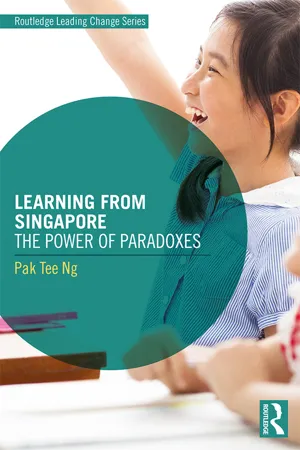
Learning from Singapore tells the inside story of the country's journey in transforming its education system from a struggling one to one that is hailed internationally as effective and successful. It is a story not of the glory of international test results, but of the hard work and tenacity of a few generations of policy makers, practitioners and teacher trainers. Despite its success, Singapore continues to reform its education system, and is willing to deal with difficult issues and challenges of change. Citing Singapore's transformation, author Pak Tee Ng highlights how context and culture affect education policy formulation and implementation. Showing how difficult education reform can be when a system needs to negotiate between competing philosophies, significant trade-offs, or paradoxical positions, this book explores the successes and struggles of the Singapore system and examines its future direction and areas of tension. The book also explores how national education systems can be strengthened by embracing the creative tensions generated by paradoxes such as the co-existence of timely change and timeless constants, centralisation and decentralisation, meritocracy and compassion, and teaching less and learning more. Learning from Singapore brings to the world the learning from Singapore—what Singapore has learned from half a century of educational change—and encourages every education system to bring hope to and secure a future for the next generation.
- 202 pages
- English
- ePUB (mobile friendly)
- Available on iOS & Android
eBook - ePub
About this book
Information
II
The Four Paradoxes
3
PARADOX 1
Timely Change, Timeless Constants
Singapore recognises that the recipe for success in the past is a ticket to doom in the future.
If you visit Singapore and talk with some teachers, you will probably hear them say the education system is always changing. Yet, in the same breath, they will also likely say that certain things just do not change at all (sometimes in exasperation)! They have unwittingly articulated a paradox of Singapore. Singapore is a land of change. It is also a land of constants. Singapore is always looking for timely change. It is also hanging on dearly to some timeless constants. Singapore is a land where change and continuity coexist and are equally valued.
Timely Change
Positioned at the top of global education rankings, the Singapore education system is widely seen to be successful by those standards. It has presumably found the recipe for success. Others have come to the island to learn its ‘secret’. Singapore has developed a reputation for a packed curriculum, didactic classroom teaching and rote learning. But if these were the features of the education system that have gotten it its stellar international rankings, Singapore seems to be abandoning them. Whatever the recipe for success was, Singapore appears to be discarding it.
Singapore is reforming its education system. Values, innovation, student-centredness, holistic education—these are the new catchphrases. But why does the education system need to change continuously, especially when it is so successful? Why abandon the recipe for success? That reminds me of Sir Humphrey Appleby, the senior civil servant, in the satirical book Yes, Prime Minister, who commented that one would not kick away the ladder one climbed up on, especially when one was still standing on it. He was of course referring to British politicians. He meant to say that politicians would not be so ‘courageous’ to abandon the strategy that has brought them success—not while they were still in power. Common sense, isn’t it? But Singapore seems to be kicking away the ladder that it has climbed up on while it is still on that ladder. The question is why.
Why Change?
The global economy that Singapore now participates in is driven by new technologies, business concepts and value propositions. Globalisation has shortened the distance between nations and cities. Technology is creating new businesses and destroying others. Times have changed. A quotable quote is now a tweetable tweet. Singapore can only continue to generate wealth if it can create and exploit knowledge, pursue new technologies and offer high level services. Singapore is a country that survives economically by doing business with the world. It has to adapt to changing global situations. Given its small size, it has to be in touch with global trends and stay ahead of the competition.
Singapore has done well economically for the past five decades. However, past successes do not guarantee future ones. Competition from emerging economies, such as China, India and Vietnam, is heating up. Prime Minister Lee Hsien Loong was understandably concerned:1
China and India alone have one billion workers altogether. Every year, millions of new graduates are entering the workforce… seven million [per year] from China… [and] if we add in some more from India, it is ten million a year, all hungry, looking for work. Quite formidable.
Formidable indeed, considering that the number of new graduates in big countries is larger than the entire population of Singapore. The challenge is heightened by rising costs in Singapore, which is a characteristic of maturing cities. Singapore’s robust economic fundamentals have attracted higher investments and capital inflows, pushing up the Singapore dollar. In 2015, the Economist Intelligence Unit (EIU) named Singapore as the world’s most expensive city.2 Land and property are expensive. The cost of owning a car is significant, as the government tries to control traffic in the congested city. (It can cost you more than $100,000 US dollars just to put a new Japanese twolitre sedan on the road.) Labour costs are high. Given that human resources are the only resource that Singapore has, Singapore needs a higher value proposition from its people to remain competitive. There is a need to change the nature of education in Singapore in a more fundamental way to create that higher value proposition. As Tharman Shanmugaratnam, who was Education Minister from 2003 to 2008, said:3
We have a strong and robust education system. It is a system well recognized for the high levels of achievement of our students, in all the courses we offer. Our students aim high, and do well by most international comparisons. In recent years we have begun repositioning our education system to help our young meet the challenges of a more competitive and rapidly changing future… Education has to evolve. We have to prepare for the workplace of the future, which will be very different from the past. If we think we are doing all we need to do because it has worked in the past, we will be blindsided by the changes happening around us.
Heng Swee Keat, who was Education Minister from 2011 to 2015, echoed these ideas:4
Many of the things we do today are good. But let us not keep good in the way of the better. If we keep all the good things, we cannot make way for the better things.
Thus Singapore has to kick away the ladder that got it to where it is now, while still standing on that ladder. It has to abandon its obsession with learning for examinations. It is now focusing on learning for life, embracing holistic education, and developing its young people to think critically and creatively. Singapore is now jumping to another ladder that can take the country further.
It is important to recognise the philosophy here. Singapore changes when it is still successful. One should not wait until one has a problem before one is forced to change. One changes before one has a problem. This is the essence of timely change. Timely change occurs in anticipation of the future. It is change launched from a position of strength rather than one of desperation. But it takes courage to change when one is successful. People around may not wish to change. Why change when the old formula has brought about so much success? Thus the change process in Singapore involves debates, persuasion and nudges. The system evolves surely but sometimes messily. It does not transform clinically or by magic.
Although ‘kicking the ladder while standing on it’ is a colourful way of expressing the spirit of change, it does not mean the system goes into a free-fall. Rather, the change is a carefully calculated risk, with well thought-through transit plans to shift the system from one state to another. Therefore, timely change requires wisdom as well. In a game of ‘chutes and ladders’, it is important to jump onto the next ladder, but not a chute that will cause the system to slide. Singapore was successful. But it recognises that the recipe for success in the past is a ticket to doom in the future. It has to reinvent itself in a way that is paradoxically both bold and careful.
In this area, Singapore has a crucial strength. Change is actually part of Singapore’s psyche. It is the central theme of the Singapore story. Founding Prime Minister Lee Kuan Yew said in 1967:5
Change is the very essence of life. The moment we cease to change, to be able to adapt, to adjust, to respond effectively to new situations, then we have begun to die.
Since independence, Singapore has understood that standing still was a ticket to doom. It was preoccupied with survival and focused on the future. Through the tough days of nation building, the relentless pursuit of reinventing itself against the odds has become embedded in the national psyche. Lee Kuan Yew spoke in 1969:6
It is the future that counts. We have to make the effort, to plan, to organise, so as to bring into being a more secure, more stable and more prosperous Singapore… Fortunately, the present generation has the courage to face difficult situations. So we have Singapore, making it possible for us to organise ourselves to preserve and safeguard the values that we all cherish.
The same spirit has been present throughout Singapore’s history. In the late 1990s, Prime Minister Goh Chok Tong echoed it when faced with the Asian economic crisis:7
We have gone through difficult times before: Confrontation in the 1960s, the British withdrawal in the early 1970s, and the severe recession in 1985. These crises have prepared us, as a nation, for the trials we face today. In time, how we surmount this regional crisis will become another chapter of the Singapore Story… We must do nothing to compromise our long term competitiveness, nor be rattled into taking unwise actions under pressure… But we need to organise ourselves to weather the storm, and use this period to gain a head start for the race ahead after the storm has subsided.
In the words of current Prime Minister Lee Hsien Loong:8
We worry all the time. People say we are paranoid, which I suppose we are and we need to be… Is it to be expected that a population of three-anda-half million citizens and maybe a million foreign workers will have the best airline in the world? The best airport in the world? One of the busiest ports in the world?… It is an entirely unnatural state of affairs…
Indeed, it was unnatural and still is. Singapore’s success comes not from the endowment of land or natural resources, but from the labours of tenacious and hard-working people. The nation emerged through a sudden baptism of fire. It matured through a long-suffering journey of change. But given that Singapore is now one of the top countries in international rankings, what is it still trying to change? Let me share with you examples from a few significant areas in our recent history.
From Quantity to Quality
While the Singapore education system may be recognised worldwide for its academic rigour and commitment to excellence, the education paradigm is shifting from a focus on quantity to a focus on quality. Simply acing examinations does not equip one for life! Curriculum and pedagogy must be changed so that students are truly engaged in the learning process where higher order thinking skills are honed. This is a century where people are digital natives and information (and misinformation) is easily available. Adaptability to change is going to serve one better and longer than paper qualification.
As part of the effort to focus on quality education, rather than examination results, the MOE launched in 2014 its framework of 21st century competencies to guide the development of education.9 This framework is a holistic approach to prepare students for future economies and society. Centred on a set of cores values—respect, responsibility, integrity, care, resilience, and harmony—the framework emphasises social and emotional competencies—self-awareness, self-management, social awareness, relationship management, and responsible decision-making. These form the foundation for children and young people to manage themselves and relate with others. To live in the globalised world, the following 21st century skills are necessary:
- Civic literacy, global awareness and cross-cultural skills
- Critical and inventive thinking
- Communication, collaboration and information skills
It is envisaged that every student who graduates from the Singapore school system will be a self-directed learner, a confident person, an active contributor, and a concerned citizen.
But one of the key hurdles to achieving holistic education is the obsession with examination results and getting children into elite schools, on the assumption that these factors ensure a good future. Singapore has made a few bold moves in this area. School ranking, which was instituted in 1992, was replaced by school banding in 2004 and abolished in 2012 to emphasise holistic education. The strategy, which used to be a key lever for school improvement, has outlived its usefulness and was finally scrapped. In 2013, Prime Minister Lee Hsien Loong announced that the PSLE scoring system would change from absolute points to wider grade bands. He said:10
One-point difference in the PSLE scores, 230 versus 231, may make all the difference in your secondary school posting. But at the age of 12, one examination, four papers and you want to measure the child to so many decimal points and say well, this one got one point better than that child? It is a distinction which is meaningless and too fine to make.
Prime Minister Lee reasoned that in doing so, students would not need to chase after the last decimal point. This would reduce excessive competition and stress among students. Teachers would also have the space to educate and develop the students more holistically. Singapore has slaughtered a few sacred cows in its own backyard.
The tertiary sector is also taking bold steps toward change. In 2014, the National University of Singapore (NUS) made a move to curb obsession with grades by implementing a ‘grade-free’ system for some modules. In this system, students will just be given a distinction, pass, or fail, in their modules instead of receiving the conventional A to F grades for their academic performance. The assessment will not form part of their Cumulative Average Point. The new system encourages students to explore courses that will make their education more holistic and develop qualities that go beyond their main subject areas.11 Nanyang Technological University (NTU), the world’s best young university (under 50 years old), allowed its students in 2014 to earn credits upon successful completion of online courses on the Coursera platform.12 In the next few years, NTU students will be given the option of completing a maximum of five elective modules online, so that they can skip a semester and even have an earlier graduation. With this saving of time, students are encouraged to select another course or take up research or work attachments.
High perfo...
Table of contents
- Cover
- Title
- Copyright
- Contents
- Acknowledgements
- I BACKGROUND AND INTRODUCTION
- II THE FOUR PARADOXES
- III THE FOUR DREAMS
- IV CONCLUSION
- Index
Trusted by 375,005 students
Access to over 1.5 million titles for a fair monthly price.
Study more efficiently using our study tools.
Frequently asked questions
Yes, you can cancel anytime from the Subscription tab in your account settings on the Perlego website. Your subscription will stay active until the end of your current billing period. Learn how to cancel your subscription
No, books cannot be downloaded as external files, such as PDFs, for use outside of Perlego. However, you can download books within the Perlego app for offline reading on mobile or tablet. Learn how to download books offline
Perlego offers two plans: Essential and Complete
- Essential is ideal for learners and professionals who enjoy exploring a wide range of subjects. Access the Essential Library with 800,000+ trusted titles and best-sellers across business, personal growth, and the humanities. Includes unlimited reading time and Standard Read Aloud voice.
- Complete: Perfect for advanced learners and researchers needing full, unrestricted access. Unlock 1.5M+ books across hundreds of subjects, including academic and specialized titles. The Complete Plan also includes advanced features like Premium Read Aloud and Research Assistant.
We are an online textbook subscription service, where you can get access to an entire online library for less than the price of a single book per month. With over 1.5 million books across 990+ topics, we’ve got you covered! Learn about our mission
Look out for the read-aloud symbol on your next book to see if you can listen to it. The read-aloud tool reads text aloud for you, highlighting the text as it is being read. You can pause it, speed it up and slow it down. Learn more about Read Aloud
Yes! You can use the Perlego app on both iOS and Android devices to read anytime, anywhere — even offline. Perfect for commutes or when you’re on the go.
Please note we cannot support devices running on iOS 13 and Android 7 or earlier. Learn more about using the app
Please note we cannot support devices running on iOS 13 and Android 7 or earlier. Learn more about using the app
Yes, you can access Learning from Singapore by Pak Tee Ng in PDF and/or ePUB format, as well as other popular books in Education & Education General. We have over 1.5 million books available in our catalogue for you to explore.