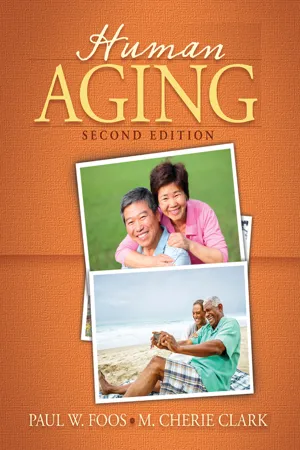
This text offers a readable and friendly presentation of the important methods, findings, and theories of human aging, while actively involving the reader in meaningful exercises and critical thinking. Students are repeatedly challenged to apply information in the text to the older adults in their own lives. Specifically, suggestions for enhancing the lives of their older relatives are offered and encouraged. These include guidelines for discussions they might have regarding social, emotional, and environmental changes as well encouraging intellectual and social interaction.
In this Edition:
Emphasis on the science of the study of aging and why questions in aging are difficult to answer, how social scientists attempt to handle such difficulties, and the successes and failures social scientists have had thus far in answering those questions.
The text also demonstrates how current research findings are now being applied in the real world and/or how they might be applied in the future.
Cross-cultural comparisons and ethnic group comparisons are included wherever possible.
Each chapter begins with "Senior View," which introduces students to a real person and gives them a chance to hear what older adults think and say about important issues related to the chapter and a chance to compare those opinions to the research findings.
Each chapter ends with "Making Choices," emphasizing the important behavioral, emotional, and social choices that students can make now to prolong a healthy, happy life.
"Chapter Projects" offer the opportunity for active learning, as students investigate for themselves an issue related to the chapter. Instructors can expand these projects for students who want to learn more, or for independent study.
"Focus on Aging" boxes compliment the material in the text, providing additional insight and examples, and encouraging critical thinking.
Every chapter includes discussion questions, study questions, chapter exercises, and related online resources.
Old age is like everything else. To make a success of it you have to start young.
—Fred Astaire
You have to start young. Regardless of how young, or old, you now are, you are continually becoming older. To make your aging successful, you need to start young and our text and this course will help you do just that. You will learn about things that typically change as we grow older and things that typically do not. You will learn that some change is beneficial while other change is not. We will examine the mind and body, our inner and outer selves, the society we live in, and the interactions among these different components of human aging. To give you an up close and personal view, each chapter will begin with the views of an older adult about the topics covered in that chapter. In our first Senior View, Dr. Joyce Shealy tells about her early introduction to the importance of learning, her relentless pursuit of education—sometimes in the face of obstacles—and her continuing quest to know more. She shows how the search for knowledge can be a habit, one that serves well into old age and one that brings lifelong fun. Let us begin the joy of learning about aging, about ourselves.
Why Study Human Aging?
Why study human aging? Why study older people? One might also ask why study children, history, poetry, or why study at all? A simple answer is that we study things so that we can know more about them. We want to know more about them because we as humans value knowledge and because knowledge can help improve our lives. One reason for studying human aging is that we value knowledge and want to learn more.
We also study aging because it is something that we all are doing every day, and hope to continue doing for many more decades. The alternative could be quite unpleasant. The study of human aging has direct relevance to the way we live. Every day that you live, you are aging, as are your family and friends. The things you learn from this book—and any other reading that you do—can influence the choices you make for yourself and your loved ones for the rest of your life. Another major reason for studying human aging is because you are human and you are aging. The things you learn may help you to age successfully.
Senior View
We talked with Dr. Joyce Shealy, professor emeritus of psychology at Queens University of Charlotte, North Carolina, about the importance of education and learning. Joyce was 80 years old when we spoke with her and recently retired from a career of over 40 years of teaching.
Joyce was born in Bucyrus, Ohio, and moved with her family to Chicago, then New Jersey, and finally to the South Carolina pecan farm where her family originated. We asked her to share the educational influences and experiences she had across her life. She said her father influenced her love of learning that has pervaded her life. She repeated his words of advice: Don’t get married right away; learn who you are first; never stop learning. Here is what she told us.
I spent 2 years at Winthrop University, where my mother went to school. Despite my mother’s urging to stay there, I needed to branch out. I wanted to go someplace else; my dream was New York. My parents let me transfer to the University of South Carolina in Columbia because that’s where my brother was and they believed he would watch over me. I earned my BA and MA in political science. Even then I had an interest in psychology as my thesis examined the personality characteristics of South Carolina legislators. I compared them to a control group of similar men who were members of a club my father belonged to. This was a fun study but my advisor published my thesis and put me in a footnote.
I had a hard time finding a job I really liked. I taught modern dance for a year and then taught history, political science, psychology, and sociology at Lees McRae College for another year. I served as faculty sponsor for a number of student organizations but still had the itch to see and do more. I moved back to Columbia and worked as a research assistant for the Bureau of Public Administration.
I was interested in personnel issues and my father thought a psychology degree was the best a person could get so I went to Ohio State to get another graduate degree, this time in industrial/organizational psychology. When I completed my MA, my professor told me that as a woman, I could not continue there for my doctorate in I/O psychology and should consider a counseling degree. That’s not what I wanted so I took the next semester off and moved to UNC Chapel Hill to work on my PhD.
My specialization there was in psychometrics and I was fortunate to have worked with Dr. Thurstone. When I finished, I got a research assistant position working in special education at the University of Delaware. However, I was not happy there as my heart was in the south, so I returned to North Carolina where I became a professor of psychology at Queens College (now Queens University) of Charlotte. I loved teaching and miss it now that I’ve retired. I still get together, once a year, with some former students who are now psychologists and judges. I also love learning and have not retired from that. I take classes at Wake Forest University and take advantage of other opportunities as they arise. I am now a docent at the Reynolda Museum and a volunteer at the humane society. I won’t stop learning and you shouldn’t either.
My advice is to continue your education.
Finally, we study human aging because that area of study is becoming more important with each passing year. A major reason for the importance of this area of study, and the increasing interest in aging, is because changes are occurring in the world population, particularly in countries such as the United States. The number and proportion of older adults in the U.S. population is likely to increase for quite some time. The growing number of older adults will impact everything in our lives. Here are just a few examples. Transportation will change as older drivers demand better public transportation. Older people vote in greater numbers than other age groups so policies and legislation will reflect their interests. More leisure and recreation opportunities will be developed in response to this large age cohort. Family dynamics may change as more grandparents and great-grandparents are available to give advice and help to younger people. Finally, this growing segment of the population will create job and career opportunities in fields that serve older consumers. The population is changing and the more we learn about it, the better equipped we will be to succeed.
Changes in Population
The number and proportion of older adults among the world population will continue to increase for the foreseeable future. In 1900, about 4 percent of the U.S. population was 65 and older (about 3 million people). In 1996, about 13 percent were 65 and older (about 35 million) (U.S. Bureau of the Census, 2000). It is not just that there are a greater number of older people; the population has grown and there are more people of every age. The important point is that the proportion of older people continues to increase. In 1900, 1 out of every 25 people was 65 and older. In 1990, it was 1 out of every 10. By 2030, it is expected that 1 out of every 4 or 5 will be 65 or older. That’s 85 million older Americans. This change is taking place in technologically advanced and industrialized countries all over the globe. Can you imagine how different things might be with such a large proportion of older adults? How old will you and your loved ones be in 2030?
There are a number of factors that are responsible for the drastic change in population including the unprecedented number of people in the baby boom generation, lower birth rate, and changes in life expectancy.
Soon there will be many more older adults.
Baby Boom Generation. The baby boom generation refers to those individuals born between 1946 and 1964. Following the end of World War II, there was a huge increase in the number of births as soldiers returned home to their families or married and began a family. There were feelings of victory, security, and prosperity and couples felt good about bringing children into these happy times. They were very successful at having babies and averaged close to three births per fertile woman (U.S. Bureau of the Census, 1989). This was the highest birth rate since right after the Civil War (1865–1900). The impact of the baby boom generation on society can be seen throughout history by looking at the growth of products and programs to serve the needs of the “boomers” and their families. The first wave of the baby boom generation will reach age 65 in the year 2011. The proportion of older adults in the population will continue to increase from 2011 until at least 2030.
Birth Rate. Following the great increase after World War II, birth rate has declined. The average number of births per fertile woman is now less than two and some experts expect the number to go as low as 1.7. The total proportion, as well as number, of older adults will be greater over the next several decades than it has ever been. This is where developing countries differ from developed nations. In developing countries, populations of older persons are not yet on the rise. While their birth rates are still quite high, their life expectancy remains low.
Lifespan and Life Expectancy. Lifespan refers to the maximum number of years that an organism in a species can live. Clearly, the lifespan for different species is very different and not many species live longer than humans do. Table 1-1 provides some examples
Table 1-1 Estimated Lifespans for Some Friends and Acquaintances
Queen honey bee
6 years
Rabbit
13 years
Cat
28 years
Cow
30 years
Dog
34 years
Tape worm
35 years
Gorilla
39 years
Alligator
56 years
Horse
60 years
Eagle
65 years
Elephant
70 years
Blue whale
80 years
Human
122 years
Tortoise
170 years
Italian cypress
2000 years
Bristle cone pine
5000 years
Source: Most of these estimated lifespans were taken from Comfort (1964) and Kimmel (1990).
of lifespans for several different common, and not so common, species. Cover the right column of the table and see if you can guess the lifespan for these different forms of life. These numbers come from reports from naturalists, scientists, zookeepers, and everyday people about the lives of animals that they have observed. They are not absolute values because it is possible that a member of that species might break the current record and live a little longer. At the same time, the numbers can be considered pretty good “ballpark” figures because these current records have, in many instances, stood for quite some time.
The estimated lifespan for humans was 120 years but since Jeanne Calment (see photo) had her 122nd birthday on February 21, 1997, and died in August 1997, 122 years is the current lifespan. Who is the oldest person alive today, and how old is he or she? While that may seem like a simple question, it is not. How do you determine a person’s age? What documentation do you use? A registered birth certificate is the most accepted record of age. However, many people born in the late 1800s either never had a birth certificate or no longer have that documentation, especially in countries where record keeping is not advanced. Regardless of how you answer that question, many older adults seem to be rapidly closing in on the record. Earlier this year Maria Esther de Capovilla of Ecuador celebrated her 116th birthday before passing away. What do you think should be required as proof?
Many scientists would argue that lifespan, once we figure out what it is, cannot be changed. (See Chapter 5 on longevity.) Life expectancy can, however, be changed and has changed since humans began recording such statistics. Life expectancy refers to the age at which half of a given birth group is expected to be living and half is expected to have died. Thus, we expect that for people born in 1993, half will live to be 75.4 years of a...
Table of contents
Cover Page
Half Title Page
Title Page
Copyright Page
Contents
1 An Introduction to Human Aging
2 Research Methods and Issues
Part One Aging and Our Bodies
Part Two Aging and Our Minds
Part Three Aging and Our Selves
Part Four Aging and Our Survival
Part Five Aging and You
References
Name Index
Subject Index
Photo Credits
Trusted by 375,005 students
Access to over 1.5 million titles for a fair monthly price.
Study more efficiently using our study tools.
Frequently asked questions
Yes, you can cancel anytime from the Subscription tab in your account settings on the Perlego website. Your subscription will stay active until the end of your current billing period. Learn how to cancel your subscription
No, books cannot be downloaded as external files, such as PDFs, for use outside of Perlego. However, you can download books within the Perlego app for offline reading on mobile or tablet. Learn how to download books offline
Perlego offers two plans: Essential and Complete
Essential is ideal for learners and professionals who enjoy exploring a wide range of subjects. Access the Essential Library with 800,000+ trusted titles and best-sellers across business, personal growth, and the humanities. Includes unlimited reading time and Standard Read Aloud voice.
Complete: Perfect for advanced learners and researchers needing full, unrestricted access. Unlock 1.5M+ books across hundreds of subjects, including academic and specialized titles. The Complete Plan also includes advanced features like Premium Read Aloud and Research Assistant.
Both plans are available with monthly, semester, or annual billing cycles.
We are an online textbook subscription service, where you can get access to an entire online library for less than the price of a single book per month. With over 1.5 million books across 990+ topics, we’ve got you covered! Learn about our mission
Look out for the read-aloud symbol on your next book to see if you can listen to it. The read-aloud tool reads text aloud for you, highlighting the text as it is being read. You can pause it, speed it up and slow it down. Learn more about Read Aloud
Yes! You can use the Perlego app on both iOS and Android devices to read anytime, anywhere — even offline. Perfect for commutes or when you’re on the go. Please note we cannot support devices running on iOS 13 and Android 7 or earlier. Learn more about using the app
Yes, you can access Human Aging by Paul W. Foos,M. Cherie Clark in PDF and/or ePUB format, as well as other popular books in Psychology & Developmental Psychology. We have over 1.5 million books available in our catalogue for you to explore.