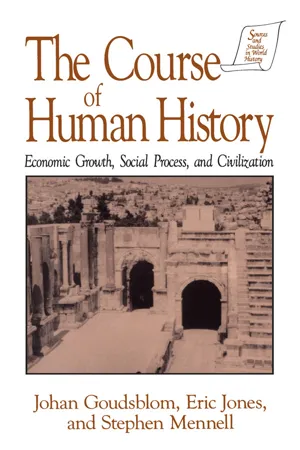
This text explores four major features of human society in their ecological and historical context: the origins of priests and organised religion; the rise of military men in an agrarian society; economic expansion and growth; and civilising and decivilising trends over time.
Human History and Long-Term Social Processes: Toward a Synthesis of Chronology and Phaseology
Johan Goudsblom
The Widening Range of “Human History”
The terms in the title of this chapter stem from two different, and diverging, traditions in European culture. First there is the idea of “human history” in the sense of “history of humanity.” This idea goes back as far as classical antiquity, where it culminated in St. Augustine’s bold attempt in The City of God to combine biblical history and pagan Roman history into one ecumenical history describing the vicissitudes of humanity from its earliest beginnings to the present.
The conception of an overarching human history has continued to inspire European writers well into the modern era. When viewed from a present-day vantage point, however, most of the works produced in this tradition appear to be hampered by some severe limitations. Instead of dealing with all of humanity, they actually followed only one particular strand in the history of humankind; what they did was to put the Greco-Roman and, ever since St Augustine, the Judeo-Christian world into a historical perspective by following an itinerary starting in Mesopotamia and leading in time through Egypt, Palestine, Greece, and Rome to Western Europe and North America (see Butterfield 1981).
Our ability to see the limitations of this trajectory is of course not simply a personal achievement. It is due to the development of human society itself, and in particular to the enormous growth of readily available knowledge, enabling us to perceive things that remained completely beyond the grasp of Herodotus and St. Augustine, or even Voltaire and Gibbon. Our view, compared with theirs, has expanded greatly both in space and in time.
The expansion in space is obvions. As European writers in the seventeenth and eighteenth century came to realize, the inhabited world was larger than the familiar stretch from the Tigris to the Thames. Yet even for Immanuel Kant, writing toward the end of the eighteenth century, the word “humanity” still expressed primarily an ethical ideal. He could not perceive it as the obvious—and in many ways menacing—reality which it has become for us today (cf. Elias 1985, 71). Whether we like it or not, we are reminded of this reality the moment we open up a newspaper or turn on the television news. We all know that, for better or for worse, the citizens of Western Europe, the political leaders in Washington and Moscow, and the masses of the poor in Asia and Africa are mutually connected by far-reaching political, military, and economic ties which—for all of us—strongly determine not only our present way of life but our very chances of survival. Global interdependency has become a hard and undeniable fact. Along with this, the need has arisen for a “human history” that is not restricted to the old familiar trajectory but encompasses the whole world.1
At the same time that our idea of human history is expanding in space, it is undergoing an even more spectacular expansion in time. There is increasing evidence that the human past reaches back much further than could have been known until fairly recently. The “classical” time perspective never went beyond a span in the order of seven to ten millennia. Even as late as the eighteenth century, the most enlightened minds had no empirical evidence of human records older than the Bible and Homer. They therefore could not possibly conceive of a human history or “prehistory” extending back further than three hundred generations—whereas today every encyclopedia tells us that the human past is to be measured not in hundreds but in tens of thousands of generations.
Not only can we now be certain that there are, and have been for many millennia, human groups living in virtually every part of the world, we also have some indication of the minimum time span of human habitation in different regions of the world. Thus we know that human (or hominid) groups were already living in the Americas more than 15,000 years ago, in Australia more than 40,000 years ago, in Europe more than 700,000 years ago, in Asia more than one and a half million years ago, and in Africa more than two and a half million years ago (cf. Wenke 1984; Scarre 1988). As these figures indicate, at the same time that our vision of human history is broadening vastly in scope, we are also able to draw its outlines with greater empirical precision.
The Primacy of Chronology in History
So much for the concept of “human history.” Now, before I proceed to link it to the concept of “long-term social processes,” I would like to make one more remark about “history” as such.
It is fair to say that history is a means for human groups to orient themselves to their past. Clearly, for this function, as for any form of intellectual orientation, some organizing principle is necessary. The most important organizing principle for history is chronology. Chronology, according to Webster’s dictionary, is “the science that deals with measuring time by regular divisions and that assigns to events their proper dates “ It is, in other words, an intellectual device which helps us to arrange events in a uniform, sequential order.
Now, such a sequential order is far from being self-evident, as all of us know from experience. We are all familiar with the difficulty of establishing, when recalling different events either out of our personal pasts or of a more public nature, which of these events came first, and, no less aggravating, how long was the interval between them. In order to cope with such problems we need, as Halbwachs (1950) showed, social benchmarks; these provide the chronology we need.
The oldest surviving—albeit not altogether reliable—attempt at constructing a chronology is the famous list of Sumerian kings (Jacobsen 1939). This, and successive lists of ancient Assyrian, Babylonian, and Egyptian kings, were drawn up originally for a use different from measuring time. Their immediate purpose appears to have been to establish the legitimacy of the ruling dynasty. For all we know, they contain numerous fabrications, as do, in all likelihood, the lineage lists in the Old Testament.
In the course of time, however, the lists of kings acquired a measure of “autonomy” as instruments for charting the past. The struggle for a more “objective” chronology, one that was less subject to the ideological interests of rulers, may still be witnessed in Greek and Roman historiography, for example in Thucydides’ meticulous ordering by season of events in the Peloponnesian war. In the long run, the Olympic Games in Greece, and the consulates in the Roman republic, came to serve as “objective” time grids—generally accepted means of orientation in the past, relatively independent from the rulers’ claims of legitimacy (see Bickerman 1980). Still, using the names of monarchs as the markers for a chronology is a custom that persists unto the present day: we still refer to “the reign of Victoria” or “the coronation of Elizabeth II” in order to pinpoint events in time.
A characteristic feature of all chronologies (and I now deliberately use the plural) is that originally they were all inherently place-bound. The list of kings of one country was not fit for another—as is still the case for us today: such concepts as “Georgian” or “Edwardian” do not apply to the European continent. In fact, all periodizations which are based on a chronological ordering of events—“Middle Ages” or “Renaissance” no less than “Tokugawa” or “Meiji”—are equally place-bound. They represent attempts to characterize larger spans of time within a given chronological order that is confined in space. The continued existence of different religious calendars in the contemporary world testifies to the fect that a uniform chronology for human history at large is not something that is automatically “given.”
Chronology and “Phaseology”
I now come to the second term in the title of this paper, “long-term processes.” This, as far as I know, is a comparatively new concept. Its origins, however, go back to a tradition that appears to be as ancient as the idea of “history”—the tradition, that is, of conceiving of the human past not in terms of the names and dates of individuals but in terms of impersonal stages or phases.
The idea that human society went through earlier stages before it reached its present condition was first recorded around the same time as the oldest lists of kings. The most familiar form this idea took was that of the image of a progressive deterioration of human life, from a golden age through a silver age to the present miserable iron age. The Assyrians knew this wretched tale, and it emerged again both in the texts of ancient Judaism and in classical Greek literature (West 1978, 172–77).
There is a marked contrast between, let us say, the book of Numbers with its long lists of lineages, enumerating every single father and eldest son on the one hand, and Hesiod’s description of the descent from the golden to the iron age on the other. Both provide orientation to the past. In the former case this is done by means of specific names, in the latter case through an evocation of general characteristics.
To take another example, think again of Thucydides’ great concern with chronology, and compare it with the way Plato and Aristotle wrote about what we would now call “social evolution” or, perhaps more properly, “social development.”2 They too were referring to the past when it suited their argument, but it was a fictitious and undated past, called up only to make certain points about the present. Thus Plato began his discussion of the variety of political institutions in the third book of The Laws with a digression on the successive stages of shepherds, farmers, and city dwellers—a digression which was very ingeniously composed but which lacked any claim to historical accuracy or veracity. The first book of Aristotle’s Politics contains a similar passage sketching how first the family arose, then the village, and then the city. Here too the author did not bother about historical evidence. The model served only as a stepping-stone to his theory of contemporary society in which he found the family and the village to be (rightfully) subordinate to the city.
This indeed can be said about all models of stages current in classical antiquity: they were designed primarily to explain conditions in the author’s present world by showing how these had arisen out of previous conditions. The models hardly ever contained any dates or names. They were typological and indifferent to chronology and might be called “achronous.” They all had a clearly evaluative tenor, as exhibited in the choice of the metals—gold, silver, and iron—to indicate the various phases. Most of the models also implied a sense of necessity. Whether the present state of affairs was decried as miserable as it was by Hesiod or appreciated positively as in Aristotle’s teleological conception of the city-state, it was invariably regarded as the climax in a series of stages.
Dealing with the past in terms of stages remained an element of European culture in medieval and modern times. It became a favorite intellectual device again in the nineteenth century for the leading sociological and anthropological theorists such as Comte, Spencer, Morgan, and Tylor (cf. Harris 1968). They were all very much aware that the human past was far more extensive than conventional chronology could account for and they therefore sought to design new, general schemes of the social evolution of humanity at large. Unfortunately the available historical record was insufficient to permit them to fill in their grand schemes with empirical detail. As a result, the ironic situation arose that at a time when historians such as Ranke and Michelet were becoming increasingly concerned with establishing the exact dates of events and with demarcating periods, some of their most brilliant counterparts in sociology and anthropology were taking a cavalier attitude toward chronological precision. What mattered to them was a theory of phases which might be used not only as a means of ordering the past but also for classifying contemporary societies and institutions. Their interest, we might say, lay not so much in chronology as in “phaseology.”
The word “phaseology”—which was used before by German evolutionary sociologist Müller-Lyer (1915)—may evoke derogatory associations, and not only because the mere addition of the letter “r” would turn it into a term of derision. Theories of phases, as developed in the nineteenth century, have come under an avalanche of criticism in the twentieth. Many of the objections raised (for example, by Popper 1957, and Nisbet 1969) pertain to the entire tradition of constructing phase models, from Plato and Aristotle to Marx and Spencer. Again and again, it has been remonstrated that the theories stemming from this tradition suffer from at least three serious defects: (1) they lack historic specificity and, consequently, testability; (2) they tend to mix factual and normative statements; (3) they imply a notion of inevitability and teleology. To these strictures may be added two others that have come very much to the fore in the last few decades: (4) they fail to explain the passage from one stage to the next, and (5) they are predicated upon the development of Western Europe and North America, and for this reason they are to be dismissed as “Eurocentric.”
Against this total rejection of stage models I would argue that, as means of orientation, chronology and phaseology both have advantages as well as disadvantages. All a chronological sequence tells us is that one thing came after the other; a succession of phases has the advantage of suggesting other relationships as well, and it therefore offers the possibility of an explanation. Herein lie both the strength and the weakness of phaseology; for the relationships which a model of stages suggests may sound very promising but on closer inspection prove to be either too vague to be testable or altogether spurious.
Another possible advantage of phase models is that they need not be inherently place-bound. Whereas each historical chronology was originally wedded to a specific dynastic or imperial center, the postulated schemes of successive stages were formulated in a way that was as indifferent to place as it was to time, and this made them, at least in principle, ecumenical. The terms in which they were couched were intended to be applicable to humanity at large. But then again, this very universality often made them unamenable to ready empirical testing.
The objections raised against the evaluative tenor and the notion of inevitability inherent in stage theories may be leveled against a great deal of nineteenth-century chronological historiography as well, concerned as it was with telling the stories of nations in terms of destiny and success. Nevertheless, these features of theories of social evolution were singled out for sharp criticism by such writers as Karl Popper and Robert Nisbet, who continued to recognize the spirit of Plato in virtually every attempt at discovering stages of social development.
What these critics have failed to acknowledge is that theories about social change themselves have changed, so that the objections leveled against Plato and Aristotle or even against Comte and Tylor need no longer pertain to them. One of the changes that has occurred is a shift in emphasis from “phases” to “processes.” This shift may also help to meet the objections that stage theories feil to explain the actual transition between stages and that they are implicitly “Eurocentric.”
Stages Within Processes: Elementary Sequential Models
The concept of “processes” may serve as an elaboration on that of “phases” or “stages.” It refers to sequences of changes in the course of which something is transformed from one phase into the next. At first sight, there appears to be a fundamental difference between processes and phases: the former seem to be dynamic—characterized by movement—whereas the latter seem to be sta...
Table of contents
Cover
Half Title
Title Page
Copyright Page
Table of Contents
Foreword
Introduction: Bringing the Very Long Term Back In
1. Human History and Long-Term Social Processes: Toward a Synthesis of Chronology and Phaseology
2. Ecological Regimes and the Rise of Organized Religion
3. The Formation of Military-Agrarian Regimes
4. Extensive Growth in the Premodern World
5. Recurrent Transitions to Intensive Growth
6. Civilizing and Decivilizing Processes
7. Asia and Europe: Comparing Civilizing Processes
Bibliography
Index
About the Authors
Trusted by 375,005 students
Access to over 1.5 million titles for a fair monthly price.
Study more efficiently using our study tools.
Frequently asked questions
Yes, you can cancel anytime from the Subscription tab in your account settings on the Perlego website. Your subscription will stay active until the end of your current billing period. Learn how to cancel your subscription
No, books cannot be downloaded as external files, such as PDFs, for use outside of Perlego. However, you can download books within the Perlego app for offline reading on mobile or tablet. Learn how to download books offline
Perlego offers two plans: Essential and Complete
Essential is ideal for learners and professionals who enjoy exploring a wide range of subjects. Access the Essential Library with 800,000+ trusted titles and best-sellers across business, personal growth, and the humanities. Includes unlimited reading time and Standard Read Aloud voice.
Complete: Perfect for advanced learners and researchers needing full, unrestricted access. Unlock 1.5M+ books across hundreds of subjects, including academic and specialized titles. The Complete Plan also includes advanced features like Premium Read Aloud and Research Assistant.
Both plans are available with monthly, semester, or annual billing cycles.
We are an online textbook subscription service, where you can get access to an entire online library for less than the price of a single book per month. With over 1.5 million books across 990+ topics, we’ve got you covered! Learn about our mission
Look out for the read-aloud symbol on your next book to see if you can listen to it. The read-aloud tool reads text aloud for you, highlighting the text as it is being read. You can pause it, speed it up and slow it down. Learn more about Read Aloud
Yes! You can use the Perlego app on both iOS and Android devices to read anytime, anywhere — even offline. Perfect for commutes or when you’re on the go. Please note we cannot support devices running on iOS 13 and Android 7 or earlier. Learn more about using the app
Yes, you can access The Course of Human History: by Johan Goudsblom,David M Jones,Stephen Mennell in PDF and/or ePUB format, as well as other popular books in History & Social History. We have over 1.5 million books available in our catalogue for you to explore.