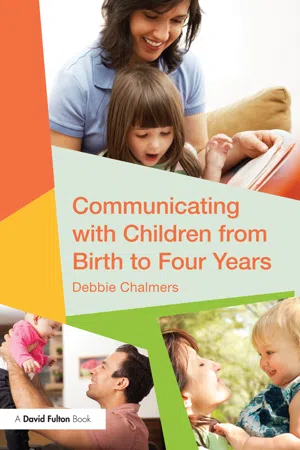
Developing Children's Communication from Birth to Four Years is an encouraging guide for practitioners and students working with young children in the Early Years Foundation Stage, which will also appeal to parents and family carers. Providing a clear outline of children's needs, responses and abilities at each developmental stage, it guides the reader on:
how to recognise and predict children's individual feelings and reactions
how to talk and listen to children at different stages
how to be aware of body language and other non-verbal forms of communication
how to support communication for children with special and additional needs
Offering advice, ideas and strategies for supporting relationships and understanding in diverse settings and at home, this book is an essential guide to developing communication and social skills in the early years.
From birth tiny babies communicate with their primary caregivers, whether parents, grandparents, nannies or other guardians. In waking moments they seek out a familiar human face for stimulation, comfort and security. Their little faces may be consumed by earnest expressions, which are a mixture of concentration and wonder. This shows us that their brains are absorbing information rapidly to allow their minds and bodies to develop, and it reminds us that another precious new life has just begun.
They will copy expressions such as frowns, closed eyes, wrinkled noses and tongues poking out and may move their mouths in attempts to mimic the movements of adults who are speaking to them. They may copy the smiles that are directed at them. These are not yet deliberate smiles to communicate happiness or serve as a greeting, but they are instinctive first attempts to please adults, to hold their attention and to make them want to continue the interactions.
Verity, aged two weeks, enjoys being held and talked to by a caring adult. She can only focus on a face that is close to hers, but concentrates hard to do so, moving her face and mouth in an attempt to mimic the expressions and sounds that she is hearing. The more the adult smiles and speaks to her, the more she tries to respond. This is rewarding for both of them, so they seek to continue the interaction until Verity becomes tired.
From the very beginning of babies’ lives, it is important that primary caregivers sing songs and lullabies and rock in time with the rhythms. This develops feelings of security and a sense of balance, as well as a strong emotional bond between adults and children. As babies grow older, hearing voices singing helps them to pay attention to rhythms and sounds within words, which prepares them for language development later on.
Early interactions
Between four and six weeks, a baby will begin to smile deliberately, having already learned that this attracts or maintains attention and brings the reward of satisfying and pleasurable interactions with familiar adults or older siblings. Family members and those who choose to work with babies respond to the small advances they make and so teach them the art of giving and taking turns in conversation from the very beginning. As it will be many months before they can communicate verbally, babies rely on body language and respond with expressions and actions when stimulated by their carers.
Figure1.1 Young babies form strong emotional bonds with adults who speak and sing to them.
Babies will now be able to make and maintain eye contact with familiar people who choose to continue this with them, and they will have enough control of their eye movements to follow carers as they approach or pass by, although their range of vision is still very limited and they will only see a face clearly when it is close to them. They may begin to reach out to touch faces and will take pleasure in their hands being held or stroked.
Lucy, aged two months, watches adults and older children intently as they approach her and moves her head to follow them. When they speak to her she makes eye contact and smiles and wriggles, which makes them more likely to speak to her again. When fully engaged in this type of interaction, Lucy makes noises of her own that mimic the sounds of words heard indistinctly, as if from a conversation a short distance away. Already, her brain is beginning to formulate the general sounds and the give and take nature of human speech.
Small babies use crying as a main form of communication. Their carers respond to the cries and seek to satisfy the babies’ needs, deciding whether they are hungry or thirsty, too hot or too cold, uncomfortable, unwell, bored, lonely, over- or under-stimulated or just tired. A confident adult or older child may soothe a baby with their presence, by holding, rocking or stroking or by speaking or singing.
Figure1.2 Babies are soothed by carers who hold them closely and talk to them confidently.
The use of ‘parentese’ language, in which words are simplified, repeated and exaggerated and a higher pitched tone of voice is used, attracts and holds the attention of the baby. Before the age of five or six months, most babies are fairly happy to be soothed and distracted by any appropriate and available caring adult and will seek to gain the attention of those around them.
Elliott, aged four months, is asked by his father, ‘Would you like a drink now? Are you ready for your milk?’ as he holds up his bottle. Elliott sees and smells the warm milk and wriggles a little in his arms in anticipation. Before the bottle touches his mouth he is already making a sucking motion with his lips and, as he begins to drink the milk, he closes his eyes for a moment and then opens them to gaze fixedly at his father’s face.
After a short time Elliott stops sucking and makes some small cries of discomfort. His father removes the bottle from his mouth and sits him up on his lap to rub his back. After a few moments, Elliott stops wriggling and crying and opens his mouth again. His father takes him back into his arms and replaces the bottle in his mouth and he sucks happily.
Personal care routines
A baby's desire to communicate is stimulated by feelings of comfort and pleasure. First attempts to establish close contacts will develop during feeding times, provided caring adults take time to hold babies close and maintain eye contact, while gently encouraging sucking and allowing them to take as much milk as they need and to enjoy it at their own pace.
When parents, siblings, other family members, friends or professional carers spend time feeding the same babies regularly, they become aware of their feelings and alert to their signals. Small wriggles of pleasure are recognised as different from squirms of discomfort and carers will know when to adjust a baby's position or temporarily stop feeding and attempt to bring up the baby's wind. They will also know when to gently encourage a sleepy baby to take a little more milk towards the end of a feed and when to stop feeding because the baby is uncomfortable, unhappy or full. This type of communication is instinctive and happens naturally. Both baby and carer read each other's signals and feel relaxed and confident in each other's company.
Figure1.3 Feeding babies regularly allows carers to become attuned to their feelings and signals.
If instinctive communication is missing, because a baby's needs are not recognised by a caring adult or regular care and attention is lacking in a baby's life, the ability to form strong bonds and attachments is adversely affected. The child is likely to have difficulty with relationships in the early years and beyond unless the situation is rectified in time. Without strong, secure relationships, consistent loving care and attention and adequate and appropriate stimulation, the development of communication skills will be delayed or may not follow the expected pattern.
Young babies like to hear familiar sounds and family noise around them because they are soothing and comforting. Silence can be frightening, especially if it comes too suddenly. While babies do need a quiet place to sleep, and should begin to learn quickly the difference between night and day using a lack of noise and light as clues, they will sleep when they are tired and are happy to drop off while being held or carried, or in a pram, cot or basket in the corner of a family room or nursery. They will also sleep in a car, pushchair or sling while the rest of their family or their carers go about essential business.
Putting small babies into a separate room some distance away from the group, and asking everybody to be silent while they sleep, can send a message to the baby that they are not wanted at that time and they must miss out on whatever is going on. Keeping them close and expecting them to sleep despite normal sounds and a low level of noise during the day communicates that they are still a part of the group and that they will be welcomed back as soon as they wake. A greater sense of security comes from the feeling that they are not alone and their needs will still be met as soon as they make them known. This can make them less likely to wake before they have slept enough and calm rather than fretful.
From a young age babies develop different types of cries to fit different situations. For example, the screaming in pain, the noisy cries of hunger and the fretful grizzling of tiredness are easily distinguishable and recognised by regular caregivers. This enables them to distinguish between more urgent needs that must be satisfied, with a feed, a nappy change or a change of position, and general discomfort, which may be relieved by the distraction of a toy, a song or a change of scene.
Gradually, as babies grow older, they use different sounds as well as crying, and begin to take turns in early conversations, listening to speech and then making some similar sounds in response, both while they are being spoken to and in any gaps left between sentences.
Different sounds and languages
Babies have to learn sounds before they can reproduce them. From their earliest months of life, babies can recognise certain familiar voices, distinguish between languages and show a preference for their mothers’ voices and the languages the mothers used while they were in the womb. They are born with experience in learning these languages, as the pitch, rhythm and sounds of the speech are already familiar to them.
Infants who use two or more languages with adults from their earliest days instinctively understand that they follow separate rules, systems and formats and effortlessly keep them apart and distinguish between them without conscious thought. Being multilingual from birth does not interfere with children's development in any way and they are expected to meet milestones at the same ages and stages as those who are monolingual.
Adults living and working with children should understand and remember that more than 70 per cent of the population of the world is bilingual and these people use two languages daily in their normal lives. Many use more than two languages and it is, in fact, a minority of people who speak and understand only one language. However, those who use a single language usually speak one that is widely used and understood throughout the world, such as English. When people travel to a new country to live, stay or work, they need to learn to understand and express themselves in the dominant language of that culture, while retaining their own first languages and their linguistic identity.
Bian, aged six months, is in her pushchair at the station with her brother, Arun, aged 17 months. Their mother is buying tickets for a future journey from the machine. Bian looks at Arun's face until he looks at her and smiles. She smiles back at him. He then makes a funny face at her, waving his head from side to side. She copies this expression and head movement too.
Arun then looks away and begins to fidget in the pushchair, so Bian looks at her mother instead, smiling and waving her arms, but her mother does not notice. Bian makes sounds to attract her mother's attention, but she is concentrating on the ticket machine and cannot look at the baby. Bian switches her attention back to her brother and makes sounds while looking at his face. Arun copies the sounds and then claps his hands. Bian lifts her arms again and almost brings her hands together to clap.
Babies crave attention from family members and familiar caregivers and enjoy interactions involving facial expressions, movements and sounds. When their basic needs are satisfied and they are looking only for entertainment, they are able to work out for themselves who is most likely to respond to them and are as happy to play with an older child as with an adult.
Stimulation and play
All humans are more likely to talk if they have something interesting to talk about and very young babies are no exception. Although they cannot yet use recognisable speech, they will vocalise as though making attempts at words if they are stimulated. Bright toys and objects in interesting shapes, their movements and the shadows they cast, the sounds they make and the textures they have if touched can stimulate babies to want to speak and encourage them to make sounds to express their feelings of excitement and to attract the attention of those around them. The desire to tell others of what they have discover...
Table of contents
Cover
Halftitle Page
Title Page
Copyright Page
Contents
Introduction
1 Starting at the beginning: birth to six months
2 Taking notice: six months to twelve months
3 Developing personality: twelve months to eighteen months
4 Branching out: eighteen months to twenty-four months
5 Fighting for independence: two years to two and a half years
6 Enlarging the social circle: two and a half years to three years 63
7 Finding a place: three years to three and a half years
8 Letting creativity soar: three and a half years to four years
Bibliography
Index
Trusted by 375,005 students
Access to over 1.5 million titles for a fair monthly price.
Study more efficiently using our study tools.
Frequently asked questions
Yes, you can cancel anytime from the Subscription tab in your account settings on the Perlego website. Your subscription will stay active until the end of your current billing period. Learn how to cancel your subscription
No, books cannot be downloaded as external files, such as PDFs, for use outside of Perlego. However, you can download books within the Perlego app for offline reading on mobile or tablet. Learn how to download books offline
Perlego offers two plans: Essential and Complete
Essential is ideal for learners and professionals who enjoy exploring a wide range of subjects. Access the Essential Library with 800,000+ trusted titles and best-sellers across business, personal growth, and the humanities. Includes unlimited reading time and Standard Read Aloud voice.
Complete: Perfect for advanced learners and researchers needing full, unrestricted access. Unlock 1.5M+ books across hundreds of subjects, including academic and specialized titles. The Complete Plan also includes advanced features like Premium Read Aloud and Research Assistant.
Both plans are available with monthly, semester, or annual billing cycles.
We are an online textbook subscription service, where you can get access to an entire online library for less than the price of a single book per month. With over 1.5 million books across 990+ topics, we’ve got you covered! Learn about our mission
Look out for the read-aloud symbol on your next book to see if you can listen to it. The read-aloud tool reads text aloud for you, highlighting the text as it is being read. You can pause it, speed it up and slow it down. Learn more about Read Aloud
Yes! You can use the Perlego app on both iOS and Android devices to read anytime, anywhere — even offline. Perfect for commutes or when you’re on the go. Please note we cannot support devices running on iOS 13 and Android 7 or earlier. Learn more about using the app
Yes, you can access Communicating with Children from Birth to Four Years by Debbie Chalmers in PDF and/or ePUB format, as well as other popular books in Education & Early Childhood Education. We have over 1.5 million books available in our catalogue for you to explore.