From the point of view of psychology and cognitive science, much of modern linguistics is too formal and mathematical to be of much use. The New Psychology of Language volumes broke new ground by introducing functional and cognitive approaches to language structure in terms already familiar to psychologists, thus defining the next era in the scientific study of language.
The Classic Edition volumes re-introduce some of the most important cognitive and functional linguists working in the field. They include a new introduction by Michael Tomasello in which he reviews what has changed since the volumes were first published and highlights the fundamental insights of the original authors. The New Psychology of Language volumes are a must-read for anyone interested in understanding how cognitive and functional linguistics has become the thriving perspective on the scientific study of language that it is today.
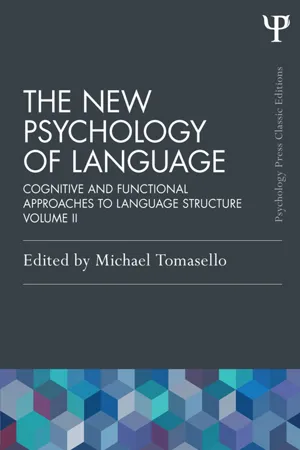
eBook - ePub
The New Psychology of Language
Cognitive and Functional Approaches to Language Structure, Volume II
- 278 pages
- English
- ePUB (mobile friendly)
- Available on iOS & Android
eBook - ePub
The New Psychology of Language
Cognitive and Functional Approaches to Language Structure, Volume II
About this book
Information
Publisher
Psychology PressYear
2014Print ISBN
9781848725942
9781848725935
Edition
1eBook ISBN
9781317693482
Chapter 1
Concept Structuring Systems in Language
University of Buffalo
This chapter is built around a selection of topics within the framework of cognitive semantics set forth in Talmy (2000a, 2000b). The topics here have been selected (with the help of Michael Tomasello) for their specific relevance to psychology. The framework is governed by certain major organizing factors, and several of these are briefly sketched now as a background for the topics discussed in greater detail later.
A universal design feature of languages is that their meaning-bearing forms are divided into two different subsystems, the open-class, or lexical, and the closed-class, or grammatical (see Talmy, 2000a, ch. 1). Open classes have many members and can readily add many more. They commonly include (the roots of) nouns, verbs, and adjectives. Closed classes have relatively few members and are difficult to augment. They include such bound forms as inflections (say, those appearing on a verb) and such free forms as prepositions, conjunctions, and determiners. In addition to such overt closed classes, there are implicit closed classes such as the set of grammatical categories that appear in a language (say, nounhood, verbhood, etc., per se), the set of grammatical relations that appear in a language (say, subject status, direct object status, etc.), and perhaps also the grammatical constructions that appear in a language.
One crucial finding here is that the meanings that open-class forms can express are virtually unrestricted, whereas those of closed-class forms are highly constrained, both as to the conceptual category they can refer to and as to the particular member notions within any such category. For example, many languages around the world have closed-class forms in construction with a noun that indicate the number of the noun’s referent, but no languages have closed-class forms indicating its color. And even closed-class forms referring to number can indicate such notions as singular, dual, plural, paucal, and the like, but never such notions as even, odd, a dozen, or countable. By contrast, open-class forms can refer to all such notions, as the very words just used demonstrate.
The total set of conceptual categories with their member notions that closed-class forms can ever refer to thus constitutes a specific approximately closed inventory. Individual languages draw in different ways from this inventory for their particular set of grammatically expressed meanings. The inventory is graduated, progressing from categories and notions that appear universally in all languages, through ones appearing in many but not all languages, down to ones appearing in just a few languages.
In accordance with the different semantic constraints on them, a further major finding is that the two types of classes have different functions. In the conceptual complex evoked by any portion of discourse, say, by a sentence, the open-class forms contribute most of the content, whereas the closed-class forms determine most of the structure. Thus, the inventory of’ conceptual categories and individual concepts that closed-class forms can ever express amounts to the fundamental conceptual structuring system used by language.
The concepts and conceptual categories in the inventory can be seen to cluster together so as to form several distinct extensive and integrated groupings, termed schematic systems. Each of these handles a certain portion of the concept structuring function of the whole inventory. One such schematic system—that of configurational structure—includes the schematic (often geometric) delineations that partition scenes, structure entities, and relate separate entities to each other within space or time or other qualitative domains. A second schematic system—that of force dynamics—covers the forces that one entity delineated by the first schematic system can exert on another such entity. This force dynamic system thus also covers all the various forms of causation. A third schematic system—that of perspective—governs where one places one’s “mental eyes” to look out over the scene whose delineations and force interactions have been determined by the first two schematic systems. And a fourth schematic system—that of distribution of attention—directs one’s attention differentially over the structured scene that one regards from one’s perspective point. The next four sections illustrate these four schematic systems.
SPACE-TIME CONFIGURATION
Several fundamental properties of the first schematic system, configurational structure, are sketched here. A further pervasive property of conceptual organization in language—a homologous structuring of space and time—is also demonstrated for this schematic system.
Figure-Ground Organization
In language, the spatial disposition of any focal object in a scene is largely characterized in terms of a single further object, also selected within the scene, whose location and sometimes also “geometric” properties are already known (or assumed known to an addressee) and so can function as a reference object (see Talmy, 2000a, ch. 5). The first object’s site, path, or orientation is thus indicated in terms of distance from or relation to the geometry of the second object. The sentences in (1) can illustrate. For their apparent relation, if not identity, to the figure and ground concepts in Gestalt psychology, these first and second scene objects are respectively termed the Figure and the Ground—capitalized to mark their specific func tion in language.
(1) a. The bike stood near the house.
b. The bike stood in the house.
c. The bike stood across the driveway.
d. The bike rolled along the walkway.
The bike’s site is characterized in (la) by near, in terms of distance from the house’s location (“proximal”). The bike’s site is characterized in (1b) by in, in terms of the house’s location and geometry (“colocational”+“part of interior”). The bike’s site and orientation are characterized in (1c) by across in terms of the driveway’s location and geometry (“colocational”+“one’s length perpendicular to the other’s length”). And the bike’s path is expresscd in (1d) by along in terms of the walkway’s location and geometry (“colocational”+“colinear with the long axis”). The bike functions as the Figure in all four sentences, while the house functions as the Ground in the first two sentences and the driveway does so in the last two. Throughout characterizations of this sort, it remains implicit that the Ground object can be used as a reference only by virtue, in a recursive manner, of its own known spatial disposition with respect to the remainder of the scene. That is, those spatial characterizations that are expressed overtly (as with prepo sitions) ultimately rest on certain further spatial understandings that are unexpressed.
The definitional functions that have here been isolated for a scene’s Figure and Ground are represented by the top entry in (2). These definitional functions are seen generally, though not absolutely, to correlate with other associated property differences between the two objects. The alignment is shown in (2):
(2)

It might be argued for cases like (1) that language simply relates two objects in space without any inequality of status, that is, without one object serving as reference for the other. But the semantic reality of their func tional difference can be demonstrated simply by interchanging the nominals, as in a sentence-pair like the following:
(3) a. The bike is near the house.
b. The house is near the bike.
One could have expected these sentences to be synonymous on the grounds that they simply represent the two inverse forms of a symmetric spatial relation. But the obvious fact is that they do not have the same meaning. They would be synonymous if they specified only this symmetric relation, that is. here, the small quantity of distance between two objects. But in addition to this, (3a) makes the nonsymmetric specification that the house is to be used as a fixed reference point by which to characterize the bike’s location, itself to be treated as a variable. These nonsymmetric role assignments conform to the exigencies of the familiar world, where in fact houses have locations more permanent than bikes and are larger landmarks, so that (3a) reads like a fully acceptable sentence. The sentence in (3b), on the other hand, sounds quite odd, and is thereby well flagged as semantically distinct from (3a). As the assertion of nearness is unchanged, the reason for the difference can only be that (3b) makes all the reverse reference assignments, ones that in this case do not happen to match the familiar world.
It might at first be thought that certain grammatical constructions, for example, the reciprocal, are means available in a language specifically to avoid assigning different referencing roles, which otherwise are inescapably imposed on a basic proposition in formulations like (3). But in fact, the reciprocal does not abstract the symmetric relation common to the inverse asymmetric forms, but rather adds the two together. This is shown by the fact that the reciprocal for the preceding example:
(4) The bike and the house are near each other.
sounds odd in just the same way as (3b) itself, that is, because of the implication that the house is somehow a floating entity to be fixed with respect to a stable bike.
As they specifically function in language, the Figure and Ground concepts can be characterized as follows:
(5) The general conceptualization of Figure and Ground in language The Figure is a moving or conceptually movable entity whose site, path, or orientation is conceived as a variable, the particular value of which is the relevant issue.
The Ground is a reference entity, one that has a stationary setting relative to a reference frame, with respect to which the Figure’s site, path, or orientation is characterized.
The Ground is a reference entity, one that has a stationary setting relative to a reference frame, with respect to which the Figure’s site, path, or orientation is characterized.
In a linguistic context, the Figure and Ground notions amount to semantic roles or “cases,” in the sense of Fillmore’s (1968) “Case Grammar.” The present notions, in fact, compete with those of Fillmore, and certain advantages can be claimed for them. Full comparison aside, one main difference is that four Fillmorian cases, “Locative,” “Source,” “Path,” and “Goal,” because they incorporate particulars of direction, fail to capture the crucial spatial factor they have in common: their function as reference object for a figural element, a function specifically delegated to our Ground notion. Further, because it names separate cases for several different incorporated directionals, Fillmore...
Table of contents
- Cover
- Half Title
- Title Page
- Copyright Page
- Table of Contents
- Introduction to the Classic Edition
- Introduction: Some Surprises for Psychologists
- 1. Concept Structuring Systems in Language
- 2. Discourse and Grammar
- 3. Human Cognition and the Elaboration of Events: Some Universal Conceptual Categories
- 4. Social Interaction and Grammar
- 5. Cognitive Processes in Grammaticalization
- 6. Pronouns and Point of View: Cognitive Principles of Coreference
- 7. On Explaining Language Universals
- 8. The Geometry of Grammatical Meaning: Semantic Maps and Cross-Linguistic Comparison
- 9. Regularity and Idiomaticity in Grammatical Constructions: The Case of Let Alone
- Author Index
- Subject Index
Trusted by 375,005 students
Access to over 1.5 million titles for a fair monthly price.
Study more efficiently using our study tools.
Frequently asked questions
Yes, you can cancel anytime from the Subscription tab in your account settings on the Perlego website. Your subscription will stay active until the end of your current billing period. Learn how to cancel your subscription
No, books cannot be downloaded as external files, such as PDFs, for use outside of Perlego. However, you can download books within the Perlego app for offline reading on mobile or tablet. Learn how to download books offline
Perlego offers two plans: Essential and Complete
- Essential is ideal for learners and professionals who enjoy exploring a wide range of subjects. Access the Essential Library with 800,000+ trusted titles and best-sellers across business, personal growth, and the humanities. Includes unlimited reading time and Standard Read Aloud voice.
- Complete: Perfect for advanced learners and researchers needing full, unrestricted access. Unlock 1.5M+ books across hundreds of subjects, including academic and specialized titles. The Complete Plan also includes advanced features like Premium Read Aloud and Research Assistant.
We are an online textbook subscription service, where you can get access to an entire online library for less than the price of a single book per month. With over 1.5 million books across 990+ topics, we’ve got you covered! Learn about our mission
Look out for the read-aloud symbol on your next book to see if you can listen to it. The read-aloud tool reads text aloud for you, highlighting the text as it is being read. You can pause it, speed it up and slow it down. Learn more about Read Aloud
Yes! You can use the Perlego app on both iOS and Android devices to read anytime, anywhere — even offline. Perfect for commutes or when you’re on the go.
Please note we cannot support devices running on iOS 13 and Android 7 or earlier. Learn more about using the app
Please note we cannot support devices running on iOS 13 and Android 7 or earlier. Learn more about using the app
Yes, you can access The New Psychology of Language by Michael Tomasello in PDF and/or ePUB format, as well as other popular books in Psychology & Developmental Psychology. We have over 1.5 million books available in our catalogue for you to explore.