- 340 pages
- English
- ePUB (mobile friendly)
- Available on iOS & Android
eBook - ePub
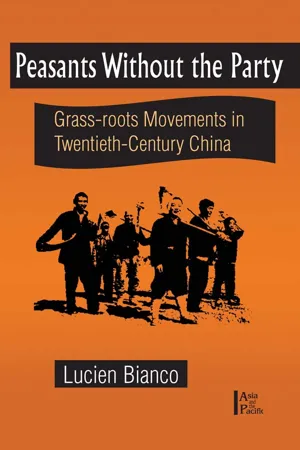
About this book
Exploring one of the most dynamic and contested regions of the world, this series includes works on political, economic, cultural, and social changes in modern and contemporary Asia and the Pacific.
The leading specialist on China's twentieth century peasant resistance reexamines, in bold and original ways, the question: Was the Chinese peasantry a revolutionary force? Where most scholarly attention has focused on Communist-led peasant movements, Bianco's story is one of peasant thought and action largely unmediated by modern political parties. This volume pays particular attention to the first half of the twentieth century when peasant-based conflict, ranging from tax and food protests to secret society conflicts, opium struggles, inter-communal conflicts, and tenant protests over rent, was central to nationwide revolutionary processes.
1

Secret Societies and Peasant Self-Defense, 1921–1933*
The effectiveness of secret societies’ defense against bandits and the military—The limits and ambiguity of secret society activity—The role of group defense
At the time the Chinese Communists were making their first experiments with rural revolutionary base areas, spontaneous peasant agitation (i.e., agitation not guided by professional revolutionaries) continued to be a fundamentally defensive response to a specific and local aggravation of the peasants’ condition. The peasants did not rebel against an exploitative established order, but against some new development posing a threat to that order. Had the status quo not been altered by the arrival of soldiers, bandits, locusts, the imposition of a new tax, or whatever, the peasants would not have rebelled. The essential difference between chronic peasant agitation and revolutionary action is that the latter is deliberately offensive in nature, whereas the former resembles the defensive reaction of a beleaguered organism. If peasant agitation was chronic (and thus a constant source of worry, not to say alarm, to officials), it was because the occasions for such conduct were endemic in rural China.1
Like spontaneous peasant agitation, as opposed to revolutionary action, the activities of rural secret societies were fundamentally defensive. … In ordinary times, the peasantry did not rely on secret societies for protection and assistance. But when all other means had proved unavailing, the peasantry might turn to secret societies for help. In certain rare cases and against certain adversaries, secret societies were better adapted to the peasants’ needs than were other, traditional forms of resistance.
It was particularly against incursions by bandits and by the military that secret societies demonstrated their effectiveness—or at least their relative effectiveness when compared with the available alternatives. Apart from the forces of order (it was precisely their defaulting that forced rural Chinese to take matters into their own hands)2 and the common practice of buying peace by paying the bandits whatever they asked for, the peasants’ main recourse was to village corps or self-defense groups (ziweituan, baoweituan). The self-defense groups were of two sorts: those composed of mercenaries (gu ziweituan) and those composed exclusively of villagers (ziweituan, or self-defense militia).3 The second category was apparently the more common. It was not uncommon for the village militia to rout small groups of bandits, capturing or killing some of them,4 or for self-preservation to persuade the bandits to prey on villages not similarly endowed with a militia.
Still, no matter how determined the village militia, it could not stand up against a large gang of bandits. For this purpose several neighboring village militias formed “associations,” “federations,” “alliances,” or “leagues” (lianzhuanghui, liancunhui). Such alliances were rare and usually short-lived, as peasants were seldom eager to defend a neighboring village. Furthermore, even though the authorities often encouraged the creation of village militias, they soon became alarmed if a militia grew too large or strong; indeed, a self-defense organization strong enough to provide effective protection against bandits, especially a village federation, ran the risk of being disbanded by the regular army. Thus there was an inherent limit on the growth of these self-defense organizations and also on their life-span. When encounters with the bandits were too costly to life and limb, the militiamen tended to get discouraged and give up. On the other hand, as soon as the immediate pressure from the bandits was relaxed, the other villagers lost interest in contributing to the militia’s equipment and training.5
It was here that, in a sense, secret societies took up the slack. In fact, they were frequently already involved at the “lower” levels of self-defense and sometimes even controlled a village federation.* More important, with memberships generally much larger than those of the self-defense organizations described above, secret societies could drive off any bandit bands that ventured into a region where they were firmly established. Their myriad branches, the close ties of their members, the sworn oath, the discipline, and the feeling of invulnerability—all these characteristics made them staunch opponents of bandit bands. On at least one occasion the contrast between their intrepidity and effectiveness and the timidity or indifference of the regular army made the army lose face so badly that jealous soldiers attacked the Red Spears (Hongqianghui) when they returned to the village.6
This was one of the paths—there were many others—that led secret societies from the fight against bandits to the fight against the forces of order. In fact, defense against bandits did not always precede conflicts with the authorities; it sometimes happened that the original call to action was directed against looting soldiers,** or, more often, against increased taxation. Still, protection against bandits remained, at the local level, a more frequent motive behind the creation or reactivation of a secret society. In 1920 and 1921, it was altogether natural that the Red Spears should appear and enjoy their first successes in the provinces (Shandong, Henan) in which banditry was most prevalent.7 As late as 1925, the most common reason for the population to turn to the Red Spears was for protection against bandits.8 At this stage it was common for soldiers and Red Spears to join forces against the bandits.
In the following years, however, conflicts between the military and the Red Spears multiplied. Taken separately, most of the incidents I have isolated beginning in 1927 involved conflicts with representatives of order as well as bandits. To illustrate the relationship between the two types of protection† and the extent to which secret societies could sometimes succeed, albeit briefly, in instigating rebellion, I shall describe in some detail the 1929 Red Spear uprising in eastern Shandong.
This uprising continued a tradition of several years’ standing. But in 1926 the large uprising aimed at the warlord Zhang Zongchang was centered farther west,9 and the eastern portion of the province remaining relatively quiet. In only one eastern county, Laiyang (in Dengzhou prefecture), do we find a strong concentration of Red Spears.10 In 1928, Laiyang was suddenly crisscrossed by village federations formed to halt a new wave of banditry; battles were constant, and several villages were destroyed.11 The uprising of 1929 can be said to have grown out of this agitation in the fall of 1928; in January 1929 the American consul in Chefoo (Yantai) reported that because of the Red Spears, not a single tax collector had ventured into Zhaoyuan county (north of Laiyang and also in Dengzhou prefecture) “for several months.”12 The magistrate of Zhaoyuan had resigned, and his successor was unable to enter the county to take up his post. Altogether, the upheaval lasted nearly a year, until fall 1929.
The causes of the movement were the already mentioned upsurge of banditry and, more important, the actions of the local military. General Liu Zhennian, a former officer of Zhang Zongchang, installed himself at Chefoo in October 1928 and established his authority over the eastern part of the Shandong Peninsula. In early 1929 a well-organized insurrection, intended to pave the way for Zhang Zongchang’s return, broke out at Longkou and Huangxian; Liu’s units immediately jumped into the fray on the rebels’ side.13 What followed was a private war, the cost of which was borne by the peasantry. Looting, burning, and the razing of entire villages were commonplace; women and young girls captured during “military” raids were sold at the market of Huangxian for ten to twenty Mexican dollars apiece. When the population tried to defend itself, it suffered pitiless reprisals: a village razed for the murder of an officer, eight villages destroyed and their inhabitants massacred for an attempt on Zhang Zongchang’s life.14 It was in these circumstances that the Red Spears extended their control over the rural population.
Sometimes membership in the Red Spears was compulsory, or at least the society set a quota of recruits to be furnished by a given village. By late summer, every family in the villages controlled by the society had to have at least one person in the Red Spears, and those who sent their men to work in Chefoo had to pay a special tax, which was used to buy arms and ammunition. Estimates of Red Spear membership in August 1929 ranged from 50,000 to 60,000.15 In Dengzhou (today Penglai, about fifty miles west of Chefoo), the administration was practically run by the Red Spears, who had set up their headquarters in a village there, named a magistrate, and begun to collect a land tax. The Red Spears had also introduced a head tax,16 while at the same time, at least in Zhaoyuan and several other counties, they prevented the payment of any tax whatever to the legal administration. And it was impossible for the legally designated military officials in the region to take up their duties: the Red Spears shot on sight anyone in a uniform. Even civilians dared not venture into the area held by the Red Spears unless they spoke the local dialect.17
Finally, when the Red Spears had grown so strong in Dengzhou that they could no longer be ignored, Liu began his oft-postponed campaign to regain control of the area. On September 23 he launched a large encirclement campaign between Huangxian and Dengzhou, burning and looting houses and killing the inhabitants or driving them away. Eighteen villages were totally destroyed, more than sixty others partly or wholly burned: men, women, and children were hunted down in the fields, and even mothers with babies in arms were slaughtered.18 The campaign lasted for two months: by the end of November, the Red Spears had practically ceased to function in Dengzhou prefecture. To win over those Red Spears who had escaped the slaughter—or were unable to get away—the magistrate of Zhaoyuan gave their defeated leaders jobs and formed a local militia of the rank-and-file members.19

No matter how great Red Spear strength was at a given time in the Dengzhou area, it was still destroyed with relative ease and (once the decision had been made, at any rate) rapidity. The situation was a familiar one. Competition among warlords for control; official failure to grasp the seriousness of the revolt (civil and military bureaucrats were so accustomed to the recurrence of minor troubles that they tended to go on applying routine measures even when a disturbance had reached dangerous proportions); localization of the dissidence in a confined area (the agitation in western Shandong in 1928 to 1929 was considerably west of Liu’s power base, and eight different petty warlords were fighting over the neighboring region to the west)20—all these factors often delayed punitive action against the rebels. Once a punitive expedition was sent out, however, it usually had little difficulty in suppressing the rebellion. (Destroying the secret society itself, of course, was a totally different matter.)
Tonghua county in southern Jilin provides another example. During late 1927 and early 1928, Tonghua was the scene of a rather large uprising instigated by the Big Knife Society (Dadaohui). Banditry and oppressive taxation were as usual the underlying causes of the revolt, though the immediate cause was an act of treachery by the authorities, who, after using the Big Knives against bandits, suddenly, on December 12, 1927, arrested several members of the society and seized the loot (money, horses, and arms) that they had just taken from the thieves. Indignation at this double-cross unleashed an uprising, which the first punitive expedition (January 12, 1928), composed exclusively of local forces, was unable to put down. But a second expedition, in which the local troops were reinforced by a contingent of cavalr...
Table of contents
- Cover
- Half Title
- Title Page
- Copyright Page
- Table of Contents
- Acknowledgments
- Abbreviations
- Introduction
- 1. Secret Societies and Peasant Self-Defense, 1921–1933
- 2. Reflections on Chinese Peasants and Revolution
- 3. A Peasant Revolution?
- 4. How Credible Are the Numbers?
- 5. Peasant Uprisings Against Poppy-Tax Collection in Suxian and Lingbi (Anhui) in 1932
- 6. The Responses of Opium Growers to Eradication Campaigns and the Poppy Tax, 1907–1949
- 7. Resistance to Land Rent, 1895–1949
- 8. Looting and Food Riots
- 9. Early Twentieth-Century Xiedou
- 10. Xiedou during the Second Half of the Twentieth Century
- 11. Peasant Responses to the Chinese Communist Party Mobilization Policies, 1937–1945
- 12. Peasant Resistance in the PRC
- 13. Weak Weapons
- Appendix 1: Time Distribution of Rural Disturbances
- Appendix 2: Cases of Peasant Resistance to Opium Eradication Campaigns, 1907–1949
- Appendix 3: Cases of Peasant Resistance to Opium Tax, 1896–1949
- Appendix 4: Geographical Distribution of Tenant Disturbances (1895–1949) According to Various Sources
- Appendix 5: Differences and Convergences Between Bernhardt’s and My Own Views
- Glossary of Chinese Terms
- Index
- About The Author
Trusted by 375,005 students
Access to over 1.5 million titles for a fair monthly price.
Study more efficiently using our study tools.
Frequently asked questions
Yes, you can cancel anytime from the Subscription tab in your account settings on the Perlego website. Your subscription will stay active until the end of your current billing period. Learn how to cancel your subscription
No, books cannot be downloaded as external files, such as PDFs, for use outside of Perlego. However, you can download books within the Perlego app for offline reading on mobile or tablet. Learn how to download books offline
Perlego offers two plans: Essential and Complete
- Essential is ideal for learners and professionals who enjoy exploring a wide range of subjects. Access the Essential Library with 800,000+ trusted titles and best-sellers across business, personal growth, and the humanities. Includes unlimited reading time and Standard Read Aloud voice.
- Complete: Perfect for advanced learners and researchers needing full, unrestricted access. Unlock 1.5M+ books across hundreds of subjects, including academic and specialized titles. The Complete Plan also includes advanced features like Premium Read Aloud and Research Assistant.
We are an online textbook subscription service, where you can get access to an entire online library for less than the price of a single book per month. With over 1.5 million books across 990+ topics, we’ve got you covered! Learn about our mission
Look out for the read-aloud symbol on your next book to see if you can listen to it. The read-aloud tool reads text aloud for you, highlighting the text as it is being read. You can pause it, speed it up and slow it down. Learn more about Read Aloud
Yes! You can use the Perlego app on both iOS and Android devices to read anytime, anywhere — even offline. Perfect for commutes or when you’re on the go.
Please note we cannot support devices running on iOS 13 and Android 7 or earlier. Learn more about using the app
Please note we cannot support devices running on iOS 13 and Android 7 or earlier. Learn more about using the app
Yes, you can access Peasants without the Party by Lucien Bianco in PDF and/or ePUB format, as well as other popular books in History & 20th Century History. We have over 1.5 million books available in our catalogue for you to explore.