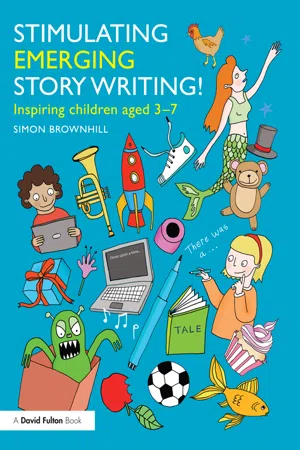
Stimulating Emerging Story Writing!
eBook - ePub

Stimulating Emerging Story Writing!

Inspiring children aged 3–7

  1. 154 pages
  2. English
  3. ePUB (mobile friendly)
  4. Available on iOS & Android
eBook - ePub

Stimulating Emerging Story Writing!

Inspiring children aged 3–7

About this book

Stimulating Emerging Story Writing! Inspiring Children aged 3-7 offers innovative and exciting ways to inspire young children to want to create stories and develop their emerging story writing skills. This practical guide offers comprehensive and informed support for professionals to effectively engage 'child authors' in stimulating story writing activities.

Packed full of story ideas, resource suggestions and practical activities, the book explores the various ways professionals can help young children to develop the six key elements of story, these being character, setting, plot, conflict, resolution and ending. All of the ideas in the book are designed to support a setting's daily writing provision such as mark making opportunities, role play and using simple open ended play resources.

Separated into two sections and with reference to the EYFS and Key Stage 1 curricula, this timely new text provides practitioners with tried and tested strategies and ideas that can be used with immediate effect. Chapters include:

  • Creating Characters
  • The Plot Thickens
  • Inspired Ideas
  • Resourcing the Story Stimulation

This timely new text is the perfect guide for inspiring young children aged 3-7 in the classroom and will be an essential resource for practitioners, teachers and students on both early years and teacher training courses.

Trusted by 375,005 students

Access to over 1.5 million titles for a fair monthly price.

Study more efficiently using our study tools.

Information

Publisher
Routledge
Year
2015
Print ISBN
9781138804845
eBook ISBN
9781317618850

Part IStory elements

DOI: 10.4324/9781315752679-2

Chapter 1Creating characters!

DOI: 10.4324/9781315752679-3

Being human!

A primary source of ‘character’ for young child authors is human beings. They come in a multitude of sizes and shapes, have different personalities and temperaments, wear various kinds of clothing, and move, talk and behave in exciting and strange ways. Angelou (in Brown Agins, 2006) quite aptly states that this “diversity makes for a rich tapestry”. With support from professionals, child authors can easily ‘unpick’ this tapestry, releasing from it wonderful human characters that can be captured in their own emerging story writing!

Early Years Foundation Stage

  • Encourage child authors to create simple characters based on human beings that are in their lives e.g. Mummy, Step Daddy, Brother Sam, Baby Jessica or Grampy. Suggest that they use the real actions of human beings as the basis of their emerging story e.g. ‘Dad fell down the stairs!’ (story dictation, Jonah, 3.6 years old), presenting an accompanying illustration which serves as a photograph that managed to capture ‘the action’!
  • Carver (2005) claims that ‘the surest way to make your readers care about the people in [a] story is to create and portray human characters who…talk as real people talk’. Get child authors to add speech-bubble-shaped paper or sticky labels to emerging story pictures to capture short examples of different parts of speech made by their human characters e.g. proper nouns (Auntie! Billy!), verbs (Sit! Listen!) and interjections (Oh! Boo!).

Key stage 1

  • One of the basic components that express a character’s character is their appearance (Boryga, 2011). Get child authors to create a distinctive ‘look’ for their lead human character by looking at illustrations in picture books, clothing magazines or via safe internet image searches. Ensure that this ‘look’ is expressed not only in any illustrations child authors present but is also described in their written story about being unique e.g. Fred wos scrufi. He had no hom. He wos a slip on the bentch. (‘Fred was scruffy. He had no home. He was asleep on the bench.’ Nazipa, 5.8 years old, story extract.)
  • Encourage child authors to ‘broaden their horizons’ when thinking about human beings as characters for stories about outings e.g. wider family members, local community members, historical figures, stars of the stage and screen or royalty. Create collaborative ‘3D character profiles’ by temporarily attaching descriptive sticky labels on the body of a human profile structure (a child author). Use these profiles to inform their subsequent story writing, titles of which might include Clever Cousins or The Smelly Queen!
Gold star!
In order to survive, human beings need food and drink. Keeping well fed and hydrated is also of great benefit to their learning, depending, however, on what they actually consume (see Ross, 2010)! Make freely available healthy snacks and drinks in the form of fresh fruit, vegetables and water as child authors mark make / write so that they can ‘Drink While They Think’ and ‘Nibble While They Scribble’ in an effort to aid the emerging story writing process. Also use food and drink as a stimulus for child authors’ mark making / writing – what happens to human characters when they consume different foods / drinks (think bananas and Eric Twinge aka Bananaman)?!

It’s all in the name!

One of the first decisions that child authors need to make is not just who is going to be in their story but what names they are going to give their characters, especially the lead protagonist (Klems, 2012). Memorable stories contain memorable characters that have memorable names – think The Gruffalo, Dora the Explorer and Spot (the dog). Professionals can support child authors to select or create names for their story character by using those that are found in baby books, telephone directories, newspapers, holy texts, film credits and street names on maps. Other inspiring suggestions are offered below!

Early Years Foundation Stage

  • Encourage child authors to orally decide on character names that have personal meaning to them e.g. those associated with their family / carers and friends, examples of which include Mummy, Pop (Dad), Mama (Grandma), Sally (their best friend) and the names of their (step)siblings. Encourage them to mark make / write an emerging story about the day they wake up to find their house is made of chocolate or the night they cannot get to sleep.
  • For non-human story characters suggest that child authors use pets’ names or simple names that are easy for them to sound out e.g. Tim, Bess and Meg; an alternative is to use the common name of the animal e.g. Duck, Cat and Dog. Get them to mark make / write an emerging story on grey paper that represents fog. Who do they literally bump into one fog-filled morning? Alternatively, consider using green paper to represent grass. ‘Who is hiding in the meadow?’

Key stage 1

  • Help child authors to appreciate how characters’ names can be based on / used to reflect their personality e.g. Mr. Happy (Hargreaves, 2008) and Grumpy (Disney’s Snow White and the Seven Dwarves). Use ‘think-alouds’ to explore this idea as a group / class (see Wilhelm, 2013). How does the character’s personality change in their written story when they fall in love, lose their keys or discover mice in the food cupboards?
  • Suggest that child authors embrace the practice of Stan Lee (Marvel Comics) by giving their story characters alliterative names – Pamela Pumpkin; Skippy Stanton – so that they are memorable to both the reader and child author. They could also offer a different spelling of a character’s name to make them memorable e.g. Jhon (John), Hanna (Hannah) or Alys (Alice). Get child authors to write a story which opens with a knock-knock-knocking on a door. ‘What happens when the door is answered? Who is behind the door? What do they want?’
Gold star!
It is not only character names that child authors can have fun selecting or creating; this could also apply to selecting or creating their own! A Series of Unfortunate Events by Lemony Snicket (2006) is actually the ‘pen name’, ‘nom de plume’ or ‘literary double’ for Daniel Handler. Suggest that child authors might like to write under a pseudonym for emerging stories that are going to be presented on a classroom display – can parents / carers / peers work out who actually wrote the story?

Act your age!

A basic consideration when constructing a character for a story relates to how old the character is. Hardy (2014) suggests that in some cases ‘age doesn’t matter’: is it really necessary to know the age of Pingu or Elmer (McKee, 2007)? It obviously helps if readers (and child authors) can relate to story characters in some way; one way of achieving this is by assuming that there is an ‘age match’. However, this does not necessarily mean that story characters have to behave in the way their age would suggest – think of Mrs Armitage and the Big Wave (Blake, 2000)!

Early Years Foundation Stage

  • Baby: Get child authors to close their eyes and imagine that they find a wand while playing in the back garden / local park. Encourage them to describe the great fun they have swishing it about until they accidently cast a magic spell over Step Mummy or Daddy who wake up the next morning and start behaving just like a baby! Get them to mark make / write an amusing emerging story about different things that they get up e.g. crying for a bottle, wanting to be cuddled, wearing a bib or sucking on a dummy!
  • Toddler: Invite child authors to think about their younger siblings who were / are at what is commonly referred to as the ‘Terrible Twos’ (or ‘Threenagers’) stage of their development. ‘What kinds of things did / do they get up to?’ (See http://tinyurl.com/nzsmgjx and http://tinyurl.com/cmbow5w for suggestions.) Use role play to bring these behaviours ‘alive’, encouraging child authors to mark make / write an emerging ‘turbulent tale’ about the noisy / messy mischief that the toddlers caused / cause e.g. tearing all the toilet paper off the roll, throwing all of the pots and pans out of the cupboards or picking the heads off the flowers in the garden. ‘Are they really being naughty?’

Key stage 1

  • Parent / carer: As a piece of weekend work, get child authors to follow a parent / carer around for a day, making a note / drawing pictures / taking digital images of all of the different things that they do e.g. making breakfast, washing the car, food shopping and mowing the lawn. Support child authors in using this information to either write a true ‘Day-in-the-life-of…’ story or a fictitious ‘Grown up day’ where they [the child author] have to take on the role of a parent / carer due to illness / absence / a dare!
  • Teenager: Children seem to either want to look and act older than they really are or are being forced to grow up too quickly (see DfE, 2011). Give child authors a piece of black card which has a keyhole...

Table of contents

  1. Cover Page
  2. Half-Title Page
  3. Title Page
  4. Copyright Page
  5. Dedication
  6. Table of Contents
  7. Acknowledgements
  8. Glossary and abbreviations
  9. Key stage bandings
  10. Introduction
  11. Part I Story elements
  12. Part II Stimulating emerging story writing provision and practice
  13. Conclusion
  14. References
  15. Index

Frequently asked questions

Yes, you can cancel anytime from the Subscription tab in your account settings on the Perlego website. Your subscription will stay active until the end of your current billing period. Learn how to cancel your subscription
No, books cannot be downloaded as external files, such as PDFs, for use outside of Perlego. However, you can download books within the Perlego app for offline reading on mobile or tablet. Learn how to download books offline
Perlego offers two plans: Essential and Complete
  • Essential is ideal for learners and professionals who enjoy exploring a wide range of subjects. Access the Essential Library with 800,000+ trusted titles and best-sellers across business, personal growth, and the humanities. Includes unlimited reading time and Standard Read Aloud voice.
  • Complete: Perfect for advanced learners and researchers needing full, unrestricted access. Unlock 1.5M+ books across hundreds of subjects, including academic and specialized titles. The Complete Plan also includes advanced features like Premium Read Aloud and Research Assistant.
Both plans are available with monthly, semester, or annual billing cycles.
We are an online textbook subscription service, where you can get access to an entire online library for less than the price of a single book per month. With over 1.5 million books across 990+ topics, we’ve got you covered! Learn about our mission
Look out for the read-aloud symbol on your next book to see if you can listen to it. The read-aloud tool reads text aloud for you, highlighting the text as it is being read. You can pause it, speed it up and slow it down. Learn more about Read Aloud
Yes! You can use the Perlego app on both iOS and Android devices to read anytime, anywhere — even offline. Perfect for commutes or when you’re on the go.
Please note we cannot support devices running on iOS 13 and Android 7 or earlier. Learn more about using the app
Yes, you can access Stimulating Emerging Story Writing! by Simon Brownhill in PDF and/or ePUB format, as well as other popular books in Didattica & Didattica per la prima infanzia. We have over 1.5 million books available in our catalogue for you to explore.