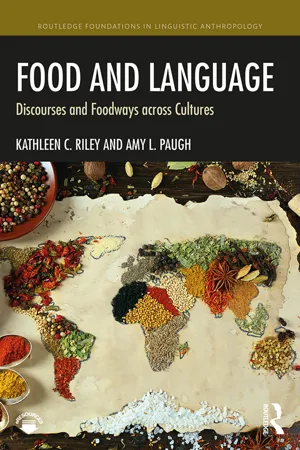
Food and Language: Discourses and Foodways across Cultures explores in innovative ways how food and language are intertwined across cultures and social settings. How do we talk about food? How do we interact in its presence? How do we use food to communicate? And how does social interaction feed us? The book assumes no previous linguistic or anthropological knowledge but provides readers with the understanding to pursue further research on the subject. With a full glossary at the end of the book and additional tools hosted on an eResources page (such as recommended web and video links and some suggested research exercises), this book serves as an ideal introduction for courses on food, language, and food-and-language in anthropology departments, linguistics departments, and across the humanities and social sciences. It will also appeal to any reader interested in the semiotic interplay between food and language.
The many connections between food and language seem obvious once we think about it: infants cry to communicate their need for milk, foods are labeled in ways that shape our consumption habits, and many of us talk on the phone while preparing dinner or Instagram the amazing dish we are about to eat. Talk about food comes in so many forms from grocery lists and TV cooking shows to nourishing coffee chats and famine relief web-sites. But despite the everyday co-occurrence of food and language in our lives, the two have only recently begun to be diced, mixed, and kneaded together by scholars.1
In this book, we bring together research from many disciplines to map out this emergent field of study. Our own approach comes from the discipline of anthropology, which is the holistic study of human beings and their many different ways of giving meaning to experience, past and present. We emphasize linguistic anthropology, the branch of anthropology that looks at language use as a social activity across cultures.2 This focus has drawn a number of linguistic anthropologists toward examining social interactions in which people are also engaged in making, eating, sharing, or simply talking about food.
In this introductory chapter, we sample many ways in which food and language are similar. We define several terms from the field of semiotics, the study of signs, needed to make sense of these food-language connections. Finally, we outline the four facets of the framework we use to organize the book: language through food, language about food, language around food, and language as food.
Food and Language: Exploring the Parallels
Perhaps the most obvious similarity between food and language is that both are oral obsessions; the mouth is the primary medium through which we savor them. But whereas language is apparently produced within us and exits the mouth to be consumed by others elsewhere, food is apparently produced elsewhere and enters the mouth to be consumed by us. The principal goal of this book is to probe how the production and consumption of both food and language are intertwined and circulated in complex ways both within and beyond ourselves.
First of all, neither food nor language is experienced only by way of the mouth. Every sense in our bodies is involved in producing and consuming them, making our engagement with both a multisensual experience. We feel the texture of both with our lips and tongues and teeth. For example, the crunch of a chip and the expletive “Damn!” are both palpable experiences of the mouth. But we also use our hands to prepare and eat food, feeling the flora and fauna that we harvest and butcher, dice and stir-fry, ladle out and bring to our lips. Similarly, we use our hands to nuance or sign our language and to feel the pages of a book, the texture of the keyboard, or the raised dots of Braille for the visually impaired. We comprehend language with our ears, from whispers to oratory, as well as with our eyes when we read a book, understand sign language, or interpret body language. But we also use our eyes and ears to appreciate food: the shapes and colors in the garden and on the plate as well as the sounds of peas snapping, meat sizzling, soup slurping… And, of course, taste and smell have everything to do with enjoying or rejecting food, but do these two senses have any role to play in language?
Figure 1.1 Copenhagen street food market, Denmark
Credit: Photo by Shane Rounce on Unsplash
Well, if we expand the term language, as we will be doing in this book, to include the many ways in which humans communicate, it becomes clear that taste and smell have roles to play in “language” as well. For instance, think about the use of perfume or cologne to signal physical appeal and the use of food gifts such as a jar of homemade jam or a donation of a Heifer International water buffalo to an impoverished family to express emotions and social concerns.
Our multisensual experience of both food and language points to a second fundamental parallel: our language and food habits both live within us as embodied forms of knowledge and practice that we acquire through everyday social interactions. This is what the sociologist Pierre Bourdieu (1977, 1985) called habitus, referring to the deeply embedded ways of being and understanding the world. Because of our constant exposure to our own community’s tastes and speech patterns, we rarely question the essential rightness of these ways of doing, thinking, and feeling. Anthropologists refer to this phenomenon as ethnocentrism.
For instance, many Americans believe that they speak English without an accent and sometimes enjoy acting out the accents of people from other parts of the United States or from Australia or India because we feel in our gut that they are the ones with the real accents (an attitude known as linguacentrism). Similarly, in the case of food, we may feel a visceral disgust at the thought of eating certain foods that we have not grown up eating. American students in our anthropology classes sometimes react with horror-stricken faces when offered taste-tests of seaweed, snails, or crickets, all items that are considered consummately edible elsewhere in the world. In other words, what we think and feel about food and language is unconsciously socialized and stored in our bodies at a time that predates memory, making it sometimes difficult for us to learn or even consider other ways of speaking or eating. Have you ever struggled to acquire a second language or to enjoy a new ethnic cuisine? What is clear to researchers is that our linguistic (language-related) and alimentary (food-related) habits and attitudes are not only acquired early but also in interwoven ways.
Finally, both food and language serve to bind communities, to define differences between communities, and to resolve or escalate conflicts across boundaries. And they both do this in multimodal ways. That is, the many sensual aspects—tastes, smells, sounds, sights, and touch—of both food and language circulate between individuals and communities using a number of modes, channels, or media. These modes include vocal and facial expressions, hand and body gestures, spoken or manual language, paper and electronic writing, music and dance, visual images (from petroglyphs to film) and, of course, food. Multimodal flow can occur face-to-face around a campfire with an exchange of smiles, an interjection of ‘yum’, and a toasted marshmallow on a stick. Or it can happen virtually via electronic media. For example, think of how those who live transnationally use both language and food to stay in touch with their friends and family at home: texting transmits verbiage only, phones add the aural qualities of the voice, and Skype offers up the situated visuals.
Figure 1.2 Caffeinated cave art
Credit: Danny Shanahan/The New Yorker Collection/The Cartoon Bank. Reproduced with permission.
Yet these same sights, sounds, smells, and tastes may also set these newcomers apart from their neighbors, who may not only mock the incomprehensible “gibberish” of the immigrants next door, but also complain about what is cooking in their kitchen or what their children are bringing to school in their lunch boxes. This is a perfect example of how the production and consumption of both food and language are not only multisensual and multimodal processes, but also governed by habitus in ways that lead sometimes to revelry and sometimes to bigotry. Thus, this book explores the intertwined roles played by food and language as communicative media across cultures past and present around the globe.
Foodways and Discourses, Material and Symbolic
In order to understand how food and language operate as multisensual and multimodal systems, we need to introduce and define a few terms here that will be essential to our discussion throughout the book, beginning with the words material and symbolic. Material is used to refer to the concrete stuff of the world, those tangible factors that have a real impact on our actual lives. Foods are material objects that we take into our material bodies. Symbolic is used to mean the abstracted notions and ways in which we think and communicate about our lives. Language, for instance, is a system consisting of conventionally agreed upon symbols used for communication. However, it will quickly become obvious that although the material and symbolic are traditionally presented as a dichotomy, along the lines of the so-called mind-body divide, they are not opposites and are in fact intermingled as commonly as are food and language.
Another two technical, but indispensable, terms for our discussion of food and language are foodways and discourses. The word foodways covers all the material and symbolic ways in which humans “do food” in both everyday and formal settings. In other words, it includes how we grow, cook, exchange, store, eat, compost, and communicate through, about, and around food, constructing both actual food as well as the notion of nourishment. The term foodways is more all-encompassing than food alone. Additionally, it indicates the cultural specificity with which we give meaning to the fulfillment of this critical human need.
Similarly, the term discourses can be used to refer to all the material and symbolic ways in which we “do language” in both everyday and formal settings. By “doing language” we mean engaging in communicative practices of all kinds, linguistic and paralinguistic (meaning alongside language). Linguistic communication includes written, signed, and spoken acts, such as jokes, compliments, or complaints, as well as genres, such as prayers, gossip, or lectures. Paralinguistic communication includes voice qualities, vocalizations such as sighs and gasps, facial expressions such as smiles and winks, and body language such as a thumbs-up or timid crouch, as well as dress, hairstyle, perfume, and so on.
We use the term discourse to refer to the activity of communicating. We use the plural of this term, discourses, to refer to the specific discursive acts circulated as well as the ideologies carried by the utterances. Ideologies include cultural beliefs, values, and assumptions that we pick up unconsciously from others, whether or not they are in the best interests of ourselves or others; ideologies are made powerful by both big media pronouncements and our own daily interactions. Some scholars use two terms, big D Discourse(s) and little d...
Table of contents
Cover
Title
Copyright
Contents
List of Illustrations
Preface
Copyright Acknowledgements
1 Introduction: Talking Food Across Cultures
2 The Communicating Eater
3 Procuring and Processing Food-and-Language Data
4 Language Through Food
5 Language About Food
6 Language Around Food
7 Language As Food
8 Applying the Food-and-Language Model
Glossary
Appendix: Ethnography of SPEAKING- and-FEEDING
Index
Trusted by 375,005 students
Access to over 1.5 million titles for a fair monthly price.
Study more efficiently using our study tools.
Frequently asked questions
Yes, you can cancel anytime from the Subscription tab in your account settings on the Perlego website. Your subscription will stay active until the end of your current billing period. Learn how to cancel your subscription
No, books cannot be downloaded as external files, such as PDFs, for use outside of Perlego. However, you can download books within the Perlego app for offline reading on mobile or tablet. Learn how to download books offline
Perlego offers two plans: Essential and Complete
Essential is ideal for learners and professionals who enjoy exploring a wide range of subjects. Access the Essential Library with 800,000+ trusted titles and best-sellers across business, personal growth, and the humanities. Includes unlimited reading time and Standard Read Aloud voice.
Complete: Perfect for advanced learners and researchers needing full, unrestricted access. Unlock 1.5M+ books across hundreds of subjects, including academic and specialized titles. The Complete Plan also includes advanced features like Premium Read Aloud and Research Assistant.
Both plans are available with monthly, semester, or annual billing cycles.
We are an online textbook subscription service, where you can get access to an entire online library for less than the price of a single book per month. With over 1.5 million books across 990+ topics, we’ve got you covered! Learn about our mission
Look out for the read-aloud symbol on your next book to see if you can listen to it. The read-aloud tool reads text aloud for you, highlighting the text as it is being read. You can pause it, speed it up and slow it down. Learn more about Read Aloud
Yes! You can use the Perlego app on both iOS and Android devices to read anytime, anywhere — even offline. Perfect for commutes or when you’re on the go. Please note we cannot support devices running on iOS 13 and Android 7 or earlier. Learn more about using the app
Yes, you can access Food and Language by Kathleen C. Riley,Amy L. Paugh in PDF and/or ePUB format, as well as other popular books in Languages & Linguistics & Linguistics. We have over 1.5 million books available in our catalogue for you to explore.