- 304 pages
- English
- ePUB (mobile friendly)
- Available on iOS & Android
eBook - ePub
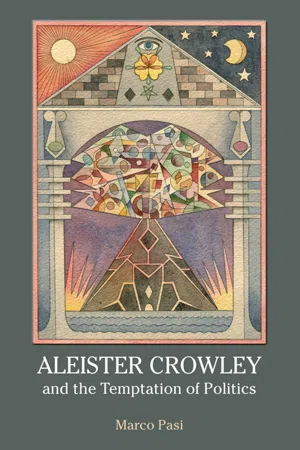
Aleister Crowley and the Temptation of Politics
About this book
Aleister Crowley (1875-1947) is one of the most famous and significant authors in the history of western esotericism. Crowley has been long ignored by scholars of religion whilst the stories of magical and sexual practice which circulate about him continue to attract popular interest. "Aleister Crowley and the Temptation of Politics" looks at the man behind the myth - by setting him firmly within the politics of his time - and the development of his ideas through his extensive and extraordinarily varied writings. Crowley was a rationalist, sympathetic to the values of the Enlightenment, but also a romantic and a reactionary. His search for an alternative way to express his religious feelings led him to elaborate his own vision of social and political change. Crowley's complex politics led to his involvement with many key individuals, organisations and groups of his day - the secret service of various countries, the German Nazi party, Russian political activists, journalists and politicians of various persuasions, as well as other writers - both in Europe and America. "Aleister Crowley and the Temptation of Politics" presents a life of ideas, an examination of a man shaped by and shaping the politics of his times.
Information

… one Crowley, a person of unspeakable life …
(W. B. Yeats, letter to Lady Gregory, 28 April 1900)
Status quæstionis
In this chapter, I will retrace the salient moments in the life of Aleister Crowley.1 But first I would like to make a few remarks about sources, which are made necessary by the peculiarity of the subject. Crowley has attracted the attention of a good number of authors, and in the last sixty years a good number of biographies and monographs devoted to him have been published.
John Symonds (1914–2006), whom Crowley himself designated as his literary executor, is the author of the biography considered by many as the “standard” one. Crowley, before his death, allegedly asked Symonds to take care of the publication of his unpublished works and of preparing new editions of those published during his life, also giving him the task of making sure that his wishes concerning the revenues from the copyright would be respected.2 By virtue of this, after Crowley’s death, Symonds had the opportunity to look through all his manuscripts, original documents, diaries and letters; and his reconstruction was based on this material. Between 1951 and 1997, Symonds’s biography went through several editions, often with changes and added material.3 Practically everyone who has taken any kind of interest in Crowley has referred to Symonds’s work. However, it certainly has its critics – sometimes very harsh, too, and usually from “Crowleyan” milieus.
What are the faults that these critics perceive in Symonds’s biography? They mainly accuse it of being very biased, of presenting only the negative traits of Crowley’s character and of having not in the least understood the meaning and goal of his work. It is true that, if a careful reader compares the sources used by Symonds and analyses the way in which he has used them, he cannot but notice how his biography is tendentious on several points, and how it shows a certain preconceived hostility toward Crowley. Perhaps it is worth giving an example. Referring to the way in which Crowley “cured” the neurosis of one of his disciples, Symonds writes:
Crowley cured psychoses and neuroses in this wise. He saw that the mind or psyche was divided into a conscious and subconscious level; that was part of the occult tradition. The notion of the subconsciousness as a dynamic and disturbing force he took from Freud, without any acknowledgment. It would have been difficult for Crowley to have made this acknowledgment in the light of his belief in himself as the greatest living psychologist.4
This remark is inaccurate to say the least; one need only flip through The Confessions, Crowley’s voluminous autobiography, to find abundant explicit references to, and implicit acknowledgement of, not only Freud and his theories, but also Carl Gustav Jung.5 Crowley also wrote a short essay on psychoanalysis, which was published in Vanity Fair in 1916.6 It may be true that he considered himself the greatest living psychologist, but ordinarily he had no problem acknowledging ideas he borrowed from others.
The above passage is merely one of many examples of the hostility Symonds indisputably shows towards Crowley. And yet, on the other hand, the wealth of documentary material placed at his disposal still enabled him to produce so complete a reconstruction that his biography remains indispensable today for those who want to do less prejudiced research on Crowley, and to some extent even for Crowley’s current followers.7
Symonds’s most outspoken critics have undoubtedly been Israel Regardie (1907–1985) and Gerald Suster (1951–2001). Israel Regardie was a highly important figure in twentieth-century Anglo-American occultism, and was also Crowley’s personal secretary and disciple from 1928 to 1931.8 His fame is due principally to the publication of the rituals of the Golden Dawn, the magical order to which both he and Crowley belonged.9 In the late 1960s, after having read Symonds’s work, Regardie decided to write a kind of “counter-biography” of Crowley. The result was the publication, in 1970, of The Eye in the Triangle.10 In this book, Regardie, taking advantage of his training as a Reichian psychoanalyst, endeavours to give a more sympathetic interpretation of Crowley, although not concealing the more negative, or even pathological, aspects of his character. Regardie’s study offers many interesting insights for understanding Crowley’s way of thinking, motivations and aspirations, and has helped me to understand the meaning of his magical practices by providing an “insider’s view”. However, apart from a few useful corrections and clarifications, it offers few factual details that are not already present in Symonds’s work.
Almost twenty years later, in 1988, Gerald Suster published his book on Crowley, The Legacy of the Beast.11 Suster was a very active figure in Crowleyan circles in England.12 Much the same can be said of Suster’s book as of Regardie’s. Although offering no new elements of great relevance, Suster likewise seeks to give a more positive interpretation of Crowley’s personality and of his magical and mystical research.
A more ambiguous position concerning Symonds’s work was taken by Kenneth Grant (1924–2011), who published several studies of Crowley.13 Grant was one of Crowley’s disciples during the last years of Crowley’s life, and later claimed the title of international head of the Ordo Templi Orientis (OTO), the fraternal order led by Crowley for many years (from 1925 to 1947).14 Grant’s name was associated with that of Symonds for a long time. Starting in the late 1960s, Symonds and Grant together edited for publication a good number of texts and documents by Crowley.15 Symonds made no secret of supporting Grant’s claims; in fact, in 1989, he dedicated the third edition of his biography to Grant himself, whom he styled “X°‑ Outer Head of the Ordo Templi Orientis”.16 Grant’s works are interesting, because they are based to a large extent on primary sources that are difficult to access, but one should still approach them with scholarly reserve. He presents his personal interpretation of Crowley’s work, which, valid as it may be in his own perspective, appears removed in some respects from Crowley’s original intentions. From a biographical point of view, Grant adds a few new details based on his own reminiscences, especially concerning the final years of Crowley’s life.17
Several other biographies of Crowley in English have appeared over the years. In particular, I should mention those of Charles Richard Cammell, Francis King, Colin Wilson, Roger Hutchinson, Martin Booth, Lawrence Sutin, Richard Kaczynski and Tobias Churton.18 Cammell, like Symonds, knew Crowley personally during the last years of his life, and was fascinated above all by his poetic works. In fact, Crowley himself asked Cammell to write his biography in the late 1930s, after he had lost hope of publishing his Confessions in their entirety. Cammell was only able to satisfy this request after Crowley’s death, and the book was not published until 1951, the same year as Symonds’s biography. The final parts of Cammell’s book are fascinating; he recalls his friendship with Crowley, offering some details about the last period of his life, and his judgements are certainly more balanced than those of Symonds. But, apart from that, the book follows the text of the Confessions (which, being then still partly unpublished, he must have received from Crowley) without adding much new information. The same goes for Francis King’s book, first published in 1977. Colin Wilson’s book, developing ideas presented earlier in a chapter of his classic study of occult phenomena,19 is not really a biography, but rather an attempt at interpretation in a similar vein as that of Regardie. In my view, however, his analyses do not offer any interesting new insight for understanding Crowley; on the contrary, the book shows a rather imprecise knowledge of Crowley’s works and ideas.20 Hutchinson’s biography offers some new information not found in other works, especially concerning the topic of this present work. Crowley’s time in the United States is discussed thoroughly, along with his activities in pro-German propaganda, including an analysis of the file that the English police kept on him over the years.
I have already discussed elsewhere the biographies of Booth, Sutin and Kaczynski, and I may refer the reader to the review article I have written on them.21 Here, I will merely note that all three represent a serious effort to offer a valid alternative to Symonds’s biography. Sutin, in particular, delves into Crowley’s psychology as perhaps no other author has done before, and offers some stimulating insights. Kaczynski’s book, although often giving an overly softened, almost sanitized, image of Crowley (obviously with the intent of balancing out Symonds’s preconceived hostility), is based on an impressive amount of research and is a very useful tool for the scholar, not only because it discusses some facts and events in Crowley’s life that had received little or no attention from previous biographers, but also because it includes a rich apparatus of footnotes and bibliographic references. The book has been recently republished in a revised and expanded edition, which improves considerably on the first one.22
Only two significant biographies of Crowley have been published after my review article of 2003. The first one is by Tobias Churton. Churton, like Kaczynski, is very sympathetic to Crowley, and his book can be considered as another attempt at “setting the record straight” in presenting a more positive account of Crowley’s actions, motivations and ideas. Now, as is the case with Kaczynski’s book, if this means using solid evidence to correct wild or unsubstantiated claims, the intent should be appreciated. And indeed, Churton does make use of previously unpublished sources that may throw new light on some episodes in Crowley’s life. But I would be less inclined to follow Churton’s enthusiastic judgement when he presents Crowley as a “major thinker, as significant as Freud or Jung”, or when he discusses what he considers as Crowley’s “five principal achievements”, which have more to do with a spiritual agenda than with a scholarly one.23
The second important book on Crowley that has been published after 2003 is Richard B. Spence’s Secret Agent 666: Aleister Crowley, British Intelligence and the Occult.24 This is not really a biography, but a monograph presenting all possible evidence about Crowley’s connection to the intelligence services of various countries, especially the British. Obviously, Spence’s book bears on aspects that are also relevant for the present study, and I will discuss them more specifically in the next chapters. But a few general comments are in order here. Spence basically interprets the whole of Crowley’s adult life as if he had had a continuous, consistent involvement in intelligence activities. Almost any episode in his life, any travel, any apparently casual meeting with other persons, is seen in this light and interpreted accordingly. Spence, a professor at the University of Idaho, clearly has a deep knowledge of the history of secret services, since it is his very field of expertise. His book is based on a considerable amount of research in archives and exploits interesting new material. It seems to me however that he is rarely able to find the “smoking gun” of Crowley’s work as a “secret agent” and is mostly obliged to recur to hypotheses and speculations, which sometimes become thin to the point of implausibility. It is true that, by its very nature, the subject is elusive and slippery, but the problem is that when a whole castle is built on a series of speculative arguments, one begins to wonder about the solidity of the whole structure. If one examines carefully the actual evidence that is available, and which Spence has so carefully collected, the picture one gets is that Crowley, on several occasions in his life, acted as an informant to British intelligence services, and that most of the time this happened out of his own initiative rather than because he was being asked. But being a voluntary informant is of course not the same thing as being an agent employed on a permanent basis by a secret service.
There is then another problem, which makes Spence’s approach very different from the one I tried to adopt for the present study. Throughout his book Spence tries to argue that whenever Crowley was involved in secret intelligence operations – which seems to be all the time – he was just serving England. Even when evidence seems to indicate the contrary, all can be interpreted as a skilful game of deception and simulation played for the better interest of his home country. Ultimately, this yields a simplistic image of a politically monotonous Crowley, as if he had been stubbornly, naïvely consistent in his patriotic faith during all his life, despite all the sacrifices and the suffering that this entailed. This is of course the image that Crowley tried to give of himself in the later part of his life, namely after the First World War. The problem is that, as I will try to show in the next chapter, this does not fit either with the evidence we have, based on Crowley’s youth writings, nor more generally with Crowley’s personality as I have come to understand it. Crowley’s psychology was extremely complex and multi-layered, and the idea of a Crowley permanently and consistently inspired by candid patriotism is simply untenable. There was indeed one part of his personality that would easily respond to the call of patriotism, and even of nationalism, but that was very far from being the whole story about him.
A few other monographs should be mentioned here, published in other languages than English: a book by Serge Hutin in French,25 one by Ralph Tegtmeier in German,26 and, most recently, one by Ruud Vermeer in Dutch.27 Hutin is inclined to give a little too much credit to the more fantastic rumours that have crystallized around the figure of Crowley, but he makes an honest effort to penetrate the more enigmatic sides of his personality, making use of his erudition as a specialist in the history of esotericism. The book by Tegtmeier, a person well known in German occultist circles, is also interesting since it draws attention to the issue of politics and attempts to situate Crowley’s figure in a broader cultural framework, often with pertinent observations. Vermeer’s biography, taking a popular slant, adds practically nothing to the preceding ones, apart from a final discussion of Crowley’s relationship to cinema, with a few pages devoted to the American underground film director Kenneth Anger (b. 1927), who took inspiration for some of his most important works from Crowley and his doctrine.28
In general, most of the authors cited above, with a few notable exceptions, take a fairly journalistic approach. Sources and references are often not indicated, and in most cases Crowley’s scandalous behaviour takes the upper hand over the intellectual and cultural aspects. B...
Table of contents
- Cover
- Half Title
- Title Page
- Copyright Page
- Dedication
- Table of Contents
- Foreword
- Acknowledgements
- Abbreviations
- Introduction
- 1. An unspeakable life
- 2. Magical politics
- 3. Dangerous liaisons
- 4. The Mouth of Hell
- 5. Counter-initiation and conspiracy
- Conclusion
- Appendix 1: Some additional remarks on Julius Evola and Aleister Crowley
- Appendix 2: Key documents
- Notes
- Bibliography
- Index
Trusted by 375,005 students
Access to over 1.5 million titles for a fair monthly price.
Study more efficiently using our study tools.
Frequently asked questions
Yes, you can cancel anytime from the Subscription tab in your account settings on the Perlego website. Your subscription will stay active until the end of your current billing period. Learn how to cancel your subscription
No, books cannot be downloaded as external files, such as PDFs, for use outside of Perlego. However, you can download books within the Perlego app for offline reading on mobile or tablet. Learn how to download books offline
Perlego offers two plans: Essential and Complete
- Essential is ideal for learners and professionals who enjoy exploring a wide range of subjects. Access the Essential Library with 800,000+ trusted titles and best-sellers across business, personal growth, and the humanities. Includes unlimited reading time and Standard Read Aloud voice.
- Complete: Perfect for advanced learners and researchers needing full, unrestricted access. Unlock 1.5M+ books across hundreds of subjects, including academic and specialized titles. The Complete Plan also includes advanced features like Premium Read Aloud and Research Assistant.
We are an online textbook subscription service, where you can get access to an entire online library for less than the price of a single book per month. With over 1.5 million books across 990+ topics, we’ve got you covered! Learn about our mission
Look out for the read-aloud symbol on your next book to see if you can listen to it. The read-aloud tool reads text aloud for you, highlighting the text as it is being read. You can pause it, speed it up and slow it down. Learn more about Read Aloud
Yes! You can use the Perlego app on both iOS and Android devices to read anytime, anywhere — even offline. Perfect for commutes or when you’re on the go.
Please note we cannot support devices running on iOS 13 and Android 7 or earlier. Learn more about using the app
Please note we cannot support devices running on iOS 13 and Android 7 or earlier. Learn more about using the app
Yes, you can access Aleister Crowley and the Temptation of Politics by Marco Pasi in PDF and/or ePUB format, as well as other popular books in Theology & Religion & Religious Biographies. We have over 1.5 million books available in our catalogue for you to explore.