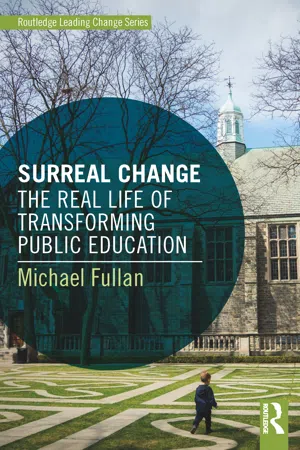
In Surreal Change: The Real Life of Transforming Public Education, internationally renowned expert Michael Fullan reflects on the leading trends and ideas within the educational change field over a 50-year period. The author traces the evolution of the field through his own personal developments and contributions to it, working chronologically through "The 12 Seminal Ideas" of his career. Fullan shows his personal and vulnerable side as well as how he came to develop breakthrough ideas. By looking at the way the field has transformed and grown over time, Fullan draws attention to what ideas have persisted, what problems still need solving, and what faces teachers, leaders and reformers today. Deeply personal and insightful, Surreal Change contextualizes the past, present, and future of school reform to help leaders continue to bring about lasting, positive, systemic change in their organization.
- 106 pages
- English
- ePUB (mobile friendly)
- Available on iOS & Android
eBook - ePub
About this book
Information
1
SURREAL CHANGE
Surreal change: Having the disorienting, hallucinating quality of a dream; unreal, fantastic
In 2014 Andy Hargreaves invited me to write a book for his Routledge Leading Change Series that would focus on the change ideas that I had lived through, and in some cases developed, over the decades of my career. The idea was to link the person to the ideas, and vice versa. This then is a very different book—an experiment in writing. I was never reluctant to take this on but somehow I was not getting around to starting the book. Maybe I wanted it to be a round 50 years of professional work—1968–2018. Or perhaps I was procrastinating not wanting to intimate that I was nearing the end. My best form of procrastination was to write another book. Finally in August 2017 I decided that I had better do it or it would never happen. Immediately I had two great ideas for two new books. One, I called Nuance—what is it that especially effective leaders know and do that other leaders can’t seem to emulate. The other is about large-scale change that I wanted to do with my close colleague, Mary Jean Gallagher and titled System change: The devil is in the details.
But this time I got wise. I did some integrative thinking and concluded that there is no reason that I could not work on my autobiography and the two new books simultaneously. In fact it seemed appropriate to the weird ‘surreal’ life I had been living for my professional career, namely that I would finish by never finishing, and that I would have several irons in the fire. So, my plan is to write three books in parallel. I have not yet written the first word of either of the other two books, and you won’t hear about them again until the postscript. I will let you know how they turned out.
This is a ‘professional’ autobiography, which means that I will be focusing on my life only insofar as it relates to the ideas and actions that I have been pursuing over 50 years. In this respect it will be personal, and I will strive to be transparent and vulnerable when the circumstances call for it (recognizing that most of us are inevitably self-serving when it comes to explaining our actions). I won’t refer to professional awards, recognitions, honorary doctorates and the like unless they are directly related to the specific change ideas associated with my ideas and development.
As for my personal life, I am 77 years old as I write this, have been married twice with a total of five children who range from 26 to 50 years of age, and generally would be considered a workaholic. I met my first wife, Sylvia, at the University of Toronto, and we married in 1966. We have three children: Chris, Maureen, and Josh. We have three grandchildren: Daniel (18) and Peter (15), sons of Maureen and her husband, Wayne Egan; and a girl, Maddie, born to Josh and Jae on September 4, 2017 just as I was finishing this book. My second marriage was to Wendy in 1980 and we have two children: Bailey (34) and Conor (26). You will find more of the personal me in the subsequent chapters, although more about the professional side than the family activities. You should find out enough to figure out my personality. For starters, for example, is my workaholicism, which might be about committing to ‘things’, rather than to people that would require personal commitment.
This brief introduction is philosophical, and intended to provide a permeable, atmospheric, quality to my development. It seemed like the things that happened to me in my life were not a result of any planning (at least not on my part). Things happened and then I would make sense of them. In many ways the notion that ‘things happen’ is an apt metaphor for the concept of change itself. The moment you over plan change is when it starts to go off the rails. If you want to kill a good idea mandate it.
Luck played a huge role in my life. Things happened that should not have ended well, but at the last moment they did. It took more than 25 years to have even a glimpse of what I might want to do. Increasingly the concept of change chased me not vice versa. Expressing or even having feelings has been missing most of my life. Yet, I found myself increasingly attuned to what I would call ‘cognitive empathy’. I could understand where most people were coming from. Making a positive difference in other people’s lives has become a large part of my life’s work, but if truth were to be told I became deeply committed to things not just because I want to do good, but because it turns me on to solve complex problems. Eventually moral purpose and trying to solve complex human problems on a large scale merged into my life. But this was not the driver early on. At the early stage there was no driver. It was ‘me being me’—drifting, and latching on to things out of survival or budding interest.
Another serendipitous thing is being born in exactly the right time and right place. Coming into this world in 1940 was not great if you were living in Europe but in Toronto, Canada being fortunate was being raised for the first five years by a group of caring women—my mother, great aunts, and great grandmother. My great aunts were Anna and Gertrude, and my great grandmother was Elizabeth (called Margaret) Fitzpatrick. All of them including my mother were my first mentors. Imagine being alive in 2018 (me), and being able to say that I was mentored by my great grandmother who was born in 1858! She died when I was 13 years old so I did experience a strong piece of what I remember as my ‘always old’ aunts and great grandmother.
Growing up in the 1950s seemed idyllic. After a few self-imposed bumps as we will see in Chapter 1, I drifted into a Ph.D as a default option, landed a university job as a junior professor without ever applying for it, and started a career at exactly the time to witness the birth of the concept of implementation. None of this was conscious. It only makes sense in retrospect. And today when a colleague ends up in remote northern Pakistan near the Chinese border that you can only reach by helicopter, and sees a sign at the entrance of the village where written in chalk is a change saying attributed to Michael Fullan, and you realize that it is something you never said or wrote—the word surreal comes to mind.
What was this 50-year journey, what were the key ideas, and how do they interface with what is happening and evolving in the world? This book is about change ideas in different decades of time—ideas that took their shape because of the particular moment in history in which they occurred, and that shaped but did not determine subsequent developments. I will try to identify milestone ideas that seemed then, or now, prominent to me. I was there! I will mark and number these ideas as they occur chronologically as Seminal Idea #1 and so on. There will be 12 of them in total. Not that they were brilliant ideas in each case, but they were key to my development and eventually as a set they became seminal for me and to a certain extent the field.
Increasingly, in leadership positions I came to realize what Kurt Lewin meant when he said that “if you truly want to understand something try changing it”. My colleagues and I did and are trying to change a lot, and we are indeed learning an enormous amount. But it is often a blur when it is occurring. Insights come but they are based on imagined patterns as much as on reality. When one realizes that there is often little difference between real time and surreal time, you know that it is time to write the story. Let’s begin.
2
THE INCHOATE YEARS: 1940–1969
Inchoate: Not yet completed, lacking order
Some people reach focus early in life, others drift or bounce around, and still others never make it. I think of myself as a late bloomer, although by today’s standards getting one’s act together can take forever. I was born in a more privileged time, November 1, 1940 in the east end of Toronto at 14 Mallon Avenue. A Catholic as I was soon christened, born on ‘All saints day’, and named Michael (who is ‘like god’). Not a bad start. Shortly after, although I have no memory of it, my father, Gerard, joined the Air Force and departed for the rapidly escalating Second World War. My mother, Mary Coffey, was a fine woman, skilled in sports, manager of our household, and destined to be a mother many times over.
The Early Years
My first five years as I mentioned earlier were idyllic. At the time Toronto was a sleepy urban sanctuary with little growth. In this solitude I was not only my mother’s joy (pride came later, I hope) but was treasured by my mother’s grandmother and aunts who lived very close by. I became increasingly connected with them as I moved into my euchre playing card days at age 6 and onward. In the midst of this dreamworld something happened. My father returned from the war and my parents started to produce a string of boys—Brian (1945), Rick (1946), Larry (1949), Ron (1953), Kevin (1955), and Dan (1957)—who will not figure much in this book as they were not connected to the ideas that we want to unearth given that these developed after I left home.
I have no idea what a 5-year old thought of all this commotion of men upon boys entering uninvited into his life, but I do remember that I invented an imaginary friend when I was about 5, named Jack. He became my constant playmate—hours and hours on end. We re-invented the world together. Maybe he was a substitute for my mother who was less and less available for me. At 3 years of age I called myself Bucky Bully—which evidently is how Michael Fullan sounds if you say it fast to a toddler. With a name like Bucky you can afford a little swagger. Looking back I wonder if being kicked off the pedestal at age 5 had a dramatic influence on my drive to be noticed, and have impact. I am only going to use three pictures in this book—the first at age 1 (Figure 1), the second at age 8 (Figure 2), and the third as a 12-year-old hockey player (Figure 3). Here I am in Figure 1 as a budding bucky bully (is that a pedestal I am sitting on?).

Figure 1 Fullan age 1, 1941.
Source: the author.

Figure 2 Fullan age 8, 1948.
Source: the author.

Figure 3 Fullan age 12, 1952.
Source: the author.
As the need for a larger and larger house became evident we moved a few miles north, still in the east end to two houses in succession in the 1950s. From 1946–1953 I attended St. Brigid’s elementary school, just north of Danforth Ave, where I did routinely well. Figure 2 shows me in grade 3—8 years old and ready to learn. I remember one teacher vividly, Sister Ste Leo Marie, because she taught me for three years running (grades 6, 7, and 8), made things interesting, and was cute. She said endearing things like “I am so inept when it comes to how things work that I am still surprised that the light comes on when I flip the switch”. In addition, she taught me the basics well. My grades were usually about 75%, I skipped a grade and then went off to high school at the age of 12 (yes, 12; I was born at the time of year to start early and I skipped a grade). I attended St. Mike’s High School—a private boys’ school—in 1952, grade 9.
A slight diversion here: I won’t dwell on my parents except to introduce them from time to time as I grew up. The basic thing to know is that their families of origin came from Ireland (Counties Clare, Kerry, Galway, and Tyrone –the latter eventually becoming part of Northern Ireland). In the 1800s the ancestors emigrated to Toronto and the surrounding area. We were what would be called a working class or lower class family. My father Gerry was gregarious and moved from career to career—a milkman who got up at 4am to deliver milk, an insurance salesman, a leading sports manager in hockey in the Toronto area including becoming manager of the famed St. Mike’s Hockey Arena attached to the all-boys school that I attended. He was a great singer—an Irish tenor who once lost on a Buffalo-based television talent show to an 8-year-old girl who tap danced.
My mother was always the responsible one. I guess you could say that my father was in charge of generalities, and my mother in particularities. When it came to family finances, household management, day-to-day issues my mother was the detail person. With seven boys and little money I would have no hesitation in recommending her as Finance Minister.
My parents had two goals in mind for their boys: a university education, and hockey. I was to become the first person in our family—all uncles, aunts, and families included—to graduate from university. And all others would follow. We had a particular other powerful figure: my mother’s father, Vince Coffey. Vince, my grandfather, was a formidable influence in my life. He had a grade 8 education and became a car and truck mechanic. He worked at Borden’s Milk Dairy in Toronto (no connection as far as I know to my father’s milkman days), and steadily worked his way up to become Manager of the entire fleet of Borden’s trucks. Vince was tough, but was also the first man I knew that was genuinely emotional. When I was older, in my late 30s, I ended up at his house one evening having a nightcap with him (In his older age he always had one drink before going to bed). That night he pulled out a bottle of rum that he had just bought duty free on a trip. Unbeknownst to him and me it was 150 proof (drinkers will know that standard alcohol was 80 proof; 40% alcohol). We were drinking 75% alcohol! We had two or three drinks only to find that we ended up hugging each other, crying and expressing our love for each other. As I said he was emotional, but as a man he rarely showed it. I was not emotional but somehow the 150-proof rum was able to crack my code.
Vince had great basic values—live a good life, work hard, and, for the new generation, get a university education. As the first born among all the sons and daughters of aunts and uncles I was the first in line. He insisted that I go to university, and was to be instrumental later in this way when I started at University of Toronto. In early high school I was not aware that university was my destination—did not give it much thought. When I was about 15 years old I was working part time at the grocery store Loblaws, and one evening I said to my mother that I wanted to quit school and go to work full time at Loblaws. My mother said that I was too young, that she would have to sign for it, and she was not going to do that. I might have cried for 10 minutes, but nothing more came of it. Apparently I only thought about one day at a time —more empty-headed than anything.
My third picture (Figure 3) taken on April 17, 1952 by a Toronto newspaper shows me as a budding hockey player posing to tie the skates of a teammate. As the newspaper reported our team won the provincial championship and “Mike Fullan was the top star in the Toronto win as he netted two goals”. The game was played at Maple Leaf Gardens, the iconic home of the Toronto Maple Leafs. (Several of my younger brothers became better hockey players than me—three of them went to Cornell University on hockey scholarships and one, Larry, played in the National Hockey League (NHL) briefly.)
At the time I was about to enter grade 9 at St. Mike’s College High School, age 12, joining an all-boys catholic high school. Six brothers, no sisters, and all male high school: my experience with girls continued to be abstract.
Another stroke of luck I had was in my first couple of weeks at school. A couple of older boys (everyone was older than me) started to pick on me and pushed me against the locker. I had a friend named Bobby Jones (a real friend, not like Jack) who was a few years older than me, from my neighborhood in the east end—and one maniacal tough guy—who happened by at the time. He took the older of the two boys and slammed him against the locker a couple of times, and said “if you every so much as glance at Mike again you are as good as dead”. I never had any trouble from then on, and it was my first lesson in the importance of having teammates. Later, my forte as a leader was to build great teams around me who operated seamlessly with and without me.
In grades 9 and 10 I did well at school, but other things, like hockey and the associated camaraderie, were calling. St. Mike’s school was located mid and uptown from where I lived, and when I first started attending there was not yet a subway line. Compounding this was my hockey that was beginning to kick in big time. There was a hockey rink in my area of town; Ted Reeves Arena by name. A group of eight or so of us discovered that we could rent an hour’s worth of ice from 7–8am, and the night caretaker would let us come at 5am or so. Twice a week we began our day by showing up at the arena at five in the morning and playing hockey for two or three hours. We were spent (and often late) by the time we made the trek across town to school. Anytime there was a slight amount of snow we would declare ourselves late and go over to a local restaurant, called the Cottage, have coffee and drift into school at 9:30am or so. The school was administered and taught primarily by Basilian Fathers. The vice-principal was Fr. David Bauer, a decent hockey play...
Table of contents
- Cover
- Half-title Page
- Title Page
- Copyright
- Contents
- 1 Surreal Change
- 2 The Inchoate Years: 1940–1969
- 3 The Formative Years: 1969–1988
- 4 The Becoming Years: 1988–2003
- 5 The System Years Part One: 2003–2013
- 6 The System Years Part Two: 2013–2017
- Postscript: Still Surreal
- Books by Michael Fullan
- Bibliography
- Index
Trusted by 375,005 students
Access to over 1.5 million titles for a fair monthly price.
Study more efficiently using our study tools.
Frequently asked questions
Yes, you can cancel anytime from the Subscription tab in your account settings on the Perlego website. Your subscription will stay active until the end of your current billing period. Learn how to cancel your subscription
No, books cannot be downloaded as external files, such as PDFs, for use outside of Perlego. However, you can download books within the Perlego app for offline reading on mobile or tablet. Learn how to download books offline
Perlego offers two plans: Essential and Complete
- Essential is ideal for learners and professionals who enjoy exploring a wide range of subjects. Access the Essential Library with 800,000+ trusted titles and best-sellers across business, personal growth, and the humanities. Includes unlimited reading time and Standard Read Aloud voice.
- Complete: Perfect for advanced learners and researchers needing full, unrestricted access. Unlock 1.5M+ books across hundreds of subjects, including academic and specialized titles. The Complete Plan also includes advanced features like Premium Read Aloud and Research Assistant.
We are an online textbook subscription service, where you can get access to an entire online library for less than the price of a single book per month. With over 1.5 million books across 990+ topics, we’ve got you covered! Learn about our mission
Look out for the read-aloud symbol on your next book to see if you can listen to it. The read-aloud tool reads text aloud for you, highlighting the text as it is being read. You can pause it, speed it up and slow it down. Learn more about Read Aloud
Yes! You can use the Perlego app on both iOS and Android devices to read anytime, anywhere — even offline. Perfect for commutes or when you’re on the go.
Please note we cannot support devices running on iOS 13 and Android 7 or earlier. Learn more about using the app
Please note we cannot support devices running on iOS 13 and Android 7 or earlier. Learn more about using the app
Yes, you can access Surreal Change by Michael Fullan in PDF and/or ePUB format, as well as other popular books in Éducation & Éducation générale. We have over 1.5 million books available in our catalogue for you to explore.