- 200 pages
- English
- ePUB (mobile friendly)
- Available on iOS & Android
eBook - ePub
About this book
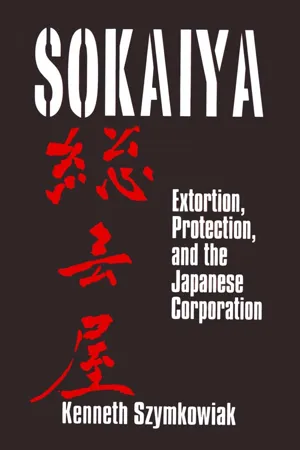
Sokaiya are extortionists who target Japanese corporations for payoffs. They threaten to reveal corporate secrets and scandals, usually at shareholder meetings. This book explores the curious but not unusual relationship that grows between executives and sokaiya, who also offer their services to protect the corporation from other sokaiya, thus becoming a necessary evil in the world of Japanese business. The book documents the history and development of sokaiya over the past 100 years since Japan first enacted a commercial code. It includes interviews with police, lawyers, corporate executives, as well as sokaiya and members of the yakuza (traditional Japanese gangsters).
1
Reconstructing Sokaiya
On February 28, 1994, Juntaro Suzuki, a sixty-one-year-old managing director of Fuji Photo Film Corporation was stabbed to death on the doorstep of his home.
Suzuki and his wife, Michiko, lived in a modest home on a narrow side street in Tokyo’s Setagaya Ward, a fashionable residential area near the shallow Tamagawa, the river that serves as the border between Tokyo and the industrial city of Kawasaki. Mrs. Suzuki was taping a television program for her son, who was on an overseas trip. The doorbell rang and Mr. Suzuki answered the door using an intercom. The man at the door said his car had hit part of the wall surrounding Suzuki’s home. He asked if someone could come out to inspect the damage.
Suzuki agreed and went out. Neighbors said later that there was some brief shouting, perhaps even a few cries for help. Mrs. Suzuki said that all she heard was her husband weakly calling “Mama ” when she found him on the step, dying from wounds on his head, legs, and arms. According to police reports, the wounds were consistent in shape with those made by a Japanese sword. The nature of the wounds gave rise to the suspicion that Suzuki was a victim of right-wing terrorism. Japan’s radical right is well known for its attacks against corporations and their executives. The Japanese sword is one of their favorite weapons, although the right wing is also known to use Molotov cocktails and the occasional firearm to shoot into a vacant home or office. But radical-right involvement became less and less a possibility as Suzuki’s encounters with extortionists became increasingly known. The details of the case pointed toward sokaiya.1
Sokaiya are a relatively unknown phenomenon in the West. Their acts of extortion against Japanese corporations are seldom reported by Western media; their work as an informal private-security force for other corporations is mentioned even less often. Nonetheless they meet the requirements of an organized-crime group as described by Kenney and Finckenauer (1995) in their review of definitions of organized crime. Sokaiya groups are hierarchical, self-perpetuating, engage in conspiratorial acts, provide illegal services as well as legal services in an illegal manner, are linked with corrupt public officials who cooperate with them and maintain a layer of immunity for their acts, and, finally, use violence or the threat of violence to facilitate their criminal activities (Kennedy and Finckenauer 1995, 25–28). So how do they fit inside Japanese organized crime?
In the constellation of groups comprising Japanese organized crime, sokaiya certainly are less well known than the yakuza, who make up the more traditional branch of syndicate crime. The yakuza can trace their existence back hundreds of years. Some yakuza are also sokaiya, but not all sokaiya are yakuza—that is, many sokaiya who operate in the subculture of organized crime in Japan do not participate in the various traditions, fictive kinship rites, and relationships required of a yakuza to become what an American mafioso might call a “made” member (Iwai 1974). In the yakuza, one does not “make his bones” through the murder of another. Instead, membership in a group is formally accomplished through the acceptance of allegiance to a more senior member of the organization.
Unlike the yakuza, sokaiya are a rather modern development in Japan’s organized-crime subculture, growing out of a particular set of circumstances present in late-nineteenth-century Japan and then adapting as those circumstances changed up to the present. Sokaiya would not find it necessary to develop or participate in the traditional culture- and history-bound rites of yakuza such as finger cutting, tattooing, or drinking sake from the same cup as their leader. Sokaiya are part of a distinctly foreign-based development in modern Japanese history—the development of capitalism during the modernization of the Japanese state following hundreds of years of extremely controlled exposure to the West and other foreign influences. The yakuza existed long before capitalism was ever known. Sokaiya, on the other hand, could not exist without modern capitalism and the joint-stock corporation in Japan.
Why is this so? Because sokaiya are usually defined as persons who disrupt shareholder meetings by asking questions or by engaging in violent acts against other shareholders or corporate managers. Consequently, corporate managers occasionally make payoffs to sokaiya to prevent such disturbances. Such services are merely part of an array of “favors” provided by sokaiya to managers willing to hire them. These services include suppressing other sokaiya or even regular shareholders bold enough to ask questions at shareholder meetings. So, without the corporation and the annual shareholder meeting required by the Japanese Commercial Code, sokaiya could not exist.
However, such a definition misses at least part of the point regarding sokaiya. They are sometimes extortionists, sometimes mercenaries—who are also Japanese. In other words, they lead lives dominated by the cultural and historical traditions of the Japanese people created over thousands of years. Sokaiya clearly understand, perhaps sometimes at an intuitive level, how they and others go about being Japanese.
This point is obvious enough that it might be ignored, but it does help answer the questions asked about sokaiya: What is peculiar to Japanese corporations that provides a place for sokaiya? Why are Japanese corporations, which have an image of great power on national and international levels, unable to eliminate sokaiya from the corporate system? Why are there no American or German sokaiya or, for that matter, sokaiya in any other modern capitalist nation?
The answer is simple: There are elements of Japanese culture, history, language, and even gesture that lend themselves to abuse through extortion, intimidation, domination, and control. Such elements either do not exist in other cultures, or the reactions to them are quite different from those that a Japanese person might have. Certainly the concepts of the corporation and capitalism could exist in Japan without sokaiya. But the elements of Japanese society that affect how the Japanese think about themselves, about others, and how they interact are also intrinsic parts of the capitalist system in Japan.
Before proceeding further, we need a better understanding of sokaiya and those with whom they most often interact—usually corporate managers and the police.
In the West, criminal and unethical activities are not always well documented. Often, newspaper articles or television reports are strained through layers of bias. Different people interpret events differently, even if the very same event is witnessed by all. As a result, the interpretation of those events can differ over time and depending on who provides the interpretation. For example, police and prosecutors ask one set of questions to see if an action fits within the elements of a crime; journalists ask another set to see if an action makes a newsworthy story. The intent of their questions is inherently dissimilar; hence the answers and how they are processed are different. The reconstruction of events “are constructions, rather than reflections, of reality” (Ferrel and Sanders 1995, 308). If criminality is involved, witnesses give careful thought to how much knowledge they want to reveal. Some people, perhaps, cannot “remember”; others did not “see.” Still others simply do not “know” anything. Reactions to such situations are no different in Japan: people are reluctant to talk about crime or scandal when it is close to them. This begs the question: How does one uncover what could be the “truth” about sokaiya who are so well hidden and protected in the Japanese system?
One answer lies in how the Japanese themselves describe sokaiya. The Japanese language is studded with colorful labels that, once analyzed, help broaden our understanding of sokaiya, just as when someone is declared part of the mafia, depending on one’s experience, varying images are raised in the mind. But one must get beyond image to reach some reconstruction of reality.
The labels the Japanese give to sokaiya are not only colorful, but practical as well, revealing that the sokaiya profession, far from being simply an obscure form of organized crime, is a field with clearly defined divisions of labor and paths of advancement. Such labels also help company managers determine how to deal with individual sokaiya.
Origin of the Term Sokaiya
The term sokaiya is derived from the combination of the word sokai, which means “general meeting”—in this case, the general meeting of company shareholders. Other groups such as religious organizations may hold general meetings, but sokaiya are not involved. The suffix ya refers to a person engaged in the business described by the root word. Hence, sokaiya refers to someone involved in the business of general shareholder meetings.
Not surprisingly, this means very little to the average Westerner. To such an individual, the given meaning might indicate that the sokaiya is in charge of running a meeting, ensuring that the chairs are arranged, that water and glasses are set out for the board of directors, and so on. To the average Japanese, however, sokaiya has decidedly negative connotations.
I learned this very early in my fieldwork. Just after arriving in Japan, I attended a party at the U.S. Embassy compound in Tokyo for new Fulbright-grant recipients. A Japanese colleague, knowing my intended topic of research, was eager to introduce me to a man who, he said, was knowledgeable about sokaiya since he had worked for many years as a director of a major corporation. After introductions, the former director inquired as to what I would be researching. Once he understood clearly that I was studying sokaiya, he abruptly turned and walked away without another word, making sure for the rest of the evening that he kept his distance and that he was protected from me by several of his friends.
When I recounted this incident to another Japanese colleague who has worked as a sokaiya “watcher” for decades, he explained, with some amusement, that the topic of sokaiya is distasteful, and certainly not something mentioned in polite company—equivalent to making scatological remarks during a formal dinner. In fact, the word sokaiya has become so weighted with negative images that even sokaiya prefer that others do not use it and have attempted to construct new terms to describe themselves.
Sokaiya, corporate managers in charge of dealing with sokaiya, and others familiar with the phenomenon might refer to sokaiya as kabunushi undo-ka (“shareholder activists”), but they are far more likely to describe them as tokushu kabunushi or “special shareholders” (Inoue 1966, 58). Before the Japanese Commercial Code was changed in 1982 to eliminate or at least control sokaiya, Shoji homu, a respected legal journal, used the term sokaiya to identify sokaiya in its annual survey of corporations and shareholder meetings.2 After the 1982 reform, when sokaiya payoffs became illegal, the editors used the term kodo ma-ku kabunushi (literally, “shareholders who are marked as active” or “marked shareholders”). The term usually refers to sokaiya, but it might also include real shareholder activists not interested in payoffs but in changing company policy. Or it could be a label for greenmailer groups (otherwise known as shite groups). Greenmailers in Japan, as in the rest of the world, purchase shares of a company in order to force the company to repurchase the shares at an inflated price (see Kester 1991, 245–62, and Isaacs and Ejiri 1990, 113–14, for descriptions of such Japanese groups and explanations of their activities). One source revealed that kod...
Table of contents
- Cover
- Half Title
- Title Page
- Copyright Page
- Table of Contents
- Introduction
- Chapter 1 Reconstructing Sokaiya
- Chapter 2 Sokaiya Foundations and History
- Chapter 3 Conflict, Resolution, Adaptation
- Chapter 4 Commercial Code Reform
- Chapter 5 Sokaiya Maintain Position
- Chapter 6 Sokaiya at a Shareholder Meeting
- Chapter 7 Riding the Bear
- Epilogue
- References
- Index
- Kenneth F. Szymkowiak
Trusted by 375,005 students
Access to over 1.5 million titles for a fair monthly price.
Study more efficiently using our study tools.
Frequently asked questions
Yes, you can cancel anytime from the Subscription tab in your account settings on the Perlego website. Your subscription will stay active until the end of your current billing period. Learn how to cancel your subscription
No, books cannot be downloaded as external files, such as PDFs, for use outside of Perlego. However, you can download books within the Perlego app for offline reading on mobile or tablet. Learn how to download books offline
Perlego offers two plans: Essential and Complete
- Essential is ideal for learners and professionals who enjoy exploring a wide range of subjects. Access the Essential Library with 800,000+ trusted titles and best-sellers across business, personal growth, and the humanities. Includes unlimited reading time and Standard Read Aloud voice.
- Complete: Perfect for advanced learners and researchers needing full, unrestricted access. Unlock 1.5M+ books across hundreds of subjects, including academic and specialized titles. The Complete Plan also includes advanced features like Premium Read Aloud and Research Assistant.
We are an online textbook subscription service, where you can get access to an entire online library for less than the price of a single book per month. With over 1.5 million books across 990+ topics, we’ve got you covered! Learn about our mission
Look out for the read-aloud symbol on your next book to see if you can listen to it. The read-aloud tool reads text aloud for you, highlighting the text as it is being read. You can pause it, speed it up and slow it down. Learn more about Read Aloud
Yes! You can use the Perlego app on both iOS and Android devices to read anytime, anywhere — even offline. Perfect for commutes or when you’re on the go.
Please note we cannot support devices running on iOS 13 and Android 7 or earlier. Learn more about using the app
Please note we cannot support devices running on iOS 13 and Android 7 or earlier. Learn more about using the app
Yes, you can access Sokaiya by Kenneth Szymkowiak in PDF and/or ePUB format, as well as other popular books in Business & Business generale. We have over 1.5 million books available in our catalogue for you to explore.