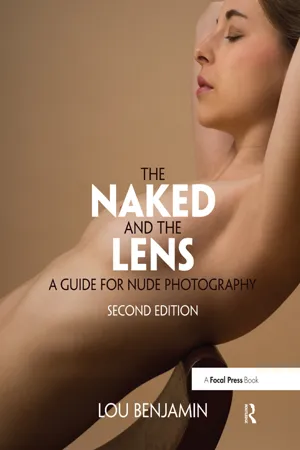
Nude photography can be intimidating, for the artist and the subject. Technique, creativity, and psychology all need to be considered and executed seamlessly to achieve a photographer's desired artistic and professional result. Author Louis Benjamin has built a career by studying the intricacies of the perfect nude photography photo shoot and he has compiled what he has learned for you in this second edition of the best-selling book, The Naked and the Lens.
This revised text updates and builds upon the key concepts presented in the first edition that guide photographers from finding models and planning a shoot, all the way through to post production. New material includes discussions of the latest equipment, software, web publishing options, as well as fresh and more diverse photographs and interviews.
- 240 pages
- English
- ePUB (mobile friendly)
- Available on iOS & Android
eBook - ePub
About this book
Information
Part I
Seeing Beneath the Skin
It’s no accident that the words “image” and “imagine” come from the same root. Photographic images are the product of your imagination. Those photographs—whether they are carefully thought out and constructed tableaus, or chanced-upon scenes with a “snapshot aesthetic” guided purely by instinct—are the result of a process that you set into motion. Your intentions, where you choose to stand, and when you trip the shutter, make all the difference and uniquely shape your art. You can see this at play when photographers in a workshop all shoot the same models with the same setup and lighting—the results are often dramatically different.
It all starts with an idea, an impulse, a curiosity, a drive, or something you want to say. However you go about making photographs, the work you produce will always say a lot more about you than it says about the person or scene you’re photographing. What is your work about? By examining your own interests, ideas, and influences, you can enhance the imprint that distinguishes your work. In this section, we’ll look at the ideas behind the work of a number of photographers with the aim of raising your artistic self-awareness and sharpening your ways of seeing.

Chapter One | Focusing In
LET’S BEGIN by focusing on what we’re talking about in this book—nudes in art photography. It is also about finding and strengthening your photographic voice. This is a wide-angle view that traces the complete arc from the initial concept or impulse through making and presenting the final image. We’re talking about work that is determined solely by the photographer’s vision and interests, rather than a client brief. This is the kind of work that appears in art salons, exhibitions, galleries, museums, and art publications. These are photographs produced for consideration or sale as art objects in their own right, rather than illustrations used to sell something else. While all of the topics covered may be relevant to producing commercial work as well, we will focus on photographers producing contemporary and fine art work.
This book takes an interdisciplinary approach to the field, drawing from art, science, and history. At its heart, it is concerned with four questions:

Facing: “Time Does Tell,” © Lou Benjamin. Model: Aubrey. Shot in digital and referencing both art history and the passage of time, this photo touches on many of the facets of photography that this book will cover.

“Jordan Swimming” © Saelon Renkes.

One caveat here: in photography, the term “fine art nudes” often refers to a very specific genre of nude photography, but fine art photography in general is much broader than that. We’ll be looking at a broad range of artists’ approaches to their personal work, including many that go beyond the very specific genres of “classic,” “art,” and “fine art” nudes.
Labels are tricky. If you search the Web for “art nudes,” you’re likely to find an almost overwhelming variety of imagery, including pinup and porn, as well as amateurish and “naughty” smartphone selfies. Among the types of images that are more germane to our discussion, you might find classics shot in the early 1900s, carefully crafted contemporary photos that reference the art of ancient Greece, and art images that have taken their cues from the commercial realm. You will also find that the terms “artistic photography,” “art photography,” and “fine art photography” all have different and sometimes contradictory meanings among various photographic circles.
The emphasis here is on photography that aims to convey a personal message—work that has more than just the look of art. We will be focusing on creating nudes as part of an artistic practice that goes beyond glamour, marketing, and exhibitionism.
Admittedly, there will be relatively few examples of male nudes. That has to do with the fact that the majority of nudes produced both by men and women artists feature female subjects—it seems that the default gender of art nudes is female. Part of the reason for this is an institutionalized bias ingrained in the culture among artists as well as patrons. A few of the artists presented in this book explicitly challenge that bias.
At the same time, you will find a significant amount of digital work in this book, even though the art world has not yet fully embraced digital, and a number of contemporary photographers shoot exclusively with film. The discussion of digital technique in this book will be limited to topics of relevance to photographing and maintaining an archive of nudes. We will look at digital technique with two types of photographers in mind: those who shoot digital, and those who work with scans from film.

Top: © Terry Donovan. For the series The Model’s Revenge, Terry Donovan wanted to make himself as vulnerable as the models in his routine shoots. He turned over creative control to the model and allowed himself to be photographed in whatever way the model asked, with no limits.
Bottom: Photos © Lou Benjamin. Model: Sie Ist Idaho. Photoshop and Lightroom work together to create a comprehensive set of tools for managing, enhancing, and transforming digital images.
Not Quite a Manifesto
At the close of this chapter, we return to the ideas behind the work. Some of the ideas, assumptions, and intentions that shaped this book are set forth below. You won’t find any hard and fast rules set forth for you to follow. The intent is to highlight and emphasize the choices you can make that will sharpen your vision and shape the way you approach your photography. The photos you make are an outgrowth of the attitude you bring to the process.
“Photographs Are Made, Not Taken”—Ansel Adams
Photographs arise from a process that is a marriage of art and technology. From the moment you decide to pick up the camera, you set in motion a process of making artwork. You decide where to stand, where to point the camera, what’s included in the frame, what’s excluded, and when to trip the shutter. Later, you decide what to print, post, or publish, and what to discard.
Photographs Don’t Capture Anything
The phrase “nice capture” is inaccurate. It’s like looking at a person and saying “nice DNA.” Not all of a person’s DNA is expressed, and neither are all of the sensor data and camera settings in a digital shot. That’s before we even consider that photographs compress the four dimensions of space-time into two. They are reasonable facsimiles at best. Photos are analogous to rubbings. Light bounces off the surface of a body and casts shadows on a photo-sensitive surface, whether it’s film or a digital sensor. From there, chemical or electrical processes “fix” those shadows so that an image can be produced.
Art and Culture Are Linked
Art happens inside the context of cultural norms and art influences those norms. Art can be political and art can be subversive. You can’t separate the nude from its cultural context or its default connotations of shame, sexuality, etc.
Art is a Response
Artists process their experiences by making art. Artwork comes through you—events, experiences, and social structures can all affect and shape the work we make.
Seeing is Thinking
What we see in an image is the product of a cognitive process. Our brains search for shapes and identify them. We look for relationships between the elements inside the frame and we overlay references to experiences and knowledge gained during our lives. As a result, what we see in a photo varies greatly from person to person. And the photographic artist sees the world in a particular way—that shapes their choice of subject matter and determines which shots are their best work.
Art is Personal
Art is based in your reality. It is always subjective, and the work is an outgrowth of you. Your work says more about you than it does about the person or thing photographed. In fact, it has been argued that all photographs are really self-portraits. Embrace that and be yourself. Many artists make nude self-portraits as a vehicle of both self-exploration and self-expression.
Go Deeper
This is a call to create photos that offer something more when you look at them a second or third time, images that make you think or feel. Robert Capa inspired generations of photographers to fully engage with their subject matter, saying, “If your photographs aren’t good enough, you’re not close enough.” That applies beyond photojournalism and refers to more than physical proximity.
We’re living in a culture that is obsessed with surface, and inundated with disposable imagery that has artistic pretenses. Real art goes deeper than merely “artful” work. Aesthetics is just one facet of art—it goes deeper than pretty pictures or decoration. In fact, good art doesn’t have to be pretty.
This is an encouragement...
Table of contents
- Cover Page
- Half Title page
- Title Page
- Copyright Page
- Dedication
- Contents
- Acknowledgments
- Introduction
- Part I Seeing Beneath the Skin
- Part II Photo Anatomy
- Part III Making Nudes
- Conclusion
- Index
Trusted by 375,005 students
Access to over 1.5 million titles for a fair monthly price.
Study more efficiently using our study tools.
Frequently asked questions
Yes, you can cancel anytime from the Subscription tab in your account settings on the Perlego website. Your subscription will stay active until the end of your current billing period. Learn how to cancel your subscription
No, books cannot be downloaded as external files, such as PDFs, for use outside of Perlego. However, you can download books within the Perlego app for offline reading on mobile or tablet. Learn how to download books offline
Perlego offers two plans: Essential and Complete
- Essential is ideal for learners and professionals who enjoy exploring a wide range of subjects. Access the Essential Library with 800,000+ trusted titles and best-sellers across business, personal growth, and the humanities. Includes unlimited reading time and Standard Read Aloud voice.
- Complete: Perfect for advanced learners and researchers needing full, unrestricted access. Unlock 1.5M+ books across hundreds of subjects, including academic and specialized titles. The Complete Plan also includes advanced features like Premium Read Aloud and Research Assistant.
We are an online textbook subscription service, where you can get access to an entire online library for less than the price of a single book per month. With over 1.5 million books across 990+ topics, we’ve got you covered! Learn about our mission
Look out for the read-aloud symbol on your next book to see if you can listen to it. The read-aloud tool reads text aloud for you, highlighting the text as it is being read. You can pause it, speed it up and slow it down. Learn more about Read Aloud
Yes! You can use the Perlego app on both iOS and Android devices to read anytime, anywhere — even offline. Perfect for commutes or when you’re on the go.
Please note we cannot support devices running on iOS 13 and Android 7 or earlier. Learn more about using the app
Please note we cannot support devices running on iOS 13 and Android 7 or earlier. Learn more about using the app
Yes, you can access The Naked and the Lens, Second Edition by Louis Benjamin in PDF and/or ePUB format, as well as other popular books in Art & Digital Media. We have over 1.5 million books available in our catalogue for you to explore.