- 288 pages
- English
- ePUB (mobile friendly)
- Available on iOS & Android
eBook - ePub
About this book
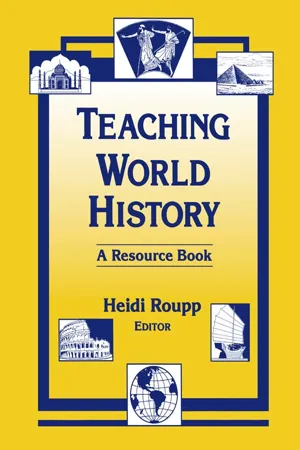
A resource book for teachers of world history at all levels. The text contains individual sections on art, gender, religion, philosophy, literature, trade and technology. Lesson plans, reading and multi-media recommendations and suggestions for classroom activities are also provided.
Information
Part I
Approaches
During the past decade world history courses have been organized by instructors and authors of textbooks using three general approaches: the comparative study of civilizations, the study of human societies using themes or topics, and the chronological survey. The choice of approach is determined by the expertise of faculty, the resources available, and the characteristics of students. World history does, however, offer an ideal opportunity for interdisciplinary, cooperative teaching units using art, literature, or computer programs to enrich the student experience.
In this book are found examples of courses of study, curricula, and texts that are useful maps of the world history landscape. William McNeill offers a rationale for world history and identifies landmarks in the human story. Leften S. Stavrianos emphasizes the importance of teaching world history from a global perspective rather than the history of Western civilization supplemented with non-Western topics. Marilynn Hitchens examines the approaches used by several textbooks to organize their surveys of world history and the organizing chronology of the National World History Standards; she concludes with the recently published SAT II World History course outline. Bob Andrian describes a one-year required world history course written by the World History Planning Group at the Loomis Chaffee School in Windsor, Connecticut. Loomis Chaffee uses a topical approach to devise a world history, designed to engage actively ninth- and tenth-grade students in the story of human experience. Robert Bain explains a seven-step process for teaching world history by the comparative method. For graduate courses, Philip Curtin advocates using comparative themes, studying published works on aspects of comparative world history, or researching a comparative topic in an experimental exercise.
Another approach to a world history course is using a repeating theme. Bernard Hollister and Lawrence McBride challenge students to define civilization through careful consideration of the relationship of historical processes and social systems in various societies. Connie Wood uses the “isms” that shape modern history as a “Wheel of Fortune” to order the study of modern history. Dwight Gibb breaks with the tradition of these approaches by beginning with the student rather than the subject matter. As his students fashion their own identities, he helps them relate their experiences to a global perspective through lessons that emphasize critical thinking skills.
How do world history courses fit into larger curriculum designs? Traditionally, children are first introduced to history through family stories beginning with “When I was your age….” The family stories are supplemented in elementary school with lessons about the child’s neighborhood and town. Children often compare their families and neighborhoods with those in other parts of the world as class projects. Younger children listen to folk tales from long ago and far away and learn about the holidays others celebrate and the foods children in other countries enjoy. Older students are initiated into the discipline of history, the process of questioning, analysis, and research, through an increasingly academic course of study. The purpose is to develop critical thinking and historical perspectives, knowledge useful to future citizens of a republic.
As communications around the globe continue to expand, new curricula reflect the need for more knowledge about the world. Current trends indicate that U.S. and world history will supply the story line for new social studies programs. Clayton, Missouri, has designed a curriculum with a global perspective under the leadership of Bill Mendelsohn, the social studies curriculum coordinator. The new plan begins in elementary school with a comparative study of societies. Each year elementary children are introduced to a new geographical region and people around the world whose societies share similar characteristics of place. A three-year middle school program acquaints students with American history in grades five through seven. Grades eight through ten include a three-year sequence of world history that considers American history as part of the story from 1400 to the present. Elective and advanced placement courses are offered to students in their junior and senior years. Several world history units written by Clayton teachers demonstrate how world history and American history are integrated into the world history sequence. The goals and courses of the California Framework for Social Studies in the next chapter offer an interesting comparison to the Clayton model. “The History–Social Science Framework for California Public Schools, Kindergarten through Grade Twelve” represented a major change in the curricula design and courses of study for California schools when it was published by the California State Department of Education in 1988. Charlotte A. Crabtree and Daine Ravitch were the principal writers.
The final articles provide a sampling of world history at colleges and universities. Patricia O’Neill teaches a world history survey. She uses a chronological approach but supplements the text and lectures with study guides on topical subjects. An example of her study guides, entitled “Sacred Writing of the World’s Religions,” is included with her course of study and paper topics. These guides direct the study of entry-level students who may find the accumulation of unfamiliar names and places overwhelming. Jerry Bentley’s “Seminar in World History” offers the reader an interesting comparative approach to world history. Bentley’s syllabus also represents an excellent reading list for individuals wishing to extend their knowledge of world history. Peter von Sivers has organized his survey course using McNeill’s History of the Human Community as the general text and three other texts dealing with specific topics. His course description and requirements indicate the fundamentals first- and second-year students master. At the University of Utah globally oriented courses begin with a survey course, “World History Since 1500 C.E.” Descriptions of other world history courses at the University of Utah indicate the range of course offerings students may take after they have completed the survey.
1
World History
William H. McNeill
What can a teacher do with the buzzing, blooming confusion that is world history? The problem is twofold. On the one hand, the subject is infinite. On the other hand, considerable attention must be paid to the heritage of Western civilization that shaped American institutions and made the country what it is. Mere confusion will inevitably result from an indiscriminate effort to deal with everything we know about the past; and if too little emphasis is placed on the world-transforming character of Western civilization throughout the past five hundred years, then our heritage from that truly remarkable epoch of world history will be inexcusably undervalued. As yet, there are no generally agreed upon models; historians have only recently begun to try to frame a coherent vision of the history of the world.
Yet the imperatives pointing toward a world history are obvious. In the first place, our country has become part of an intensely interactive world system that no longer revolves solely around events in Europe, as was (or at least seemed to be) the case as recently as the 1930s. To deal effectively with Asians, Africans, Latin Americans, and Europeans, we need to know how the historical past has shaped their diverse outlooks upon the world. In the second place, migrants from Asia, Africa, and Latin America have filled our classrooms with students whose ethnic and cultural background is now “Western.” They need a past they can share with Americans of European descen...
Table of contents
- Cover
- Half Title
- Title Page
- Copyright Page
- Dedication
- Table of Contents
- List of Contributors
- Foreword
- Introduction
- Part I. Approaches
- Part II. Articles
- Part III. Strategies and Lessons
- Index
Trusted by 375,005 students
Access to over 1.5 million titles for a fair monthly price.
Study more efficiently using our study tools.
Frequently asked questions
Yes, you can cancel anytime from the Subscription tab in your account settings on the Perlego website. Your subscription will stay active until the end of your current billing period. Learn how to cancel your subscription
No, books cannot be downloaded as external files, such as PDFs, for use outside of Perlego. However, you can download books within the Perlego app for offline reading on mobile or tablet. Learn how to download books offline
Perlego offers two plans: Essential and Complete
- Essential is ideal for learners and professionals who enjoy exploring a wide range of subjects. Access the Essential Library with 800,000+ trusted titles and best-sellers across business, personal growth, and the humanities. Includes unlimited reading time and Standard Read Aloud voice.
- Complete: Perfect for advanced learners and researchers needing full, unrestricted access. Unlock 1.5M+ books across hundreds of subjects, including academic and specialized titles. The Complete Plan also includes advanced features like Premium Read Aloud and Research Assistant.
We are an online textbook subscription service, where you can get access to an entire online library for less than the price of a single book per month. With over 1.5 million books across 990+ topics, we’ve got you covered! Learn about our mission
Look out for the read-aloud symbol on your next book to see if you can listen to it. The read-aloud tool reads text aloud for you, highlighting the text as it is being read. You can pause it, speed it up and slow it down. Learn more about Read Aloud
Yes! You can use the Perlego app on both iOS and Android devices to read anytime, anywhere — even offline. Perfect for commutes or when you’re on the go.
Please note we cannot support devices running on iOS 13 and Android 7 or earlier. Learn more about using the app
Please note we cannot support devices running on iOS 13 and Android 7 or earlier. Learn more about using the app
Yes, you can access Teaching World History: A Resource Book by Heidi Roupp in PDF and/or ePUB format, as well as other popular books in Didattica & Didattica della storia. We have over 1.5 million books available in our catalogue for you to explore.