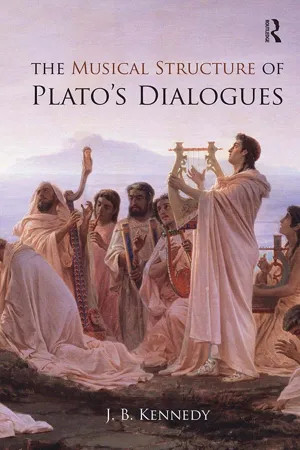
- 240 pages
- English
- ePUB (mobile friendly)
- Available on iOS & Android
eBook - ePub
The Musical Structure of Plato's Dialogues
About this book
J. B. Kennedy argues that Plato's dialogues have an unsuspected musical structure and use symbols to encode Pythagorean doctrines. The followers of Pythagoras famously thought that the cosmos had a hidden musical structure and that wise philosophers would be able to hear this harmony of the spheres. Kennedy shows that Plato gave his dialogues a similar, hidden musical structure. He divided each dialogue into twelve parts and inserted symbols at each twelfth to mark a musical note. These passages are relatively harmonious or dissonant, and so traverse the ups and downs of a known musical scale. Many of Plato's ancient followers insisted that Plato used symbols to conceal his own views within the dialogues, but modern scholars have denied this. Kennedy, an expert in Pythagorean mathematics and music theory, now shows that Plato's dialogues do contain a system of symbols. Scholars in the humanities, without knowledge of obsolete Greek mathematics, would not have been able to detect these musical patterns. This book begins with a concise and accessible introduction to Plato's symbolic schemes and the role of allegory in ancient times. The following chapters then annotate the musical symbols in two of Plato's most popular dialogues, the Symposium and Euthyphro, and show that Plato used the musical scale as an outline for structuring his narratives.
CHAPTER 1
The nature and history of philosophical allegory
The nature and history of philosophical allegory
There is a musical scale embedded in each of Plato’s dialogues. Symbolic passages at regular intervals are used to mark successive notes.
The surface conversations in the dialogues can seem meandering. Some of the dialogues are even thought to be composites of material written at different times and in different styles. The musical scales give each dialogue an elegant formal unity.
The dialogues often end aporetically. They reach important conclusions at intermediate points and then end negatively with unresolved puzzles. The musical scales explain this. The dialogues each reach their climax at more consonant, intermediate notes and then peter out with the last dissonant notes of the scale.
Platonic forms are generally found by making comparisons and measurements. Applying the same methods to the dialogues themselves reveals the forms beneath their surface narratives.
The early Pythagoreans reportedly held that the entire cosmos was filled with an inaudible “harmony of the spheres”, an unheard melody accessible only to philosophers. Plato has filled his dialogues with a similar music.
The early Pythagoreans reportedly held that each object had an inner, mathematical constitution. Vitruvius believed they even gave their writings a mathematical organization. Perhaps for the first time since antiquity, the dialogues are presented below in the style characteristic of classical, literary papyri and so of Plato’s own autographs: as a parade of mathematically uniform columns. This restoration of the classical format makes the regular, musical patterns in the dialogues visible almost at once.
This preliminary chapter is an analytical literature review, and relies on quotations and summary reports of conclusions established by other scholars. There are two reasons for resorting to such an economical presentation. First, this chapter draws on scholarship in a range of fields and adequate justifications of the results surveyed here would require several volumes. Second, while this chapter establishes the plausibility and perhaps the intelligibility of the interpretations advanced in the chapters that follow, they must finally stand on the particular evidence given there. This chapter is stage-setting; later chapters turn to advancing novel claims buttressed by argument and evidence.
1.1 Rehabilitating ancient ways of reading
There has been a decisive shift in recent scholarship on classical conceptions of reading and interpretation. There is now a growing consensus that certain roles played by language have been neglected or misunderstood. This change significantly corrects our picture of various literary activities in the circles around Socrates and Plato. Today’s philosophers, trained in the analysis and testing of arguments, may be unfamiliar with the strategies of ancient allegory. Even the attention paid over the past generation to the dramatic and dialogical strategies of Plato’s writings has proceeded without extensive grounding in this recent research on ancient allegory.
Early in the Hellenistic era, a fire in a tomb charred and preserved a scroll of Orphic and philosophical commentary perhaps dating from the fifth or the fourth century BCE. Excavated by Italian archaeologists, this Derveni papyrus has been called the most ancient, surviving philosophical papyrus, and is now the subject of an extensive literature (Laks & Most 1997; Betegh 2004; Janko 2009). Perhaps the most prominent theme in the recovered text is a kind of allegorizing commentary, and this has contributed to a broad re-evaluation1 of the significance of ancient allegory among classicists, literary theorists and historians of ancient philosophy:
A number of pieces of evidence had suggested the existence at a relatively early date of allegorical interpretations of a “philosophical” nature, whether their perspective was physical or moral. Little information on Theagenes or the circle of Anaxagoras was available, but that little was confirmed by what we knew about the Sophists, in particular via Plato. No work of this kind, however, had survived. The Derveni papyrus permitted scholars to glimpse for the first time directly and concretely a literary genre to which access had previously only been indirect and abstract.(Laks & Most 1997: 4)
In short, recent scholarship has come to distinguish between two rival traditions of understanding and interpreting language in ancient times. The “rhetorical tradition” looked back to Aristotle’s Rhetoric, passed through Longinus and Quintilian, and until recently was perceived as dominant. This tradition was oriented towards the needs of the public orator, whose speeches succeeded when they were clear and persuasive. In contrast, the “philosophical tradition” of reading and interpretation was oriented towards wisdom, and regarded texts as repositories of arguments and symbols, of exoteric and esoteric knowledge in need of careful interpretation. In the rhetorical tradition, language immediately worked its effects or was defective; in the philosophical tradition, difficult texts were potentially deep.
These two traditions were centrally divided over the nature of “allegory”. Today, this term is usually applied to literary works in which one extended story is concealed beneath another by a sequence of metaphors or symbolic names, as in Pilgrim’s Progress. In contrast, recent literature on ancient “allegory” treats it as a more diverse, evolving range of linguistic subterfuges, including “undermeanings” (hyponoia), riddling or oracular speech (ainigmata), “symbols”, etymological interpretations, metaphors, similes and puns.2 In classical studies, at least, “allegory” thus designates any language that intimates some meaning beneath, or in tension with, its ordinary or apparent sense. In the rhetorical tradition, perhaps inspired by some remarks in Aristotle’s Poetics (1458a18–26), allegory in this broad sense was generally regarded as a blemish to be avoided. In the philosophical tradition of interpretation, on the other hand, allegory in its many guises was central.
Before these recent developments, the neglect of the philosophical tradition had been resisted a generation ago in a pioneering monograph by James Coulter, which helps convey the distance travelled by the later scholarship discussed below:
[It is] a fact that modern histories of ancient literary criticism and theory, for whatever reasons, generally exhibit an anti-allegorical bias … such histories are written as if the rhetorical tradition and the less widespread tradition of genre criticism were the only modes of literary interpretation in the ancient world with a respectable claim … is assumption is, I believe, historically and intellectually unjustified [and is] only a particular expression of prevailing critical prejudices …(Coulter 1976: 22)
The recent revisionist movement is broad but has in the main confirmed and amplified Coulter’s conclusions. It has many sources and was in part galvanized by the Derveni papyrus. Here, a few passages from three significant contributors will concisely portray the nature and breadth of the progress made since Coulter.
David Sedley’s monograph Plato’s Cratylus (2003) is a defence of Plato’s interest in etymological allegory. The relatively neglected Cratylus is mainly a catalogue of ingenious and seemingly implausible etymological interpretations of isolated words. Since the nineteenth century, it has often been considered an elaborate joke and dismissed. From a modern viewpoint, it may be easy to do so. Socrates, for example, there suggests that a man is called an anthrōpos because the word is a compact form of anathrōn ha opōpe, that is, “one who reviews or reflects on what he has seen” (Pl. Cra. 399c1ff.; Sedley 2003: 37). Sedley concedes that there is much jesting and irony in the Cratylus, and that the proposed etymologies are condemned by modern linguists (2003: 40), but nonetheless argues that etymological allegory was a serious philosophical enterprise for Plato and his contemporaries:
Plato in his mature work – including the Cratylus – remained thoroughly committed to the principles of etymology, that is, to the possibility of successfully analysing words as if they were time capsules – encoded packages of information left for us by our distant ancestors about the objects they designate. This finding, although it may come as no surprise at all to most classicists, is I am afraid calculated to cause apoplexy among many of Plato’s philosophical admirers.(Ibid.: 23)
Sedley argues that this view of language was “endemic to Plato’s culture” (ibid.: 28) and concludes that “Hunting, by the science of etymological encoding, for the resemblances that bind names to their objects is [for Plato] an entirely legitimate and enlightening procedure” (ibid.: 153). In sum, for Sedley, the Cratylus is not a mystifying and ponderous joke, but rather a serious exposition of etymological allegory intermixed with Plato’s typical humour and irony. As such, it is an approach to language entirely representative of its times.
Andrew Ford’s The Origins of Criticism (2002) clearly registers the shift away from the Aristotelian rhetorical tradition in histories of textual interpretation. It canvasses a wide variety of social contexts in which textual interpretation and criticism were practised and treats the Derveni papyrus as evidence for an important tradition of allegoresis:
In the classical period, then, allegorical interpretation remained one among a number of modes of seeking hidden meanings beneath the ostensibly literal purport of a text. Within this methodological melting pot, the promise of a recherché knowledge of Homer continued to hold out an appeal, as allegorists and other up-to-date explicators of old poetry sought students among the educated young men of the democracy … [This method] united sophists, allegorists, and those Plato refers to as “the ones who are so clever about Homer today”: when they “explained” that Homer “intended” the name “Athena” to signify “divine intelligence”.(Ford 2002: 87–8)
Ford is especially attentive to Plato’s role in the debates over allegory and drives a wedge between Plato’s subtle views and the anti-allegorical rhetorical tradition.
Peter Struck’s Birth of the Symbol (2004) is concerned to contextualize and trace the history of symbolic language through early and late antiquity. His introductory chapter surveys the change in scholarship over the past generation, and concludes in part:
with the discovery of the Derveni Papyrus some decades ago, alongside the fragments of other famous allegorists from the classical period, we have indication enough that allegoresis forms a more or less continuous strand of literary thinking through the classical, Hellenistic, and early and late Roman periods. For these reasons, it is difficult to accept that this method of reading was “never very popular” [as J. Tate had said], that it was exotic or clearly outside the mainstream, or that it was concentrated in late periods of literary thought.(Struck 2004: 18)
Like Ford, Struck is particularly concerned to contrast the positions of Plato and Aristotle:
Aristotle’s notion of clear language, sensible as it seems, was actually a radical departure from the intellectual currents of the day. It stands out in stark relief against the extent evidence for the linguistic theories that preceded him …(Ibid.: 51)
[Aristotle’s] focus on clarity is in my view as strikingly novel as his ideas on mimesis and katharsis and serves as another of the foundational building blocks of his decisive contribution to poetics.(Ibid.: 67)
Stated so starkly, the conclusions presented here only gesture towards the broad rehabilitation of the philosophical approach to interpretation and allegoresis. In their own ways, Sedley, Ford and Struck are concerned not only to survey the extent of the tradition at various times and in various genres but also to defend its coherence and earnestness. Whether Platonists, Stoics, philosophers, literary scholars, poets, novelists, pagans, Christians or Jews, some of the best philosophical and literary minds of antiquity were engaged with allegory.
The results of recent scholarship may be summarized in a formula: Plato has been read through Aristotelian spectacles. Earlier scholarship underestimated the radical departure and disruption posed by Aristotle’s conceptions of language, and marginalized the rival philosophical tradition of interpretation. Newer work on the dramatic and historical context in the dialogues (as in Zuckert 2009) inherits from and shares with the older analytic interpretation an unexamined commitment to literalism.
1.2 Allegory, Socrates and Plato
The rehabilitation of ancient...
Table of contents
- Cover
- Half Title
- Title Page
- Copyright Page
- Dedication
- Table of Contents
- Preface
- Abbreviations
- 1. The nature and history of philosophical allegory
- 2. Introducing the dialogues' musical structure
- 3. Independent lines of evidence
- 4. An emphatic pattern in the Symposium's frame
- 5. Making the Symposium's musical structure explicit
- 6. Parallel structure in the Euthyphro
- 7. Extracting doctrine from structure
- 8. Some implications
- Appendix 1: More musicological background
- Appendix 2: Neo-Pythagoreans, the twelve-note scale and the monochord
- Appendix 3: Markers between the major notes
- Appendix 4: The central notes
- Appendix 5: Systematic theory of the marking passages
- Appendix 6: Structure in Agathon and Socrates' speeches
- Appendix 7: Euripides and line-counting
- Appendix 8: Data from the Republic
- Appendix 9: OCT line numbers for the musical notes
- Notes
- Bibliography
- Index
Trusted by 375,005 students
Access to over 1.5 million titles for a fair monthly price.
Study more efficiently using our study tools.
Frequently asked questions
Yes, you can cancel anytime from the Subscription tab in your account settings on the Perlego website. Your subscription will stay active until the end of your current billing period. Learn how to cancel your subscription
No, books cannot be downloaded as external files, such as PDFs, for use outside of Perlego. However, you can download books within the Perlego app for offline reading on mobile or tablet. Learn how to download books offline
Perlego offers two plans: Essential and Complete
- Essential is ideal for learners and professionals who enjoy exploring a wide range of subjects. Access the Essential Library with 800,000+ trusted titles and best-sellers across business, personal growth, and the humanities. Includes unlimited reading time and Standard Read Aloud voice.
- Complete: Perfect for advanced learners and researchers needing full, unrestricted access. Unlock 1.5M+ books across hundreds of subjects, including academic and specialized titles. The Complete Plan also includes advanced features like Premium Read Aloud and Research Assistant.
We are an online textbook subscription service, where you can get access to an entire online library for less than the price of a single book per month. With over 1.5 million books across 990+ topics, we’ve got you covered! Learn about our mission
Look out for the read-aloud symbol on your next book to see if you can listen to it. The read-aloud tool reads text aloud for you, highlighting the text as it is being read. You can pause it, speed it up and slow it down. Learn more about Read Aloud
Yes! You can use the Perlego app on both iOS and Android devices to read anytime, anywhere — even offline. Perfect for commutes or when you’re on the go.
Please note we cannot support devices running on iOS 13 and Android 7 or earlier. Learn more about using the app
Please note we cannot support devices running on iOS 13 and Android 7 or earlier. Learn more about using the app
Yes, you can access The Musical Structure of Plato's Dialogues by J.B. Kennedy in PDF and/or ePUB format, as well as other popular books in History & Ancient History. We have over 1.5 million books available in our catalogue for you to explore.