- 288 pages
- English
- ePUB (mobile friendly)
- Available on iOS & Android
eBook - ePub
About this book
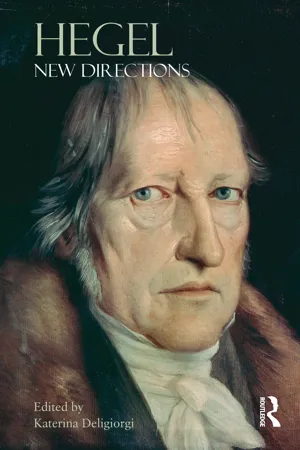
Over the last decade renewed interest in Hegel's thought and its legacy, especially in Anglo-American philosophy, has combined with the publication of new critical editions of his work in German to underline the value of Hegel for contemporary philosophy. "Hegel: New Directions" takes stock of this re-evaluation and presents an assessment of current thinking on this seminal philosopher. Leading scholars, who have spearheaded the reappraisal, bring the history of philosophy into dialogue with contemporary philosophical questions. Drawing on a broad range of themes, the essays offer a critical and stimulating guide to Hegel's thought, whilst addressing central questions of contemporary philosophy in epistemology, ethics, political and social theory, religion, philosophy of nature and aesthetics.
Information
Chapter One
Hegel on Conscience and the History of Moral Philosophy
Allen Speight
Conscience, Hegel claims, "represents an exalted point of view, a point of view of the modern world" (PR: §136A). The notion that conscience is indeed closely linked to the experience of modernity has played an important role in a number of approaches to the history of moral philosophy, but these approaches often differ in terms of their accounts of what precisely it is that makes conscience a modern phenomenon. In what follows I want to show what is distinctive about Hegel's view of the modernity of conscience, in the process re-examining some conventional assumptions about Hegel's relation to the history of moral philosophy. I hope thereby to make some contribution to the still not entirely developed philosophical subdiscipline of the history of moral philosophy, as well as to the broader connection it shares with political and religious concerns that were always central to Hegel's treatment of the concept of conscience.
The issue of conscience and the history of moral philosophy might in general be framed at the start in terms of recent discussion of it in Edward G. Andrew's Conscience and its Critics: Protestant Conscience, Enlightenment Reason and Modern Subjectivity (2001), more specifically in Andrew's response to the history of moral philosophy he finds implicit in J. B. Schneewind's The Invention of Autonomy (1998). Andrew's concern is the development of particularly the Protestant notion of conscience between the sixteenth and nineteenth centuries. On the one hand, Andrew sees something of an overall trend in these centuries. First, there is a development in the sort of activity that conscience could be allowed as describing; he follows here C. S. Lewis's famous characterization of conscience as moving from the activity of the witness box to that of the judge and ultimately even the legislator (Lewis 1960). Secondly, there is a division between the two terms "conscience" and "consciousness"; in the post-Lockean Enlightenment, he argues, the "elevation of consciousness as the basis of personal identity accompanied the rejection of conscience as innate practical principle" (Andrew 2001: 7).
On the other hand, and despite this general trend, Andrew sees in the relevant time period an underlying tension between conscience and reason that he appears to take to be in some sense unresolvable: there are views and philosophical moments that seem more dominated by Enlightenment reason and others that seem more dominated by Protestant conscience. Here Andrew sets out his account in terms of a set of determinate oppositions: the Enlightenment view of reason enshrines itself often in law, while conscience has an antinomian streak; rational judgement is opposed to the conscientious judgement that is simply one's own; reason is sceptical and conscience is certain; reason strives for a sociality while conscience is the province of the individual; reason is communicative while conscience is often portrayed as deeply silent (ibid.: 8-9).
This view of conscience as representing a recalcitrant element in tension with reason is articulated in part as a contrast to what Andrew calls Schneewind's "harmonious conjunction of Protestantism and Enlightenment" (ibid.: 179). Some of the differences between Andrew's and Schneewind's projects can be attributed to a difference of focus. Andrew is concerned to examine primarily the development of views of conscience in the English-speaking tradition; Schneewind has a broader perspective that is not focused on simply the concept of conscience but on the broader issue of autonomy and that includes the rather different development within German cultural and intellectual history.
Andrew explains away his avoidance of figures such as Kant as connected with the desire to focus on philosophical approaches that do not suggest so strongly possible grounds of synthesis between the notions of Protestant conscience and Enlightenment reason (ibid.: 8). He further suggests that Schneewind gives insufficient consideration to social counter-movements to the notion of conscience, especially, he holds, "the rise of society and the regulation of conduct by social expectations" in the eighteenth century (ibid.: 180). This latter point is somewhat of a strained claim, since Schneewind makes clear that he thinks the history of moral philosophy is frequently more driven by social developments than the history of philosophy more generally often recognizes (Schneewind 1998: 5-8). Nonetheless, a brief consideration of Andrew and Schneewind has yielded a question concerning the relation between conscience and reason that bears underlining: is there a way of understanding the relation between individual self-certainty in judgements of conscience and normative judgements of reason that does not simply view them as opposed tensions? I shall claim that Hegel's approach to the issue of conscience does in fact offer such a synthetic possibility for construing both the rational and self-certain sides of the experience of conscience.
Conscience in Hegel’s History of Philosophy
At first glance, we might think that Hegel tells a story similar to Andrew's about the place of conscience within the history of moral philosophy. It appears, to begin with, to be a developmental story of conscience as a distinctively modern phenomenon. Hegel often makes the point, for example, that conscience is a notion that was not available to the ancient Greeks: "of the Greeks in the first and true shape of their freedom, we can insist that they had no conscience; among them ruled the habit of living for the fatherland, without further reflection" (PH: 253; SW 12: 308). Even more decisively, and closer to the specific developmental account that Andrew gives, the experience of conscience appears for Hegel to be a crucial marker not just of the Christian as opposed to the classical era but of the distinctively Protestant moment within Christianity itself. Among Hegel's more famous remarks is this from the preface to the Philosophy of Right:
It is a great obstinacy [Eigensinn], the kind of obstinacy which does honor to human beings, that they are unwilling to acknowledge in their attitudes anything which has not been justified by thought - and this obstinacy is the characteristic property of the modern age, as well as being the distinctive principle of Protestantism. What Luther inaugurated as faith in feeling and in the testimony of the spirit [Zeugnis des Geistes] is the same thing that the spirit, at a more mature stage of its development endeavors to grasp in the concept so as to free itself in the present and thus find itself therein.
(PR: 12, emphasis added)
Hegel's remark here may suggest the two sides of Andrew's tension: although Hegel speaks about an appropriation of this experience into a conceptual or rational form, the description of a characteristic Protestant "obstinacy" certainly suggests a recalcitrant, not-necessarily-rational side of the claim to trust one's own judgement. (The German word for "obstinacy", Eigensinn, is one that Hegel uses otherwise in the Philosophy of Right when talking about topics such as the unwavering and occasionally impolite insistence he thinks uncultured persons can place on the satisfaction of their own rights in various situations.)
But Hegel's view of the relation between these two sides is actually quite different from Andrew's. A first window on to the differences in their views can be seen etymologically: while the notion of conscience, as Andrew argues, increasingly comes to be defined in the English language in distinction from its emergent cognate consciousness, the German Gewissen - as Hegel's account of it famously exploits at a number of levels - instead is linked at once both to the related terms gewiss ("certain") and Wissen ("knowledge"). The difference in Hegel's view can be glimpsed from a section of the account of conscience in the "Morality" section of the Philosophy of Right:
This subjectivity, as abstract self-determination and pure certainty of itself alone, evaporates into itself all determinate aspects of right, duty, and existence [Dasein], inasmuch as it is the power of judgment which determines solely from within itself what is good in relation to a given content, and at the same time the power to which the good, which is at first only an Idea and an obligation, owes its actuality.
The self-consciousness which has managed to attain this absolute reflection into itself knows itself in this reflection as a consciousness which cannot and should not be compromised by any present and given determination. In the shapes which it more commonly assumes in history (as in the case of Socrates, the Stoics, etc.) the tendency to look inwards into the self and to know and determine from within the self what is right and good appears in epochs when what is recognized as right and good in actuality and custom is unable to satisfy the better will.
(PR: §138 and Remark, emphasis added)
The first thing to notice is that Hegel is talking here about a coordinate power that seems to work in two directions: on the one hand, to evaporate or condense ethical actuality, and, on the other hand, to give it fullness and actuality (perhaps we could call this a kind of "solidifying"). The examples Hegel gives to illustrate his conception of conscience as a sort of evaporated form of rational ethical life are striking: Socrates and the Stoics, he says, are instances of "the tendency to look inwards into the self and to know and determine from within the self what is right and good" which appear "in epochs when what is recognized as right and good in actuality and custom is unable to satisfy the better will": "When the existing world of freedom has become unfaithful to the better will, this will no longer finds itself in the duties recognized in this world and must seek to recover in ideal inwardness alone that harmony which it has lost in actuality" (PR: §138 Remark).
The double image of evaporation and solidification, as well as the appeal to exceptional figures who, like Socrates and the Stoics, can in some relevant sense withdraw from the ethical whole, suggests that Hegel views conscience and reason not as two separate elements that are in tension with one another, as though, on Andrew's view, there are simply moments in history when either conscience or reason just happens to dominate; rather, the extreme inward experience of conscience must be thought of in terms of being a concentrated power of judgement that is, in fact, the source of the actuality of the rational ethical whole that is Sittlichkeit. Or we might say it in this way: it appears that Hegel appeals to the notion of a conscience that must act in a world in which it can find its own purposes present. Presumably, then, conscience must not be regarded as a sudden eruption of what opposes rational ethical order but rather as having a more intimate conceptual connection to that order.
In addition to this conceptual point - what we might call Hegel's "holistic" stance toward conscience - there is a further issue raised by Hegel's use of examples in this passage: paradoxically, given the stress Hegel places on the modernity of conscience, it is two ancient ethical examples, Socrates and the Stoics, that play a central role in this passage. What sort of historical account is Hegel actually giving, then, of the notion of conscience?
To begin with, we must notice that it is not the history of moral philosophy that we might perhaps expect of someone who makes Hegel's claim about the essential modernity of conscience: that is to say, a history that might track the development of the notion of conscientia from late antiquity in the writings of figures such as St Paul through its medieval appropriation in figures such as Peter Lombard, Thomas Aquinas and Bonaventure.1 Hegel does not, in fact, give an explicit developmental account of the notion of conscience, and his own brief references, for example, to conscience in its medieval context are limited to a framework defined by his familiar criticism of the "external" Orientation of Catholic religious views more generally. (Characteristic are these comments about conscience and the medieval Church: "In the same way that the administration of the means of grace belongs as an outward possession to the Church in relation of worship, so is the Church also in possession of a moral estimate for judging of the actions of individuals; it is in the possession of the conscience, as of knowledge as a whole, so that man's inmost essence, his accountability, passes into other hands and to another person, and the subject is devoid of individuality even in his inmost self" (LHP 3: 56; SW 19: 538).
Instead, as we have begun to see, Hegel's account of the history of the concept of conscience is surprisingly punctate, emphasizing the historical moments defined by individual figures such as Socrates and Luther (and to a lesser extent the Stoics) in whom subjective self-awareness is in especially stark relief to the conventional order. And, perhaps more problematically, while Hegel does mark a difference between the inauguration of the modern age in Luther and the ancient figures of Socrates and the Stoics, it is not initially clear why he seems to want to stretch the "modern" notion of conscience to include these ancient "exceptions". A brief comparative look at Hegel's description of these moments seems warranted.
Socrates and the Stoics
Hegel describes the Socratic moment of conscienc...
Table of contents
- Cover
- Half Title
- Title
- Copyright
- Contents
- Contributors
- Acknowledgements
- Abbreviations
- Introduction: On reading Hegel today
- 1. Hegel on conscience and the history of moral philosophy
- 2. The apperceptive I and the empirical self: towards a heterodox reading of "Lordship and Bondage" in Hegel's Phenomenology
- 3. Hegel, McDowell and recent defences of Kant
- 4. Substance, subject and infinity: a case study of the role of logic in Hegel's system
- 5. Dialectic as logic of transformative processes
- 6. Hegel, ethics and the logic of universality
- 7. Recognition and reconciliation: actualized agency in Hegel's Jena Phenomenology
- 8. The contemporary relevance of Hegel's practical philosophy
- 9. Catching up with history: Hegel and abstract painting
- 10. New directions in Hegel's philosophy of nature
- 11. Hegel and the gospel according to Immanuel
- 12. What is conceptual history?
- 13. On Hegel's interpretation of Aristotle's psyche: a qualified defence
- Bibliography
- Index
Trusted by 375,005 students
Access to over 1.5 million titles for a fair monthly price.
Study more efficiently using our study tools.
Frequently asked questions
Yes, you can cancel anytime from the Subscription tab in your account settings on the Perlego website. Your subscription will stay active until the end of your current billing period. Learn how to cancel your subscription
No, books cannot be downloaded as external files, such as PDFs, for use outside of Perlego. However, you can download books within the Perlego app for offline reading on mobile or tablet. Learn how to download books offline
Perlego offers two plans: Essential and Complete
- Essential is ideal for learners and professionals who enjoy exploring a wide range of subjects. Access the Essential Library with 800,000+ trusted titles and best-sellers across business, personal growth, and the humanities. Includes unlimited reading time and Standard Read Aloud voice.
- Complete: Perfect for advanced learners and researchers needing full, unrestricted access. Unlock 1.5M+ books across hundreds of subjects, including academic and specialized titles. The Complete Plan also includes advanced features like Premium Read Aloud and Research Assistant.
We are an online textbook subscription service, where you can get access to an entire online library for less than the price of a single book per month. With over 1.5 million books across 990+ topics, we’ve got you covered! Learn about our mission
Look out for the read-aloud symbol on your next book to see if you can listen to it. The read-aloud tool reads text aloud for you, highlighting the text as it is being read. You can pause it, speed it up and slow it down. Learn more about Read Aloud
Yes! You can use the Perlego app on both iOS and Android devices to read anytime, anywhere — even offline. Perfect for commutes or when you’re on the go.
Please note we cannot support devices running on iOS 13 and Android 7 or earlier. Learn more about using the app
Please note we cannot support devices running on iOS 13 and Android 7 or earlier. Learn more about using the app
Yes, you can access Hegel by Katerina Deligiorgi in PDF and/or ePUB format, as well as other popular books in Philosophy & Ethics & Moral Philosophy. We have over 1.5 million books available in our catalogue for you to explore.