eBook - ePub
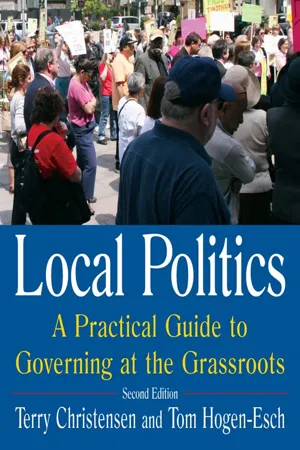
Local Politics: A Practical Guide to Governing at the Grassroots
A Practical Guide to Governing at the Grassroots
- 400 pages
- English
- ePUB (mobile friendly)
- Available on iOS & Android
eBook - ePub
Local Politics: A Practical Guide to Governing at the Grassroots
A Practical Guide to Governing at the Grassroots
About this book
Unlike most competing texts that are densely written and heavily theoretical, with little flavor of political life, this book is a readable, jargon-free introduction to real-life local politics for today's students. While it encompasses local government and politics in cities and towns across America, "Local Politics: A Practical Guide to Governing at the Grassroots" gives special attention to the politics of suburbia, where many students live, and encourages them to become engaged in their own communities. The book is also distinguished by its strong emphasis on nuts-and-bolts practical politics. It provides focused discussion of institutions, roles, and personalities as well as the dynamic environment of local politics (demographics, immigration, globalization, etc.) and major policy issues (budgets, land use, transportation, education, etc.). Other texts treat communities as abstractions and readers as passive observers. "Local Politics: A Practical Guide to Governing at the Grassroots" is designed to inspire civic engagement as well as understanding. It features "In Your Community" research projects for students in every chapter along with informative tables, clear charts, essential terms, and guides to useful websites.
Information
| 1 | Introduction to the Study of Local Politics |
| Why We Bother and How We Go About It |
You walk into a room where a meeting is in progress. A few of the participants glance at you as you enter; a few are too intent on the business at hand to notice you; most look bored and disinterested; several are reading. A voice is droning on over a loudspeaker. You find a seat and take in your surroundings. If you’re in a large, old city, the room may seem a bit like a church, with people sitting in wooden pews facing the front of the room, where some more official-looking people in big chairs sit at desks, perhaps facing one another rather than their audience, which they may outnumber. If you’re in a newer city, perhaps in the suburbs or the Sunbelt, the room will be modern and may seem more like a theater, with rows and rows of comfortable seats for the audience and a small group of official types at desks and in padded chairs that swivel, but facing the audience rather than one another.
The official-looking people sitting in the front are mostly men and mostly white. The one who looks most important and official of all sits in the middle and seems to be running the show. Nearby, perhaps below or to one side of the official group, are people shuffling papers or taking notes. Also beneath or to one side of the group is a podium from which a man in a suit is addressing them, his back to the audience. His, you now discern, is the voice on the loudspeaker. Some of the official types seem to be listening to him, but others are whispering to each other, talking on the phone, pouring themselves coffee, reading, or seemingly having an out-of-body experience. The speaker concludes with some ingratiating remarks, and the official in the middle thanks him and calls on one of the paper-shufflers at a nearby desk. Referring to a report of some sort, this person speaks quickly, using many unfamiliar words and phrases. Then one of the important-acting officials mutters something and the presider rattles out, “All-in-favor-all-opposed-motion-approved-the-next-item-is-18c.” A few people leave the room looking pleased; others seem to wake up.
Another jargon-spouting official reports, one of the people at the top table gives a mini-lecture, and a succession of people line up behind the podium. You understand that item 18c involves a housing development. The first speakers, all in suits, proclaim its economic benefits and its contribution to solving your community’s dire housing shortage. You are sympathetic. Then, one after the other, people who seem to be average citizens speak. They turn out to be residents of neighborhoods near the proposed development. Unlike the earlier speakers, they are nervous. They do not use jargon and they sometimes seem a little vague, but they make clear their worries about the project’s impact on traffic, schools, and other local services. Some decry the loss of open space and ask for the land to be made into a park. You are sympathetic until some declare that they fear that the “type of people” who might live in the new housing would decrease property values and lead to the deterioration of their neighborhoods. If the proposed condominiums would really cost $350,000, as their developer announced, you suspect it would be people like your own family who might buy them. When the speakers conclude, the officials debate the issue briefly. One or two clearly play to the audience; others seem indifferent. Another quick vote is taken and the housing is approved. The men in suits leave smiling. The more casually dressed people seem bewildered at first, then straggle out grumbling and frowning, glancing disgustedly back at the officials up front. One comes down to walk out with them, pursing her lips and shaking her head.
“Item 19a,” announces the front-and-center official and another paper-shuffler mutters a report, halting abruptly when the doors burst open and a television camera crew sweeps in led by someone in heavy makeup and hair that doesn’t move. Blinding lights suddenly bathe the chamber. The person making the report stutters to continue, and all of the important-acting officials now sit up straight and look attentive and concerned. A couple of rumpled-looking people sitting at a table to one side and writing in funny little notebooks smirk. As the made-up person directs the camera, a new set of speakers queues up at the podium. This time they are elderly and gray haired, and you gather that the officials are about to take something away from them. But before they begin their speeches, the bright lights fade, the TV crew sweeps out, and everybody slumps, looking dazed and disappointed. Meanwhile, a group of police officers in uniform enters the room and sits together, right in front.
You’ve got an early class the next day, so you make your way out, noticing that you could have picked up a printed agenda at the door. You’re surprised to find a crowd in the hall. Some people are talking angrily; you recognize them from the housing debate. A couple of men in suits are huddled with one of the important-looking officials. Some average-citizen types are walking in wearing yellow “Save Our” something-or-other pins.
Mulling it over on the way home, you are surprised that although it seemed boring while you were sitting through it, what you observed now seems sort of interesting, even a little exciting. You’ve just witnessed a bit of local politics at work: a city council or county board with its mayor or chairperson and supporting bureaucracy along with lobbyists and citizens and a reporter or two. The process, the people, and even the room and building (grand and intimidating or comfortable and accessible) reveal a lot about local government and politics. After another meeting or two, you will discern organizational structures and an operating style. You’ll figure out which people, interests, and values have clout. If you go to enough meetings, you’ll see most of the elements of local politics in action—elected officials, bureaucrats, interest groups and lobbyists, the media, and sometimes even important members of the local business elite. You may sense the abstract presence of the voters or the public, especially around elections. You’ll hear talk of taxes and budgets, of economic development, social issues and services, regional problems, and relations with state and federal governments.
Such meetings will not tell you all you need to know about local politics, but they are a pretty good starting place. They can help you generate questions about how your local politics works and can connect the things you learn about in class to the real world. If you study other communities, you’ll find that for all their differences, they have much in common with your own.
IN YOUR COMMUNITY
Have you ever been to a city council meeting? (If not, go to one!) What kinds of issues were discussed and what groups were represented? How were the issues resolved?
Why Study Local Politics?
The most practical reason to study local politics is that it affects us all every day, from what happens when we flush the toilet to life in our neighborhoods, to getting along with one another, personal safety, jobs, schools, traffic on our streets, and even the air we breathe. Yet as much as it affects us, few of us understand how local politics works or how to make it work for us.
The foiling of an international terrorist plot receives more media attention and may seem more glamorous, but international or even national politics rarely touch us as immediately or directly as do events at the local level. The glamour of a movie-star governor in California or a cliffhanger presidential election may grab our attention, but since most of us do not live in our state capitals or in Washington, DC, the action is too far away for us to observe in person. Modern media, with cable channels like C-SPAN and with the Internet, are changing that, but for the most part we still have to rely on intermediaries to pass on information and impressions to us. As excellent as they may be, journalists and editors (and even Web bloggers) filter information and interpret it for us. In your own community, however, you can be your own reporter. You can go see for yourself, actually talk to the participants, and learn the ropes of politics by “doing.” Sheer proximity makes studying local politics a worthwhile endeavor, and many of the lessons we learn can be applied to all levels of politics. As the saying goes, in a very real way, all politics is local.
At first glance, local matters such as a zoning change may seem mundane, even trivial. Some are. But just as often, the controversies, politics, and personalities surrounding a zoning change can be compelling and dramatic. Either way, they affect us too intimately to dismiss or leave to others. Moreover, acting as individuals or as part of an interest group, our ability to influence local politics far exceeds our power to shape events at the state or national level. One of the first surprises for students of local politics is learning how few players actually participate and how easy, with a little chutzpah, it is to become one—particularly if you are someone who understands how the game is played. As an informed participant in the local political process, you can develop, in a relatively short period of time, knowledge and expertise on issues that few others in the community have.
We should not, however, fixate on just one community. This is a common pitfall in studying politics at all levels. In studying only one city or “case” there is a tendency to assume that its dynamics will more or less resemble politics elsewhere. This may or may not be true. The solution to this dilemma is fairly simple: compare. The feasibility of such comparison makes local politics an excellent subject of study, in some ways better than national or even state politics, which is limited to only fifty states. In contrast, some metropolitan areas alone contain hundreds of local governments, so you don’t even need to go far away to begin making comparisons. The sheer number of local political jurisdictions creates other problems—which we will discuss later—but for now, the basic point is that comparison allows us to avoid the “tunnel vision” that comes from studying only one community.
Comparison also enables us to develop generalizations or theories, not only about local politics, but about politics and political behavior at all levels. Building theories about human behavior is not easy, but there is a method to the madness. First, researchers make observations and then hypotheses (educated guesses) about how and why human events happen. Next, they gather data or evidence to test their hypotheses. If their hypotheses are confirmed, the process moves on to the development of a theory, or a model for explaining how something works. Ultimately, the purpose of theories is to predict what might happen in similar cases. Again, it isn’t enough to look at just one community or tell a story about a particular event, as a journalist does. One of our goals is to look at many communities or events and try to discern patterns among them in order to arrive at useful, predictive generalizations.
So what kinds of things might we study and begin to make hypotheses about? We can study the relative influence of different individuals and groups and their influence on what issues make it onto the agenda, what alternatives are considered, and, ultimately, how issues are decided and implemented. We might seek to understand why and under what conditions groups form alliances, or coalitions, with one another to affect policy decisions. We could also consider the impact of government structures or a city’s social psychology, which we will discuss later, in producing a particular political outcome. We might study the impact of age, class, ethnicity, education, or even geography on why groups vote the way they do. Again, whether we are studying power relations, political institutions, voting behavior, or something else, it is through comparison with other cases that the most useful conclusions are reached.
Finally, comparison has a more practical utility as well. In addition to building theories, comparison is also a critical tool in solving practical problems facing urban areas—one of the most important skills we hope you will learn from this book. Whether you are interested in finding ways to save on street maintenance, improve the delivery of services, or more effectively incorporate residents into the decision-making process, comparison opens our eyes to solutions to problems that we might not have thought of on our own. Often called “best practices research,” one of the first places to look in solving everyday problems is to study how similar problems have been dealt with in other cities.
In short, the larger goal of comparison is to better understand politics and find better solutions to problems. But your own community is still the best starting point. Think of it as the frog you dissected in biology lab. You cut up one frog, not to learn only about that frog but to learn about frogs and anatomy in general. Your frog was unique, as are all living creatures and communities, but its anatomy had a lot in common with other frogs and creatures, so you learned about them, too. Remember, though, that unlike that frog, the communities we’re going to study are very much alive. They may change as we study them. Who knows, the results of your study might even change them!
Know Your “City Limits”
As a budding practitioner of local politics, one of the things that can set you apart is to become one of the few who truly understand “the big picture.” In order to practice the art of what is possible in city politics, we need to begin with an understanding of several important limitations that face cities and other local governments. Local politics is somewhat unique in that it is subnational and largely subordinate to other levels of politics and to larger economic and social forces. Althoug...
Table of contents
- Cover
- Half Title
- Title Page
- Copyright Page
- Table of Contents
- List of Tables and Figures
- Preface
- 1 Introduction to the Study of Local Politics: Why We Bother and How We Go About It
- Part I The Environment of Local Politics: Characteristics of Urban Places
- Part II Official Decision Makers: Inside City Hall
- Part III Outside City Hall: Elections, Influence, and Power
- Part IV Budget Politics, Public Policy, and Regional Government
- Index
- About the Authors
Trusted by 375,005 students
Access to over 1.5 million titles for a fair monthly price.
Study more efficiently using our study tools.
Frequently asked questions
Yes, you can cancel anytime from the Subscription tab in your account settings on the Perlego website. Your subscription will stay active until the end of your current billing period. Learn how to cancel your subscription
No, books cannot be downloaded as external files, such as PDFs, for use outside of Perlego. However, you can download books within the Perlego app for offline reading on mobile or tablet. Learn how to download books offline
Perlego offers two plans: Essential and Complete
- Essential is ideal for learners and professionals who enjoy exploring a wide range of subjects. Access the Essential Library with 800,000+ trusted titles and best-sellers across business, personal growth, and the humanities. Includes unlimited reading time and Standard Read Aloud voice.
- Complete: Perfect for advanced learners and researchers needing full, unrestricted access. Unlock 1.5M+ books across hundreds of subjects, including academic and specialized titles. The Complete Plan also includes advanced features like Premium Read Aloud and Research Assistant.
We are an online textbook subscription service, where you can get access to an entire online library for less than the price of a single book per month. With over 1.5 million books across 990+ topics, we’ve got you covered! Learn about our mission
Look out for the read-aloud symbol on your next book to see if you can listen to it. The read-aloud tool reads text aloud for you, highlighting the text as it is being read. You can pause it, speed it up and slow it down. Learn more about Read Aloud
Yes! You can use the Perlego app on both iOS and Android devices to read anytime, anywhere — even offline. Perfect for commutes or when you’re on the go.
Please note we cannot support devices running on iOS 13 and Android 7 or earlier. Learn more about using the app
Please note we cannot support devices running on iOS 13 and Android 7 or earlier. Learn more about using the app
Yes, you can access Local Politics: A Practical Guide to Governing at the Grassroots by Terry Christensen,Tom Hogen-Esch in PDF and/or ePUB format, as well as other popular books in Politics & International Relations & American Government. We have over 1.5 million books available in our catalogue for you to explore.