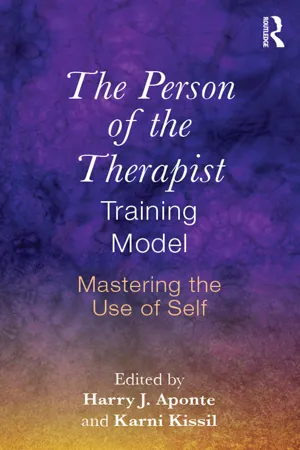
The Person of the Therapist Training Model presents a model that prepares therapists to make active and purposeful use of who they are, personally and professionally, in all aspects of the therapeutic process—relationship, assessment and intervention. The authors take a process that seems vague and elusive, the self-of-the-therapist work, and provide a step-by-step description of how to conceptualize, structure, and implement a training program designed to facilitate the creation of effective therapists, who are skilled at using their whole selves in their encounters with clients. This book looks to make conscious and planned use of a therapist's race, gender, culture, values, life experience, and in particular, personal vulnerabilities and struggles in how he or she relates and works with clients. This evidence-supported resource is ideal for clinicians, supervisors, and training programs.
eBook - ePub
The Person of the Therapist Training Model
Mastering the Use of Self
- 144 pages
- English
- ePUB (mobile friendly)
- Available on iOS & Android
eBook - ePub
The Person of the Therapist Training Model
Mastering the Use of Self
About this book
Information
1 The Person-of-the-Therapist Model on the Use of Self in Therapy
The Training Philosophy
DOI: 10.4324/9781315719030-1
The Training Philosophy of the POTT Approach
The main thrust of the POTT model has to do with a use of self that emanates from the personal depths of the individual who is conducting the therapy. This is more than a strategy about how therapists use themselves. This is about us, as clinicians, developing a conscious, purposeful and disciplined access to our humanity within our professional role in the therapeutic relationship. This means that as therapists we view the therapeutic process, at its core, as a person-to-person human encounter. The POTT approach assumes that the more both therapist and client are experientially present in this living process of therapy, the greater the access the therapist has to self and to client to do the work of therapy. POTT’s concept of being “present” in the therapeutic relationship implies a professionally tailored purposeful personal engagement with the client (individual, couple or family) that lends clarity of insight, depth of sensitivity and potency of effectiveness to the therapist’s clinical performance.
That encounter in session is a living experience among family members and between therapist and client. Whatever the therapeutic model, when therapist and client (family, couple or individual) come together in a session, they engage in the common task of therapy, which generates a human system with its own unique to the moment complex of dynamics. Even as the narrative therapist consciously focuses on constructing or deconstructing a story with a family (West & Bubenzer, 2000) there is personal engagement between them that affects all parties involved and their relationships with each other, and therefore the course of the therapy. A structural family therapist can witness or actively coax interactions among the clients themselves when it is a couple or a family. In the enactment, a human connection is activated among the parties that connects minds and hearts in deeply personal ways that give a unique color and shape to the therapeutic process. Classical psychoanalysts foster those human connections in their silence, which triggers transference that incites countertransference, again affecting all parties in profoundly human ways (Bochner, 2000). The psychoanalyst may perceive through the inner experience of the “Third Ear,” by hearing “the voices [of the patient] from within the self that are otherwise not audible” (Reik, 1948, p. 147). These personal transactional effects in all therapeutic methods become integral to the therapeutic process. Whether we are attending primarily to technique based on the articulation of language, the drama of human interaction or the perception of the projection of an unconscious introject, these are transactional processes within the therapeutic relationship that facilitate the understanding and promote the therapeutic change of therapy.
We take the position that the relationship in therapy, whether recognized or not by the therapeutic model, is a critical factor through which all therapies achieve positive change. Note Weiss and colleagues (2015):
Most of the research on the therapeutic alliance has been conducted with therapies that emphasize the relationship as an essential mechanism of (e.g., psychodynamic or humanistic orientations), but results appear to be similar for treatments that do not emphasize the relationship as the main mechanism of change.(p. 29)
See Muntigl and Horvath (2015):
Over the last three decades empirical research has provided robust support for the general claim that the quality of the therapeutic relationship bears a ubiquitous and significant relation to treatment outcome across the breadth of client problems and variety of treatment approaches.(p. 41)
These claims lead to two critical questions: How does the therapeutic relationship make therapy work? How do we train therapists to use the therapeutic relationship to achieve their goals? These questions are particularly intriguing since we are looking at this relational process between therapist and client in the contexts of the full range of therapeutic modalities and therapeutic components.
The POTT perspective asserts both that we as therapists are active agents in the dynamic, living experience of the therapeutic relationship to relate, assess and intervene with clients, and that our level of expertise can be enhanced through training. Therapists can decide the degree and manner in which they wish to be present and work through the forces of their personal connections and interactions with clients. For example, when talking about the technique of “enactment” in which family members are prompted to interact around their issues, family therapists “can engage in a facilitating manner from inside the family transaction by participating in it, or from outside by not engaging directly in the transaction” (Aponte & VanDeusen, 1981, p. 325). Structural therapists do this as an integral part of their model (Minuchin & Fishman, 1981). Dattilio includes a form of enactment in his cognitive-behavioral approach to working with families (2010). In talking about attachment-based therapies, Wylie and Turner (2011) state that, “much or even most of this therapy is intuitive, played out in ‘enactments’” (p. 27). “The core emotionally focused therapy intervention is restructuring interactions” (p. 117), which Sprenkle and colleagues (2009) assert is worked through the enactment. Whether or not the enactment or any other technique is explicitly scripted in our approach, we as therapists choose consciously or unconsciously what to do with ourselves personally vis-à-vis our clients when intervening with them. As such, we can be emotionally present or absent, open or closed, connected or disengaged, active or passive, etc. However, as therapists, for that connection with the client to be purposeful, it must be conscious on our part, and for it to be professionally purposeful, it must be actively directed by us toward articulated therapeutic ends.
The POTT approach views the personal connection in the therapeutic relationship as a factor common to all therapies in the sense that in all approaches we face the challenge, consciously or subliminally, to assume a genuine personal relational posture with respect to clients that fits our own and our clients’ personalities and backgrounds, the issue of the moment, and our therapeutic ideologies. Because of the POTT perspective about the impact of the personal component on the therapeutic relationship, the model emphasizes the importance of us as therapists being able to both identify with and differentiate ourselves from our clients. We should be able to engage the client most aptly clinically while maintaining in that clinically decisive moment the most therapeutically effective professional distance. With respect to the relationship, ultimately the goal is for us to connect closely enough to gain that moment’s clinically necessary accessibility to the client while remaining free in the relationship to perform the requisite professional task.
Identification and Differentiation
For a therapist to be able at any given moment to integrate these polar opposites (personal and professional) within the role of therapist, we will need to be able to both personally identify with and differentiate from our client(s) as required clinically at any particular moment in the therapeutic process. This identification calls for our being able to see ourselves in the client’s issue at the appropriate moment, in some way getting in touch with the facet of the client’s struggle with which we need to then resonate through an awareness and connection with some relevant trace of our own human frailty and vulnerability. This empathic resonance has both affective and cognitive elements (Gerdes & Segal, 2011). As therapists we need to be able to both feel with our clients, and be conscious of the nature of the connection. The resonance can be with the client’s issue that may in some part of the issue have even a trace resemblance to a personal issue of ours. The resonance can also or even only find a reflection in how the client and we struggle with our respective issues that in themselves can be quite different. We look to feel what it is like to walk in the client’s shoes just enough to realize a personal sense of the client’s experience as needed to carry out a therapeutic task.
However, to be able to achieve this intimate connection in the moment and still operate with the emotional independence of a professional, we must also be able to differentiate from the client and the client’s experience, much along Bowen’s concept of differentiation, which speaks to a relative personal autonomy and freedom from emotional fusion with others (Bowen, 1972; Kerr, 1981), but from the POTT perspective relative to what is needed in the moment of the therapeutic process. In the general perspective, differentiation, as POTT uses the term, has to do with our sense of self and grounding in self. It touches on our emotional responsiveness as ensconced in the strength of our personal boundaries that are shaped by commitment to our personal ideals and the journey to the personal goals connoted by those ideals. At the level of our functioning in the role of therapist in the clinical moment, this concept of differentiation speaks to the ability to be connected to the point of identification with a client, while also retaining the freedom to relate, assess and intervene with clients as stipulated by the therapeutic needs of our client in the now.
Pursuing these ends requires that therapists work toward:
- Knowledge of Self: Therapists look to understand themselves in the moment by continually studying and examining how their past and their present impinge on who they are today. Self-insight includes the psychological and relational aspects of our lives, along with the personal worldviews, values, morality and social location that color not only our vision of our clients and our clients’ issues, but also our own philosophies about change in therapy.
- Access to Self: As they engage with clients, therapists reach to access their memories, emotions, spirituality and social consciousness relevant at the moment to the therapeutic process. This is much more than intellectually recalling them. It means being in touch with what belongs to self, and is inside of self so as to draw from within ourselves into the living moment of the therapeutic encounter whatever aspects of our life experience, personal makeup and philosophical/spiritual perspectives are needed for the therapeutic tasks of forming relationships, assessing and intervening in the clinical instance.
- Management of Self: For therapists to purposefully use whatever they need of themselves when called for, we need the discernment and discipline to selectively open ourselves to the client and the client’s issues, and to activate and project the specific aspects of ourselves that are needed for the therapeutic task of the moment.
Self-insight, self-access and self-management cannot be simply willed. For all of us there are things about ourselves that we do not want to face. Doing so will hurt, make us anxious or discouraged, or cause us shame. There are aspects of our inner or relational lives that we avoid being in touch with because we cannot tolerate what we feel when we touch the memories or emotions attached to them. And there are parts of ourselves over which we have little control to our embarrassment or dismay. Yet, these discomforting facets of ourselves are treasures of human experience that bond us to the rest of humanity and can allow us to resonate empathically with our brothers and sisters. There are also parts of ourselves that we so take for granted that we are unaware of the extent to which they shade and shape how we see and relate to people and their lives. These may be attitudes and values that are part of our family legacies, culture or spirituality. Unless we are conscious of them we cannot make active use of them therapeutically, cannot take them into account when we interpret and evaluate what we see and hear of our clients.
As therapists, we need to be able to work with all of who we are within the various component tasks of the therapeutic process at the appropriate clinical moment. Yet, we will need help, and we argue here—training that specifically enables us to see, reach and actively utilize all these parts of ourselves as needed, when needed. It also happens that any training process that succeeds in gaining us such personal insight, access and governance of ourselves within our roles as therapists will likely also spark personal change in us. Any such change in us in the POTT model is not directly intended, although it is welcomed, especially if it helps us to do better therapy, which is what POTT is all about. To the question of whether that makes the POTT training therapy, the answer is “no” because those personal changes are not the essential or primary goals of the training. The basic aim of the POTT training model is to give the therapist greater freedom and skill in the use of the self to conduct better therapy. The trainers assume responsibility for helping to produce better therapists, not to help people resolve their personal issues although if in the process of the training they happen to contribute to people’s efforts to improve themselves personally, the trainers will be happy they did. We will examine here what it means to work on self to enhance our therapeutic skills.
Let us consider some very brief examples of how therapists may utilize their personal selves to carry out some therapeutic tasks. We must have the self-insight, be able to access the called-for place within ourselves, and then put into an actionable place that part-of-self required by the task at hand. We may even need to draw from within ourselves a mental and emotional disposition that may not come easily to us to carry out a therapeutic task in a particular situation with a particular client. For example, in one actual instance, a therapist’s goal was to gain the trust of an especially well-defended client. For the therapist, remaining open and engaged in the face of the woman’s emotional lockdown was a difficult challenge because of a core emotional issue of his own, the drive to attain his goals, in this case a palpable therapeutic outcome, which he experienced her as blocking.
The client hides her insecurities and vulnerability behind her considerable ability to intellectualize, discouraging the therapist’s inquisitiveness. The therapist feels the wall of self-protection. Knowing himself, he resists his natural impulse to push against it, and consciously (self-management) puts himself in the mindset of just wondering, “Why the wall?” He looks within himself (self-access) for the barriers he knows well (self-knowledge) that he puts up to protect his own vulnerabilities. In this self-reflection about his personal manner of going it alone, he finds the bridge to identify and empathize with his client’s need to protect her self. He can then access within himself at the appropriate moment an empathically felt desire to engage her in talking about the wall, enabling him to substitute interes...
Table of contents
- Cover Page
- Half-Title Page
- Title Page
- Copyright Page
- Dedication
- Contents
- List of Contributors
- Preface
- Acknowledgments
- 1 The Person-of-the-Therapist Model on the Use of Self in Therapy: The Training Philosophy
- 2 The POTT Program: Step-by-Step
- 3 Journaling in POTT
- 4 Looking at the POTT Process: The Case of Lynae
- 5 Looking at the POTT Process: The Case of the “Rescuer”
- 6 About the Facilitators
- 7 Integrating POTT into Your Setting: Applications and Modifications
- 8 POTT Principles Across Mental Health Disciplines: “Just Use Your Clinical Judgment”
- 9 Supervision in the POTT Model
- Appendices
- B. Winter Quarter Materials
- C. Spring Quarter Materials
- D. Supervisory Materials
- Index
Trusted by 375,005 students
Access to over 1.5 million titles for a fair monthly price.
Study more efficiently using our study tools.
Frequently asked questions
Yes, you can cancel anytime from the Subscription tab in your account settings on the Perlego website. Your subscription will stay active until the end of your current billing period. Learn how to cancel your subscription
No, books cannot be downloaded as external files, such as PDFs, for use outside of Perlego. However, you can download books within the Perlego app for offline reading on mobile or tablet. Learn how to download books offline
Perlego offers two plans: Essential and Complete
- Essential is ideal for learners and professionals who enjoy exploring a wide range of subjects. Access the Essential Library with 800,000+ trusted titles and best-sellers across business, personal growth, and the humanities. Includes unlimited reading time and Standard Read Aloud voice.
- Complete: Perfect for advanced learners and researchers needing full, unrestricted access. Unlock 1.5M+ books across hundreds of subjects, including academic and specialized titles. The Complete Plan also includes advanced features like Premium Read Aloud and Research Assistant.
We are an online textbook subscription service, where you can get access to an entire online library for less than the price of a single book per month. With over 1.5 million books across 990+ topics, we’ve got you covered! Learn about our mission
Look out for the read-aloud symbol on your next book to see if you can listen to it. The read-aloud tool reads text aloud for you, highlighting the text as it is being read. You can pause it, speed it up and slow it down. Learn more about Read Aloud
Yes! You can use the Perlego app on both iOS and Android devices to read anytime, anywhere — even offline. Perfect for commutes or when you’re on the go.
Please note we cannot support devices running on iOS 13 and Android 7 or earlier. Learn more about using the app
Please note we cannot support devices running on iOS 13 and Android 7 or earlier. Learn more about using the app
Yes, you can access The Person of the Therapist Training Model by Harry J. Aponte, Karni Kissil, Harry J. Aponte,Karni Kissil in PDF and/or ePUB format, as well as other popular books in Psychology & Education in Psychology. We have over 1.5 million books available in our catalogue for you to explore.