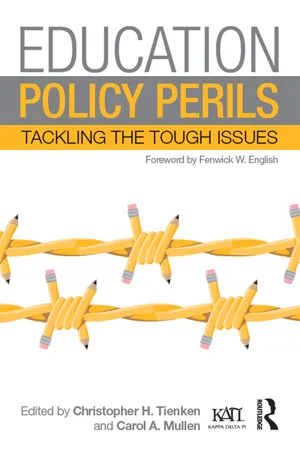
Education Policy Perils provides educators and those interested in the future of public education with research-based and practical analyses of some of the foremost issues facing public schools today. The collection, written by experienced scholar-practitioners, offers insights that include nuanced descriptions of various challenges facing educators and recommendations for overcoming them with an eye toward more successful policy and better implementation. The authors apply their expertise to a range of issues from international testing to policy challenges related to curriculum on the state and national levels. This volume positions ongoing debates within the wider context of an education landscape struggling to displace junk-science ideology with empirical research. The scope and sequence combined with the expertise of the contributors make this volume a vital resource for educators at all levels during a pivotal time of major changes in education policy.
eBook - ePub
Education Policy Perils
Tackling Tough Issues
- 200 pages
- English
- ePUB (mobile friendly)
- Available on iOS & Android
eBook - ePub
Education Policy Perils
Tackling Tough Issues
About this book
Information
PART I
Education Leadership in the Current Policy Environment
1
THE RHETORIC AND REALITY OF SCHOOL REFORM: CHOICE, COMPETITION, AND ORGANIZATIONAL INCENTIVES IN MARKET-ORIENTED EDUCATION
UNIVERSITY OF ILLINOIS AT URBANA–CHAMPAIGN
School choice is not a new feature of education in the United States. Yet, since the late 1980s, school choice as education reform policy has helped reshape the administration and character of how educational services are delivered. School choice existed in the postwar era, prior to these changes, with parents of means being able to decide where and with whom their children went to school by way of neighborhood choice. Today, across most states, there is still some mechanism by which parents of varying means can select among different models of schooling. According to the Evergreen Education Group (2014), a digital learning advocacy organization, more than 300,000 students were schooled solely online during the 2013–2014 school year. That organization also reported that during the 2014–2015 academic year, 30 states were expected to have various forms of K–12 schools that operate fully online. The National Center for Education Statistics (2012) estimated that more than 1.7 million students were homeschooled in 2011. Though the online and homeschooled populations represent only a modest number of students, they illustrate the present and increasing options for parents to decide what schooling should look like for their children.
Beyond online schooling and homeschooling, there are a number of alternatives to the assigned neighborhood public school. The other options within the realm of school choice include private schools, magnet schools, charter schools, vouchers, savings accounts, tax credits, deductions, and scholarships (Friedman Foundation for Educational Choice, 2014). Choice also implies a number of administrative or institutional practices that include open enrollment programs, adjustments in admissions policies, creating culturally or linguistically aware schools, or the decentralization of governance, curriculum, assessment, or hiring practices.
Often in educational policy discourse, the forms of schooling are presented as supply-side innovations/interventions away from what is portrayed as the older, bureaucratic catchment-area model. Funding changes, conversely, are often understood as demand-side adjustments. These policies typically tie funding to the student and thus allow the family-cum-consumer some mobility. Similarly, administrative adjustments can impact which students are enabled to attend certain schools in order to generate more movement and demand, while policies that ease entry for new providers into the education market—as is the case with charter schools—can create additional supply (Gaskell, 2002). Most if not all of these policies have come to have wide acceptance and application with policymakers in the United States and elsewhere.
Although school choice and other related issues are and have been important areas of study in departments of public policy, economics, and education policy, there has been little in the way of concerted efforts to involve educational leadership in either the enterprise of cooperative research or the debates around school choice. This is problematic, given that the market logic underlying school-choice policies makes universal assumptions about how schools—and particularly school leaders—will react to competitive incentives placed on them through choice. Because of their unique role in shaping school policy, this chapter seeks to engage educational leadership thinkers and practitioners in the ongoing conversation. Indeed, school and district leaders are central, if only implicitly, in the rhetoric and reality of the “new normal” of school-choice policies. According to Cravens, Goldring, and Penaloza (2012), these policies have varied effects on what school leaders do within and outside their schools to enhance teaching, learning, and the ability to attract and retain students within their schools.
The latter issue—the enticement of families into schools of choice—is explored in a review of research in the following section of this chapter. Within that section, we consider the often tacit relational proxy of choice for competition. That is, while policies allowing parents to select a school use a rhetoric and visual language of symbols to incite choice, what actually drives these policies is the desire for increased competition among schools. Following that discussion, the chapter moves into an examination of the inverse relation of choice and competition in a market-like arrangement of schools. Within that section, we highlight the implications of this relationship on school and district leaders.
Finally, we close with a discussion of the meaningfulness of these relationships to school personnel, policymakers, and educational leadership. With school choice being presented using a specific set of messages and symbols, we argue that it is increasingly important that rising principals and school administrators possess a clear view of the landscape of schooling. We hope that this chapter, through a careful progression of extant research, not only clarifies the marketized educational landscape, but also fosters greater connections between educational policy, which seeks to question and formulate present theory, and educational leadership, which deals more readily with the administering of the provision of education.
The Appeals of Choice
School choice is often advanced as an expression of individual freedom. Parents, or “consumers,” are “liberated” to select the best educational institution for their child (Feinberg & Lubienski, 2008; Lubienski, 2007b; Lubienski, Weitzel, & Lubienski, 2009). Choice policies give students, parents, and communities freedom from the school to which they are assigned within their district—an assignment usually based on residence. Using the framework of Hirschman (1970), school choice promotes the use of consumer sector style “exit” to address the perceived decline or insufficiencies of a given school so that families can enroll their children in schools thought to be of better quality.
Exit, theoretically, is then akin to Tiebout’s (1956) idea of preference expression that has come to be known as “voting with your feet,” which is an option that can be made equitably available only to completely mobile populations. Through adopting such market-style mechanisms in the public school sector, it is generally assumed that this arrangement engenders families with a greater sense of agency in shaping children’s education and improving their life chances (Bell, 2009).
For reformers, advocacy groups, and proponents in government, school choice offers the promise of greater quality, “including more innovation and responsiveness to consumers, and increased efficiency and overall effectiveness in securing gains in academic achievement” (Lubienski, 2003b, p. 4). Such beliefs are grounded in public choice theory and the presumed benefits of marketization, if not privatization (Lubienski & Lubienski, 2014). Public choice theory asserts that individuals operate largely from their own self-interest, typically best expressed in a businesslike arrangement. This is largely because public bureaucracies cannot be relied upon to operate for the elusive “public good.” Bureaucrats, and the bureaucracies they control, are prone to “capture” by special interests that they supposedly regulate (Laffont & Tirole, 1991). According to public-choice logic, this may advance the preferences of interest groups like teachers’ unions and other organized policy beneficiaries while failing to meet the needs of myriad other constituencies, such as children, that are less organized but reliant upon the benefits of a well-operating public school system.
Choice allows for the more effective articulation of the interests of these peripheralized groups because “by streamlining these arrangements into a neat consumer ⇒ provider relationship … a more business-style conception of the public is less susceptible to internal influences and corruptions” (Lubienski, 2005, p. 467). This newfound ability of consumers to pursue their own preferences within the publicly funded education sector promotes the diversification and decentralization of choice. By allowing schools to diversify in response to choosers’ preferences, an atomization of choosers and the subsequent coalescence of “preference clusters” occurs (Lubienski, 2005, p. 467). These groups of consumers will have schools that are more readily able to meet parents’ notions of quality, yet, due to the consumer-provider arrangement, are able to exert consumer pressure through dissent and exit (Lubienski, 2006b).
Choice and Competition
While “school choice” is often framed by advocates as the empowerment of families, the policies those advocates propose almost invariably and implicitly involve some level of competition between schools for the choices of the families. Because the ability to choose is essentially moot unless there are substantive differences in a range of alternatives, market logic posits that schools will differentiate themselves—by program or quality (although composition may also be a factor)—in order to attract families and improve the school’s competitive advantage in the local education marketplace (Lubienski, 2006a). Indeed, this may mean that schools take measures that effectively put them in the position of choosing students as they establish themselves as exceptional in some regard (Lubienski & Dougherty, 2009).
Yet, some advocates of choice do not discuss this matter outright. This may be because while the idea of “choice” has an inherent appeal, the competition that results from choice can mean that there are winners and losers—something that violates our equity impulse when applied to children. Hypothetically, parents may choose a school that meets their standard of quality and other criteria. When this is presented simply as “choice,” it would appear that all children are given a fair opportunity to do well and none are necessarily disadvantaged by the act of choosing. Consumers make choices that may simply be matters of preference, as opposed to differentials in organizational effectiveness—that is, selecting schools on dimensions of programmatic differences instead of distinctions in quality (Lubienski, 2003a). But as schools compete to be chosen, they may recognize competitive incentives to provide parents with incomplete, or “soft” information that shifts the basis of choice away from evidence of school effectiveness toward emotional appeals and group affinity (Lubienski, 2007a). Thus, if parents are choosing schools based on factors other than school effectiveness, this may undercut the driving force market advocates hope to leverage for school improvement (Lubienski, 2007b; Lubienski & Weitzel, 2009).
Another reason for possibly shying away from discussing competition is that the research around the effects of competition in schooling yields mixed—and sometimes detrimental—results. In some studies, competition has been shown to induce some improvement and greater efficiency (Goldhaber & Eide, 2002; Hoxby, 2000). Yet other studies have suggested that competition may induce schools to adopt organizational behaviors with more harmful impacts—for instance, shifting resources away from instruction toward other areas, including marketing (Lubienski, 2005; Ni & Arsen, 2010). In a large-scale study of nationally representative samples of private, charter, and public schools, Lubienski and Lubienski (2014) found that the latter were producing similar or better mathematics results when controlling for demographics across these schools. Moreover, they noted that one of the reasons private and charter schools were underperforming was because in more competitive environments, they often were using their autonomy in ways that were undercutting student outcomes—for instance, by embracing outdated curricula or hiring less effective, uncertified teachers. This “challenges the very basis of the current movement to remake public education based on choice, competition, and autonomy” (Lubienski & Lubienski, 2014, p. 127). Such dynamics might also be evident in student selection, as schools may see opportunities to use their autonomy to avoid certain types of students (Lubienski, Lee, & Gordon, 2013).
While many advocates of competition and choice point to the possibility of better results for minority or impoverished students in schools that compete with one another by design, Frankenberg, Siegel-Hawley, and Wang (2011) found that many metropolitan area charter schools have a percentage of White students that surpasses that of the local public schools; thus minorities are underserved by these charter schools (see also Garcia, 2010). Similarly, Lee and Lubienski (2011) found that there is a trend toward segregation in charter schools in a number of states. Ultimately, what this means is that competition may too often be incentivizing schools to pursue preferred students rather than to develop more effective ways of engaging and educating all students (Lubienski, Gulosino, & Weitzel, 2009). In the following section, we consider some ways that this is happening, as indicated in the research literature.
The Visual and Linguistic Representations of School Competition
As choice and competition increasingly become primary considerations in the education landscape, a set of symbols and marketing strategies employed by schools appears to be emerging. Indeed, for schools to compete, marketing becomes a near inevitability (Lubienski, 2005). For school administrators facing the possibility of a decline in enrollment, particularly to rival schools, consideration of this development and how it might be managed has a pragmatic utility. Cravens et al. (2012) found that while the differences are not statistically significant, school leaders in choice schools (charter, magnet, and private schools) spend more of their time doing public relations-type work, and some charter schools require their teachers to help in student recruitment.
As schools are being placed in the position of attracting students or going out of business, educational and extracurricular activities are reconfigured as potential marketing events: For instance, the school play can be a way to promote the school to potential students (Boldt, 1999; Gilder, 1999; Lubienski, 2006a; Ravitch, 2010). In some cases, schools and districts have hired managers or management companies with no particular expertise in education simply because they better understand how to conceive of schools as firms within a marketplace (Lubienski, 2007a). Of course, the increased need to undertake marketing activities has implications for the preparation of school and district leaders, who must be able to maneuver effectively and ethically through the competitive landscape of school choice.
Although there is a logic that guides the organizational behavior of schools, there are ethical considerations and concerns regarding how these market forces may then impact educational equity. This is made clear in situations where school personnel end up choosing students, as opposed to students choosing schools. In an analysis of enrollment practices in Auckland, New Zealand, schools serving more affluent students were found to be much more likely to employ self-imposed attendance zones that were gerrymandered to avoid areas with greater concentrations of poor and minority students (Lubienski et al., 2013). Moreover, Lubienski, Linick, and Yo...
Table of contents
- Cover
- Half Title
- Title Page
- Copyright Page
- Dedication
- Table of Contents
- Foreword
- Acknowledgments
- Introduction
- PART I Education Leadership in the Current Policy Environment
- PART II Curriculum and Assessment Policy Perils
- Editors and Contributors
- Index
Trusted by 375,005 students
Access to over 1.5 million titles for a fair monthly price.
Study more efficiently using our study tools.
Frequently asked questions
Yes, you can cancel anytime from the Subscription tab in your account settings on the Perlego website. Your subscription will stay active until the end of your current billing period. Learn how to cancel your subscription
No, books cannot be downloaded as external files, such as PDFs, for use outside of Perlego. However, you can download books within the Perlego app for offline reading on mobile or tablet. Learn how to download books offline
We are an online textbook subscription service, where you can get access to an entire online library for less than the price of a single book per month. With over 1.5 million books across 990+ topics, we’ve got you covered! Learn about our mission
Look out for the read-aloud symbol on your next book to see if you can listen to it. The read-aloud tool reads text aloud for you, highlighting the text as it is being read. You can pause it, speed it up and slow it down. Learn more about Read Aloud
Yes! You can use the Perlego app on both iOS and Android devices to read anytime, anywhere — even offline. Perfect for commutes or when you’re on the go.
Please note we cannot support devices running on iOS 13 and Android 7 or earlier. Learn more about using the app
Please note we cannot support devices running on iOS 13 and Android 7 or earlier. Learn more about using the app
Yes, you can access Education Policy Perils by Christopher H. Tienken, Carol A. Mullen, Christopher H. Tienken,Carol A. Mullen in PDF and/or ePUB format, as well as other popular books in Education & Education General. We have over 1.5 million books available in our catalogue for you to explore.