- 352 pages
- English
- ePUB (mobile friendly)
- Available on iOS & Android
eBook - ePub
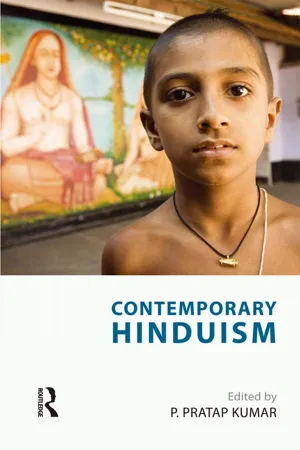
Contemporary Hinduism
About this book
Most overviews of Hindu belief and practice follow a history from the ancient Vedas to today. Such approaches privilege Brahmanical traditions and create a sense of Hinduism as a homogenous system and culture, and one which is largely unchanging and based solely on sacred texts. In reality, modern Hindu faith and culture present an extraordinary range of dynamic beliefs and practices. 'Contemporary Hinduism' aims to capture the full breadth of the Hindu worldview as practised today, both in the sub-continent and the diaspora. Global and regional faith, ritualised and everyday practice, Brahmanical and non-Brahmanical belief, and ascetic and devotional traditions are all discussed. Throughout, the discussion is illustrated with detailed case material and images, whilst key terms are highlighted and explained in a glossary. 'Contemporary Hinduism' presents students with a lively and engaging survey of Hinduism, offering an introduction to the oldest and one of the most complex of world religions.
Information
PART I
Hinduism in diaspora
In the last century and a half, and even earlier, millions of south Asians have emigrated to various parts of the world and have made their home in foreign lands, among various cultural and religious groups. While some went to these places due to colonial transfer of labour, others (mostly in the last few decades) went of their own volition in search of better education and careers, mostly in western countries such as North America and Europe. The result of these emigrations of south Asians is the presence of Hinduism in these countries. Hinduism is a flourishing religion today in most Western societies, and is actively practised and studied by Western students as well as south Asians living in these countries. As Hinduism began to take root in these foreign lands, it has adopted new ways of expressing itself in the new environments. To offer some examples of these attempts, we have included two chapters from North America and two from Trinidad. They represent two different traditions of contemporary Hindu expressions. We have also included a chapter on Norway to represent the spread of Hinduism in Europe.
In Chapter 1, Jeffery Long offers an insight into the ability of Hinduism to adapt itself to a new environment as well as into how a localized form of Hinduism, which he identifies as indigenous Hinduism. Here he brings a new connotation to the word indigenous. Deepak Shimkhada, in Chapter 2, offers an insight into how the first-generation Nepali Hindus continued their traditions in California, USA. In his narrative he offers insight into how they adapted to the new environment, their identity issues and the role of women in preserving the traditions. The third chapter in this part, by Paul Younger, offers an insight into the evolution of Hinduism in Trinidad, the changes it underwent, the challenges it faced and the emergence of new ritual forms. The uniqueness of “Trindad Hinduism” is maintained even when the Hindus from Trinidad resettle in other Western countries such as Canada, USA and UK. In Chapter 4 Indrani Rampersad weaves her narrative around the practice of hoisting a flagpole in the domestic and temple grounds, and tells about the role it played in forging the identity unique to the Caribbean Hindus. In Chapter 5 Knut Jacobsen focuses on the establishment of Tamiḻ Śaivism through temples, rituals and festivals, noting distinguishing features of their religious calendar.
1. Diasporic and indigenous
Hinduism in North America
Jeffery D. Long
As a number of the articles in this volume illustrate, Hinduism, a tradition (or, perhaps more accurately, a collection of traditions) indigenous to the Indian subcontinent (south Asia) is now an international tradition, practised worldwide in such disparate locations as Europe, Africa, Australia, the Caribbean and North America.
In this chapter, I hope to illustrate both the adaptability of the Hindu diaspora to the relatively new environment in which Hindus find themselves in North America, as well as the emergence of an indigenous North American Hinduism, the membership of which draws not only from the Indian community that has traditionally practised Hinduism, but also from non-Indians, such as myself, who have come to identify ourselves as Hindus.
HARI temple
The Hindu American Religious Institute (HARI) temple is located on a two-lane road that winds through the woods of rural central Pennsylvania. Unlike many Hindu temples in North America, the building does not immediately strike us as distinctively Hindu in its appearance. It looks somewhat like a large, two-storey house, with a parking lot in the front and an American flag flying in the breeze near the entrance. The only clearly Hindu architectural feature is the large gate through which we enter the property, with the holy mantra Om (`) written at the top in the Devanagari script of Sanskrit, and the names Sītā Rām and Rādha Kṛṣṇa written in the Roman alphabet on the sides.
Entering the temple on a Sunday morning, the first sight to meet our eyes is that of three brightly clothed and highly decorated mūrtis, or images, of three Hindu deities in the central altar of the temple, directly facing the front entrance. At the centre is Rām, or Rāma (as he is known in Sanskrit). Just to his left (the right, from the perspective of the viewer) is his wife, Sītā, and to his right is his brother and “right-hand man” Lakṣman (or Lakṣmana). Unlike many temples, where the central deities often reside behind closed doors, opened only at certain special times for worship, the deities at HARI are out in the open and available for viewing, or darśana, at all times.
Before leaving the lobby area and entering the temple proper, we turn to our left and enter a room where shoes are kept on wooden shelves. After removing our shoes – a gesture of respect that is observed not only in temples, but in most Hindu homes as well – we climb a half-staircase and enter the main sanctuary of the temple. Because it is a Sunday morning, the temple is not a quiet place. On the contrary, there is a great deal of activity here. At the far left of the sanctuary, there is a performance stage where cultural events are held. At the moment, a group of elementary school children are sitting cross-legged in a semicircle around a woman playing a harmonium and teaching the children to sing bhajans, or devotional songs. All but one or two of the children present are Indian, as is their teacher.
At the far right of the sanctuary, a bearded man – not Indian, but wearing a kurtā and pajāma – is showing another, smaller group of slightly older children, around middle school age, how to play a Sitar. Scattered throughout the sanctuary are smaller groups of adults – mostly, but not exclusively, Indian – engaged in quiet conversation. Seated in front and slightly to the side of the central images of Rām, Sītā and Lakṣman is one of the two priests who serve the HARI temple.
We approach the central images and make a praṇām, or a gesture of respect, by bringing the palms of both our hands together, raising them to the level of our face and bowing slightly. Before doing this, we may ring a large brass bell that hangs from a rope suspended from the ceiling. The ringing of the bell does not disturb any of the activity already occurring in the sanctuary. At this point, the priest, unless he is already engaged in conversation with another devotee, will smile at us warmly and say, “Namaste! Aap kaise hain?”, which in Hindi means “Hello! How are you?”. The priest, Śrī Naranji Pandya, who is originally from Ahmedabad, in the Indian state of Gujarat, speaks Hindi, English and Gujarati, but seems most comfortable with Hindi. (He also knows that I am trying to learn it.) The other priest, Śrī Seetharamaswamy, speaks English, Hindi, and Telugu, and is from Hyderabad, in the Indian state of Andhra Pradesh.
After exchanging pleasantries with Śrī Naranji Pandya, known affectionately as “Shastriji”, we walk around the central altar in a clockwise direction, keeping the main images to our right side and passing through a small corridor, the walls of which have been decorated with two-dimensional portraits of Hindu deities, as well as various saints from Hindu history. We note that among these sacred figures are included Mahavira, the twenty-fourth Tirthankara, or enlightened teacher of the Jain tradition, and Guru Nanak, the founder of Sikhism. And if we are accustomed to thinking of religion as an exclusive, either/or affair, we may be puzzled to find figures associated with these two traditions in a place of honour in a Hindu temple.
After circumambulating the central altar, we hold out our right hand to Shastriji and are given a few drops of water mixed with the oil of the tulsī plant – a variety of basil that is sacred to the deity Viṣṇu. After we drink this water from the palm of our hand, we again extend our right hand and are given a mixture of nuts and sugar cubes. This is prasād – food that has been offered to the deities and is then returned to devotees as a form of divine blessing.
Set in the back wall of the sanctuary, extending to either side of the central altar, are smaller altars that house the images of other Hindu deities. From left to right, moving towards the central altar, we see Sarasvati, goddess of wisdom; the divine couple, Śiva and Pārvatī; and a large image of Mahavira, who is adorned in keeping with Śvetaṃbara Jain tradition. Continuing from left to right, moving our gaze away from the central altar, we can see another divine couple, Kṛṣṇa and Rādha; Durgā, the divine mother, having eight hands and riding a lion; and Balaji, or Sri Venkateswara, a popular southern Indian image of Viṣṇu.
Returning our gaze to the central altar, we see, on the pedestal on which Rāma is standing, a bright red “Om”, beneath which is a small bronze image of a baby Kṛṣṇa. At Lakshman’s feet is a small image of Hanumān, the ape deity who assisted Rāma in his quest to rescue Sītā from the demonic Ravana in the sacred epic poem, the Rāmāyaṇa. A similar-sized image of the elephant-headed Ganesa is at Sītā’s feet. Just to Gaṇeṣa’s left is a grey stone abstract symbol of Śiva – the liṅgam – which is closely guarded by an image of Nandi, the bull – Śiva’s animal vehicle, or vāhana – made from the same type of grey stone as the liṅgam. Rāma is the central deity of this temple because its membership is mostly (though, as we shall see, not exclusively) Vaiṣṇava.
The sanctuary as a whole is a large, simple, functional room, with little in the way of adornment, apart from the images themselves – which are brilliantly decorated. On the floor is a dark red carpet, except for a square roughly one metre to a side in the right half of the room, which is bare white marble. Directly above this bare spot is a vent. This space is for the lighting of a small fire (held in a metal container that is placed on bricks) in order that a havan, a ritual offering in the sacred fire accompanied by Vedic chanting, might be performed. The havan is held once each month at the temple and on New Year’s Day. When we go downstairs, we will find a large communal dining room and kitchen, as well as restrooms, an apartment for the family of one of the priests (the other priest lives with a family of devotees nearby), and a storage space for chairs and tables, which are set up and taken down as needed. The basement also has classrooms. Because it is Sunday morning, these are filled with children learning Indian languages and taking religion classes from volunteers from the community. (I have occasionally served as one of these volunteers, coming in once a month to talk with the older students – middle school and high school age – about yoga and Vedānta philosophy, and to discuss contemporary issues in relation to Hinduism.)
Classes run from about ten in the morning until noon. At noon, all of the children gather in the centre of the sanctuary directly in front of the central images. Their parents and teachers sit to the sides. Almost everyone sits on the carpeted floor, although there is a row of chairs along the back wall for the elderly or anyone who does not feel like sitting on the floor. The head of the Sunday school stands at the front of the room and makes announcements, as well as inviting the children to tell the community something that they learned that day. If any of the children has had a birthday in the past week, the temple community applauds them. Then everyone stands for āratī.
Āratī is a ritual that one of the priests performs at the temple daily, at both noon and seven o’clock at night, regardless of whether any devotees are present. Small oil lamps sitting on metal plates are lit and waved in front of the images of the deities to the accompaniment of communal singing. The traditional āratī song at HARI temple, as at many North American Hindu temples, is Om Jaya Jagadisha Hare, or “Victory to Hari (Viṣṇu), Lord of the Universe”, as popularized by the Hindi singer, Lata Mangeshkar. After āratī, everyone heads downstairs for lunch, which is provided by volunteer families from the temple community.
HARI is a type of temple that is quite common in the Hindu diaspora – a “universal temple”; that is, a non-sectarian temple that does not cater exclusively to any saṃpradāya or denomination of Hinduism, but is open to all. The goal of the temple community is to provide a place of worship and cultural experience for as wide a cross-section of Hindus as possible. Although the Vaiṣṇava presence is considerable – the central deity is Rām, the song sung at āratī is Vaiṣṇava, and one of the priests, Śrī Seethasamaswa...
Table of contents
- Cover
- Half Title
- Religions in Focus
- Title Page
- Copyright Page
- Table of Contents
- List of illustrations
- Acknowledgements
- A note on terminology
- Introduction
- Part I: Hinduism in diaspora
- Part II: Contemporary Hinduism in north India
- Part III: Contemporary Hinduism in south India
- Glossary
- Bibliography
- Contributors
- Index
Trusted by 375,005 students
Access to over 1.5 million titles for a fair monthly price.
Study more efficiently using our study tools.
Frequently asked questions
Yes, you can cancel anytime from the Subscription tab in your account settings on the Perlego website. Your subscription will stay active until the end of your current billing period. Learn how to cancel your subscription
No, books cannot be downloaded as external files, such as PDFs, for use outside of Perlego. However, you can download books within the Perlego app for offline reading on mobile or tablet. Learn how to download books offline
Perlego offers two plans: Essential and Complete
- Essential is ideal for learners and professionals who enjoy exploring a wide range of subjects. Access the Essential Library with 800,000+ trusted titles and best-sellers across business, personal growth, and the humanities. Includes unlimited reading time and Standard Read Aloud voice.
- Complete: Perfect for advanced learners and researchers needing full, unrestricted access. Unlock 1.5M+ books across hundreds of subjects, including academic and specialized titles. The Complete Plan also includes advanced features like Premium Read Aloud and Research Assistant.
We are an online textbook subscription service, where you can get access to an entire online library for less than the price of a single book per month. With over 1.5 million books across 990+ topics, we’ve got you covered! Learn about our mission
Look out for the read-aloud symbol on your next book to see if you can listen to it. The read-aloud tool reads text aloud for you, highlighting the text as it is being read. You can pause it, speed it up and slow it down. Learn more about Read Aloud
Yes! You can use the Perlego app on both iOS and Android devices to read anytime, anywhere — even offline. Perfect for commutes or when you’re on the go.
Please note we cannot support devices running on iOS 13 and Android 7 or earlier. Learn more about using the app
Please note we cannot support devices running on iOS 13 and Android 7 or earlier. Learn more about using the app
Yes, you can access Contemporary Hinduism by P. Pratap Kumar in PDF and/or ePUB format, as well as other popular books in Theology & Religion & Hinduism. We have over 1.5 million books available in our catalogue for you to explore.