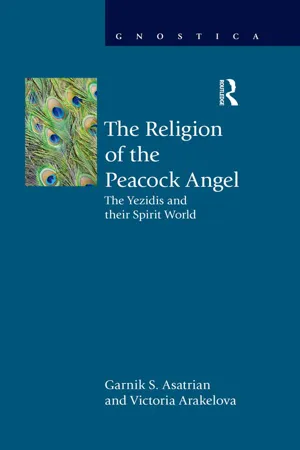
eBook - ePub
The Religion of the Peacock Angel
The Yezidis and Their Spirit World
- 160 pages
- English
- ePUB (mobile friendly)
- Available on iOS & Android
eBook - ePub
The Religion of the Peacock Angel
The Yezidis and Their Spirit World
About this book
Based in Iraq, Syria and Turkey, the Yezidi people claim their religion - a unique combination of Christian, Islamic, and historical faiths - to be the oldest in the world. Yezidi identity centres on their religion, Sharfadin, which has evolved into a highly complex pantheon of one God with many incarnations, the chief of whom is Melek Taus, the Peacock Angel. The Yezidi faith can be traced to a range of pre-Islamic belief systems, such as Sufism, some extreme Shi'ite sects, Gnosticism and other traditions surviving from the ancient world. This particular formulation has served to unify Yezidi religious identity and ethnicity. Based on extensive fieldwork, 'The Religion of the Peacock Angel' presents the first detailed examination of the Yezidi pantheon. The idea of one God and his chief incarnations is first analysed, then the various 'deity figures,' saints, holy patrons and divinized personalities in the Yezidi belief system are considered in the context of related religious traditions. The study determines the place of all these characters in the system of the Yezidi faith, defining their main functions, features, and genealogies.
Information
PART I
THE ONE GOD
Although the relevant literature will often classify the Yezidis as followers of polytheism, and thus as worshipping an array of gods with differing degrees of significance, a closer scrutiny will show this view of matters requires a radical review.
Using this older style of approach, some will identify elements of polytheism in the unambiguously monotheistic religions as well. Muslims, for instance, erroneously see the concept of the Christian Trinity – the Father, the Son and the Holy Spirit – as a manifestation of polytheism in Christianity. Meanwhile, in Islam itself, where monotheism is an indisputable basis – even “the alpha and omega” of the entire theology – some heterodox sects (the extreme Shi’as, for example) deify the fourth caliph, ‘Ali ibn Abi-Talib, and other figures such as Fatima. They thereby come in for criticism by orthodox Islamic theologians for their departure from the monolithic Allah – from the very idea of tauḥīd, monotheism.
The poly-variation in the Yezidis’ religious thought, or rather, their dismembered representation of the divine entity or of god, is none other than the personification of the functional division of the divine, which has nothing to do with polytheism in its pure form, the essential nature of which does not change even in the presence of a manifestly principal divinity within the system of gods. This principal divinity in a “polytheistic system”, while endowed with a greater power compared to others (greater attributes, functions, and so on), is, however, not the Absolute, which is the main characteristic of the One God. It is therefore necessary to differentiate clearly between the Yezidis’ dismembered representations of the divine (by different spheres of manifestation and even under differing names) reduced to the single initiation, and polytheism characterized by a dispersed representation of the divine.
In “classical” monotheism the Divine Essence in its manifestations does not in any way lose even partially the role, functions or power of God, the sole source of divine emanation and of the Divine in its entirety, but rather manifests its qualities within different hypostases. From this viewpoint, even Zoroastrianism, often represented as a dualistic religion, can only be regarded as such with great reservations. Indeed, despite quite an impressive pantheon of gods as a whole, Ahura Mazdā is featured generally as the supreme god, with the functions of the demiurge or creator deity.1
In the Old Iranian religion, god is designated by the term *bága- (cf. Old Persian baga “god”, Avestan baga-“ lot, good fortune”, Sogdian baγ). This denotes one (single) God (rather, supreme god), unlike the Yazats (Avestan yazata, Middle Pers. yazat, New Pers. īzad, literally meaning “one [or any being] worthy of worship or of sacrifice”). As for *bága-, this concept also means “dispenser (of good fortune)” (cf. Skt. bhága-). Another denotation of the supreme god in Old Iran was *dātār-, that is, “creator” (New Pers. dādār). At the present time the general designation of god in New Persian and in most New Iranian dialects is xudāy, from Old Iranian *xwa-tāwan-, literally “autocrat”, and basically the same term, xwadē, also designates the one god among the Yezidis, the subject of this study.2
As for Angra Mainyu or Ahriman in the Zoroastrian religion, he is only a manifestation of evil, a force of destruction, and to some degree a parallel of Satan, although possessing more significant attributes than the devil in Christianity because he is the author of part of creation and is hostile to Ahura Mazdā and his creation. The classical Iranian religion, which was never unambiguously monotheistic, even after Zarathustra, nonetheless tended in its various manifestations towards monotheism, with one god, Ahura Mazdā, dominating over a whole array of divinities. The situation did not change radically when the priority of Ahura Mazdā was challenged by Zurvān, even by Mithra. In effect, a thoroughgoing dualism, with equally significant god and demon locked in unending combat with an unpredictable outcome, has never been known in Iran, although the Manichaeans came to draw on Zoroastrianism to accentuate a greater dualism than that which was indigenously Iranian.3 Some students of Zoroastrianism characterize its theology as monotheism, while they read the speculative philosophy of this religion to be dualistic.4
In the meantime, even classical Greek religion, whose designation as “polytheism” is unambiguously substantiated, had monotheistic tendencies with ancient roots: “Der monotheistische Gedanke war alt in Griechenland”, as noted by one well-known expert of the “Old Greek religion”.5 This does not mean we should doubt its polytheistic nature in general terms, for clearly if we are to face up to genuine dominances of religious mentality, and not be too taken by particular ideas allowed to co-exist within a common system, pre-Christian or pagan Greek religion attended to many deities and spirits. And in any case, when characterizing any discrete religion, especially a syncretic one such as Yezidism, it is necessary to consider the entire complex of its structure without leaning mainly upon the external manifestation of the transcendental in the system of the religious dogmas.
A careful analysis of the Yezidi triad will show its component deities to be unambiguous manifestations of the one god worshipped by adherents. In establishing this, an absence of canonized dogmatic literature admittedly leaves us no choice but to lean upon the oral religious code of the Yezidis, yet the folkloric religious texts, particularly within the context of a wider analysis, provide material quite sufficient for research needs. The monotheism of the Yezidis is seen, for example, in the following prayer adopted as their Symbol of Faith called Šahdā dīnī:
Šahdā dīnē min ēk Allāh, …
Silt’ān Šēxadī pādšē mina, …
Silt’ān Ēzdī pādšē mina, …
Tāwūsī malak šahdā ū īmānēd mina. …
Haqa, xwadē kir, [am] ēzdīna,
Sar nāvē Silt’ān Ēzdīna.
Al-h’amd lillāh, am ži ōl ū tarīqēd xō di-řāzīnā.
The testimony of my faith is one god,
Sultan Sheikh ‘Adi is my king,
Sultan Yezid is my king,
Malak-Tāwūs [The Peacock Angel] is the Symbol [of Faith] and my faith.
Indeed, by god’s will [we] are Yezidis,
We are called by the name of Sultan Yezid.
God be praised, we are content with our religion and our community.6
As for the minor deities of the Yezidi pantheon, the spirits, demons, and so on, their existence provides no reason to talk of polytheism, for similar characters (including the exact counterparts of those of the Yezidis) have been retained by many Iranian (and non-Iranian) Islamic nations at the level of so-called popular or folk Islam.
The Yezidi triad comprises the following: Malak-Tāwūs, the Peacock-Angel (in the Yezidi imagination being featured as a bird, a peacock or a cock, and sometimes even a dove); Sheikh ‘Adi (Šeyx ‘Ādī = Sheikh ‘Adi bin Musafir, a historical personality, the founder of the proto-Yezidi community, as an old man); and Sultan Yezid (Silt’ān Ēzīd, as a youth). All three characters are manifestations of god – xwadē (or xwadī, xudā, the term, deriving from New Pers. xudāy). There are also other variations to designate god: xudāvand, rab(b)ī, as well as Allāh (mostly in the Arabic formulas); occurring in some religious songs is the term ēzdān (from New Pers. yazdān – “god”).
The Yezidi ideas on xwadē are quite hazy and blurred, and can be subjected to systemic processing only with great difficulty. The Y...
Table of contents
- Cover
- Half Title
- Gnostica Texts and Interpretations
- Title Page
- Copyright Page
- Table of Contents
- Preface
- Part I: The one god
- Part II: The Yezidis' pantheon and the syncretic features of their religion
- Conclusion
- Bibliography
- Index
Trusted by 375,005 students
Access to over 1.5 million titles for a fair monthly price.
Study more efficiently using our study tools.
Frequently asked questions
Yes, you can cancel anytime from the Subscription tab in your account settings on the Perlego website. Your subscription will stay active until the end of your current billing period. Learn how to cancel your subscription
No, books cannot be downloaded as external files, such as PDFs, for use outside of Perlego. However, you can download books within the Perlego app for offline reading on mobile or tablet. Learn how to download books offline
Perlego offers two plans: Essential and Complete
- Essential is ideal for learners and professionals who enjoy exploring a wide range of subjects. Access the Essential Library with 800,000+ trusted titles and best-sellers across business, personal growth, and the humanities. Includes unlimited reading time and Standard Read Aloud voice.
- Complete: Perfect for advanced learners and researchers needing full, unrestricted access. Unlock 1.5M+ books across hundreds of subjects, including academic and specialized titles. The Complete Plan also includes advanced features like Premium Read Aloud and Research Assistant.
We are an online textbook subscription service, where you can get access to an entire online library for less than the price of a single book per month. With over 1.5 million books across 990+ topics, we’ve got you covered! Learn about our mission
Look out for the read-aloud symbol on your next book to see if you can listen to it. The read-aloud tool reads text aloud for you, highlighting the text as it is being read. You can pause it, speed it up and slow it down. Learn more about Read Aloud
Yes! You can use the Perlego app on both iOS and Android devices to read anytime, anywhere — even offline. Perfect for commutes or when you’re on the go.
Please note we cannot support devices running on iOS 13 and Android 7 or earlier. Learn more about using the app
Please note we cannot support devices running on iOS 13 and Android 7 or earlier. Learn more about using the app
Yes, you can access The Religion of the Peacock Angel by Garnik S. Asatrian,Viktoria Arakelova,Victoria Arakelova in PDF and/or ePUB format, as well as other popular books in Theology & Religion & Comparative Religion. We have over 1.5 million books available in our catalogue for you to explore.