- 731 pages
- English
- ePUB (mobile friendly)
- Available on iOS & Android
eBook - ePub
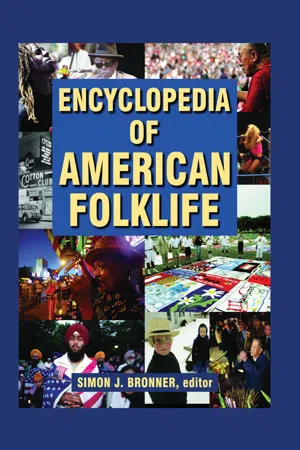
Encyclopedia of American Folklife
About this book
American folklife is steeped in world cultures, or invented as new culture, always evolving, yet often practiced as it was created many years or even centuries ago. This fascinating encyclopedia explores the rich and varied cultural traditions of folklife in America - from barn raisings to the Internet, tattoos, and Zydeco - through expressions that include ritual, custom, crafts, architecture, food, clothing, and art. Featuring more than 350 A-Z entries, "Encyclopedia of American Folklife" is wide-ranging and inclusive. Entries cover major cities and urban centers; new and established immigrant groups as well as native Americans; American territories, such as Guam and Samoa; major issues, such as education and intellectual property; and expressions of material culture, such as homes, dress, food, and crafts. This encyclopedia covers notable folklife areas as well as general regional categories. It addresses religious groups (reflecting diversity within groups such as the Amish and the Jews), age groups (both old age and youth gangs), and contemporary folk groups (skateboarders and psychobillies) - placing all of them in the vivid tapestry of folklife in America. In addition, this resource offers useful insights on folklife concepts through entries such as "community and group" and "tradition and culture." The set also features complete indexes in each volume, as well as a bibliography for further research.
Information
A
ADIRONDACKS
See Northern Appalachian Region (Catskills and Adirondacks)
ADOLESCENTS
In American culture, adolescence is a politically defined stage of life, bounded on the one hand by the beginning of sexual maturity and on the other by laws defining legal and financial responsibility. Hence, the adolescent years are ones of preparation for adult independence and are characterized by rites of rebellion that are, paradoxically, ways of exploring and internalizing adult religious and social mores.
Jokes and Humor
An early manifestation of this process involves jokes that arise among males and females just at the period of puberty. These forms of verbal humor explore linguistic taboos of language and subject and often focus on images that dramatically breach these social rules. Peaking around the age of twelve, “grosser-than-gross” jokes, for example, dealing with dead babies, contaminated food, and, especially among postpubertal males, female menstruation, have been common since the late twentieth century. Around the same age, subversive rhymes and parody songs take a turn toward sexually explicit taunts, particularly with references to oral sex.
Similarly, jokes dealing with gruesome accidents or disasters are popular among adolescents, who favor items that playfully allude to gross images. While many of these jokes are simply intended to play with social rules governing what is mentionable in normal conversation, their topics also refer to the aspects of adult life that are the newest and the most anxiety-producing for young adolescents. Individual jokes are extremely short-lived, but motifs from them are recycled as new gross occasions arise.
Cultural Performances
Many adolescent activities involve a complex form of cultural performance, in which participants agree collectively to become engrossed in an alternative reality. That is, a situation is created, usually through the narration of traditional stories or beliefs, in which a threat (often supernatural in nature) is invoked. Participants then form teams to explore this threat. In many cases, the exploration occurs only in the imagination, mediated by one of the many role-playing game (RPG) scenarios available as board games. These groups generate strong identities with their own customs and histories. In some cases, participants may adopt appropriate dress for such RPGs, a practice known as live-action role-playing (LARP), which has inspired many clubs and events. In an increasingly computer-mediated world, role-playing also takes place on interactive message boards in which participants can adopt a fantasy character’s identity and communicate with others who may actually be logged on in many different locations.
Such role-playing has its traditional roots in the form of “ostension,” enacting a shared narrative through real-life actions. Ostension occurs frequently in the context of institutionalized events such as haunted houses or summer camps. In the complex interplay of elaborately costumed monsters and visitors to institutional haunted houses, adolescents, both male and female, often behave in highly stereotypical fashion. The bogeymen and mad killers portray well-known scenes from movie and fiction, while girls act as if they are in a panic and boys display macho bravado. In fact, such actions involve no real fear or bravery, but only an enactment of these emotions. Recognition that one is playing a part in a fiction allows participants to probe the boundaries of reality by choosing to behave as if the threats were real, while at the same time recognizing that one is in no real danger. However, part of the attraction of such events for adolescents is making the apparent threats as realistic as possible, so that what emerges is a complex dramatic situation in which both “monsters” and “victims” cooperate to maintain a thrilling form of engrossment.
Narrative and Legend Tripping
The narration of horror stories by summer camp counselors often sets a context for ostensive play, in which campers and counselors tacitly collaborate in creating a fantasy world. Activities following such stories often involve literal enactment of the stories, in which campers go into the woods and confront the monsters described. In so doing, they show how they can protect themselves from supernatural dangers through collective action, a strong identity-building ritual. At a later time, teens may use local legends about ghosts or monsters to set up a legend trip, or ritual visit, to an allegedly dangerous site. These trips often involve the use of drugs or alcohol, and both involve a kind of escape from a mundane adult-controlled world into an alternative world in which many everyday rules are inverted or abolished. Here the ghosts or monsters are often parodic images of repressive adults, and the act of visiting the legend trip site may include ritual acts of defiance, including open use of profanity, sexual experimentation, and even acts of vandalism. Adolescents’ behavior during the legend trip, like that during a visit to a haunted house, show not so much an expression of belief in the supernatural as the creation of an antiworld in which it is acceptable, even admirable, to defy adult mores.
The use of an automobile is an essential element in legend tripping, as it is in a wide variety of adolescent cultural performances. Teenagers use cars as a moving personal territory inside of which they can set their own rules and challenge adults’ authority. Cruising, or using a vehicle to hang out and interact with other adolescents, is a widespread tradition with its own rules, and it often serves as a ground for other activities, including legend tripping and impromptu racing. The ability to move the car to a private location also gives rise to many traditions of lovers’ lanes, where adolescents can experiment sexually without adult interference. These places often generate horror stories about maniacs who might threaten teens who park there; among these are tales of “Hookman,” who tries to open the car door with his prosthetic arm or murders the boyfriend. Such legends do not limit the appeals of these lovers’ lanes; in fact, they may create an atmosphere that makes the sexual encounter more exciting.
Subversive Play
Other adolescent cultural performances provide an even more intense form of role playing. Ouija board rituals create an environment in which adolescents can half believe that they are conversing, through the messages spelled out by the board, with evil spirits or even Satan himself. These messages are often, like gross jokes and parodies, extremely obscene, violating both religious and social norms of speech. Accounts of these rituals, however, make it clear that these messages do not constitute a temptation to those who participate; in fact, adolescents often respond to the “demon’s” profanity with equally extreme obscenity, mocking his power and finally sending him away. In fact, the religious beliefs on which Ouija rituals are based are often quite orthodox, and those who participate the most seriously are not so much anxious to develop a new religion as they are to receive a sign that their own is valid.
Nevertheless, adults have expressed concern over adolescents’ subversive play for centuries, especially that involving the occult. In some cases a group situation may generate a momentum of its own in which a corruption of play occurs and individuals may be drawn by the excitement into actions that lead to serious, even tragic consequences. Fatal accidents do occur during automobile games of chicken or drag racing, and some legend trips have involved serious acts of vandalism or even grave desecration. Many times, however, official response to adolescent folklore is misguided and may even heighten its potentially sociopathic aspect. In recent decades, high schools have frequently been hit with rumor-panics, in which a story circulates that an act of violence will occur on a certain imminent date, often a graduation or prom night. The perpetrators and their motives vary: sometimes they are Satanists about to carry out a human sacrifice, and at other times they are gang members or fanatics threatening a massacre. In any case, a common reaction is the scapegoating, official sanctioning, and even physical harassment of people who are seen as outsiders.
It is therefore important for folklorists to recognize the traditional elements in adolescent behavior and help concerned authorities understand it as a form of cultural performance. Though the language and the actions may be offensive on the surface, the performance often reflects an effort to understand social norms by testing their limits, not by disregarding them altogether. Official overreactions that define such traditions as Satanic or as warning signs of future school massacres may further alienate teenagers and in fact create the seeds of real violence.
Bill Ellis
See also: Automobiles; Childhood; Children’s Groups; Courtship; Cults and Rumor-Panics, Satanic; Dance, Secular; Fans, Extreme Metal; Fans, Heavy Metal; Games, Drinking; Gangs, Youth; Goths; Halloween; Hip-Hop; Humor; Legends; Punk; Rituals and Rites; Skateboarders; Skinheads; Straight Edge; Students; Toasts and Dozens; Wiccans.
Sources
Bronner, Simon J. “What’s Grosser Than Gross?: New Sick Joke Cycles.” Midwestern Journal of Language and Folklore 11 (1985): 39–49.
Ellis, Bill. “Hitler’s Birthday: Rumor-Panics in the Wake of the Columbine Shootings.” Children’s Folklore Review 24, nos. 1–2 (2002): 21–32.
———. “Speak to the Devil: Ouija Board Rituals Among American Adolescents.” Contemporary Legend 4 (1994): 61–90.
Fine, Gary Alan. Shared Fantasy: Role-Playing Games as Social Worlds. Chicago: University of Chicago Press, 1983.
Licht, Michael. “Some Automotive Play Activities of Suburban Teenagers.” New York Folklore Quarterly 30 (1974): 44–65.
Magliocco, Sabina. “The Bloomington Jaycees’ Haunted House.” Indiana Folklore and Oral History 14 (1985): 19–28.
Samuelson, Sue. “A Review of the Distinctive Genres of Adolescent Folklore.” Children’s Folklore Review 17 (1995): 13–32.
Sato, Ikuya. “Play Theory of Delinquency: Toward a General Theory of ‘Action.’” Symbolic Interaction 11 (1988): 191–212.
AESTHETICS
Aesthetics refers to a particular kind of experience, response, and judgment often influenced by taste. An aesthetic is a set of articulated philosophical principles regarding form and its evaluation. The word “aesthete” derives from the Greek aisthētē, or “one who perceives form.” Individuals as well as groups differ with respect to the colors, textures, and degree of ornamentation they prefer, along with styles of music, dance, and other expressive behaviors. Conflicts can occur, particularly among people of different ethnic or national identities and sociocultural backgrounds, although sometimes others’ tastes are accommodated, especially with respect to objects made for sale. The concept of aesthetics figures significantly in folklife in regard to understanding the cultural distinctions among groups in their responses to objects and performances.
Positive and Negative Aesthetic Responses
Physical sensations of muscular tension and release typify a positive aesthetic response, along with a heightened consciousness of form, diminished awareness of other stimuli, and suspension of time. The experience results in a feeling of well-being, sometimes even a sense of oneness, or unity of self with the object of attention and other people in the event. Not only does one enjoy the aesthetic experience when it occurs, recalling and savoring the memory later, but some individuals cultivate the conditions that precipitate the response. Remarked one person about going to folk dance clubs for many years: “The reason I went to so many ethnic events is because of the possibility of that happening. It’s so exciting when it happens. It’s worth it for the event and for the memory—for that… highly… heightened… something happening!”
People also react disapprovingly toward objects, performances, and events. A negative response, like a positive experience, consists of a unique configuration of intellectual and physiological states. Muscular tension goes unrelieved, however, and might even intensify. Time seems drawn out rather than suspended and an individual experiencing this response welcomes distracting stimuli. Feelings of doubt, loathing, and sometimes anger rather than joy and pleasure characterize the negative aesthetic response.
Aesthetic Judgment and Expressions
The term “aesthetic judgment” connotes assessment of form. Rarely in everyday life do people articulate their opinions as a set of aesthetic principles and evaluations. More often, they express themselves in simple acts such as selecting one item over another to purchase, display, or use, applauding a performance, or laughing at a joke. We may employ rudimentary vocalizations. One fast-food chain capitalized on this, airing a com mercial in which happy, smiling people consuming slices of pizza punctuated their eating with culturally understood exclamationsof“oooohhhh— mmmmmmmmmmmm—aaaahhhhh” in the same way that many individuals respond to fireworks displays. On the other hand, folk utterances such as “Ugh!” and “Yuck!” typify the expression of a negative reaction. In contemporary folklife, perhaps influenced by the Olympic tradition, it is common to hear people provide a grading or ranking system, such as evaluations ranging from 1 to 10. People may find it difficult to verbalize their experiences and responses: “Too beautiful for words” reads a print ad for an expensive garment. Even if they did not express themselves verbally, James West in Plainville, U.S.A. found that women in a small town took aesthetic pleasure from labeling and arranging jars of home-canned goods on a shelf, decorating their homes, and cultivating flower beds.
People also express themselves through demeanor and gesture. Those enjoying an aesthetic experience usually smile, open their arms expansively, and even touch others in their excitement, pleasure, and feeling of unity. When reacting negatively to an object or performance, individuals tend to frown or scowl and cringe or protectively cross their arms in front of themselves. What is appropriate to express may be traditionally learned. In many Japanese communities, for example, it is common to lean forward and cover the mouth when laughing or smiling, while European Americans find it normal to tip the head back and laugh.
One can infer aesthetic principles from the nature of objects and the style of performance as well as individuals’ remarks, particularly those of artists and also judges or critics at traditional events such as a sand-sculpting contest, chili cook-off, or county fair. Cleanliness as well as neatness, propriety, and uniformity dominate in rural life, where people daily confront dirt, refuse, and excrement. Floral displays going off in all directions seem “messy” and merely replicate existing conditions in nature. Participants at a county fair prefer realism in photographs and paintings in response to the abstractions and ambiguities of nature.
While recognizing differences in individual style, audiences assess storytellers on the basis of skill in regard to vividness through language, voice, and body movement, flow or rhythm in speaking of the events and feelings described, imitation of characters and visual pictures of the actions, and building of plot tension. People also consider circumstances, not expecting, for example, a child to evince the mastery of technique ...
Table of contents
- Cover
- Half Title
- Title
- Copyright
- Contents
- Topic Finder
- Contributors
- Acknowledgments
- Introduction
- Volume 1
- Volume 2
- Volume 3
- Volume 4
- Bibliography
- General Index
- Cultural Group Index
- Geographical Index
Trusted by 375,005 students
Access to over 1.5 million titles for a fair monthly price.
Study more efficiently using our study tools.
Frequently asked questions
Yes, you can cancel anytime from the Subscription tab in your account settings on the Perlego website. Your subscription will stay active until the end of your current billing period. Learn how to cancel your subscription
No, books cannot be downloaded as external files, such as PDFs, for use outside of Perlego. However, you can download books within the Perlego app for offline reading on mobile or tablet. Learn how to download books offline
Perlego offers two plans: Essential and Complete
- Essential is ideal for learners and professionals who enjoy exploring a wide range of subjects. Access the Essential Library with 800,000+ trusted titles and best-sellers across business, personal growth, and the humanities. Includes unlimited reading time and Standard Read Aloud voice.
- Complete: Perfect for advanced learners and researchers needing full, unrestricted access. Unlock 1.5M+ books across hundreds of subjects, including academic and specialized titles. The Complete Plan also includes advanced features like Premium Read Aloud and Research Assistant.
We are an online textbook subscription service, where you can get access to an entire online library for less than the price of a single book per month. With over 1.5 million books across 990+ topics, we’ve got you covered! Learn about our mission
Look out for the read-aloud symbol on your next book to see if you can listen to it. The read-aloud tool reads text aloud for you, highlighting the text as it is being read. You can pause it, speed it up and slow it down. Learn more about Read Aloud
Yes! You can use the Perlego app on both iOS and Android devices to read anytime, anywhere — even offline. Perfect for commutes or when you’re on the go.
Please note we cannot support devices running on iOS 13 and Android 7 or earlier. Learn more about using the app
Please note we cannot support devices running on iOS 13 and Android 7 or earlier. Learn more about using the app
Yes, you can access Encyclopedia of American Folklife by Simon J Bronner in PDF and/or ePUB format, as well as other popular books in Histoire & Économie du travail. We have over 1.5 million books available in our catalogue for you to explore.