- 296 pages
- English
- ePUB (mobile friendly)
- Available on iOS & Android
eBook - ePub
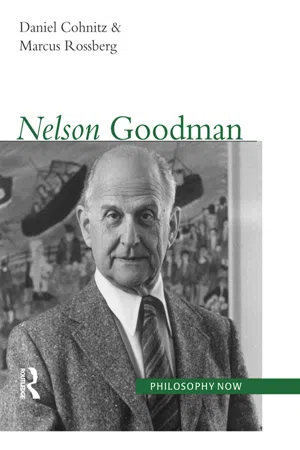
Nelson Goodman
About this book
Nelson Goodman's acceptance and critique of certain methods and tenets of positivism, his defence of nominalism and phenomenalism, his formulation of a new riddle of induction, his work on notational systems, and his analysis of the arts place him at the forefront of the history and development of American philosophy in the twentieth-century. However, outside of America, Goodman has been a rather neglected figure. In this first book-length introduction to his work Cohnitz and Rossberg assess Goodman's lasting contribution to philosophy and show that although some of his views may be now considered unfashionable or unorthodox, there is much in Goodman's work that is of significance today. The book begins with the "grue"-paradox, which exemplifies Goodman's way of dealing with philosophical problems. After this, the unifying features of Goodman's philosophy are presented - his constructivism, conventionalism and relativism - followed by an discussion of his central work, The Structure of Appearance and its significance in the analytic tradition. The following chapters present the technical apparatus that underlies his philosophy, his mereology and semiotics, which provides the background for discussion of Goodman's aesthetics. The final chapter examines in greater depth the presuppositions underlying his philosophy.
Information
Chapter 1
The worldmaker’s universe
The whole and its parts
Nelson Goodman was a philosopher of enormous breadth. He made important and highly original contributions to epistemology, logic and the philosophy of science, but is also a famous figure in the analytic philosophy of art and in metaphysics.
Unlike many other philosophers of the twentieth century, Goodman was not a puzzle-solver who wrote in an almost inaccessible technical style on unrelated highly specialized problems; on the contrary, he worked on the most fundamental problems, contributing original and provocative insights, and his writing was always brilliant in both precision and style. As his students and/or co-authors Catherine Elgin, Israel Scheffler and Robert Schwartz have remarked in retrospect, he:
delighted in making points in the most provocative way possible. There is some controversy over what is the most outrageous thing he ever said. Among the more obvious contenders are the repudiation of sets, the grue paradox, the contention that one wrong note disqualifies a performance as an instance of a musical work, and the claim that there are many worlds if any. In such remarks, Goodman threw down the gauntlet. If you disagree with one (or more) of the above, you need to show what is wrong with the argument that leads to it. All too frequently the initial irritation is compounded as we begin to appreciate the difficulty of evading his conclusions without begging the question, or committing ourselves to claims that seem even more dubious than his.
(Elgin et al. 1999: 207)
Goodman clearly ranks among the most important philosophers of the twentieth century. Full appreciation of the value of his work, however, has barely begun. One might go as far as saying that of the most influential philosophers of the twentieth century, Goodman is today the most neglected. This book, for example, is, as far as we know, the first attempt to introduce Goodman’s philosophy as the coherent, interconnected system of ideas it is. Thus one of our major aims here is to show by way of example that studying Goodman systematically and in some detail is worthwhile.
What we also hope to achieve is to put some of Goodman’s better known contributions into the right context. Goodman’s Languages of Art (1968) brought him to the attention of postmodern thinkers, who tend to interpret him (with approval) as a culture relativist with leanings towards irrationalism.1 This is a much distorted picture of Goodman’s philosophy, based on a misunderstanding of his constructionalism. Unlike philosophers such as Paul Feyerabend or Richard Rorty, who worked in a certain analytic tradition for a part of their lives and then converted to some sort of non-analytic philosophy in later years, Goodman’s whole work is within one and the same tradition of analytic philosophy. Of course, Goodman’s views have developed over the years (it would be sad if this was not so), but we want to demonstrate that his early work in logic and epistemology and his later work on art and constructionalism actually form a coherent whole, methodologically as well as in their content.
This enterprise might be doomed from the start. In what we believe to be Goodman’s last publication he writes:
There is no such thing as the philosophy of Nelson Goodman any more than there is such a thing as the finger of Nelson Goodman. There are many philosophies, but on the other hand there is no nice neat order of different complete philosophies: there are lots of ideas, conjectures about various fields. A few months ago, at the Technische Universität in Berlin, … I gave an impromptu talk called “Untangling Nelson Goodman” and I said, ‘Well, here’s all this mess and can I do anything about untangling these things?’. The answer was that I couldn’t do very much.
I mean, for instance, I had dealt with certain topics many different times and in many different contexts; but it is not always clear how these relate to one another. And so perhaps I should try to make it clear. All I could do is suggest some of the different attacks that I made on some of the problems at different times and at least note that these were not all part of a well organized scheme. They were all different attempts to deal with different aspects of the problem. And then it occurred to me that untangling this mess might entail a good deal of loss, the kind of loss you get if you try to untangle a plate of spaghetti: you would end up with some rather uninspiring strings of dough which would not have anything of the central quality of the whole meal.
(Goodman 1997: 16–17)
Despite Goodman’s pessimism, we hope to have achieved an introduction to Goodman’s philosophies that points out the coherence and unity that Goodman denies in the quote above. We hope to have “untangled” Goodman a bit, or to have at least provided a starting-point for further studies.
The most systematic presentation of Goodman’s work would start with his PhD thesis A Study of Qualities (SQ) and develop everything else from there. A Study of Qualities, however, is one of the the most complicated books he ever wrote, which is why we have decided to sacrifice some systematicity on the altar of didactics. Instead, after some remarks about Goodman’s life, personality and historical background in this chapter, we shall introduce Goodman’s so-called “new riddle of induction” – one of Goodman’s major contributions to the philosophy of science – in Chapter 2. Presumably, readers are already familiar with the “new riddle” or have already heard about ‘grue’ and kindred predicates. We hope that learning by way of example how Goodman approaches a philosophical problem is a useful start for understanding his philosophy.
Having introduced Goodman’s way of doing philosophy in a specific area of epistemology, we turn to the broader perspectives. In Chapter 3 we reconstruct Goodman’s view on the purpose and aim of philosophy as a professional activity. We will see that Goodman’s philosophy aims at elucidation and understanding in a very specific sense. Philosophically problematic notions are clarified by way of rational reconstructions. In the ideal language tradition, the philosophical tradition Goodman belongs to, this gets done by explicating problematic concepts. What explication is, and how it differs from other forms of definition, is explained in the second half of the chapter.
In Chapter 4, with a few broad brushstrokes, we introduce the formal basis for Goodman’s nominalism. In 1940 Goodman and Henry S. Leonard published a mereological system called the calculus of individuals, departing from work that Leonard had already done for his PhD (1930). Goodman and Leonard demonstrate that this apparatus is able to make precise, and hence elucidate, important philosophical concepts with the aid of relations such as ‘overlapping’, ‘part’ or ‘mereological sum’, which are definable in the calculus.
This powerful formal tool was brought to use in Goodman’s chief work, The Structure of Appearance (1951), a considerably revised version of A Study of Qualities. This book is a thorough analysis and further elaboration of the work of Rudolf Carnap, his most famous predecessor in the ideal-language tradition. In Chapter 5 we characterize Carnap’s project in Der logische Aufbau der Welt (the Aufbau) ([1928] 1961) and also review Carnap’s early conventionalism (of the early 1930s), which arose from Carnap’s collaboration and discussions with Otto Neurath. Goodman’s work is usually classified as being an anti-foundationalist version of Carnap’s project, but Carnap himself endorsed most of Goodman’s later results shortly after the Aufbau (in the period including The Logical Syntax of Language ([1934] 1937), with its principle of tolerance). The main characteristics of this period of Carnap’s are also characteristics of Goodman’s Structure of Appearance and his later work. Since much in The Structure of Appearance is in direct confrontation with Carnap’s Aufbau, it is best, and probably solely, understood on the basis of a firm knowledge of the key issues of the Aufbau. We therefore take the space to dedicate a good part of this chapter to the pre-Goodman philosophy, from which his own work arises as a criticism and further development.
The second formal basis for Goodman’s philosophy, his theory of symbols, will be introduced in Chapter 6. All of our cognitive access to the world, Goodman insists, is governed by the use of symbols of all sorts. In Languages of Art he develops a taxonomy of symbol systems that contribute in different ways to our different cognitive enterprises. All kinds of symbol systems and all ways of reference have nevertheless one thing in common: they facilitate our understanding.
Chapter 7 will finally take us to Goodman’s philosophy of art. Taking a work of art as a complex symbol, Goodman has a good part of what he needs for his “epistemic turn” in aesthetics (Elgin 1997a: ch. 3). Goodman sees art as an essentially cognitive endeavour, and so the most important thing is to recognize a work of art as promoting our understanding (or making) of a world version. Along with this comes a relocation of what was traditionally taken to be essential to art.
After having placed Goodman in a certain branch of analytic philosophy and having already noted the constructionist nature of his solution for the new riddle of induction, in Chapter 8 we shall explain Goodman’s constructionalism and relativism. According to Goodman, worlds and the objects in them are made rather than found. The enterprise of cognition is to construct symbol systems, so-called versions. True versions constitute a world. So in choosing a symbol system that, for example, categorizes the celestial bodies, we, in a sense, make the stars. In this chapter we shall present the worldmaking that Goodman describes, for example, in Ways of Worldmaking (1978), and in doing so demonstrate why for Goodman art, philosophy and science are all “ways of worldmaking”. These ways are on a par, but construct different worlds, each appropriate for different epistemic purposes.
In order to help the understanding of the unity of Goodman’s thought, most of the book is conceived as a rather affirmative reconstruction of Goodman’s views. Chapter 9, however, will deal mainly with critical remarks.
One group of Goodman’s publications that are often forgotten are the highly technical papers he wrote, most of which have been published in the Journal of Symbolic Logic. Ullian (1999) gives an overview of them; this book is not the place to introduce them. Another area of Goodman’s work that we cannot adequately treat here is his non-philosophical engagement with the arts and art education, although we shall say something about that in the next section.
Nelson Goodman (1906–1998)2
Henry Nelson Goodman was born on 7 August 1906 in Summerville, Massachusetts, USA, the son of Sarah Elizabeth (Woodbury) Goodman and Henry L. Goodman. In the 1920s he enrolled at Harvard University. As a student, Goodman was interested in philosophy, as well as in mathematics and creative writing; in fact, at the very beginning of his studies he wanted to become a novelist. However, at the end of the first semester, after a seminar on the pre-Socratics, he knew that philosophy was right for him (Scholz 2005). At that time, Harvard was a good place to study philosophy. Alfred North Whitehead, Clarence Irving Lewis and Henry Maurice Sheffer were prominent members of the faculty, as were William Ernst Hocking, Ralph Barton Perry, and James Haughton Woods. Looking back on his early years of study, Goodman wrote:
Our introduction to philosophy included the historic running debate over idealism versus realism between W. E. Hocking and Ralph Barton Perry, and over monism and pluralism in logic between C. I. Lewis and Harry Sheffer. We were absorbed by Lewis’ courses in the theory of knowledge, based on the just published Mind and the World Order; and we were first exasperated and then enthralled by the nearly incoherent but inspired and profound lectures of James Haughton Woods on Plato. We sharpened our philosophical teeth in almost daily discussions of such matters as Berkeley’s idealism, Plato’s theory of ideas, Whitehead’s extensive abstraction, and problems in logic.
(1969b: ix)
Goodman graduated from Harvard with a BS (Phi Beta Kappa,3 magna cum laude) in 1928, his PhD, however, which he received in 1941 for A Study of Qualities, took him more than 12 years to complete. There are several possible reasons for the lateness of his PhD. Maybe the most important was that Goodman was Jewish, and therefore not eligible for a graduate fellowship at Harvard (Schwartz 1999, Elgin 2000a, Scholz 2005). He had to work outside the university to finance his studies. This, however, leads to the more often recognized reason for the lateness of his PhD: Goodman’s interest and activity in the art world.
In 1937, the German philosopher Rudolf Carnap had just accepted a permanent post at the University of Chicago. Carnap was offered the leadership of a research group with several assistantships. He wrote to his friend Willard Van Orman Quine at Harvard for advice on whom to hire. Quine responded with a list of recommendations, naming J. C. C. McKinsey, Leonard and Goodman:
My next recommendation would be H. Nelson Goodman … Candidate for PhD. Age about 30. Very competent and industrious. An authority on the Logischer Aufbau, and conversant with your later work. Well grounded in philosophy and logic. As you know, he is in business – which accounts for the lateness of his PhD. I am not sure that he would not be interested in the assistantship. Teaching experience and pul’ns [publications], none.
(Creath 1990: 233)
‘In business’ here refers to Goodman’s activities as the director of an art gallery. As Oliver Scholz (2005) reports, Goodman started extensive studies in practical and theoretical aspects of art. In the seminars and colloquia of the collector and connoisseur Paul Joseph Sachs (1878–1965), Goodman learnt about the basics of art history as well as about practical matters of art presentation and art appreciation. In particular he learnt to see the difference between the cursory perception of artworks in a museum or a catalogue and the intensive appreciation of an original. Sachs’s seminars and lectures created many an art collector and Goodman was one of them. It was a passion that Goodman kept throughout his life:
Goodman’s professional role as a gallery director and his private art collecting were sources of great satisfaction. His life-long pursuit of collecting art began in his student days. He was well known in the art world for his discriminating aesthetic perception and equally for his astuteness in negotiating the price of an object. A visit to his home in Weston, Massachusetts would reveal a collector with enthusiasm and in-depth knowledge over a wide range of art. Virtually every corner and closet held yet another group of art treasures. It was not unusual to see hanging on opposite walls an important Flemish Old Master by Jan Van Kessel and an exquisite naïve work by an unknown twentieth century Italian immigrant farmer, Peter Petronzio. His collections included seventeenth century Old Master paintings and drawings, modern art from Picasso to Demuth, ancient Asian sculptures, and Native American arts of the Northwest Coast and the Southwest, even Pre-Columbian.
(Carter 2000: 252–3)
From 1928 until 1941 Goodman was Director of the Walker-Goodman Art Gallery at Copley Square, Boston. Here he met his later wife Katharine (“Kay”) Sturgis, who came to the gallery in order to exhibit her watercolours and ink drawings.4 From this time on, Goodman would constantly be travelling between the art world and the world of academic philosophy, as at home in museums, at art exhibitions and in auction houses as at congresses and conferences on logic and epistemology.
Working as the director of an art gallery at least provided Goodman with a bigger car than teaching at Harvard did for contemporaries such as Quine. When Carnap visited the US in 1935, Quine organized a trip5 to the annual philosophy convention at Baltimore. To Carnap he wrote: “Everything is in order for our trip to Baltimore. A man by the name of Goodman, who is busy with your [Aufbau], will take us in his large car” (Creath 1990: 194). Although he was successfully running an art gallery, Goodman still found time for philosophy. During the early 1930s Goodman belonged, with David Prall, Leonard, Charles Stevenson and John Cooley, to the privileged few who attended Quine’s early...
Table of contents
- Cover
- Half Title
- Title Page
- Copyright Page
- Dedication
- Table of Contents
- Acknowledgements
- Abbreviations
- 1 The worldmaker’s universe
- 2 If this were an emerald it would be grue: problems and riddles of induction
- 3 The big picture
- 4 Particulars and parts
- 5 From Vienna Station to Boston Terminus
- 6 Follow the sign
- 7 Diagnosing art
- 8 Starmaking
- 9 Never mind mind, essence is not essential, and matter does not matter
- List of symbols
- Glossary of technical terms
- Further reading
- Notes
- Bibliography
- Index
Trusted by 375,005 students
Access to over 1.5 million titles for a fair monthly price.
Study more efficiently using our study tools.
Frequently asked questions
Yes, you can cancel anytime from the Subscription tab in your account settings on the Perlego website. Your subscription will stay active until the end of your current billing period. Learn how to cancel your subscription
No, books cannot be downloaded as external files, such as PDFs, for use outside of Perlego. However, you can download books within the Perlego app for offline reading on mobile or tablet. Learn how to download books offline
Perlego offers two plans: Essential and Complete
- Essential is ideal for learners and professionals who enjoy exploring a wide range of subjects. Access the Essential Library with 800,000+ trusted titles and best-sellers across business, personal growth, and the humanities. Includes unlimited reading time and Standard Read Aloud voice.
- Complete: Perfect for advanced learners and researchers needing full, unrestricted access. Unlock 1.5M+ books across hundreds of subjects, including academic and specialized titles. The Complete Plan also includes advanced features like Premium Read Aloud and Research Assistant.
We are an online textbook subscription service, where you can get access to an entire online library for less than the price of a single book per month. With over 1.5 million books across 990+ topics, we’ve got you covered! Learn about our mission
Look out for the read-aloud symbol on your next book to see if you can listen to it. The read-aloud tool reads text aloud for you, highlighting the text as it is being read. You can pause it, speed it up and slow it down. Learn more about Read Aloud
Yes! You can use the Perlego app on both iOS and Android devices to read anytime, anywhere — even offline. Perfect for commutes or when you’re on the go.
Please note we cannot support devices running on iOS 13 and Android 7 or earlier. Learn more about using the app
Please note we cannot support devices running on iOS 13 and Android 7 or earlier. Learn more about using the app
Yes, you can access Nelson Goodman by Daniel Cohnitz,Marcus Rossberg in PDF and/or ePUB format, as well as other popular books in Filosofía & Estética en filosofía. We have over 1.5 million books available in our catalogue for you to explore.