- 448 pages
- English
- ePUB (mobile friendly)
- Available on iOS & Android
eBook - ePub
About this book
South Asia has become a major center of attention on the world stage with the U.S. military involvement in Afghanistan since 9/11, the ongoing concern over Islamic fundamentalism in Pakistan, and India's emergence as a regional economic power. In addition, the age-old problems of South Asia - mass poverty, poor infrastructure, misgovernance, rampant corruption, political uncertainty, and regional wars - add to the increased interest in the region. Incorporating the most current information available, the expert international contributors to this handbook examine the economies and geo-political developments of India, Pakistan, Afghanistan, Nepal, Bangladesh, Sri Lanka, and Bhutan. They focus on three core areas of importance: trade and development in the post-WTO era of globalization; macroeconomic adjustment and economic growth; and poverty, governance, the war on terror, and social indicators. With its cutting edge analysis, the handbook is an essential reference for all students, researchers, and practitioners dealing with the region.
Part I
Introduction
1
South Asia at a Glance
A Taxonomy of Growth Challenges
Anjum Siddiqui
South Asia, a region of 1.3 billion people or one-fifth of the world’s population, comprises Afghanistan, Pakistan, India, Nepal, Bangladesh, Sri Lanka, Bhutan, and the Maldives. These countries are members of the South Asian Association for Regional Cooperation (SAARC) (Figure 1.1).1 The region accounts for about 3 percent of the world’s gross domestic product (GDP) and approximately 1 percent of total world export volume, with strong market positions in sugar, cotton, manufacturing, and textiles, and, more recently, information technology. At the same time, South Asia has the largest concentration of poverty in the world, with human development indicators ranked among the lowest, and with five of its eight countries currently classified by the United Nations among the world’s least developed countries (LDCs). With the emergence of India as a regional economic and military power and with Pakistan acting as a frontline state for U.S. interests in the region, South Asia has taken on new prominence for the West since the terrorist attacks on the United States on September 11, 2001 (9/11).
Regardless of their political differences and disparate resource base, South Asian countries share common concerns and exigent needs with the rest of the developing world. However, South Asia is distinguished from other developing regions by its huge population and military conflicts, with drastic consequences for its political economy, as well as its society and institutions. Another striking feature of South Asian economies is the endemic institutional, bureaucratic, and political corruption that is widely recognized as an impediment to socioeconomic progress.
This chapter provides an overview of South Asia’s human development status and a snapshot of the South Asian economy, to set the stage for a discussion of the region’s development challenges in a globalized world connected by trade, capital flows, and international labor mobility.
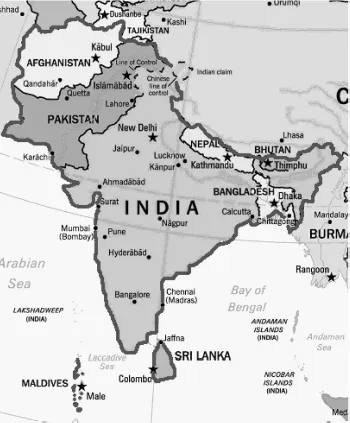
Figure 1.1 Political Map of South Asia
The Development Challenges of South Asia
Some stylized common characteristics of developing nations around the world include low standards of living, low per capita national income, high rates of population growth and dependency burdens of the nonworking population, high and rising levels of unemployment and underemployment, substantial dependence on agricultural production and primary product exports, a prevalence of imperfect markets and limited information, and dependence, and vulnerability in international relations.2 Certainly, all of these characteristics are present to some extent in South Asia, but some more than others.
This section will address some pressing development challenges in South Asia: large population and population growth, and corresponding low per capita income measures; low levels of human development, that is, low levels of living standards and quality of life, and poor opportunities; and a high degree of dependence on agriculture as a source of livelihood. In addition, several other major impediments to development in South Asia are identified, including low savings and capital accumulation ratios, large and unsustainable debt burdens, rampant and pervasive corruption, and a high incidence of political instability.
Large Population and Population Growth
Many of South Asia’s problems are exacerbated by the region’s large population and high population growth rate. In aggregate, with at least twice as many people as each of the members of the Association of Southeast Asian Nations (ASEAN), Latin America, and sub-Saharan Africa, South Asia’s population has grown 2.2 percent annually (since 1960) compared to 1.6 percent population growth in the rest of the world and 0.8 percent population growth in the high-income countries of the Organization for Economic Cooperation and Development (OECD). Among other factors, South Asia’s economic development is clearly hampered by the sheer number of people to whom it is home. As a case in point, compare the astounding population density in Bangladesh of 1,007 people per square kilometer to a mere 26 people on average in Latin America. More pertinently, population density per square kilometer of arable, cultivatable land is extremely high in South Asia, which raises issues of food security.
Population was and remains a challenge and bottleneck to growth and quality of life for teeming millions in South Asia. The annual world population growth rate is 1.3 percent, at about 77 million people a year. Six countries— India, China, Pakistan, Nigeria, Bangladesh, and Indonesia—account for half of that total. The population control record of various governments in the region has been mixed and the population growth rate remains around 2.6–3 percent, which is clearly unsustainable. Free condom distribution by itself has had mixed results, at best, and has not proved to be very successful in arresting the high rates of fertility among married couples.3 The battle against high population growth rates can be won only through increasing literacy rates—a case in point is the lower number of children per family in educated middle-class households of South Asia.
South Asia’s huge population has created a slew of problems, including lower capital intensity of production, reduced labor productivity, thinly spread land and food resources, growing gender inequality due to increased dependency ratios, and lower savings and investment due to less productive consumption expenditure. The other obvious impact of high population growth is that it lowers per capita GDP and increases poverty.
Table 1.1
Population Growth vs. GDP Growth, 1990–2000
(compound annual growth rate, %)
GDP growth | Population growth | Per capita GDP growth | |
Afghanistan | NA | 4.1 | NA |
Bangladesh | 4.8 | 1.7 | 3.0 |
Bhutan | 6.3 | 3.0 | 3.2 |
India | 5.5 | 1.8 | 3.6 |
Maldives | 7.4 | 2.6 | 4.6 |
Nepal | 5.0 | 2.1 | 2.5 |
Pakistan | 4.0 | 2.5 | 1.4 |
Sri Lanka | 5.2 | 1.3 | 3.9 |
South Asia | 5.2 | 1.9 | 3.2 |
ASEAN | 4.9 | 1.7 | 3.2 |
Other | |||
China | 10.1 | 1.1 | 9.0 |
United States | 3.3 | 1.2 | 2.0 |
Source: World Bank, World Development Indicators, 2002.
South Asia’s 1.9 percent annual population growth between 1990 and 2000 decreased per capita GDP growth by exactly 1.9 percent (see Table 1.1). ASEAN’s GDP over the same period grew by 0.3 percent less than SAARC’s GDP, but in per capita terms the two regions are equal. Conversely, high GDP growth in countries like China is amplified in per capita terms by corresponding low population growth.
An additional perspective on the population of South Asia is that a high dependency ratio implies a drag or inefficiency of the working economy, potentially due to high birthrates without corresponding growth in the economy, or perhaps a high degree of age dispersion with large concentrations of the population incapable of working. Moreover, high dependency implicitly suggests a high degree of “momentum” for the population growth rate . This means that even if fertility rates diminish significantly, as the large number of dependent youths mature and have children of their own, substantial population growth will continue until a time when both fertility and dependency rates are low.
In South Asia (see Table 1.2), there has been a gradual decline in dependents per worker over the past five decades, although the dependency ratio remains higher than in any other region, with the exception of sub-Saharan Africa. South Asia’s dependency ratio of 0.66 is about equidistant between high-income OECD countries at 0.48 and the United Nations list of LDCs at 0.85.
Table 1.2
Dependency Ratio (dependents to working-age population)
1970 | 1980 | 1990 | 2000 | |
Afghanistan | 0.82 | 0.84 | 0.89 | 0.89 |
Bangladesh | 0.96 | 0.98 | 0.90 | 0.70 |
Bhutan | 0.80 | 0.81 | 0.85 | 0.89 |
India | 0.79 | 0.74 | 0.69 | 0.63 |
Maldives | 0.85 | 0.87 | 1.00 | 0.85 |
Nepal | 0.81 | 0.85 | 0.87 | 0.80 |
Pakistan | 0.98 | 0.90 | 0.85 | 0.82 |
Sri Lanka | 0.84 | 0.66 | 0.61 | 0.48 |
South Asia | 0.82 | 0.78 | 0.73 | 0.66 |
ASEAN* | 0.87 | 0.75 | 0.67 | 0.60 |
Latin America and Caribbean | 0.88 | 0.79 | 0.69 | 0.59 |
Sub-Saharan Africa | 0.91 | 0.94 | 0.94 | 0.89 |
European Monetary Union | 0.59 | 0.55 | 0.48 | 0.48 |
North America* | 0.75 | 0.65 | 0.58 | 0.53 |
World | 0.77 | 0.71 | 0.64 | 0.59 |
Source: World Bank, World Development Indicators, 2002.
*Unweighted average across countries.
Low Growth of Human Capital and Poor Human Development Indicators
The United Nations Development Programme (UNDP) definition of human development goes beyond per capita income. It includes such variables as education, which creates human capital, longevity (health), and civil rights, which reflect noneconomic aspects of the quality of life. The economic relevance of these variables, simply put, is that just as health can potentially increase earnings opportunities (in addition to its direct benefits in terms of quality of life), so can increases in levels of education and freedom (UNDP 2004).
Countries in South Asia typically rank among the lower and middle countries out of the 175 ranked in terms of human development (Table 1.3). The dispersion of rankings in South Asia ranges from Pak...
Table of contents
- Cover
- Half title
- Title Page
- Copyright Page
- Dedication
- Table of Contents
- Tables and Figures
- Acknowledgments
- Introduction
- Part I Introduction
- Part II Macroeconomic Performance and Issues in Economic Growth
- Part III Globalization, Trade, and Development
- Part IV Corruption in Governance and Its Effects
- About the Contributors
- Index
Trusted by 375,005 students
Access to over 1.5 million titles for a fair monthly price.
Study more efficiently using our study tools.
Frequently asked questions
Yes, you can cancel anytime from the Subscription tab in your account settings on the Perlego website. Your subscription will stay active until the end of your current billing period. Learn how to cancel your subscription
No, books cannot be downloaded as external files, such as PDFs, for use outside of Perlego. However, you can download books within the Perlego app for offline reading on mobile or tablet. Learn how to download books offline
Perlego offers two plans: Essential and Complete
- Essential is ideal for learners and professionals who enjoy exploring a wide range of subjects. Access the Essential Library with 800,000+ trusted titles and best-sellers across business, personal growth, and the humanities. Includes unlimited reading time and Standard Read Aloud voice.
- Complete: Perfect for advanced learners and researchers needing full, unrestricted access. Unlock 1.5M+ books across hundreds of subjects, including academic and specialized titles. The Complete Plan also includes advanced features like Premium Read Aloud and Research Assistant.
We are an online textbook subscription service, where you can get access to an entire online library for less than the price of a single book per month. With over 1.5 million books across 990+ topics, we’ve got you covered! Learn about our mission
Look out for the read-aloud symbol on your next book to see if you can listen to it. The read-aloud tool reads text aloud for you, highlighting the text as it is being read. You can pause it, speed it up and slow it down. Learn more about Read Aloud
Yes! You can use the Perlego app on both iOS and Android devices to read anytime, anywhere — even offline. Perfect for commutes or when you’re on the go.
Please note we cannot support devices running on iOS 13 and Android 7 or earlier. Learn more about using the app
Please note we cannot support devices running on iOS 13 and Android 7 or earlier. Learn more about using the app
Yes, you can access India and South Asia by Anjum Siddiqui in PDF and/or ePUB format, as well as other popular books in Economics & Business General. We have over 1.5 million books available in our catalogue for you to explore.