![]()
LESSON 1 OF 16
Meeting friends and discovering differences!
“Let’s meet Archie”
Key social principle
We begin by teaching children how to offer a friendly greeting and how to respond to one. This is where friendship begins! This also introduces the accompanying theme that friends can like different things; what’s most important is to delight in differences. Our What’s the Buzz? Group Values are also established during this lesson as a promise to help one another and become a friendly group of learners.
Materials required
• Name tags
• Chairs or mats on the floor to mark out a social circle for the children to sit in
• Whiteboard/butcher’s paper and markers
• Print and display the What’s the Buzz? Group Values (located at the end of the Introduction)
• Organise ‘thumbs up’ and ‘reminder’ cards (see Introduction for additional background)
• Have Archie’s Story ready to read aloud
• Write a simple outline of the lesson on the whiteboard/butcher’s paper for all to see
• Enlarge to A3 and print an ‘Archie Happy Face’ and an ‘Archie Sad Face’ to play ‘Archie’s likes and dislikes’ in The Buzz (located at the end of the chapter)
• A lightweight medium ball to play ‘Name Roll’
• Prepare handouts for parent(s):
∘ copy of the lesson for each parent
∘ copy of After the Buzz, social thinking ideas for parents and caregivers (located at the end of the lesson, or as a Microsoft Word doc. from www.whatsthebuzz.net.au)
“Let’s meet Archie”
Welcome to What’s the Buzz? For Early Learners! It’s built for teachers, school support workers, parents, caregivers, and a range of allied health professionals, to awaken social consciousness and build friendship skills in youngsters. Over 16 lessons, the children will be immersed in a variety of essential relational skills, stimulated by the experiences of our much-loved character, Archie. Each lesson, the children can help Archie solve the very same social dilemmas that occur in their everyday lives. Through activity, discussion, role-play and quizzes they’ll learn how to become a better friend and a more flexible social thinker.
In this first lesson the group gets to meet Archie, and each other. They’ll also have a chance to compare what Archie, and others in the group, like and dislike.
1. What’s the Buzz?
Before beginning, place chairs or mats on the floor to mark out a social circle for the children to sit in. Provide a brief lesson plan on the whiteboard/butcher’s paper for the children to see. As the children enter, warmly greet each one and help them put on their name tag. Welcome everyone to this friendship group.
Now it’s time for the group to listen to Archie’s Story. Moments after you start the story, stop and praise the group for being attentive. Hand each child a ‘thumbs up’ feedback card and explain why they have received it (see Introduction for an explanation about feedback cards and feedback ideas).
Archie’s Story – “Let’s meet Archie”
Large colour images can be downloaded from www.whatsthebuzz.net.au to fill the electronic whiteboard. Two illustrations accompany each story. Archie’s BIG BOOK can also be purchased. It contains all the Archie stories and full page images in colour (www.whatsthebuzz.net.au/main-menu/to-purchase-whats-the-buzz). This is an engaging way for children to listen to the story and allows them to reexperience the key social principles.
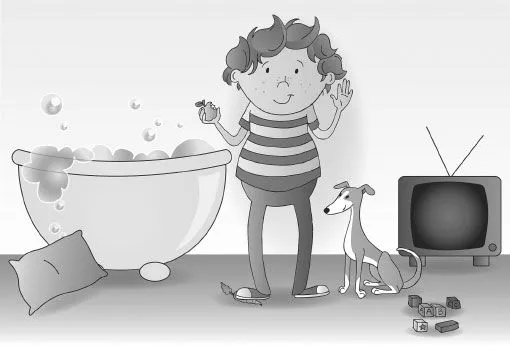
This is Archie and he’s just about your age.
Archie likes playing with friends, building, games, apples and chocolate doughnuts. He especially loves hugging Maxi – his dog. He does not like eating carrots, going to bed early, the smell of his dog’s poo or going shopping. Most of all he doesn’t like waiting for his mother while she talks and talks and talks to other grown-ups. He thinks his mother talks too much!
Let’s look at his face. Archie has a big smile. That makes him look friendly. Hey, Archie is waving to us as well. I think he’s happy to meet us! I can see that his smile is making each of you smile too. Do you think he wants to be our friend? I think so.
Look at Archie’s hair. It’s as red as a fire engine and looks like an upside down mop on fire! Don’t worry, Archie’s not upside down and he’s not on fire! It’s just the way his hair is. You see, his mother brushes it every morning, but it still goes wherever it likes. Archie says he’s got ‘naughty hair’ and gets cross with it sometimes. Archie’s hair just does what it likes. Archie can remember when two boys teased him and called him ‘Mr Mophead’. He didn’t like it – it was mean. He ignored them and walked away. Archie’s friends adore his fire engine red hair and tell him they wish they had wild hair like him.
I want you to look at Archie’s face again. Is he still smiling? Yes, he is. That tells me he must be friendly. Can you see that Archie has three brown freckles on his cheeks and seven small red freckles that sit alongside his nose?
Come on, help me count them. Let’s do it together…
When Archie gets excited and he jumps up and down those freckles look like they might jump right off his face!
Over the next few weeks you’ll hear a lot more about Archie and his adventures with his friends at Castle Rock School. What you’ll see is that Archie’s life is a lot like yours. There will be some great times and some tricky times. Being a friend and trying to be kind to everyone isn’t always easy.
2. Show me the Buzz
Explain to the group that now they have met Archie, it’s time for them to meet each other.
Begin by leaning into the group so your body looks eager, smile so they know that you’re friendly and use your friendliest voice to say,
‘Hello, my name is ………. and I like ………..’
Encourage each child to take a turn. Hand out thumbs up feedback cards as each introduces themselves. Also hand thumbs up cards to those showing respectful audience skills. Tell them the pleasing behaviours you are noticing!
Next, start all over again. Lean into the group, smile and with a friendly voice say,
‘Hello again, my name is ………. and I don’t like ………..’
Once again, encourage each child to take a turn.
Finally, tell the children that What’s the Buzz? is going to be a happy and safe place where they can learn together. Hold up the group values (located at the end of the Introduction) to highlight them. The best way to stress these desired behaviours is by catching the children doing them. As you do, praise them and present a thumbs up feedback card!
| TEACHING POINT You may wish to take photographs of the group displaying the group values. Add them to the poster, have it laminated and display it at each session to heighten the best of intentions. |
Something more
1 Develop a Big Book that you can write lesson by lesson as the children learn alongside Archie. This is an ideal way to reinforce the key social principles contained within each session. In this lesson, photograph the children as they introduce themselves in Show me the Buzz. Add these with captions to the Big Book.
2 Alternatively, develop a video diary to track the lessons and allow the children to review footage of activities and role-plays. This is such an appealing way to re-experience and strengthen the key social principle within each lesson.
By developing either of these options, you’ll be creating a social story. These explain the social world to children and teach them what to do, when to do it, how to do it and why do it. They give rules and guidance about the making of appropriate choices. For an original explanation of social stories and deep resources, visit www.thegraycenter.org/social-stories/what-are-social-stories
3. Do you know the Buzz?
This is a fast-moving question time. It usually allows facilitators to discover the extent the children have grasped the key social principles. Always arrange the children back into the social circle. Ask them to listen carefully as you read the ‘What if’ questions. Their job is to find the best answer they can! Have the thumbs up cards ready and be sure to reward everyone’s best efforts with a steady stream of them.
‘What if’ questions
• ‘What if’ Archie was NOT smiling at us? What might you think about him? Is it a good idea to smile when you meet someone? Why? What does a smile tell others about you?
• ‘What if’ you use a grumpy voice when you meet someone? What might they think of you?
• ‘What if’ you use a friendly voice, but look down at the ground? What wou...