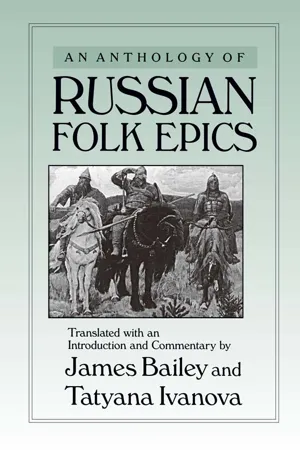
An extensive introduction provides basic information about Russian epics, their historical background, their poetics, the history of their collection, their performance context, and their main interpretations. In addition, their is a short introduction to each song, explaining its plot, allusions, and interpretations. A glossary of common terms and a selected bibliography of studies about the Russian epic in English and Russian are also included in the volume.
As the central figure in the Russian epic tradition, Ilya Muromets is the subject of more songs and has a more complete epic biography than any other bogatyr (Astakhova 1958: 393–419). His appearance as “Ilyas von Riuzen” in several German and Scandinavian sagas dating from the twelfth and thirteenth centuries reveals that he was an established hero by that time in Kievan epics. Since that period the characteristics of Ilya Muromets as an epic hero have undoubtedly changed. For example, even though he is frequently referred to as an “old Cossack,” folklorists believe that this appellation appeared in the sixteenth or seventeenth century. They also note that the adjective “old” does not indicate age but rather respect, experience, and seniority. The image of Ilya appears to have evolved further in the nineteenth century when peasant performers started emphasizing his peasant background. The importance of Ilya Muromets in Russian culture is also shown by the fact that his relics were long believed to lie in a Kiev monastery and that he appeared in many tales circulated in chapbooks in the eighteenth and nineteenth centuries.
The song “Ilya Muromets and Nightingale the Robber” has been recorded 132 times and is one of the most popular Russian epics. Singers may more accurately call this bylina “The First Journey of Ilya Muromets” because in it he leaves his village of Karacharovo near the city of Murom (the names vary), performs his first exploits, and for the first time comes to Kiev, where he is accepted as a bogatyr at Prince Vladimir’s court. The events in other songs about Ilya largely do not follow any chronological order: “Ilya and Idolishche,” “Ilya and the Highwaymen,” “The Three Journeys of Ilya Muromets,” “Ilya Muromets and Falconer,” “Ilya Muromets’s Fight with Dobrynya,” “Ilya Muromets Quarrels with Prince Vladimir,” and “Ilya Muromets and Kalin Tsar.” However, the earliest part of this hero’s biography appears in a work entitled “The Cure of Ilya Muromets,” where Ilya is presented as the son of peasants and lies paralyzed on a stove for thirty years. He is miraculously cured by several passing pilgrims whom he befriends and who give him something special to drink. Ilya then helps his parents clear a field by uprooting whole trees and, realizing that he now has the strength of a bogatyr, he leaves home on his first journey. From the mysterious pilgrims Ilya also learns that he is not fated to die in battle. “The Cure of Ilya Muromets” probably is a relatively recent work, is composed in prose instead of verse, and reflects the attempt by singers to complete Ilya’s epic biography by describing his childhood and peasant origin.
Although the confrontation with Nightingale the Robber forms the core of this epic, three conflicts ac...
Table of contents
Cover Page
Half Title Page
Series Title Page
Title Page
Copyright Page
Dedication
Contents
Foreword
Preface
The Russian Oral Epic Tradition: An Introduction
I. Epics About the Oldest Heroes
II. Kievan Cycle
III. Novgorod Cycle
IV. Epics with Biblical or Religious Subjects
V. Historical Songs of the Sixteenth Century
VI. Skomoroshina
VII. Ballad
Glossary
Bibliography
About the Editors
Trusted by 375,005 students
Access to over 1.5 million titles for a fair monthly price.
Study more efficiently using our study tools.
Frequently asked questions
Yes, you can cancel anytime from the Subscription tab in your account settings on the Perlego website. Your subscription will stay active until the end of your current billing period. Learn how to cancel your subscription
No, books cannot be downloaded as external files, such as PDFs, for use outside of Perlego. However, you can download books within the Perlego app for offline reading on mobile or tablet. Learn how to download books offline
Perlego offers two plans: Essential and Complete
Essential is ideal for learners and professionals who enjoy exploring a wide range of subjects. Access the Essential Library with 800,000+ trusted titles and best-sellers across business, personal growth, and the humanities. Includes unlimited reading time and Standard Read Aloud voice.
Complete: Perfect for advanced learners and researchers needing full, unrestricted access. Unlock 1.5M+ books across hundreds of subjects, including academic and specialized titles. The Complete Plan also includes advanced features like Premium Read Aloud and Research Assistant.
Both plans are available with monthly, semester, or annual billing cycles.
We are an online textbook subscription service, where you can get access to an entire online library for less than the price of a single book per month. With over 1.5 million books across 990+ topics, we’ve got you covered! Learn about our mission
Look out for the read-aloud symbol on your next book to see if you can listen to it. The read-aloud tool reads text aloud for you, highlighting the text as it is being read. You can pause it, speed it up and slow it down. Learn more about Read Aloud
Yes! You can use the Perlego app on both iOS and Android devices to read anytime, anywhere — even offline. Perfect for commutes or when you’re on the go. Please note we cannot support devices running on iOS 13 and Android 7 or earlier. Learn more about using the app
Yes, you can access An Anthology of Russian Folk Epics by James Bailey,Tatyana Ivanova in PDF and/or ePUB format, as well as other popular books in Literature & European Literary Collections. We have over 1.5 million books available in our catalogue for you to explore.