![]()
PART I
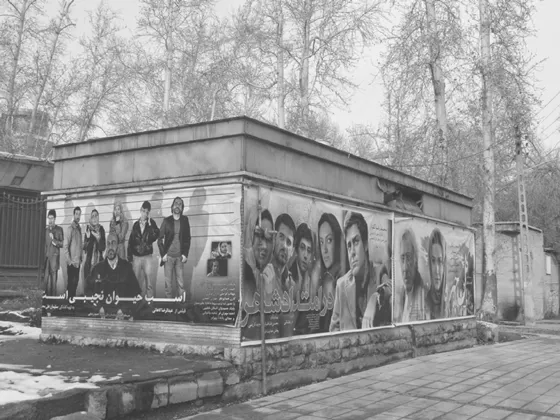
Figure 3 Iranian cinema mirrors Tehrani lives.
Source: © Ali Madanipour.
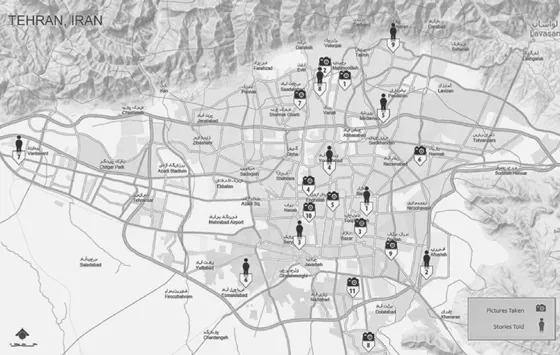
Figure 4 Map of Tehran showing locations of pictures and stories.
Source: © Faranak Miraftab and Neema Kudva.
![]()
| | | | |
| “Urban Lives: Stories from Tehran”1 | | | | |
| | | |
| Essay written for Cities of the Global South Reader (2015) | | | |
Ali Madanipour
How can we acquire a complete profile of the city? Is it at all possible to arrive at such a picture? Whatever approach we take, we confront a different scene. Whoever we talk to will tell us a different story. Do we dismiss these stories as “subjective” and try to build up a completely “objective” model of reality? But we know that even this objective story is a narrative told from a perspective, embedded in a set of contexts and experiences. We can look at the patterns of the city’s economy, its social life, the way it is managed, the way its space is organized, and some of the problems it faces. We can draw a sketch of the city along these lines and add more details to render a more accurate picture of the city. Whatever we do, however, will not capture a complete portrait of the city in its rich diversity and complexity of meaning. If we took any of these approaches, something very essential would be missing: the stories and the voice of the people who live in the city.
Below we hear the stories of a variety of people from one particular city: Tehran, the capital of Iran and one of the major cities of the global South. Like any other city, Tehran is a dense tapestry of relationships and meanings, developed and constantly changed by its inhabitants in their daily lives. Compiled below are nine stories of men and women, of young and old, of rich and poor—a cross-section of the population in Tehran. By hearing these stories we hope you begin to get a sense of the city. Obvi-ously these nine people don’t tell the whole story of Tehran, as there is no end to the diversity of these stories and each can fill many books. But they do offer us some glimpses of what lies beneath the skin of the city from different perspectives.
However, before you read these personal accounts, some historical content might help to make the narratives more understandable. For this purpose, three events are important to keep in mind: the 1979 revolution which overthrew the monarchy (the Shah or the King) and brought into place an Islamic republic where religious codes of conduct were reinforced in the public arena; the war with Iraq which started shortly after that and lasted through the 1980s; and the political instability of Afghanistan to this day beginning with the Russian occupation in 1979 (hence the presence of Afghani refugees in the city). These events intertwine with the daily experiences of pleasure and pain in the city and how residents have attributed meaning to their urban lives. Here are some scenes and a handful of possible monologues from among millions of Tehrani voices.
[Editors’ Note: Along with these stories we also include a series of pictures taken in Tehran and a map of the city that shows the approximate locations of the pictures and the stories. The pictures do not belong to the stories. But combined we hope the keyed-in locations will help you navigate the diverse experiences of the city of Tehran.]
PORTRAITS FROM A LABYRINTH
1
I am a young man. I used to be a teacher in Kabul, Afghanistan, but had to run away because of the civil war in my country. Here I have had to work as a construction worker. It is very hard and nothing in my previous life had prepared me for this job. I wish I could go back to Kabul and live an ordinary, more dignified life. But things are worse back home, with all the continuous fighting. Here some people don’t like Afghanis. They think we take work opportunities away from the locals and get paid less for the same work. None of them appreciate that we get paid less for often harder jobs, which even Iranian workers are not prepared to do, like digging and cleaning the sewage wells. Some times when I go to the street corner, where we are picked up by the clients, we get jeered by the Iranian workers who were more expensive and could not find a job. Others think we are too violent, that on the evidence of only a few incidents, often among ourselves.
I live with six other Afghani workers in a small section of an old, crumbling house in the middle of Tehran. It is awful to live like that, but I have no other alternative. These houses look a bit like some places in Afghanistan. Some parts of Tehran have huge buildings with fancy shapes I had only seen in the movies. One good thing about being in the middle of the city is that a lot of things happen here. Our rent is low and we are together. There are so many people from everywhere that nobody bothers us about our documents. I don’t wear my traditional costume so that I don’t stand out in the street. If I don’t get a job for a day, I just wander around in the city center, looking at thousands of passers-by and at the street vendors, shops, and places. I can get some rest in a mosque or go to one of many cinemas nearby. I like these cinemas, although in this country they don’t show many Indian films, which are very popular back home.
Despite all this, for me Tehran is an alien place. I am Shiite and my mother tongue is Persian, the same as most people here. Even my Dari accent is not a problem because many people have different accents here. There are some Iranian people who even don’t speak Persian. But these don’t make me feel at home. Things are very different here and I am not comfortable with most things. My jobs don’t last long and I have to look for new ones. I know some friends who work in a neighborhood on the outskirts of the city, where many new buildings are being built. They live on the site and if I am desperate I can go and stay with them. But this line of work cannot go on forever. I wish to get married and start a family, but there are no prospects. Most Afghanis who have come to Iran are men and I don’t know any local people. I have not heard from my parents for a while, that is ever since one of my clan came over and said they were rather well but suffering from the civil war.
2
I am a middle-aged woman, living in Gharchak, in the southern outskirts of Tehran. I go out to the city every day, working as a domestic helper, cleaning, washing, cooking, etc. I am originally from a village in Khurasan. My husband did not own agricultural land and there was nothing to do in the village apart from working on other people’s land. He thought it’d be better to do the same in Tehran and earn much more. Therefore, we moved to Tehran, where we had some relatives who had come before. My husband learned to work as a plasterer. He was often violent and was addicted to drugs. He was killed in an accident on the construction site. After him, I have had to bring up our eight children on my own. I had rented a room in Afsariyeh, southwest city. Life in that house was really difficult. Several families lived there each in one room round a courtyard. In our village, houses are much more spacious and you don’t have strangers as house mates. But here, with so many people in a house, things were too bad. One of my daughters who was often ill had to fast during the month of Ramadan because of pressure from neighbors. They were very nosy. Thank God we are out of that house now. My elder son managed to buy a piece of land in Gharchak and with the help of his cousins built a home for us.
I take a bus to the city every day. All my time in this city I have had to travel to various places where my clients live. I have had a few good clients for many years. They appreciate that a trustworthy domestic helper is not easy to find. Before the revolution, it was easier to find work. People even imported domestic help from the Philippines. I rarely go back to my village. There is nothing there for me. I left when I was very young and my children are now my most important relatives. I have always had to work to earn my living and support my children. I have had some help from various people, like some of my clients, for my children. But that was never enough. God knows how I got used to this huge city, which has no beginning and no end, after coming from our little village.
3
I am a middle-aged housewife, living with my husband in Amiriyeh in the south of Tehran. We are both originally from Shiraz and have come to Tehran many years ago. When our children were still young, we used to go back to Shiraz every summer. We go back rarely now, as the children are no longer interested, fewer of our close relatives are alive or live there, and traveling is not easy. We have lived in this house for nearly thirty years. My two youngest children were born here. I go out of the house every day, for shopping. I know all the shopkeepers in our street and they know me. In the past, they were friendlier and looked after us. Nowadays they seem to have so many customers that they don’t care much about any of them. At the time of the war rations, the butcher and the grocer and many others all felt like the God on earth. I’m glad those war days are gone. The city would go completely dark and you could hear these missiles landing in around the city. One fell not very far from here. You keep your nerves for the first few, ...