I am almost always aware of race, alert to its power as an idea, sensitive to its nuances in the world.
Arthur Ashe (1993: 138)
Du Bois (1994: 1) famously announced that the problem of the twentieth century is the problem of the color line. His words have not gone unheeded in sport and it is argued here that ‘race’ continues to be one of the most significant problems of the twenty-first century. There are relentless accounts of racism in sport that continue the relevance of these words within and without its domain. Yet Du Bois’ idea of the veil hints at more than these overt manifestations of odious behaviours, it points to more subtle, systemic and structural racialised forms of oppression that require concentrated levels of critical consciousness to isolate, explain and disrupt.
Du Bois speaks of a double consciousness that he became aware of as a result of being Othered at a very early age. The outcome of early traumatic events led to him recognising that he was viewed differently by those racialised as White in the public domain. He argued that they drew on negative racialised behaviours, tropes and characteristics that delineated his identity from the majority White community just as Shuford (2001) more specifically describes ‘race’ as a construct for defining and locating people through imposed racialised categories, and for the allocation of resources. The veil signifies a position of racial consciousness for many that reveals the significance of ‘race’ in sport and society and the insidious nature of racism (Bell 1992)
For Du Bois, a ‘veil’ hung between him and the dominant whiteness that he experienced. It was emphasised by the privileges and supremacy of whiteness and those with the power to Other him. Living within the veil offered security and purview from which to observe and strategise how to navigate the racialised society outside. The veil also emphasised the racialised fractures found more generally across society where sport is but one contested domain (Winant 2004; Carrington 2013). Further, Du Bois’ (1994) striving to become an African and an American is a pernicious fight against a forced hybridity that consequently leads to notions of ‘them’ and ‘us’, processes that include and exclude in the way that everyday business is regularly conducted (Werbner and Modood 1997; Giardina 2003; Ratna 2007).
Many scholars have argued for sport and ‘race’ to be taken seriously amid claims of it seamlessly mimicking dilemmas in other social settings. For example, sport’s racialised dynamics affect, and are affected by, wider discourses, ideologies, structures, issues and controversies (van Sterkenburg, Knoppers et al. 2010; Burdsey, Thangaraj et al. 2013; Carrington 2013; Klugman and Osmond 2013; Testa and Amara 2016). The symbolism of sport for diasporic communities makes it more than whimsy (Burdsey, Thangaraj et al. 2013) and its analysis requiring a shift from the ‘toy department of human affairs’ (Edwards 1979: 116) to a clear recognition that sport matters (Zirin 2007). Like Zirin (2007), Edwards (1979) supports the view of others today whom implicate sporting arenas in recreating and faithfully sustaining how racialised dynamics play out elsewhere (Lawrence 2014; Poulton and Durell 2014; Farrington, Hall et al. 2015). At the same time, sporting arenas are capable of challenging behaviours, attitudes and customs where thoughtful practice is harnessed (Long and Spracklen 2011; UN 2013).
Viewing the veil as a dialectic in sport, it can be argued that it not only reflects lived raced realities but can also signify the unstable and contradictory aspects of ‘race’ and sport (see Winant 2004). Hence, where there is racialised oppression and subordination there is the potential for anti-oppression work and empowerment. Where the veil is revealed institutionally the tensions of organisations and their actors must continue in a dynamic of resistance to these hegemonic forces. We have seen this in sport where moments of social or political resistance have revealed the subtle dynamics of the veil. Yet what these successes have regularly signalled in sport and society is the scale of the task of racial equality and ‘race’ which continues to be the problem of the twenty-first century.
Ashes to racism
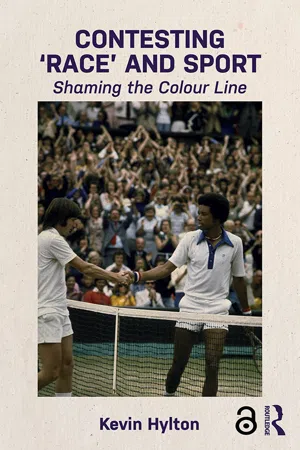
When African American tennis legend Arthur Ashe described an interview with a journalist about how he was coping with AIDS he hinted at his own double consciousness, the veil and the prevalence of racism. Ashe wrote the following in a chapter entitled ‘The Burden of Race’ in his autobiography Days of Grace:
I could see that she was groping for the right words to express her sympathy for me before she left … ‘Mr Ashe, I guess this must be the heaviest burden you have ever had to bear, isn’t it?’ she asked finally. I thought for a moment, but only a moment. ‘No, it isn’t. It’s a burden alright. But AIDS isn’t the heaviest burden I have had to bear.’ ‘Is there something worse? Your heart attack?’ […] ‘Race has always been my biggest burden. Having to live as a minority in America. Even now it continues to feel like an extra weight tied around me.’
(Ashe 1993: 133)
Ashe reached his conclusion about ‘race’ and AIDS because he contracted AIDS after a blood transfusion whereas he stated that his experience of racism … is entirely made by people, and therefore it hurts and inconveniences infinitely more (Ashe 1993: 134). Ashe was conscious of the effects of ‘race’ and racism growing up in the state of Virginia and despite his undeniable successes his psyche was marked as a result, and captured in the quote at the beginning of this chapter. However, Ashe’s revelations are not unique in the biographies of sportspeople where ‘race’ and racism permeate this arena as much as the next.
In my inaugural professorial lecture I felt compelled to explain, even to a learned audience, that ‘race’ and racism are problematic in sport and society. A set move for most critical sociologists, but an important one to establish a starting point for the discussion that ensued. The term ‘race’ is significant for me not just as a socially constructed concept but as a significant ontological truth, which is why I use it in scare quotes. What that does is to signpost that it should not be read nor used uncritically. I refer to Omi and Winant’s (2002) work on racial formations to describe how we must understand that ‘race’ is a paradox, that it has been decried as a fallacy by the United Nations, high ranking and influential organisations, politicians, and academics (UNESCO 1978; Carrington 2013; UN 2013; Hylton and Long 2016; IOC 2017).
However, challenging ‘race’ at one end as a non-existent fallacious concept or as a social construction at the other oversimplifies the fact that for many like Ashe the lived reality trumps these sociological concerns. I acknowledge the dilemma of ‘destabilising the notion of race theoretically’ while recognising ‘the lived presence of ‘race’ (Fine, Weis et al. 2003: 176). In a racialised society, to reduce ‘race’ to an objective condition or to an ideological construct denies our everyday experiences which has become the basis for most of my work. So, for those who feel that talking about ‘race’ only perpetuates racism, consider Malcolm X’s view that Racism is like a Cadillac, they bring out a new model every year!
Racism
The notion of racism is often misunderstood or viewed narrowly in sport resulting in inadequate responses to incidents, or with systematic and more subtle infractions being missed completely. Elsewhere I consider the everyday understandings of what racism is because it means different things to different people (Hylton 2009: 10). There are different descriptions of what racism is and how it operates. For Sue (2003) racism is a mix of attitudes, actions, structures or policies that lead to the subordination of people due to colour or culture. Westwood (1990) signals that mistakenly held beliefs of natural racial superiority reinforce assumptions of racial dominance and underpin rationales for maintaining hegemonic racial hierarchies. While Trepagnier (2010) goes as far as to conclude that some social groups think about racism in different ways. White people are more likely to think of racism in binary opposites of ‘racist or not racist’ which in both cases ignores the unintended systematic nature of racism which, not surprisingly, Black people are more likely to be persuaded by, however. Racism can be viewed existentially as a ‘felt’ individual or group experience; it is a noun that names stigmatising processes; it is ignorance of other cultures; it is a concept with little analytical credibility; it is a concept that differs over time and space; it is a phenomenon that intersects with other axes of power; it is systemic; it is not aberrant; it is structural. Holland (2012: 3) agrees that Critical Race Theory sees racism as ordinary; she goes on to to state that racism is almost always articulated as an everyday occurrence, as pedestrian rather than spectacular. What racism is, and how we can best understand and challenge it, is a worthy undertaking for key stakeholders in sport.
Definitions of racism tend to have certain characteristics in common. They stress the prevalence of racialised ideologies of superiority, prejudice and power while reinforcing the notions of exclusion, subordination, and subjugation of racialised and minoritised others. Solorzano, Miguel et al. (2000) identify three important points in definitions of racism: (1) one group believes itself to be superior, (2) the group that believes itself to be superior has the potential to carry out the racist behaviour, and (3) racism affects multiple racial groups. Racism is a worldwide phenomenon and is not isolated to the West or historical imperialist colonisers, it is not one but a multiplicity of manifestations and experiences, it presents itself in different forms, in different contexts, with varied histories and politics that shift over time and place (UN 2005). This dynamic can be viewed in Anthias and Yuval-Davis’ definition of racism in its plurality when they state that,
Racism(s) need to be understood as racialised … Modes of exclusion, inferiorization, subordination and exploitation that present specific and different characters in different social and historical contexts
(Anthias and Yuval-Davis 1993: 2)
I am not repentant for doing work in this area; I do not hold on to the hope that I will stop talking about ‘race’ and racialised dynamics in sport and society too soon. But we must remember that Peace won’t be still of its own free will, and if those words were poetic enough for Gil Scott Heron then they are good enough for me!
‘Race’ and sport: whose story?
Dominant epistemologies in sport and leisure theory, policy and practice are very powerful and yet it is important to ask Whose story is it? Whose knowledge is included and who/what is excluded from research? For example, one story of ‘race’ and sport can be a very liberating one. One that would state that ‘sport is a meritocratic, colourblind, equal opportunities site of social relations where diversity can meet and people, possibly for the first time, can begin to accept each other for who they are. Playing together, integrating, cohering … in fact sport becomes this “cultural glue” that binds us within and across groups. Prejudices dissipate, community is strengthened and society functions more smoothly.’ This is the dominant story of sport and its benefits which most of us may have succumbed to at some stage.
Another story could be that through sport our social divisions are reinforced as hierarchies are maintained, remain monocultural and assumptions about the ‘other’ are left unchallenged. Post-‘race’ arguments of meritocracy obscure the racial processes that emerge and aggregate, as microinsults, microassaults and microinvalidations become a matter only of ad hoc concern for key stakeholders. These are issues that continue to exercise the mind of critical race scholars and push them to find better and more insightful responses to these concerns.
Du Bois (1994: 1) would describe me as bone of the bone and flesh of the flesh of them that lives within the veil; I do not say this in a way of articulating an aggrandised way of being, but rather one that reflects how I navigate places and spaces. Being a Black British-Caribbean, straight, able-bodied, adopted northerner, from the East End of London, and male, I am in a constant state of reflexivity and consciousness. Either implicitly or explicitly I rarely have an interaction that is not subtly racialised in some way … whether the scenario is impacted by the past, present or what I am likely to do in the future. Tate (2016: 73) describes this state of ‘affect’ as racism’s familiar invisibility. Further, in my teaching over the years in sociology, sport, leisure, community and education, I have always had to consider how questions raised about ‘race’ have had to be carefully constructed for my predominantly White students so as not to draw questions about my motives for discussing issues relating to ‘race’ and social inequalities. This denial of standing for the Black voice on ‘race’ and racism is reflected in the diversity of knowledge formers and leaders in sport and the academy (Bell 1992; Carrington 2012).
Denied standing also operates when the notion of a ‘Race Card’ is deployed to describe stealing an unfair advantage over others because of ‘race’. What many do not consider is that the idea of the ‘Race Card’ invalidates real experiences of racism by trivialising and objectifying them. ‘Playing’ the ‘Race Card’ suggests that structural obstacles and everyday microaggressions are excuses. Reducing racism to inconsequential and strategic game playing renders ‘race’ irrelevant. There is a strong possibility that some seeing my inaugural lecture online or reading this book will argue that I am evidence that there are no obstacles in sport, leisure and education, and that some people use the ‘Race Card’ as an excuse for not progressing or working hard enough. To those people I say this, I remember Kim Crenshaw, a central figure in CRT, saying that sometimes she leaves work to find that she is exhausted not just from her work but also the performance of what scholars describe as whiteness. One cannot play at being a racialised individual and neither is racism a game that anyone would wish to play. This performance can be wearisome. Yet in sport we can see that the conspicuous nature of whiteness or even perceptions of who can succeed in a particular environment, whether practical or academic, can cause a haemorrhaging of highly productive colleagues (Press Association 2017).
I have been a [full] professor for a number of years now and yet I am one of only a few Black professors in the UK (Alexander and Arday 2015). That says much about the education system in the UK, and in sport and leisure studies that figure drops down to just one. This might explain why the perception of the ‘knowers’ in sport and leisure do not necessarily look like me and that what is ‘known’ in dominant epistemologies does not necessarily reflect my experiences.
Such issues are symptomatic of my work. Not only this, my research has incorporated an ongoing pursuit of revealing the dangers of racialised dynamics; improving our theoretical and methodological approaches to these and related issues; while offering a challenge to academics and practitioners to locate themselves within these processes of power so that they become part of the solution to complex racial issues. On this note, in 1934 W. E. B. Du Bois (1998) wrote in Black Reconstruction in America (1860–1880) that stories are influenced by two views: one that believes racialised others are ordinary beings who under fair circumstances can develop like anyone else, and a second that holds on to notions of inferior others, that therefore require different sorts of answers. If you are reading this book and the second view is held then you will need more than the ideas I discuss in this book … Like Du Bois I am not trying to convince those people … I assume the truth of the first (Du Bois 1998: 1).
Critical Race Theory
The praxis of CRT reminds me of two observations. One came from Martin Luther King Jnr, who said In the end we will not remember the words of our enemies but the silence of our friends, and the second is a comment from (Hutnyk 1997) who argued that, It is well and good to theorise the diaspora, the post-colony and the hybrid but where this is never interrupted by the necessity of political work it remains a vote for the status quo. Critical Race Theory signals the incompleteness of sport and leisure theorising and practice where broad discussions on ‘race’ have inconsistently factored-in these social issues (Hylton 2005; Hylton 2010; Hylton and Morpeth 2012; Hylton and Lawrence 2016). Yet CRT can be used as a cross-disciplinary compass to guide a critical approach to sport and leisure analyses. An approach to sport and leisure that has had me transfixed by what Gaertner and Dovidio (2005) would describe as the tension between public commitments to equality, systemic discrimination and bigotry, and the ongoing struggle against racialised inequalities and disparities.
Using the metaphor of a camera, Zamudio, Russell et al. (2011) and Solorzano (2013) emphasi...