- 133 pages
- English
- ePUB (mobile friendly)
- Available on iOS & Android
eBook - ePub
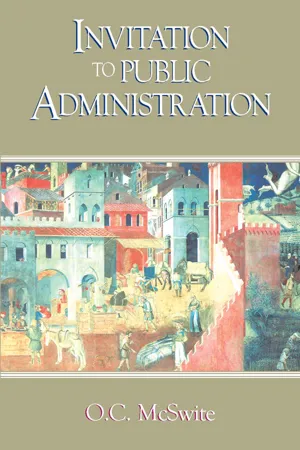
Invitation to Public Administration
About this book
This engaging book presents a model for personal reflection on what a career in public service means. It's designed not to convince the reader to take up a public service career, but rather to invite him or her to explore the implications for one's identity that are inherent in the public service life. Lively and anecdotal, Invitation to Public Administration directly confronts the various difficult issues involved with a public service career even as it evokes self-reflection. It is equally useful for undergraduate through Ph.D. level readers, and it is ideal supplemental reading for any foundational course in Public Administration. The book will also stimulate public service professionals seeking fresh insights for their own careers.
Information
1 • The Delicate Connection of Work to Person
Today the expending of powers n the flat ephemeral pamphlet and the boring meeting.—W.H. Auden
The Situation Then
Each generation seems to produce some defining epithet. Mine is called the “silent generation.” When I read this, I am puzzled. Officially it seems to refer to the fact that my generation has not produced many great leaders, social or institutional innovations, or dramatic shifts in fashion or style. We apparently have simply chugged along through our lives, maintaining the status quo, low profile all the way. Sometimes I feel defensive about this, but mostly I try to understand what silenced us, what sent us into the background of society. The best explanation I have come up with has to do with the war, World War II, which we lived through as children and then suffered the aftermath of as adolescents and young adults. The main thing about seeing the war from my point of view as a child was that it scared me witless. The saving grace of being a child (if you are lucky enough to be put in such grace by your parents, and I was) is that you are made to feel precious. This feeling feeds off into a specific attitude of loving and treasuring your little body—which is mostly the whole identity that you have to yourself—and a general attitude of thinking that all human beings are valuable (because, to begin with, you are). Being alive is good. Observing war directly undermines this central attitude.
So, when I watched war movies (and I saw plenty of them) that showed Nazis setting up machine guns to mow people down as they disembarked from the cattle cars in which they had been shipped to death camps, it was a horrible shock. The explanation that it was due to anti-Semitism did not help; this was far too abstract to me. In my hometown, while there must certainly have been anti-Semitism, Jews were high-status people, valued members of the community. This complicated matters even more. The world as depicted in the war movies did not make sense to my little child’s eyes no matter what I was told. I now realize that, to some extent, this was the case for everybody, adults and children alike. (Adults simply have more resources with which to contextualize their experience.) It was necessary for everybody to believe that the world (and thus the war) did make sense. Since we were fighting the war, we had, perforce, to regard it as a just war. There was certainly propaganda enough presented to us to make it easy to adopt this perspective and make us think that we really believed it. But I actually did not, because I could not. I suspect that this was true for many of my generation. The term “just war” was what I, as an adult, have now learned to label an oxymoron.
The tension of having to render the inconceivable defensible produced a deep-seated psychological double bind and induced a certain kind of passivity in people; at least it did in me. Whether I knew it or not, I, and I think others, gave up troubling over the question of whether the broader framework of life—society, nation, inter-nation relations—could ever be truly sensible. I noticed that after the war the adults around me and in the movies I watched adopted a strangely ambivalent attitude toward social and political life. There was probably never a time before this when the American people were clearer about what defined good and evil, but at the same time, they did not want to talk openly about such things. It was as if discussing the issues raised by the war experience would reveal the fundamental inconsistency of life and irreparably damage people’s abilities to maintain their images of themselves as virtuous and their image of their society as moral.
An implicit deemphasis on all sorts of ideological talk was in effect. There were still too many unresolved tensions at the philosophical and emotional levels, and these translated into profound uncertainty at the personal level. Even people who were appalled at what Hitler had done to the Jews had to admit that they actually did not like Jews themselves. For instance, just after the war was over, the people in my town built a country club and then voted not to admit Jews to it. Also, a lot of people had made a lot of money on the war; everyone knew it, but no one mentioned it.
The result was that people wanted to turn away from considering the moral conundrums of collective existence and to define the core of life as private, as life at home. Work, a job, was just a way to make money to support private family life. People had a weak sense of the idea of career anyway; few believed in it then. A lot of people had been exposed to the reality of career and of large bureaucratic organizations through the military, but they had not liked what they had seen. The more popularly accurate image of life was captured by Sloan Wilson’s novel The Man in the Gray Flannel Suit. This was widely read and made into a movie. It told the story of a man who rejected a corporate career in favor of facing and attending to his more immediate moral responsibility to family—one member of which was an illegitimate child he had fathered in Italy during the war. This was regarded as the heroic and honorable choice.
Everything in the 1950s became personal and concrete. The workplace was where a person labored with other people whom one hoped would become friends. The pain of work was offset by the pleasures of association, of being in the same boat with others. Also, most of the work was “real” work, work that had something directly to do with meeting the necessities of life. People either made things or fixed things that had been made before. There were few services or other such abstract products. The only service workers that most people did business with were physicians and nurses, and they were regarded as considerably more exotic than they are today.
What this kind of social context unknowingly created in me was a profound naivete about the relation between work and life, one so profound that I did not gain perspective on it until I had completed graduate school and become a professor. I would later characterize my early sensibility as a basic innocence about the fundamental relation between me in my career and me as a person.
This innocence did not stem from an insulated, protected youth in which I never had to work for money. I had, in fact, had many jobs in my life before going to graduate school, even one as a full-time, professional public administrator, but none of them marked a genuine separation from the world of my growing up. As an undergraduate I had worked in a bookstore, a job that entailed a surprising amount of physical labor created by the process of shipping in and selling and then buying back and reselling thousands of copies of textbooks each semester. This kind of work balanced the abstraction of my university courses and made a nice transitional linkage back to my days as a summertime physical laborer.
Then for two years after I finished my undergraduate degree I worked in my first public administration job as an administrative assistant for the city manager in my hometown. Although undeniably professional, the job came to me via straightforward patronage: My father was a close friend to the city manager’s staff. At the time I took the job as a summer intern, I had only the most fragmentary sense of public administration as a distinct area of activity. I had been raised in this region and working for the city seemed rather like a return to and extension of my high school days.
I was thrust into the oddly unenviable position of being the primary assistant to a new city manager after the firing, on the day I started, of the former manager. I had planned to go directly to graduate school in the fall, but my new boss convinced me to stay and help him learn about “my city.” Interestingly enough, I found I knew as little about it as he did, and my work seemed mostly like enhancing the social skills my parents had taught me and broadening my existing social networks. I tended to refer all issues and questions to the context of my family and local community, rather than to any more abstract standards of profession or organization. I dressed the same as I had throughout college, kept roughly the same schedule, and associated with the same people in my off hours.
I began, though, to experience a serious disconnection between who I thought myself to be and the burgeoning demands of my job identity. I never seemed to do any “real” work, and I noticed a level of anxiety about performance and status in the people around me that I had not experienced before. I began to feel alienated from myself—as if I were unsure of who I really was. It was as if I were becoming a different person, some new person—at work. I didn’t really have to face this at all, though, as my new city manager mentor was fired himself after eighteen months, and I finally went on to graduate school.
It was in graduate school that the real separation between the person I had grown up as at home and my new professional work identity occurred. During that period I was awarded a research assistantship and was sent one summer to work in Washington, D.C. Living alone in a city like that was culture shock enough, but the psychological confrontation that was more difficult for me to come to terms with was the work I was doing. Each day I “dressed up” and made my way to the offices of what was then the Civil Aeronautics Board, where I was carrying out my research. After a round of preliminary interviews and an orientation session arranged by my supervising professor, I settled down to do the work. This consisted of sitting in the library and reading the transcripts of the congressional hearings that made up the legislative history of the Civil Aeronautics Act. I read, and I made notes on what I read. All day. At first I did this enthusiastically with a kind of physical zeal. Then I noticed that I began to watch the clock and anticipate my breaks for coffee and lunch in the cafeteria on the ground floor. As the summer wore on, definite boredom set in. The hearings testimony was repetitive and, after a while, completely predictable. My mind went on autopilot for the purpose of reading and making the notes, and the reflective part of me began to marvel at the job itself.
I regarded myself with my mind’s eye as I sat there and turned the pages. I felt genuine amazement at the realization that this was all there was to this kind of work. I was being paid “good money” to sit and read. I didn’t even have to manage the interpersonal relationships of a standard office or store. At one point I calculated how many pages I read each day, and how much I earned for reading each page. It was a strange new world. Having started out taking the reading with utmost seriousness, I now looked at it as something I had mastered and could do with my “hands behind my back,” so as to speak. I began to attend, to an unacademic degree, to my physical appearance. I began to spend more on coffee breaks and lunch than I could afford. Garnering the gazes of others on the elevator began to be important to me, and I secretly tallied up how much attention I gained each time. I would notice with painful envy the expensive leather briefcases of the lawyers who came and went, doing airline business. I took protracted coffee breaks and lunches. Such encounters, the contents of the daily Washington Post, the odd bits of agency gossip I picked up, and my own personal image became the focus of my daily work life. I was becoming professional.
This episode of naïve encounter with an alien professional world was repeated many times in a variety of ways as I slowly made the transition from graduate student to professional academic. The most important part of the transition was unconscious. One of the best examples of how the unconscious dimension of this transition operated on me was the time I spent working for the Environmental Protection Agency (EPA) in Washington (again) after getting my M.P.A. My days were filled largely with boredom, as we were both overstaffed and directed to contract out the bulk of what had previously been our tasks.
My office colleagues were largely demoralized and disaffected from the irrational bureaucracy that surrounded us. The sense of mission that had infused the earlier days of the agency had diminished, and those at headquarters were really quite distant from the outcomes of the programs they directed. My coworkers compensated by focusing their attention on personal hobbies and daily routines designed to create a sense of purposeful activity. I, however, still took my job seriously and couldn’t seem to figure out productive ways to spend the time.
I found myself becoming irresponsible, arriving late and devising excuses to leave early. I didn’t want to be there; I didn’t like the quality of relationships I had with my coworkers and the constant gossip that passed for conversation. Most of all I didn’t understand why the world of organizations and careers was set up as it was. Why was it necessary for people to conform to roles that made them unhappy and to pretend to do work that they felt was unnecessary? I was “dressing the part” each day but finding it increasingly difficult to “act the part.”
Within months my unconscious mind created a physical symptom in the form of severe abdominal pains that caused me ultimately to quit my job and return to the impoverished but safer container of graduate school and doctoral work. Miraculously my physical symptoms disappeared. It was clearly a necessary retreat from the professional world but one that prepared me for the biggest lessons to come—those that would finally destroy my naivete about the relation of work to self. These lessons were repeated time and again as I slowly learned my career as an academic.
One notable repetition came about three years after I had taken my first job as a university professor. I developed my courses and settled in during my first couple of years and then hunkered down to face the long-term grind of life as an academic. When I turned this corner, a pervasive mood of quiet desperation began to overtake me. It seemed clear to me that academic life was dry and bloodless, an intuition that had come to me many times during my student days but one that I had quickly suppressed, caught up as I was in the melodrama of making grades, negotiating my way through the interpersonal politics of a large academic department, and playing out the social life of shabby psuedo-bohemianism that is the lot of graduate students in the social sciences. Of course, I also desperately wanted this life to be different from that which I had experienced in government practice. If I had not been so young and full of the energy that comes to those who have been released from prison (in my case the penitentiary of bureaucracy and graduate school), I would have become outright depressed. As it was, I came close enough.
I didn’t really become conscious, though, of how naïve I was until I had been a professor for several years. I found that I had become pervasively anxious about what kind of human being I was turning into as a result of having become a university professor. About the same time that I was experiencing this swelling anxiety, I noticed that my father had taken up painting. He had had a varied work career, including being a businessman and an oil well survey engineer, but none of these had affected him in the way that his present career as a union organizer had. He found that when he was in the middle of a campaign, he could not get the work off of his mind. This was new for him, and given his generational disposition toward work, he saw it as seriously wrong. He experimented with various types of reading and then hit upon painting as the device that was most effective for taking his mind away from work. It was not that he did not enjoy his work—he absolutely reveled in it and was successful at it. He just saw it as a matter of principle that work should not take over one’s life. He painted so as to refuse the domination of work and to subordinate his work to his life. When we discussed this, I realized that the same thing was happening to me (work was beginning to take over my mind completely), but I, unlike him, was not doing anything about it.
My awareness of my dilemma was heightened, and I was able to put an intellectual frame around it, when I encountered Ivan Illich’s book, Tools for Conviviality. Illich was a radical Catholic priest in Latin America who wrote critiques of modern society and advocated for more intermediate scale in social organization. In this book, he discussed the social psychology of the interaction between tools and workers. His idea was that the various relations workers have to tools constitute the workers themselves in correspondingly various ways. Where the tool is of a scale that requires that the worker be fitted to its processes, as is the case with most manufacturing, laborers are created. In this instance, the body is taken over and dominated by the tool, for example, a shovel. Where the tool does the work, but requires human direction, as is the case more and more these days, the worker is created as an operator. This is what we know as professional work. The distinctive aspect of being a professional is that while it appears that one is free of the tool and acting autonomously so as to be in charge of the tool and directing it, in order to do this, one must actually give oneself over to the tool entirely. While the worker is dominated in body, the professional is dominated body, mind, and, eventually, soul, as professional ethics take over the capacity for moral choice. Most fearsome of all in this respect is the fact that professional roles increasingly involve mostly conceptual tools, and these are grounded in set specifications about the use of language: what and how things are to be said and written. This evacuates the human person in perniciously invisible ways. I was deeply affected by reading this book, and it provoked intense reflection in me on my own situation and ways of relating to it.
I remembered a photograph of great pathos I had once seen. It was of a very young boy who was a child laborer in an American textile factory. His face was sad and awesomely tired, and seeing it evoked pain in me. I asked myself what makes it so clearly tragic when children are forced to work. The answer is that this does not allow them the time to play and to learn. I imagined the little boy during his eating break playing with a toy car on the floor of the factory. This would be fun for him, I knew, no matter how serious his having to work made him. His fantasy stream would certainly have stayed alive. The tragedy of child labor is that this precious aspect of human life is denied. But then, why is it not also tragic that adults must give up this part of themselves as part of becoming adult and moving into the world of grown-ups? It seems clear that this is tragic, too. I realized that my father was preserving the little boy aspect of himself that insisted on having a life of its own.
Look at the situation I am in, I thought. All around me were people who talked of their “lifelong research programs” and posed questions of what the best “career strategies” were, given the changes currently taking place in academics. I participated in such conversations, and I knew the game fairly well, but I wasn’t really interested in it. So when I discussed the “academic game” (i.e., our careers) with people who took it quite seriously, I felt like an imposter.
Despite this feeling, however, I moved along in my university employment, changing jobs (i.e., “making career moves,” etc.) with an eye to increasing my salary and prestige. I began to understand more, but the psychological situation only worsened. I realized I was repeating the pattern of graduate school. The opportunity to study for a Ph.D. had been presented to me, I had seized it even though I was intending to do something else, and then, when I found myself in the academic game, it became a high-stakes struggle that I could not relinquish. I was playing a game that I had stumbled into and was caught up in, but I could not make sense of my increasing ambivalence about it. The problem was that time was passing ever more rapidly, and the stake on the table was my life.
I found cold comfort in an article I came across, titled “Careers as Idiosyncratic Predicates.” It was written by a social psychologist, Karl Weick, and the argument was that what people actually do in their work lives proceeds in the manner of a steel ball m...
Table of contents
- Cover
- Half Title
- Title Page
- Copyright Page
- Dedication
- Table of Contents
- Preface
- Acknowledgments
- 1. The Delicate Connection of Work to Person
- 2. A Letter from Prague: Kafka's Insight
- 3. A Second Letter from Prague: Existential Crisis on Ostrovni Street
- 4. Back in D.C. in a New Millennium
- Appendix. What Is at Stake?
- Bibliography
- About the Authors
Trusted by 375,005 students
Access to over 1.5 million titles for a fair monthly price.
Study more efficiently using our study tools.
Frequently asked questions
Yes, you can cancel anytime from the Subscription tab in your account settings on the Perlego website. Your subscription will stay active until the end of your current billing period. Learn how to cancel your subscription
No, books cannot be downloaded as external files, such as PDFs, for use outside of Perlego. However, you can download books within the Perlego app for offline reading on mobile or tablet. Learn how to download books offline
Perlego offers two plans: Essential and Complete
- Essential is ideal for learners and professionals who enjoy exploring a wide range of subjects. Access the Essential Library with 800,000+ trusted titles and best-sellers across business, personal growth, and the humanities. Includes unlimited reading time and Standard Read Aloud voice.
- Complete: Perfect for advanced learners and researchers needing full, unrestricted access. Unlock 1.5M+ books across hundreds of subjects, including academic and specialized titles. The Complete Plan also includes advanced features like Premium Read Aloud and Research Assistant.
We are an online textbook subscription service, where you can get access to an entire online library for less than the price of a single book per month. With over 1.5 million books across 990+ topics, we’ve got you covered! Learn about our mission
Look out for the read-aloud symbol on your next book to see if you can listen to it. The read-aloud tool reads text aloud for you, highlighting the text as it is being read. You can pause it, speed it up and slow it down. Learn more about Read Aloud
Yes! You can use the Perlego app on both iOS and Android devices to read anytime, anywhere — even offline. Perfect for commutes or when you’re on the go.
Please note we cannot support devices running on iOS 13 and Android 7 or earlier. Learn more about using the app
Please note we cannot support devices running on iOS 13 and Android 7 or earlier. Learn more about using the app
Yes, you can access Invitation to Public Administration by O. C. McSwite in PDF and/or ePUB format, as well as other popular books in Politics & International Relations & Business General. We have over 1.5 million books available in our catalogue for you to explore.