eBook - ePub
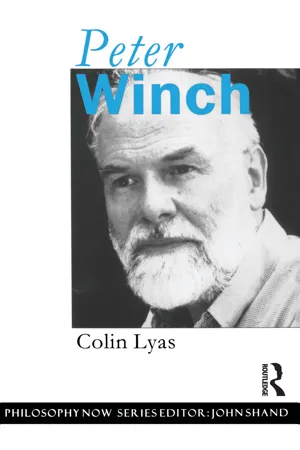
Peter Winch
About this book
This is the first introduction to the ideas of the British philosopher, Peter Winch (1926-97). Although author of the hugely influential "The Idea of a Social Science" (1958) much of Winch's other work has been neglected as philosophical fashions have changed. Recently, however, philosophers are again seeing the importance of Winch's ideas and their relevance to current philosophical concerns. In charting the development of Winch's ideas, Lyas engages with many of the major preoccupations of philosophy of the past forty years. The range of Winch's ideas becomes apparent and his importance clearly underlined. Lyas offers more than an assessment of the work of one man: it introduces in a sympathetic and judicious way a powerful representative of an important and demanding conception of philosophy.
Information
Chapter 1
"Such understanding as I have": The influence of Wittgenstein
Anything I have had to say . .. is grounded in such understanding as I have of Wittgenstein’s philosophy. . .. My attitude to Wittgenstein’s work has always been one of gratitude for the help it has given me in seeing what are the important questions and what kind of questions they are.
(Winch 1987: p. 1)
Influences
No active philosophers come innocent to their enquiries. Even a philosopher as apocalyptic in rejecting the past as Nietzsche aspired to be, comes to that task equipped with a knowledge of the problems that have constituted the subject matter of philosophical enquiries, of the methods by which these problems have been approached and of the kinds of solutions that have been proposed for them. The beginning of wisdom in understanding this or that contemporary philosopher is, therefore, the discovery of the relation of that philosopher to the history, both recent and more distant, of the subject.
With Peter Winch the question of influence is easy to determine. Wittgenstein was the philosopher to whom Winch gave his categorical allegiance, to the extent of believing anything he had to say to be “grounded in an understanding” of that philosopher.
Some of Winch’s writings sought to give exegeses of various aspects of the work of Wittgenstein and to correct what he thought to be mistaken accounts of that work. Others, which constitute Winch’s own distinctive contribution to philosophy, sought to apply what he learned from Wittgenstein to questions not always explicitly or fully dealt with in Wittgenstein’s work; questions, for example, about ethics, the nature of social science and religion.
To say that Winch endorsed and sought to apply the philosophy of Wittgenstein, however, simply defers illumination until one is told to what beliefs Winch was committed by that endorsement.
Winch was, to begin with, committed to a view of philosophy, a view that can best be understood by first seeing how philosophy became a challenged subject, and, then, by contrasting the view of philosophy that Winch derived from Wittgenstein with a popular alternative.
Philosophy challenged
We are now used to the notion of a subject for study; a notion invoked when, on meeting a fellow student, the polite equivalent of the dog-sniffing ritual is the question “What’s your subject?”, where the reply “Physics” is greeted with respect, “Psychoanalysis” with alarm and “Philosophy” with the fixed smile of baffled incomprehension.
A distinct subject, it is thought, must have some distinct subject matter to study and some distinct way of going about it. Philosophy becomes challenged when we ask “What is its distinct subject matter?” For puzzlement about philosophy is almost certainly due to the fact that people do not know what philosophers study. They think that there must be some distinctive objects in the world that are studied by philosophy as atoms are studied by physics and feet by chiropody.
The trouble is that all the high quality goods seem already to have been appropriated by other flourishing enterprises. Physics has sub-atomic particles; chemistry, molecular structures; biology, the fauna and flora; astronomy, the stars; religion, the gods; psychology, our minds; mathematics, the numbers; linguistics, the languages; criticism, the objects of art; and history, the past. What is left over, such things as, say, the divination of lottery numbers and the distillation of sunbeams from cucumbers, seem not to offer philosophy ready or attractive substitutes.
The underlabouring philosophers
Faced with this challenge there emerged, with Locke as a notable early proponent, the notion of the philosopher as an “under-labourer”. Winch quotes the following vivid expression of this view, where for Boyle and Sydenham, Newton and Huygenius we may substitute Hawkins, Einstein, Dorothy Hodgkin and Marie Curie. Locke wrote that:
The commonwealth of learning is not at this time without its masterbuilders, whose mighty designs, in advancing the sciences, will leave lasting monuments to the admiration of posterity: but everyone must not hope to be a Boyle or a Sydenham; and in an age which produces such masters as the great Huygenius and the incomparable Mr Newton . .. it is ambition enough to be employed as an underlabourer in clearing the ground a little, and removing some of the rubbish that lies in the way of knowledge.
(quoted in Winch 1958: pp. 3–4)
Suppose, using the underlabourer account of philosophy, we find a term used unclearly in one of the special disciplines, the term “cause”, say, in psychology, and that problems arise in that discipline from that unclarity. The philosopher will analyse this term, clarify its meaning and then psychology can get on with its job of giving us understanding of its special area of the universe. Philosophy is not, according to this view, in competition with, say, the natural sciences. It is, rather, parasitic on the special disciplines. In performing its cleaning up role, it will be tolerated by the special disciplines of the intellectual community, much as other sharks tolerate the parasitic fish that clean the debris from their teeth.
But now suppose someone wonders about the very existence of things. Suppose, that is, people ask, as Berkeley did, not whether particular things, dolphins, say, exist but whether things as such really exist, independently of any perception of them. These are metaphysical and epistemological questions. They are metaphysical because we are asking not whether this or that particular thing exists, but what it is for something of whatever sort really to exist. They are epistemological because we are now concerned not to acquire knowledge but to comprehend under what conditions, if any, knowledge is possible at all.
Simply to raise these questions is already to damage the underlabourer view. For, according to that view, philosophy has problems only because, for example, psychology or literary criticism have problems. But the metaphysical and epistemological questions I have instanced are not questions we have only because we have the special disciplines. When Hamlet asked whether he had seen a ghost, he might have been asking a straightforward question about whether there was present an object answering a certain description. But he could, equally, have been puzzled as to the criteria for ghostly reality. He did not have to wait for the development of science to ask that question. These epistemological and metaphysical questions are not questions about existents, which might well be answerable by empirical observation, but are questions about what it is to exist and what it is to know that something exists.
Philosophy and reality
We can see the ultimate shortcomings of the underlabourer view by more closely considering questions about real existence. Suppose I ask “Are there really people who believe that Tiger Woods will achieve what Jack Nicklaus has achieved?” You can answer that question simply by producing some people who testify to that conviction. But suppose I ask “Are there really human beings?” There are circumstances in which this question might well be answered in the same sort of way as the previous one, for example, during a discussion between aliens in the kind of intergalactic trucker stop portrayed in Star Wars. But if I ask the question here and now, it is unlikely that my question will be answered to my satisfaction by your producing the population of Paris, Texas. For my questions will be “Are these really people?”, and “How do I know that there are minds behind those movements?” And this shows my puzzlement not to be about the existence of a certain kind of fauna on this planet, but, rather, as Winch puts it at the beginning of his The idea of a social science, about the concept of reality; about what it is for something to be real.
The claim for science
Suppose the answer were given that for something to be real is for it to be available to the kinds of empirical observational methods used in the natural sciences and in everyday life. What exists is what, in some sense, observably exists. Here Winch takes a fundamental step, deriving from a reading of Wittgenstein, from which the remainder of his own philosophy unfolds.
To begin with, suppose we have the assertion that what really exists is decided by reference to what is available to the observational methods of the natural sciences. We then need to distinguish two questions. First we might ask whether that assertion gives a correct account of what it is for something to have the kind of reality in which natural science is interested. Is science only interested in the observable? Even if that were so, there is the further question of whether that assertion gives a correct account of what it is for something to be real in any sense whatsoever. Even if we know what it is for something to be “observably”, “empirically” (“scientifically”) real, we may still ask whether that is the only way something can be real. Here Winch simply points out that we need an argument for the assertion that science provides the only viable notion of reality. That assertion is about science, and whether or not it is true is not for science to decide. So, Winch asserts, “it is evident that the expression . .. ‘independent reality’ . .. cannot . .. be explained by reference to the scientific universe of discourse”, as this would “beg the question” whether science does provide the only measure of reality (Winch 1972: p. 13). Hence, the assertion that whether or not something is real is decided by whether or not it is available to the empirically observational methods of science, is not itself an observationally based scientific assertion. Rather it is a statement about the meaning of the term “real”.
I do not think that Wittgenstein or Winch would have been in the least inclined to deny that the reality of the rabbits at the bottom of my garden is a matter to be determined in some way observationally. What they resisted was the inclination to make the observational methods thought characteristic of the natural sciences the only yardstick by which to determine whether something is or is not real. Certainly, it is not the method by which one determines whether there really is a prime number between 9987 and 15667.
When one does make these scientific methods the yardstick by which to test claims about reality, then, of course, religion, aesthetics and ethics are in trouble. What observations underpin claims about the reality of an eternal creator who transcends the observational world? What empirical means are used to detect the value of a picture or the wrongness of murder? And in the absence of this observational evidence, then, were science to give us our only understanding of what is for something to be real and our only access to that reality, it would follow that values and religious entities do not really exist. That follows, however, only if one has established that empirical verifiability is the only criterion for reality, and one doesn’t automatically establish that by establishing that empirical verifiability is the criterion of scientific reality.
Winch doubts that our notion of reality is to be confined to what science admits as existent. He writes:
science is wrapped up in its own way of making things intelligible to the exclusion of all others. . .. This non-philosophical unselfconsciousness is for the most part right and proper in the investigation of nature . .. but it is disastrous in the investigation of a human society, whose very nature is to consist in different and competing ways of life, each offering a different account of the intelligibility of things.
(Winch 1958: p. 103)
And he writes that “science is one . .. mode . .. [of social life] . . . and religion is another; and each has criteria of intelligibility peculiar to itself” (1958: p. 100).
It does not follow from this that Winch is, as some who cannot have read him carefully supposed, anti-science. “Philosophy has no business to be anti-scientific: if it tries to, it will succeed only in making itself look ridiculous” (Winch 1958: p. 2). One must not confuse queries about the pretensions of science to be the only way to knowledge, with queries about whether science offers any way to knowledge.
The empirical and the conceptual
So far, then, we have the claim that, although whether there really are still Tasmanian tigers may be a scientific question, what is meant by attributing reality to something is a philosophical question. Further if a scientist were to say that what is real is a matter of what can be determined by the methods, whatever they are, of the empirical sciences, this is not a statement from within science but a statement about science, and, so, is an assertion the truth of which science itself cannot decide. We have also seen that Winch is inclined to query the truth of that assertion. That, however, leaves a number of things unclear, including the question “What kind of statements are philosophical statements about the meaning of terms like ‘real’?” and the question “How is the truth of such statements to be determined?”
The empirical study of language?
Let us begin by noting that claims about what is meant by the term “real” are claims about what we in fact mean by a word. Some then claim that as the term “real” is in fact used, to say that something is real is simply to say that its existence is determinable by the observational methods of the natural sciences. Winch, let us suppose, denies that. How is that dispute to be resolved?
It has been claimed that assertions about how we use words are themselves ordinary empirical claims, to be tested by the methods of the empirical science of linguistics. That yields this striking conclusion: philosophy, which undertakes to tell us the meaning of terms like “real”, is itself an empirical science (and one due to be superseded by the empirical science of linguistics). It is this claim, which strikes at the roots of Winch’s position, and a certain conception of philosophy embodied in it, that I now wish to examine. Winch was, I think, clear...
Table of contents
- Cover Page
- Half Title page
- Title Page
- Copyright Page
- Table of Contents
- Preface
- Introduction Peter Winch, a glimpse of a life
- 1 "Such understanding as I have": The influence of Wittgenstein
- 2 "I was investigating the notion of the social": The idea of a social science
- 3 "Seriously to study another way of life": Understanding another society
- 4 "Good examples are indispensable": The ethical life
- 5 "The concept of God is used": The religious forms of life
- 6 "The interval of hesitation": Peter Winch's Simone Weil
- 7 "Someone willing to die for truth": Peter Winch's legacy
- Envoi
- References
- Index
Trusted by 375,005 students
Access to over 1.5 million titles for a fair monthly price.
Study more efficiently using our study tools.
Frequently asked questions
Yes, you can cancel anytime from the Subscription tab in your account settings on the Perlego website. Your subscription will stay active until the end of your current billing period. Learn how to cancel your subscription
No, books cannot be downloaded as external files, such as PDFs, for use outside of Perlego. However, you can download books within the Perlego app for offline reading on mobile or tablet. Learn how to download books offline
Perlego offers two plans: Essential and Complete
- Essential is ideal for learners and professionals who enjoy exploring a wide range of subjects. Access the Essential Library with 800,000+ trusted titles and best-sellers across business, personal growth, and the humanities. Includes unlimited reading time and Standard Read Aloud voice.
- Complete: Perfect for advanced learners and researchers needing full, unrestricted access. Unlock 1.5M+ books across hundreds of subjects, including academic and specialized titles. The Complete Plan also includes advanced features like Premium Read Aloud and Research Assistant.
We are an online textbook subscription service, where you can get access to an entire online library for less than the price of a single book per month. With over 1.5 million books across 990+ topics, we’ve got you covered! Learn about our mission
Look out for the read-aloud symbol on your next book to see if you can listen to it. The read-aloud tool reads text aloud for you, highlighting the text as it is being read. You can pause it, speed it up and slow it down. Learn more about Read Aloud
Yes! You can use the Perlego app on both iOS and Android devices to read anytime, anywhere — even offline. Perfect for commutes or when you’re on the go.
Please note we cannot support devices running on iOS 13 and Android 7 or earlier. Learn more about using the app
Please note we cannot support devices running on iOS 13 and Android 7 or earlier. Learn more about using the app
Yes, you can access Peter Winch by Colin Lyas in PDF and/or ePUB format, as well as other popular books in Philosophy & Philosopher Biographies. We have over 1.5 million books available in our catalogue for you to explore.