"This isn't learning: this is fun!" - dyslexic pupil
"Fantastic ideas that engage learners in their learning: thank you!" - Teaching Assistant
"I like finding tactics which help me win!" dyslexic pupil
"My son is now asking to play spelling games!" - parent
"I like playing homework games with my dad." - dyslexic pupil
"Its easy to adapt a game to suit different topics." Teacher
"Things aren't so difficult now I know how to make hard things fun." dyslexic pupil
Dragonfly Games is designed for use with small groups of dyslexic pupils. These practical and varied resources can be used inside and outside of the classroom to encourage over-learning and revision of curriculum topics. Stimulating and fun to do, the games help pupils:
Overcome specific barriers to learning through the use of experience, over-learning and discovery
Master skills beyond those of literacy and numeracy development, including thinking skills, tactical strategies, sequential application and gamesmanship.
Devise their own games, developing their ability to use varied methods of application, useful for overcoming learning weaknesses within their own specific profile. .
Fully updated in its second edition, this book builds on the success of the author's Dragonfly Worksheets, as featured in her previous book Supporting Dyslexia Pupils Across the Curriculum and can be used independently or in conjunction this resource. Dragonfly Games further extends the practitioner's portfolio of materials designed to successfully and effectively support the dyslexic learner.
Also available from this author
Supporting Dyslexic Pupils Across the Curriculum, 2nd edition, 978-1-138-77462-9
Spelling Rules, Riddles and Remedies 978-0-415-71000-8
Frequently asked questions
Yes, you can cancel anytime from the Subscription tab in your account settings on the Perlego website. Your subscription will stay active until the end of your current billing period. Learn how to cancel your subscription.
No, books cannot be downloaded as external files, such as PDFs, for use outside of Perlego. However, you can download books within the Perlego app for offline reading on mobile or tablet. Learn more here.
Perlego offers two plans: Essential and Complete
Essential is ideal for learners and professionals who enjoy exploring a wide range of subjects. Access the Essential Library with 800,000+ trusted titles and best-sellers across business, personal growth, and the humanities. Includes unlimited reading time and Standard Read Aloud voice.
Complete: Perfect for advanced learners and researchers needing full, unrestricted access. Unlock 1.4M+ books across hundreds of subjects, including academic and specialized titles. The Complete Plan also includes advanced features like Premium Read Aloud and Research Assistant.
Both plans are available with monthly, semester, or annual billing cycles.
We are an online textbook subscription service, where you can get access to an entire online library for less than the price of a single book per month. With over 1 million books across 1000+ topics, we’ve got you covered! Learn more here.
Look out for the read-aloud symbol on your next book to see if you can listen to it. The read-aloud tool reads text aloud for you, highlighting the text as it is being read. You can pause it, speed it up and slow it down. Learn more here.
Yes! You can use the Perlego app on both iOS or Android devices to read anytime, anywhere — even offline. Perfect for commutes or when you’re on the go. Please note we cannot support devices running on iOS 13 and Android 7 or earlier. Learn more about using the app.
Yes, you can access Extending Support for Key Stage 2 and 3 Dyslexic Pupils, their Teachers and Support Staff by Sally Raymond in PDF and/or ePUB format, as well as other popular books in Didattica & Didattica generale. We have over one million books available in our catalogue for you to explore.
There are some individuals who find cryptic crossword clues impossible to comprehend. However, it is worth investigating your pupils’ interest in this game, as I have found that some are absolutely fascinated by the twiddles and riddles that can be created with the English language. This nature of focus also registers spellings in a way that develops memory prompts and long-term memory recall.
Lateral thinking skills are also utilised. As many dyslexics possess good lateral thinking skills, they enjoy this element of play, which allows them the opportunity to develop (and excel) in this type of approach when solving other problems.
There are (variable) conventions of language used in cryptic clues (e.g. I have used capital letters to denote anagrams); this language provides another example of how a communication style can convey meaning.
Preparation
Copy clues for each player. Provide players with an empty crossword grid. Ensure dictionaries, pens and paper are to hand. In some cases, discuss clues together, or provide answers and let players match them to clues.
New crosswords can be created by teachers or pupils, and others found in puzzle books. These can be displayed by hand or through IT.
Introduce the use of anagram-solving books, along with a thesaurus. ‘Quick’ crosswords and general knowledge ones also help to develop literacy skills.
Incorporate key terminology from the pupils’ curriculum, and play about with clues that share a theme (e.g. birds or parts of the body).
Game C Cryptic Clues
How to play
Working individually, as pairs, or in groups, players attempt to complete the crossword before their opponent(s). Support the players as necessary.
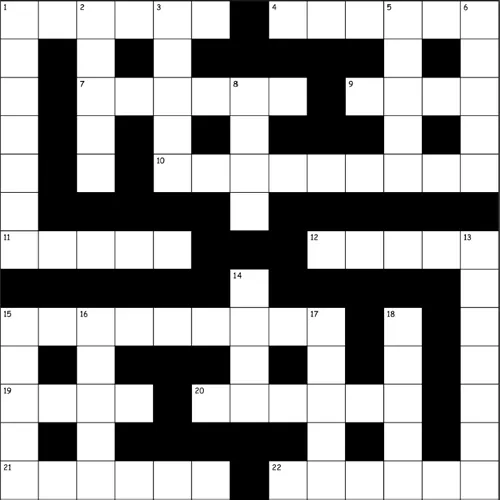
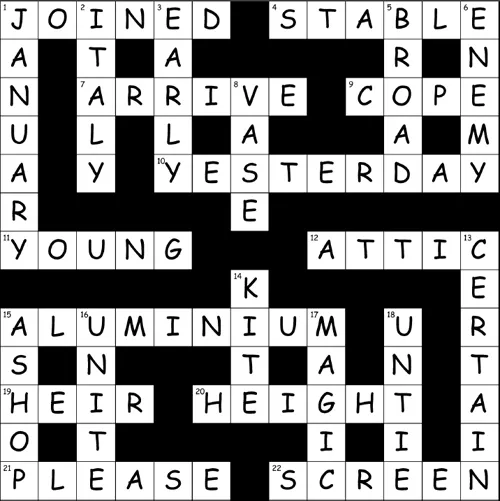
Conventions of play are illustrated in the crossword overleaf. These include:
When last bit of slab is added to road it becomes very wide. (5)
The word(s) underlined indicate a synonym. The solution (broad) is created by the last letter of ‘slab’ being added to ‘road’.
Car in south east will frighten me. (5)
South east = se. The solution (scare) is created by the letters ‘se’ going around the word ‘car’.
Shake A TONIC to create some movement. (6)
Capitalisation indicates an anagram. The solution (action) is created by rearranging the letters of ‘a tonic’.
Jan, you and headless Mary join together for a month. (7)
Letters can be denoted by words, you = u; bee = b; etc. The solution (January) is created by adding Jan + u + ary.
Henry arrives before 8. He is 1.5 metres tall. (6)
Use words that are often misspelled. The solution (height) is created by putting ‘h’ before ‘eight’.
Game C Cryptic Clues
Letters that are un...
Table of contents
Cover
Half Title
Title Page
Copyright Page
Table of Contents
Introduction
Meeting the needs of dyslexic pupils
Support throughout the curriculum
Processing weaknesses found within the dyslexic profile