![]()
Part I
THE FIELD OF ORGANIZATION DEVELOPMENT
1
AN INTRODUCTION TO ORGANIZATION DEVELOPMENT
• Chapter Overview
• What is OD?
• OD and Change Management
• Why OD?
• A Short History of OD
• “Classical OD” and “New OD”
• The Values of OD
• The Professional Practice of OD
• The Organization of This Book
• Chapter Summary
• Key Words and Concepts
• Learning Activities
• Case Study: Do Bookstores Have a Future?
Chapter Overview
Chapter 1 includes a definition and brief history of organization development (OD). The chapter also focuses on the values held by OD practitioners and the kinds of work that OD consultants perform.
Along with his 2,000-year-old observation that nothing endures but change, Heraclitus also wrote that “Everything flows, nothing stands still.” Heraclitus’ words seem especially applicable to life in the 21st century, with most people feeling as if change keeps coming faster and faster. Although there were no large organizations or companies in Ancient Greece comparable with Apple, Walmart, or the World Bank, Heraclitus’ idea that nothing stands still is certainly relevant to modern organizations. In both personal and organizational life, change comes faster and its impact seems more dramatic.
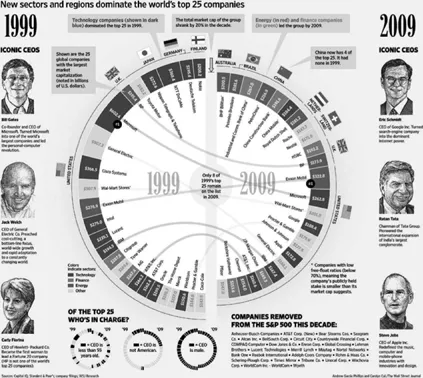
Figure 1.1 Changes in the World’s Largest Companies 1999–2009
Source: Phillips and Cui, 2010
At the end of the Great Recession of 2007–2009, for example, the Wall Street Journal published a chart (Figure 1.1) showing changes in the world’s top 25 companies from ten years earlier. Whereas 19 of the top 25 companies (76%) in 1999 were based in the U.S., ten years later that number had dropped to nine (36%). In 1999, the top 25 companies were based in just four Western countries—the U.S., U.K., Germany, and Finland—and Japan. Ten years later, the top companies included the U.S., U.K., Switzerland, Netherlands, France, China, South Korea, and Japan. Of the top 25 in 1999, 17—including Microsoft, IBM, Intel, Merck, and Coca-Cola—had dropped off the list.
Five years later, that list had changed even more. The U.S. had 11 of the top companies, but five companies, including the three largest in the world, were based in China. Six of the companies were from Europe, with one each coming from Japan, Russia, and South Korea (Chen, 2014).
But one area where the top companies had not changed was leadership. In 1999, at the end of the Great Recession in 2009, and five years later, no woman headed one of the world’s largest companies.
But globalization and corporate growth or decline are hardly the only factors that bring change to organizations. The near collapse of the American financial system during the Great Recession of 2007–2009—followed by corresponding recessions in other parts of the world—created a crisis in the banking, investment, automotive, and real estate industries. The British Petroleum oil disaster in the Gulf of Mexico in 2010 created new challenges for both the energy and tourist industries, and the Japanese tsunami of 2011 so damaged that country’s nuclear reactors that countries throughout the world began to reconsider the advisability of building nuclear power plants. In the U.S., the government promised to continue its support for a slow and cautious approach to nuclear power, but, in Germany, the government announced it would end its reliance on nuclear power by 2022.
Today, some products, such as newspapers, video cameras, and compact discs seem bound for the dust heap of history, whereas the future seems bright for products and services such as computer watches, self-driving cars, and cell phones with ever-expanding features. In most workplaces, interoffice memos have given way to e-mails, instant messages, texting, and social media. Today, managers must learn to adapt their style of leading away from the preferences of Baby Boomers to the preferences of Generations X and Y. The change in generational values—which has affected many different aspects of the workplace—profoundly impacts the way organizations operate and will continue to do so for the foreseeable future. Table 1.1 summarizes some of the differences among these groups of workers.
So even though Heraclitus lived 2,000 years before the rise of the modern organization, his observations about the inevitability of change seem completely relevant for the 21st century. But, as prescient as Heraclitus’ views on change seem to be, the idea that change could be managed—at least in organizations—is less than 100 years old. The theory and practice of bringing planned change to organizations is known as organization development or OD.
What is OD?
One of the most important characteristics of change is its unpredictability. It’s unlikely that the leaders of Tokyo Electric Power or Sweden’s Vattenfall AB could have foreseen how a tsunami would change attitudes toward nuclear power or, in the U.S., how the entry of young people into the workplace would require managers to change the ways they supervise their employees.
When change occurs, some organizations adapt more effectively than others. The field of OD is based in the beliefs that, first, change is inevitable and, second, having a plan for managing change helps organizations become more competitive and effective. OD practitioners use a set of theoretical assumptions and practical tools to help organizations address challenges or prepare for the future.
Table 1.1 Generation X, Millennials, and Baby Boomers | Birth Year | Nicknames | Description | Age in 2016 |
| 1925–45 | Silent Generation or Traditionalists | Prefer face-to-face meetings or phone calls See themselves as defined by their work ethic Express a desire to give back to their community Respect for corporate hierarchy. | 71–91 |
| 1946–61 | Baby Boomers | Resist retirement Prefer face-to-face meetings or phone calls Don’t see the importance of social media See themselves as defined by their work ethic Express a desire to give back to their community Respect for corporate hierarchy Identity tied to career. | 55–70 |
| 1962–81 | Generation X | Concerned Baby Boomers will never retire from senior positions Prefer e-mail over face-to-face meetings or phone calls Often need training in delegating and giving feedback See themselves as defined by their work ethic Tendency toward cynicism about work Aloof management style Self-reliant Respect for corporate hierarchy. | 35–54 |
| 1982–2000 | Millennials or Generation Y | Believe work hours should be flexible Highly skilled with technology Unconcerned about privacy and hierarchy Quicker to respond to texts than e-mails Want to interact with management at least once a day Look to their parents for advice See themselves as defined by their technology skills High level of confidence about their abilities Express a desire to give back to their community Optimistic. Low respect for corporate hierarchy Value knowledge over seniority. | 16–34 |
| 2001– | Generation Z or Digital Natives | Not yet known. | <16 |
Source: Adapted from Fox, 2010
In the language of OD, interventions are the techniques that OD practitioners use to bring about change. Interventions can be directed at individual workers, work groups, teams, departments, or the organization as a whole (Burke, 2008). Typical interventions might include the following:
| Level | Intervention |
| Individual | A talented worker is promoted to manager, but lacks the interpersonal skills to succeed in his new position. The company contracts with an OD practitioner to help develop the worker’s communication skills. |
| Work groups | Increased diversity in a work group has created ... |