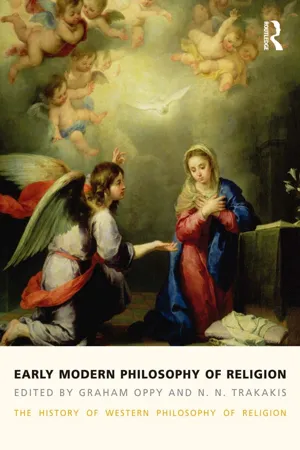
eBook - ePub
Early Modern Philosophy of Religion
The History of Western Philosophy of Religion, volume 3
- 368 pages
- English
- ePUB (mobile friendly)
- Available on iOS & Android
eBook - ePub
Early Modern Philosophy of Religion
The History of Western Philosophy of Religion, volume 3
About this book
The early modern period in philosophy - encompassing the 16th to the 18th centuries - reflects a time of social and intellectual turmoil. The Protestant Reformation, the Catholic Counter-Reformation, and the birth of the Enlightenment all contributed to the re-evaluation of reason and faith. The revolution in science and in natural philosophy swept away two millennia of Aristotelian certainty in a human-centred universe. Covering some of the most important figures in the history of Western thought - notably Descartes, Locke, Hume and Kant - "Early Modern Philosophy of Religion" charts the philosophical understanding of religion at a time of intellectual and spiritual revolution. "Early Modern Philosophy of Religion" will be of interest to historians and philosophers of religion, while also serving as an indispensable reference for teachers, students and others who would like to learn more about this formative period in the history of ideas.
Information
1
EARLY MODERN PHILOSOPHY OF RELIGION: AN INTRODUCTION
Peter Anstey
The early modern period is one of the richest, perhaps the richest, period in the history of relations between philosophy and religion. The chapters in this volume bear this out again and again, dealing as they do with some of the foremost thinkers of modern times, such as René Descartes, John Locke, David Hume and Immanuel Kant. Each of the following chapters is organized around the contributions of one of these philosophers or a group of philosophers, some of whom lived centuries apart, so it is important at the outset to get a bird’s-eye view of the broad contours of the relations between philosophy and religion in the early modern period. This introduction aims to provide just such an overview by taking a thematic approach to the subject.
It goes without saying that Christianity was the dominant religion within Europe throughout the early modern period and almost all of the philosophers and religious thinkers who appear in these pages developed their views in relation to the Christian religion. Even those, such as Baruch Spinoza, who were not nurtured within a Christian community, found that Christian theology and Christian ecclesiastical structures were a dominant force in the polemical context in which they worked. To claim that Christianity was the dominant religion of the period is not, however, to claim that it faced no rivals or internal divisions. In fact, the internal ructions of the period were some of the most intense that the religion has ever faced. From 1517, when Martin Luther posted his ninety-five theses on the church door in Wittenberg and set off the Protestant Reformation, through the Counter Reformation and the Thirty Years War ending with the Peace of Westphalia in 1648, to the revocation of the Edict of Nantes in 1685, Christianity underwent massive changes and challenges. It is hardly surprising, therefore, that this coincided with such a fertile period of philosophical engagement with religion. However, interesting as these issues are, the socio-religio-political background to developments in philosophy and religion are not explored in any depth in this volume. Rather the approach is what historiographers call an ‘internalist’ one, focusing on the actual ideas and arguments of the leading philosophers and theologians of the period. There are, however, a number of historiographical issues that are worth highlighting before we commence our general survey.
HISTORIOGRAPHY
Any attempt to understand early modern thought must first come to terms with the question of periodization: when was the early modern period and why is it distinctive? Normally the term ‘early modern’ refers to the period spanning from the late sixteenth century to the early eighteenth century. In this volume, however, the term is used a little more broadly to encompass thinkers from the Protestant Reformation in the early sixteenth century through to the late eighteenth century. Thus, the centuries covered in this volume encompass other periods that historians have found to be distinctive, namely the Reformation, the late Renaissance, the Scientific Revolution and the Enlightenment. Although this may seem overam-bitious, it will become clear that there is a genuine continuity of thematic content in the issues that were discussed throughout these three centuries. Of course, all of these terms, ‘early modern’, ‘Reformation’, ‘Scientific Revolution’ and so on, are to a large extent the creations of historians rather than terms used by those living in the respective eras, and at times one needs to be careful not to let these historio-graphical categories obscure or unduly influence one’s interpretation of the writings and events of these periods. But as long as we remain self-conscious of our categories, they can be of great use.
The same can be said of the sorts of disciplinary categories and boundaries that we use in philosophy and theology today and which we tend to read back into early modern thought. We speak, say, of Berkeley’s epistemology or Leibniz’s metaphysics meaning Berkeley’s theory of knowledge and Leibniz’s account of what there is, respectively. However, the branch of philosophy called ‘epistemology’ is a relatively new discipline, even if many of the questions it seeks to answer can be traced back to the Presocratics. Likewise, the term ‘metaphysics’ had quite a different semantic range in the early modern period than what it has today. When Jean Le Rond d’Alembert (1717–83) says in the Preliminary Discourse to Denis Diderot’s Encyclopédie that Locke “created metaphysics, almost as Newton had created physics” (d’Alembert 1995: 83) a student of contemporary philosophy might find this puzzling; after all, Locke is normally thought to have made a major contribution to epistemology and only secondarily to metaphysics. However, d’Alembert is referring to the study of the understanding or pneumatology, something to which Locke did make a major contribution.
Likewise, we tend to speak of science when the early moderns referred instead to natural philosophy, and we speak of scientists where the latter would refer to natural philosophers. For most of the early modern period, theology was still the queen of the sciences where ‘science’ is derived from the Latin scientia, a term with quite a different semantic range to our modern term ‘science’. Moreover, it has even been argued that the concept of religion is itself a product of the early modern period (Harrison 1990). All of this needs to be borne in mind as we approach the subject of the relations between philosophy and religion in the early modern period.
THEISTIC PROOFS
Undoubtedly the most famous and challenging development in the relations between philosophy and religion in the early modern period was the development of a series of rational arguments for the existence of God, often called ‘theistic proofs’. There is a sense in which the theistic proofs are foundational to any philosophical theology. While all of these arguments predate the sixteenth century and while they were subject to important innovations and developments in the hands of Anselm and Aquinas, the high-water mark of the articulation and polemical deployment of this cluster of arguments occurred in the seventeenth and eighteenth centuries.
Luther and Calvin held a rather low view of rational theology in general, preferring to appeal to what they regarded as the revealed word of God rather than vain human ratiocinations (Calvin, Institutes, I. ii–v). However, theistic proofs were debated among scholastic theologians throughout the sixteenth and early seventeenth centuries and provide an important backdrop for the discussions of the leading seventeenth-century philosophers who made the arguments famous. In a rough and ready sense there is a discernible progression in the development of the theistic proofs from the ontological arguments, as spelt out by Descartes and Gottfried Wilhelm Leibniz, through to the cosmological arguments enunciated by the English natural philosopher Robert Boyle (1627–91), Samuel Clarke (1675–1729) and Leibniz, to the teleological argument championed by William Paley (1743–1805). This is not to say that these were the only theistic proofs discussed in the period, but these were the dominant and philosophically most interesting attempts to establish the existence of God by the use of reason.
It should also be stressed that by the end of the early modern period the value of the whole project of rational theology had become highly contentious. This was in part a result of the fact that the theistic proofs had ceased to be evaluated within the framework of Christianity itself, but were rather studied, at least up to the time of Hume’s essay on “The Natural History of Religion” (1757), as a constituent of natural religion. Yet this is not to say that there were not strident promoters of the proofs within Christian ranks: Paley, for one, continued an apologetical tradition inaugurated by Boyle in the English-speaking world. And yet on the Continent Kant’s attack on the theistic proofs in his Critique of Pure Reason (1781/87) marked a watershed in the debate and a natural terminus for early modern rational theology.
Once the existence of God has been argued for on rational grounds, it is then incumbent on the theist (or polytheist) to establish the manner in which God interacts (or the gods interact) with the material world. This brings us to another central concern of philosophy and religion in the early modern period: the relation between God and nature.
GOD AND NATURE
The question of God’s relation to nature was far more widely discussed than the theistic proofs. This is in part because the issue impinged very closely on the new natural philosophy that emerged in the period. The predominance of the mechanical philosophy in the mid-to late seventeenth century set the problem of how God interacts with nature in sharp relief. The new conception of laws of nature, the widely held view that matter is completely inert and explanations of change in terms of the contact criterion – one body colliding with another – forced philosophers to articulate just what role God had in everyday events. Did causal interactions occur independently of God or was God involved in some or all physical causes? The problem was particularly acute in Cartesianism because Descartes’ philosophy could be interpreted as not requiring divine intervention in material causal interactions, or as a form of occasionalism, that is, as requiring God’s constant causal intervention. Moreover, the problem only intensified when it came to accounting for the interaction of immaterial entities and bodies and the nature of miracles.
Some philosophers, notably the Cambridge Platonists, augmented the doctrine of inert matter with an all-pervading World Soul that gave a basic form of perceptivity to matter and accounted for its law-like behaviour. Easily the most radical solution to the problem of God and nature, however, was that of Spinoza, who denied that God is a transcendent being and asserted instead that God is identical with nature herself. By collapsing the God and nature dichotomy, Spinoza presented a new set of problems in philosophical theology, but while he had his admirers, it is true to say that few took up his denial of God’s transcendence. Thomas Hobbes, on the other hand, denied that there are any immaterial substances and claimed that everything can be explained using the principles of matter and motion. Not surprisingly, Spinoza and Hobbes were quickly marked out by their contemporaries as proffering philosophies that tended to atheism, and to be dubbed a Spinozist, as Lessing was more than a hundred years after Spinoza’s death, was tantamount to being called an atheist.
Among the Cartesians, however, the favoured response was some form of occasionalism. Nicolas Malebranche (1638–1715) held undoubtedly the most radical form of this doctrine, claiming that God is the sole causal agent in the physical universe. Others, such as Antoine Arnauld (1612–94) and Boyle adopted a via media between the deistic (in the popular sense of the word) view that God is disengaged from his creation and occasionalism. It was a form of nomic occasionalism whereby matter has some limited causal powers, but God is required to guarantee that it obeys the laws of motion.
In the eighteenth century occasionalism was defended by Jonathan Edwards, but on the whole the doctrine remained a minority position. The opponents of occasionalism, on the other hand, denied that matter was causally impotent and asserted that the nature of matter and the laws of motion are sufficient for the emergence of the current fabric of the world and its continued existence. If they were right, what grounds are there for supposing that God communicates with human beings? Does humankind even need a revealed religion? And is there a form of knowledge that can be acquired only through special revelation? This brings us to another contested field within early modern philosophy: the nature and scope of knowledge and the relation between faith and reason.
KNOWLEDGE, FAITH AND REASON
In the early modern period the scope and limits of human reason were subjected to careful and sustained analysis by philosophers. Of particular importance in their reflections was the relation between religious faith and human reason. In fact, the debate over the powers of human reason and its relation to faith was conceptually prior to the enterprise of establishing arguments for the existence of God. Thus, natural theology was pursued as a consequence of an acceptance that human reason could make a contribution to reasons for believing in religious doctrines.
A cluster of doctrines fed into these discussions, some theological and others derived from Hellenistic philosophy. In particular, the doctrine of epistemic impairment or fallen knowledge and the clever use of argument forms derived from Pyrrhonian scepticism put important constraints on the development of many accounts of the power and scope of human reason. As for the former, the central idea is that at the Fall humankind was corrupted both morally and epis-temically. In its most common form, the doctrine of epistemic impairment maintained that human beings had lost knowledge, particularly knowledge of the essences of natural objects. In its more radical form, the doctrine also claimed that the reasoning powers of human beings were irrevocably corrupted. This corruption was thought by some to be manifested in the ascendency of the passions over reason. Compounding the problem for the status of human reason was the deployment of sceptical arguments concerning the fallibility of the senses in the writings of Michel de Montaigne and others.
Philosophers from the period can be roughly grouped along a continuum of views ranging from belief in a highly depraved and negative view of human reason to a more moderate and optimistic account of the effects of the Fall. For those philosophers with a low view of the post-lapsarian condition of human reason, a form of what has come to be called fideism was the inevitable consequence of the Fall. That is, some philosophers, such as Blaise Pascal, and possibly Montaigne, argued that it is futile, or even impossible, to come to believe in the truth of the Christian religion on the basis of human reason. So, while Pascal’s Wager was an attempt to give probabilistic reasons for the rationality of belief in God, it should be stressed that the wager does not concern probabilistic reasons for the truth of that belief (Pascal 1931: §233). By contrast, Descartes, in spite of his deployment of sceptical techniques of argumentation in the first two Meditations (Descartes 1984: 12–23), tended to downplay the doctrine of epistemic impairment and sought to complement the coherence and evidential basis of the Christian religion with natural theology. Others, such as Francis Bacon, believed that a new approach to natural philosophy would offer an opportunity to overcome the epistemological consequences of the Fall by opening up the ‘book of nature’ by using the correct method and by the use of newly invented instruments such as the microscope (Bacon 2004: 2–5; Hooke 1665: preface). In England this promotion of the complementarity of natural philosophy and religion led to the emergence of the vocation of the Christian virtuoso, epitomized by Boyle, who instituted in his will an annual series of Boyle Lectures for the defence of the Christian faith, which provided a major impetus to the development of natural theology in eighteenth-century Britain. Boyle promoted what he and others called ‘physico-theology’ in which natural philosophy served to augment the truths revealed in Scripture (Harrison 2005).
Philosophical reflection on the role of witnesses and testimony in the new experimental natural philosophy of the mid-seventeenth century naturally extended to a reflection on the role of testimony in establishing Christian belief, particularly belief in the miracles of the New Testament. Discussions on the nature and credibility of miracles spanned the period from Pietro Pomponazzi to the Cambridge Platonist Ralph Cudworth, Locke, Spinoza, Leibniz, the deists and Hume. Hume’s treatment of miracles in his An Enquiry Concerning Human Understanding (1748) is perhaps the most widely discussed early modern treatment today (Earman 2000).
Not surprisingly, doctrinal divisions emerged within the Christian church as to the correct way to articulate the powers of human reason and the relation between reason and special revelation. When natural philosophical knowledge was to the fore, hermeneutical principles became the point of contention. This is perhaps best illustrated in Galileo’s (1564–1642) marvellous Letter to the Grand Duchess Christina (1615) in which he claims that “nothing physical which sense-experience sets before our eyes, or which necessary demonstrations prove to us, ought to be called in question (much less condemned) upon the testimony of biblical passages which may have some different meaning beneath their words” (Galileo 1957: 182–3). When special revelation was to the fore in the seventeenth century, a series of fine-grained distinctions emerged around which theologians and philosophers were grouped, from the latitudinarians and Socinians, who held a high view of the powers of human reason in matters pertaining to special revelation, to those who argued that human reason should submit to revelation.
Indeed, the period is characterized by sects and ‘enthusiasts’ who believed that they still received revelation, and who were harshly censured by Locke and others. But contemporary revelation was not the only sort of revelation to come under attack by philosophers, for the late seventeenth century saw the emergence of a new form of biblical criticism in which the traditional belief in the Mosaic authorship of the first five books of the Old Testament was seriously challenged in the writings of Hobbes, Isaac La Peyrère (1596–1676) and Spinoza (see Malcolm 2002: ch. 12).
Furthermore, in the late seventeenth century, among those who accepted special revelation, there was an intense debate as to whether and in what sense parts of that revelation can be above reason but not contrary to reason (see Wojcik 1997; Antognazza 2006; Stewart 2006). This is the context in which Locke’s famous discussion in book IV of the Essay Concerning Human Understanding (hereafter Essay) “Of Faith and Reason, and their Distinct Provinces” should be interpreted. With the rise of deism in the eighteenth century, reason was in the ascendancy. The deists of the eighteenth century are properly characterized as those who believed that all that can be known about God is able to be derived from human reason alone. The doctrine spread from Britain to the Continent and America, in spite of the countervailing impact of Bishop Joseph Butler’s Analogy of Religion (1736) in Britain and Edwards’ claims for a ‘spiritual sense’ of the heart. On the Continent, deism was advocated by Voltaire and Rousseau in France, and in America by Thomas Paine.
Finally, for the first time since the Hellenistic era, we find in the early modern period the philosophical development of forms of unbelief. This unbelief was found in various guises: unbelief in God’s involvement in the created order; unbelief in God’s revelation; unbelief in God as a personal being; and even the denial of the existence of God. From the time of the Reformation a new vocabulary emerged to describe various forms of unbelief. It is important, however, that one does not read the strict contemporary meaning of ‘atheism’ back into the early modern period, for...
Table of contents
- Cover
- Half Title
- Title Page
- Copyright Page
- Table of Contents
- Editorial Introduction
- Contributors
- 1. Early Modern Philosophy of Religion: An Introduction
- 2. Niccolò Machiavelli
- 3. Martin Luther
- 4. John Calvin
- 5. Michel de Montaigne
- 6. Francisco Suárez
- 7. Thomas Hobbes
- 8. René Descartes
- 9. Ralph Cudworth
- 10. Blaise Pascal
- 11. Baruch Spinoza
- 12. John Locke
- 13. Gottfried Wilhelm Leibniz
- 14. George Berkeley
- 15. Voltaire
- 16. The Deists
- 17. Jonathan Edwards
- 18. Thomas Reid
- 19. David Hume
- 20. Denis Diderot
- 21. Immanuel Kant
- 22. Gotthold Ephraim Lessing
- 23. William Paley
- Chronology
- Bibliography
- Index
Trusted by 375,005 students
Access to over 1.5 million titles for a fair monthly price.
Study more efficiently using our study tools.
Frequently asked questions
Yes, you can cancel anytime from the Subscription tab in your account settings on the Perlego website. Your subscription will stay active until the end of your current billing period. Learn how to cancel your subscription
No, books cannot be downloaded as external files, such as PDFs, for use outside of Perlego. However, you can download books within the Perlego app for offline reading on mobile or tablet. Learn how to download books offline
Perlego offers two plans: Essential and Complete
- Essential is ideal for learners and professionals who enjoy exploring a wide range of subjects. Access the Essential Library with 800,000+ trusted titles and best-sellers across business, personal growth, and the humanities. Includes unlimited reading time and Standard Read Aloud voice.
- Complete: Perfect for advanced learners and researchers needing full, unrestricted access. Unlock 1.5M+ books across hundreds of subjects, including academic and specialized titles. The Complete Plan also includes advanced features like Premium Read Aloud and Research Assistant.
We are an online textbook subscription service, where you can get access to an entire online library for less than the price of a single book per month. With over 1.5 million books across 990+ topics, we’ve got you covered! Learn about our mission
Look out for the read-aloud symbol on your next book to see if you can listen to it. The read-aloud tool reads text aloud for you, highlighting the text as it is being read. You can pause it, speed it up and slow it down. Learn more about Read Aloud
Yes! You can use the Perlego app on both iOS and Android devices to read anytime, anywhere — even offline. Perfect for commutes or when you’re on the go.
Please note we cannot support devices running on iOS 13 and Android 7 or earlier. Learn more about using the app
Please note we cannot support devices running on iOS 13 and Android 7 or earlier. Learn more about using the app
Yes, you can access Early Modern Philosophy of Religion by Graham Oppy,N. N. Trakakis in PDF and/or ePUB format, as well as other popular books in Theology & Religion & Modern Philosophy. We have over 1.5 million books available in our catalogue for you to explore.