This unique volume examines the life and thought of Basil of Caesarea. Stephen M. Hildebrand brings together a lengthy introduction to his life and thought with a selection of extracts from his diverse works in new translations, with each extract accompanied by an introduction and notes. This format allows students to better understand this significant figure in the Early Church by providing an accessible representative selection of his works in one concise volume, making this an invaluable resource for students of Early Christianity.
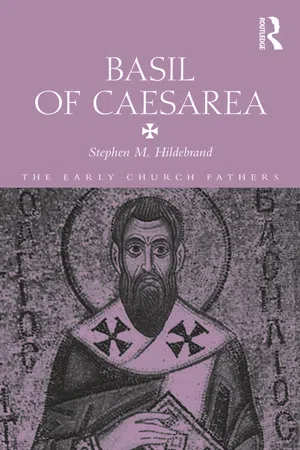
- 220 pages
- English
- ePUB (mobile friendly)
- Available on iOS & Android
eBook - ePub
Basil of Caesarea
PART I
INTRODUCTION
1
Life and times
Background and early life
By the time of Basil’s birth, the Roman empire had controlled a vast and varied range of land centering on the Mediterranean Sea. At the height of its expansion, on its western side it stretched from Britain in the north through Gaul (roughly modern-day France) and Spain, across the Straits of Gibraltar, to Mauritania (the northernmost parts of modern day Morocco and Algeria) in the south. On its eastern side, it extended from the Caspian Sea in the north, through Mesopotamia and the Holy Land, to Egypt in the south. Basil spent most of his life in the Roman provinces of Pontus—in northeast Turkey, on the southeastern coast of the Black Sea—and, later, of Cappadocia—which occupied a more or less central location in Asia Minor, extending from the center of modern-day Turkey eastward. It goes without saying that the various parts of the empire differed greatly in climate. Cappadocia contained highlands and mountains and was famous for long and harsh winters.1 It was productive—in natural resources like stones and minerals, in livestock, and in grain.
The best ancient sources for Basil’s life are, of course, his own writings, some writings of Gregory of Nazianzus, especially the oration that Gregory delivered in his honor after his death, and some writings of Basil’s brother, Gregory of Nyssa, especially his Life of Macrina.2 Basil’s letters, of course, are the best way to trace the course of his episcopal career (370–79), but therein he rarely alludes to his earlier life and, in any case, precise dating often proves elusive.
Gregory of Nazianzus begins the story with Basil’s distinguished extended family, who lived in the Roman province of Pontus, north of Cappadocia, and he tells us that the family was distinguished both in a spiritual and in a worldly sense: spiritually, because many of them suffered nobly in a time of persecution, and worldly, because they came from the higher classes and held significant positions in government. Gregory thus gives us a glimpse here into the social stratifications that characterized Late Antiquity.
We might think of Roman society as breaking down into roughly three classes: elite, middling, and subsistence.3 The “elites,” writes Kyle Harper, “included senators, equestrians, decurions, and a number of wealthy households without official status, so that the category comprised 1.2–1.7 percent of the population and claimed roughly 20 percent of the empire’s annual gross income.”4 The middle class could live a comfortable existence and comprised 6–12 percent of the population.5 The vast majority of the population, however, was poor, and, of course, there were gradations here, too. The elites and the middle classes had in common that both owned slaves, although they used them differently. Harper, who studied slavery in the Empire from 275–425, estimates that there were roughly five million slaves in the Roman Empire, about half owned by the elites and half by the middlings. In short, the slaves of the highest classes were integral in the production of surplus wealth, whereas for the rich peasant and others across the middle class, slaves were the most attractive economic solution to the challenges created by farming and the production of textiles.6
So, Basil’s family was among the elite classes, perhaps a decurion household. Gregory of Nazianzus testifies that Basil’s father’s ancestors had suffered as confessors in the Great Persecution (303–13) under Maximinus.7 Gregory of Nyssa adds the detail that their paternal grandmother, Macrina, for whom their sister Macrina was named, was among these confessors.8 They had fled to the mountains of Pontus and lived there for seven years under a sort of ascetic life that the Cappadocian wilderness forced upon them.9 Basil’s parents, Basil and Emmelia, lived a devout Christian life marked by generosity to the poor, hospitality, and self-discipline—Gregory notes that they had dedicated a portion of their property to God.10 Basil’s mother had chosen not to marry, but reconsidered in the face of the risk that she would be forced against her will by the violence of some suitors.11 While this incident gets passing mention by Gregory of Nyssa, it is nonetheless a witness to some of the dangers that women faced in Late Antiquity. Roman society valued virginity above all in young women, and men were quite anxious about guarding it. Above all a woman must have modesty—pudicitia or sôphrosynê—that was best protected by paternal surveillance.12 Emmelia may have been in an especially compromised position, for both of her parents had died before she came of age.13
Gregory of Nyssa’s account of Macrina’s life gives us some insight into the home life in which Basil shared. He tells us that Macrina, the oldest child in the family, essentially had the Psalter memorized and that she recited them at the proper times of the day. Macrina, at the age of 13 or so, decided also to live as a consecrated virgin in their home, performing the tasks of the slaves—for those who embraced the ascetic life, at least in the East, left behind the class distinctions that exist only in this fallen world and no longer exist in heaven.
The details surrounding Macrina’s refusal to marry, again, highlight the particular circumstance of upper-class women at this time. Macrina, it seems, preferred not to marry but had deferred—she would have hardly had a choice—to the wishes of her father and was engaged to a young kinsman who showed virtue, to be sure, but also worldly promise as a lawyer. When her fiancé died, Macrina “called her father’s decision a marriage … and she determined to remain by herself for the rest of her life.”14 There are a couple of interesting points here. First, Macrina is invoking the tradition that a woman could be forced to marry once, but not a second time. Indeed, as we will see in Basil’s canonical letters, second marriage after the death of a spouse is very much frowned upon, and, in fact, it is the sort of thing for which one must do penance. Second, Gregory tells us that in order to persevere in her choice, Macrina employed the tactic of staying close by her mother at all times.
She hit upon one safeguard for her good decision, never to be separated from her mother even for a moment, so that her mother often said to her that she had been pregnant with the rest of her children for the prescribed term, but as for Macrina she bore her always and everywhere, embracing her, as it were, in her womb.15
It is as if this proximity to her mother prevented Macrina from being forced by violence to abandon her consecration. Young women such as Macrina lived under the constant threat of unwanted male aggression (or suspicion), against which parental supervision—of the mother in Macrina’s case, as her father had passed—was the best defense.
It is clear enough that not all the members of the family lived life as Macrina in these early years, but it would be safe to say, given all the evidence, that the whole family took the obligations of the Christian life seriously. It does not take too much imagination to see in these early years the roots of the ascetic practice that Basil will develop later in life. Indeed, eventually the entire family followed her lead, and their home became a domestic monastery of sorts.16
Basil, born around 330, was next in line after Macrina. His first education came at the hands of his father in Pontus. Gregory of Nazianzus says that “he was trained in general education, and practiced in the worship of God.”17 It is interesting to note that Gregory offers an apology for Basil’s secular education. One need not reject the good in it in order to avoid the evil: “from secular literature we have received principles of enquiry and speculation, while we have rejected their idolatry, terror, and pit of destruction.”18 In order to get a sense of the education that Basil’s father imparted to him, it is helpful to step back and see it in the larger context of education in Late Antiquity. There was at this time a two-tiered system of education. “For the average man,” writes Edward Watts, “education consisted of a school of letters … [that] taught basic, functional literacy, and their students left with an education unencumbered by classical reminiscences or arcane rules of grammar and composition.”19 In a word, this education was not ordered to paideia. Basil’s education, however, and the first step alo...
Table of contents
- Cover
- Epigraph
- Half-Title
- Series
- Title
- Copyright
- Dedication
- Contents
- Preface
- Acknowledgements
- Abbreviations
- Maps
- PART 1 INTRODUCTION
- PART 2 Texts
- Bibliography
- Index of Scriptural Citations
- Index
Trusted by 375,005 students
Access to over 1.5 million titles for a fair monthly price.
Study more efficiently using our study tools.
Frequently asked questions
Yes, you can cancel anytime from the Subscription tab in your account settings on the Perlego website. Your subscription will stay active until the end of your current billing period. Learn how to cancel your subscription
No, books cannot be downloaded as external files, such as PDFs, for use outside of Perlego. However, you can download books within the Perlego app for offline reading on mobile or tablet. Learn how to download books offline
Perlego offers two plans: Essential and Complete
- Essential is ideal for learners and professionals who enjoy exploring a wide range of subjects. Access the Essential Library with 800,000+ trusted titles and best-sellers across business, personal growth, and the humanities. Includes unlimited reading time and Standard Read Aloud voice.
- Complete: Perfect for advanced learners and researchers needing full, unrestricted access. Unlock 1.5M+ books across hundreds of subjects, including academic and specialized titles. The Complete Plan also includes advanced features like Premium Read Aloud and Research Assistant.
We are an online textbook subscription service, where you can get access to an entire online library for less than the price of a single book per month. With over 1.5 million books across 990+ topics, we’ve got you covered! Learn about our mission
Look out for the read-aloud symbol on your next book to see if you can listen to it. The read-aloud tool reads text aloud for you, highlighting the text as it is being read. You can pause it, speed it up and slow it down. Learn more about Read Aloud
Yes! You can use the Perlego app on both iOS and Android devices to read anytime, anywhere — even offline. Perfect for commutes or when you’re on the go.
Please note we cannot support devices running on iOS 13 and Android 7 or earlier. Learn more about using the app
Please note we cannot support devices running on iOS 13 and Android 7 or earlier. Learn more about using the app
Yes, you can access Basil of Caesarea by Stephen Hildebrand in PDF and/or ePUB format, as well as other popular books in History & Ancient History. We have over 1.5 million books available in our catalogue for you to explore.