eBook - ePub
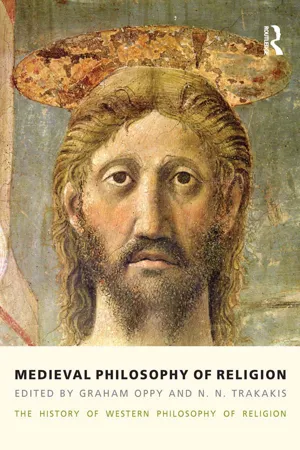
Medieval Philosophy of Religion
The History of Western Philosophy of Religion, Volume 2
- 304 pages
- English
- ePUB (mobile friendly)
- Available on iOS & Android
eBook - ePub
Medieval Philosophy of Religion
The History of Western Philosophy of Religion, Volume 2
About this book
The Medieval period was one of the richest eras for the philosophical study of religion. Covering the period from the 6th to the 16th century, reaching into the Renaissance, "The History of Western Philosophy of Religion 2" shows how Christian, Islamic and Jewish thinkers explicated and defended their religious faith in light of the philosophical traditions they inherited from the ancient Greeks and Romans. The enterprise of 'faith seeking understanding', as it was dubbed by the medievals themselves, emerges as a vibrant encounter between - and a complex synthesis of - the Platonic, Aristotelian and Hellenistic traditions of antiquity on the one hand, and the scholastic and monastic religious schools of the medieval West, on the other. "Medieval Philosophy of Religion" will be of interest to scholars and students of Philosophy, Medieval Studies, the History of Ideas, and Religion, while remaining accessible to any interested in the rich cultural heritage of medieval religious thought.
Information
1
MEDIEVAL PHILOSOPHY OF RELIGION:
AN INTRODUCTION
G. R. Evans
I. PHILOSOPHY AND THE ‘GREAT WORLD RELIGIONS’
IN THE MIDDLE AGES: AN OVERVIEW
The transition from the ancient world
The period from the collapse of the Roman Empire to the beginning of the sixteenth century saw several significant transitions in the way students of philosophy and religion understood the relationship of the two, and whether they saw them as distinct at all. For the Greeks and Romans they were closely allied, if not one, because philosophy was a way of life as well as a way of thinking about the universe. A philosopher could be a ‘practitioner’, even an ‘adherent’, as well as a student. In the ancient world, philosophy had been concerned with moral as well as intellectual explanation of the universe and how to live in it. It is not too much to call it a ‘vocation’.
In Christianity, Judaism and Islam, ‘rules for living’ and a ‘framework of belief ’ were distinctive to each religion, and stood in a particular relationship in each case. Each arrived at its own ‘settlement’ with ancient philosophy, while preserving its integrity. Christianity and some forms of Judaism found it comparatively easy to identify the ‘love of wisdom’ in the Wisdom literature of the Old Testament; and once the doctrine of Christ as Logos developed in Christianity, Christ himself was frequently portrayed as a philosopher, teaching his disciples much as philosophy tutors taught young men in the late antique world. But the era of persecutions in late antiquity had made it clear that neither Jews nor Christians could engage in a simple syncretism.
The Christians
From the point of view of direct influence on Western civilization, the adoption of Greek philosophical ideas by the early Christian community was of the first importance, not least because this more perhaps than any other factor drove the Latin speakers among them to enlarge the capacity of their language for the expression of abstract ideas. The heritage of Rome, with its synthesis of Greek and Roman intellectual traditions and its ultimate dependency at many points on the Greek, also lingered in the oriental Orthodox churches which divided from the rest after the Council of Chalcedon in 451, bringing in Syriac speakers to this process. Classical philosophy left the Middle Ages a booklist, which the burgeoning intelligentsia of the Christian community largely shared with Judaism, too, especially Hellenic Judaism, and it found its way into Islam, where indeed it was exploited with particular intellectual skill. We might usefully begin with a general overview of this mixed process of transmission, modification and ‘inculturation’ as it affected each category of believers.
Points of view, and ways of understanding the relationship of ‘philosophy’ and ‘religion’, were different, and increasingly diverged in the Greek-speaking East and the Latin-speaking West, as they became two increasingly distinct ‘language communities’ with the end of Empire. It was primarily in the West that the leading authors represented in this volume emerged, for the Western tradition was a good deal more analytical and argumentative than that of the East. But in the lands that lay at the Eastern end of the dying Empire there were also subtle shifts of understanding and emphasis.
Greek-speaking Christians
The Greeks went through the Middle Ages in a spirit that discouraged the kind of debate and writing we see going on so energetically in Western authors. They took it that the Christian faith was a ‘given’, certainly after the end of the period of the Ecumenical Councils, and its truth a fixed quantity. In Christology the Council of Chalcedon of 451 formed a decisive endpoint, separating the oriental Orthodox or non-Chalcedonian churches from the rest. In Greek eyes, development of doctrine, any form of innovation, even if apparently right in itself, was unacceptable if it made a change in the way something was expressed or thought about. That became plainer still when the West added ‘and the Son’ (the filioque clause) to the Creed in the Carolingian period and the Greeks objected that this was heresy, and that even if it had not been heresy it would be wrong because it was something new.
A second reason for the distinctiveness of the understanding of the relationship of philosophy and religion in the Greek East of medieval Europe was the fact that philosophers were reading and thinking in Greek. Something of the crucial difference between the way Platonism persisted in the West and in the Greek East maybe seen in Volume 1, Chapters 19 and 20, “Proclus” and “Pseudo-Dionysius”. Late Platonism (Platonism had become inextricably mingled with Stoicism and Aristotelianism from the Neoplatonist stage of its evolution) had also fostered a taste for mysticism. The West had its mysticism, too, but it had, again, a more analytical character. It involved the climbing of a ladder to God in the mind rather than a trusting leap into the unknown. The mysticism of the medieval Greek Christian world was developed in a monastic and eremitical tradition where the individual soul, stripping itself of all worldly connections, often in extremes of suffering from deprivation of food and from physical discomfort, travelled into the far distance of contemplation in the search for union with God.
Latin-speaking Christians
Few Western philosophers were fluent in Greek by the sixth century. Even though Gregory the Great had spent time in Constantinople, it remains uncertain whether he had any command of Greek. Among the authors discussed in this volume, only Eriugena can claim to have been competent to discuss certain of the questions Greeks were thinking about and the way they approached them, and even he could not do so as an insider.
This language divide alone meant that for centuries Western access to Aristotle and Plato remained limited. Boethius (b. c.476) had planned to translate the whole corpus, but he was executed c.525 in the political turmoil of the times, with only a part of Aristotle’s logic completed, not all of which survives. The early medieval West was able to study only the Categories and the De interpretatione (On interpretation). In the twelfth century new translations of the remainder of Aristotle’s logic were made and by the thirteenth century Aristotle’s writings on science, ethics and politics (the last about 1270) were arriving in Latin in the West partly by way of Arabic scholarship and some directly from the Greek.
A diffuse ‘Platonism’ was mediated through Augustine and others, including references to Plato in Aristotle. Platonic themes were also to be found in Cicero’s popular Dream of Scipio and in the commentary Augustine’s contemporary Macrobius wrote on it, this also becoming quite widely studied in the medieval West. A translation of the Timaeus, which became fashionable to study for a time in the mid-twelfth century, presented a considerable challenge to Genesis with its different explanation of the way the world was made by its creator. The Meno and the Phaedo were also available in translations by Henry Aristippus, although they never became central to academic study. Otherwise, Plato remained almost literally a closed book in the West until the revival of the study of Greek from the fifteenth century. Once Plato began to be studied again directly, problems of compatibility with the Christian faith re-emerged. Marsilio Ficino (1433–99) revived Platonic notions of the existence of a ‘World Soul’, which had been controversial in the early Christian world and again in the twelfth century.
An additional strand in which there was an admixture of Platonism was the ‘hermetica’, a body of probably second- to third-century writings linked to Egypt, comprising debased late antique philosophical notions that proved attractive to medieval minds. An example is the idea that human beings are creatures poised between beast and god, who become more like beasts if they behave like beasts, and more like gods if they lift up their heads and concentrate on spiritually and intellectually ‘higher’ things. This material was discussed by Augustine and therefore became familiar in an abbreviated form to his medieval Western readers.
Judaism and Jewish scholars
Jewish scholarship also had its particular medieval concerns. It has been suggested that the account of the creation of the world in Genesis prompted philosophical discussion of the question how the world began in ways that changed the emphasis of ancient philosophical discussions, especially those on the eternity of the world. This was an issue for Jews as much as for Christian scholars. Could a creator who made the world from nothing have made it in any way he chose? This was a very different being from Plato’s craftsman-creator, and a very different situation from the one presented by a world that had somehow always been there, as Aristotle argued.
The twelfth-century Maimonides helped to frame a Jewish philosophical tradition in Arabic, which took forward earlier Islamic scholarship (Inglis 2002: 202). Among his concerns was this question of the beginning of things, on which he disagreed with Aristotle. But Maimonides also took a view on the nature of the highest good in which he found it unsatisfactory to believe that the highest good did nothing but think; and he disputed Aristotle’s views on the nature and divisions of the virtues.
For Western Christian Europe, Jews could be a source of advice on the meaning of certain Old Testament Hebrew terms. Peter Abelard (1079–1142) seems to have consulted Hebrew speakers for this purpose. But talking with Jews presented challenges, since they, like the Arab scholars, thought in terms of a monotheism in which the complexities of Christian Trinitarian theology and the Christian theology of redemption had no place. Abelard was the author of one of the experimental philosophical and religious literary dialogues between Jews and Christians that were briefly fashionable in the late eleventh and early twelfth centuries, although unlike Gilbert Crispin, he left Christological questions out of the debate. In such dialogues, as in the related ‘anti-heretical’ writings such as the Contra haereticos (Against the heretics) of Alan of Lille in the later twelfth century, it is Christology that is typically the sticking-point.
Islam and the Nestorian Christians
Nestorian and Jacobite Christians who spoke Syriac and Arabic, as well as Islamic scholars, translated Greek philosophers from Syriac or Greek into Arabic. This work was done mainly in the eighth and ninth centuries during the period of the Abbasid caliphs. Al-Kindi (d. c.870) was one of the leading figures (Inglis 2002: 24). These generations seem to have been struck by points at which the texts chimed with the pre-Christian beliefs of their region. They commented; they wrote monographs. Al-Kindi, for example, realized the importance of clarity in the use of terms and wrote a treatise on definitions to help Arabic speakers in their study of the translated Greek. But he also took a more extended view of the questions that were presenting themselves about the nature of philosophy. In his On First Philosophy, he encourages Muslims to welcome perceptions of truth even if they come from outside their own tradition. He extols Aristotle, he tackles the question of the origin of the world, and he creates his own synthesis of Greek and Islamic thinking in the spirit he encourages others to adopt.
The rise of Islam created still more new scholarly communities, for the translations were of a high standard and stimulating to their Muslim readers. After al-Kindi’s death, the links with Nestorian Christians continued. Al-Farabi (d. c.950) was a member of a circle of students of logic and philosophy that included Nestorians, and he was a pupil of at least one of these. Al-Farabi became a leading logician and philosopher in his own right and an influential commentator on Aristotelian texts.
The encounter with Aristotle was probably more direct than that with Plato, for although Arabic histories record the existence of Plato’s Republic, the Laws, the Parmenides and the Timaeus, it seems that the translations were probably from summaries such as Galen’s synopsis of Plato’s dialogues. It was not until the twelfth century that the translations were seized on by a hungry West and rendered into Latin for Western use.
Avicenna (Ibn Sina, d. 1037), who impressed Albert the Great (1193/1206–1280), was an even bolder synthesizer of Greek and Islamic thought. Among the Islamic thinkers represented in the present volume is al-Ghazali, whose late-eleventh- and early-twelfth-century career coincided quite closely with that of Anselm of Canterbury. Al-Ghazali was struck by the contradictoriness of the opinions of the ancient philosophers he read. Also discussed in this volume is Averroes (Ibn Rushd, d. 1198), who was based in Spain and in a part of the Islamic world in much closer touch with the West, and wrote a rebuttal that sought to retrieve the ancient philosophers’ reputations.
We turn now to the developments and emphases that entered what was to become, in terms of its subsequent influence on the history of philosophy, the mainstream of medieval European culture.
II. KEY ASPECTS OF THE MEDIEVAL RELATIONSHIP OF PHILOSOPHY AND RELIGION
The changing syllabus
The main energy of Western medieval thought went into the study of philosophical and theological method and the underlying questions of the nature of logic and language. Here the Western medieval contribution was considerable. Epistemology and the theory of language were taken well beyond the point they had reached in ancient philosophy. Aristotle’s logic was added to, as medieval Western scholars became interested in questions of logic and language, and the conflict between Aristotle and some points in Priscian’s teaching of Latin grammar. The doctrine of transubstantiation arose directly out of this line of study, for it is framed in terms of a reversal of the norms of Aristotle’s Categories. Ordinary bread changes in its accidents (i.e. perceptible qualities) when it grows mouldy but remains bread in substance. The doctrine claims that the consecrated bread of the Eucharist remains the same in its accidents for its appearance does not alter, but its substance has changed completely, for it has now become the actual body of Christ.
From the early thirteenth century, physics and metaphysics became established as additions to the old staples of the ‘arts’ course (the grammar, logic and rhetoric of the trivium, and the arithmetic, geometry, music and astronomy of the quadrivium), and their inclusion in the syllabus of the emerging universities led to challenging debate about their relationship and the way they might fit into the study of philosophy and theology. Universities were to be one of the major contributions of the Middle Ages to the intellectual life of the Latin West. Within them there was, from the first, highly competitive debate, not least between the ‘arts’ students and their te...
Table of contents
- Cover
- Half Title
- Title Page
- Copyright Page
- Table of Contents
- Editorial Introduction
- Contributors
- 1. Medieval Philosophy of Religion: An Introduction
- 2. Boethius
- 3. Johannes Scottus Eriugena
- 4. Al-Farabi
- 5. Avicenna (Ibn Sina)
- 6. Anselm of Canterbury
- 7. Al-Ghazali
- 8. Peter Abelard
- 9. Bernard of Clairvaux
- 10. Averroes (Ibn Rushd)
- 11. Moses Maimonides
- 12. Roger Bacon
- 13. Thomas Aquinas
- 14. John Duns Scotus
- 15. William Ockham
- 16. Gersonides
- 17. John Wyclif
- 18. Nicholas of Cusa
- 19. Erasmus of Rotterdam
- Chronology
- Bibliography
- Index
Trusted by 375,005 students
Access to over 1.5 million titles for a fair monthly price.
Study more efficiently using our study tools.
Frequently asked questions
Yes, you can cancel anytime from the Subscription tab in your account settings on the Perlego website. Your subscription will stay active until the end of your current billing period. Learn how to cancel your subscription
No, books cannot be downloaded as external files, such as PDFs, for use outside of Perlego. However, you can download books within the Perlego app for offline reading on mobile or tablet. Learn how to download books offline
Perlego offers two plans: Essential and Complete
- Essential is ideal for learners and professionals who enjoy exploring a wide range of subjects. Access the Essential Library with 800,000+ trusted titles and best-sellers across business, personal growth, and the humanities. Includes unlimited reading time and Standard Read Aloud voice.
- Complete: Perfect for advanced learners and researchers needing full, unrestricted access. Unlock 1.5M+ books across hundreds of subjects, including academic and specialized titles. The Complete Plan also includes advanced features like Premium Read Aloud and Research Assistant.
We are an online textbook subscription service, where you can get access to an entire online library for less than the price of a single book per month. With over 1.5 million books across 990+ topics, we’ve got you covered! Learn about our mission
Look out for the read-aloud symbol on your next book to see if you can listen to it. The read-aloud tool reads text aloud for you, highlighting the text as it is being read. You can pause it, speed it up and slow it down. Learn more about Read Aloud
Yes! You can use the Perlego app on both iOS and Android devices to read anytime, anywhere — even offline. Perfect for commutes or when you’re on the go.
Please note we cannot support devices running on iOS 13 and Android 7 or earlier. Learn more about using the app
Please note we cannot support devices running on iOS 13 and Android 7 or earlier. Learn more about using the app
Yes, you can access Medieval Philosophy of Religion by Graham Oppy,N. N. Trakakis in PDF and/or ePUB format, as well as other popular books in Theology & Religion & Medieval & Renaissance Philosophy. We have over 1.5 million books available in our catalogue for you to explore.